
How Did I Grieve?

Estimated reading time: 12 minutes, 26 seconds
Publicly Mourning
Helped Me to Learn and Grow

It has been almost thirty-eight months since my wife passed away. Losing a loved one, particularly a spouse, is an experience no one would wish for. Atul Gawande wrote in “Being Mortal” that we have come to believe that every medical professional has a magic cure to prevent death or postpone it indefinitely. However, the truth is that death is one of the life cycle events encoded in our DNA.

When Jan, my wife, passed away, I mourned as if I was the first ever to suffer such a loss. I didn’t know if I could choose to grieve in public or private, so I decided to write about my experiences and develop habits that served as guardrails. I shared my writings on social media, attended grief support groups, and even organized a memorial service where I spoke about Jan and our life together. Looking back, I realize the importance of public mourning as it not only helps us heal but also helps others understand and cope with their grief. My journey, marked by resilience and growth, is a testament to the human spirit’s ability to overcome even the most profound loss.

After reading Cody Delistraty‘s essay “It’s Mourning in America” in The New Yorker, I understood I had chosen the best option. The subtitle “In the past century, grief has shifted from a public process to a private problem—something meant to be solved. Is there a better way?” made me reflect on how I mourned and coped with grief. More than three years after the loss, it was a timely reminder to review where I was during the darkest days and how I have learned to live and thrive, showcasing the remarkable resilience of the human spirit.

I have experienced the loss of my parents, Jan’s parents, and friends over the years, which has given me firsthand knowledge of the impact of death. Witnessing the deceased has also been a familiar experience. However, I have struggled to understand how to mourn. As pointed out by Mr. Delistraty, there is a prevalent notion in American culture of seeking closure and swiftly moving on from loss. This concept of ‘closure’ implies that one should neatly tie up their emotions and memories of the deceased, and resume normal activities and routines without allowing oneself to linger in grief. This expectation can be challenging and even harmful, as it may prevent individuals from fully processing their grief and healing in their own time.

After nearly two years of caring for my wife before her passing, I find myself without an understanding of what ‘normal’ means, if it means anything, or how to attain a state of equilibrium that would enable me to carry on. This complexity of grief is a shared experience, and it’s okay not to have all the answers. The more than 100,000 words on my blog have been a form of public mourning. I have shared the depths of despair, the steps I have taken, and how I have grown and sometimes failed. I have found solace in nature, in the support of friends and family, and in giving back to the community. These experiences have been instrumental in my healing and growth, and I hope they can offer some guidance and comfort to others on a similar journey.

Sharing Jan’s Love

In his essay, Mr. Delistraty eloquently discusses public and private grieving traditions. Before the 20th century, death was more common, and mourning was a public process involving family, friends, and neighbors. Now, “there is the stigma of grief—the idea, now rampant in American life, of closure. Most people are reluctant to linger on loss. We are expected to get back to work and back to normal.”

For everyone I know who lost a loved one during COVID-19, the concept of closure was unachievable. Three days before my wife died, NJ Governor Murphy rescinded a rule that limited mourners at a funeral to a dozen as long as those attending practiced social distancing. This rule change was a relief, as it meant more people could attend the funeral and pay their respects to Jan. However, it also presented a new challenge. I am not sure how I would have managed a funeral with such strict limitations. Whom would I have excluded from attendance if only a dozen could attend? These unique circumstances would have added a layer of complexity to my mourning process and forced me to reconsider traditional notions of closure and mourning.

On May 5, during my wife’s funeral at Beth Israel Cemetery in Woodbridge, it was lightly raining, and many of the almost one hundred-attendees had only a day’s notice about her passing and the funeral arrangements. In this shared moment of grief, I tried to express my deep gratitude to everyone who attended, as I recognized that they, too, were mourning Jan. Although some may have perceived my actions as unusual, I felt it was important to publicly thank them and expand our shared support network as we all navigated life without my wife. Their presence and support have been a source of strength and comfort, reminding me that I am not alone in this journey of grief and healing.

Merrit Malloy’s Epitaph, which Jan and I like, was read at her funeral and will be read at mine. When Rabbi Renee read the poem, I knew clearly that I had to give her love away if I would not only mourn but honor her. The last stanza is my wife’s final message to me.

Love doesn’t die,
People do.
So, when all that’s left of me
Is love,
Give me away.

Merrit Malloy’s Epitaph

I am sharing her love not because I no longer love her but because I love her now more than ever. By sharing her love, it will come back to me even more potent. Sharing Jan’s love will keep her memory and legacy alive and strengthen us all. Sharing her passion will inspire and empower us to improve the world and make it a better place for everyone. Sharing Jan’s love is the true expression of my love for her! This commitment to sharing her passion is a testament to the enduring power of love and its ability to transcend even the most profound loss.
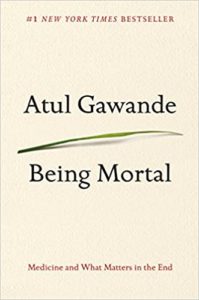
Being Mortal

I understood, standing by her grave, that my sense of loss was unique as Jan’s husband, but accepting that I was not the only one was a crucial step in how I would manage grief. Having read Being Mortal by Atul Gawande days before my wife’s diagnosis of lymphoma prepared me for hospice but also for acceptance that her death was unavoidable once she was also diagnosed with COVID. He reminds us that “when it comes to the inescapable realities of aging and death, what medicine can do often runs counter to what it should.” As he writes in the book, the current system does not work and, in many cases, actually shortens life. Without that knowledge, I am not sure how I would have coped with hearing from her oncologists that there was no way of treating her and hospice was the only option.

Pages: 1 2 3

11 comments add your comment

Share your thoughts and ideas

This site uses Akismet to reduce spam. Learn how your comment data is processed.

The Jan Lilien Education Fund!

Can You Feel This?

Read: January 2023

Get this book

Can You Feel This?

by Julie Orringer

Today I read Can You Feel This? by Julie Orringer. This short story rekindled so many memories. In the chaos of a maternity ward, memories of tragedy and grief come flooding back for an anxious mother-to-be as she struggles to balance her child’s needs with her healing. Although Jan and I did not have the shadows of tragedy and grief when our sons were born, this short story was more than a page-turner. Can You Feel This? reminded me of the power of the love Jan and I shared.

When our second son was born, we almost had him at home or in the as we waited too long. In Can, You Feel This? , that was not the case. Both children had two loving parents but also grandparents.

When Jan had the first of several hospitalizations, she was in the hospital where her mother died. Jan told me her feelings, and I comforted her, but I could not fully comprehend her angst.

Can You Feel This? is part of Inheritance, a collection of five stories about secrets, unspoken desires, and dangerous revelations between loved ones. Each Inheritance piece can be read or listened to in a single setting. By yourself, behind closed doors, or shared with someone you trust. This is the second one in the series I have read. The previous one was Everything That my Mother Taught Me.

The Goodreads summary provides an overview,

Rushed into an emergency cesarean section, a woman finds herself in the same hospital where her suicidal mother died. She’s buried the trauma of her mother’s last hours—and also the dread that she might be just as vulnerable to breaking. As the new mother relives one crisis in the midst of another, prize-winning author Julie Orringer turns the joyous event of birth into a harrowing, poignant short story.


The Jan Lilien Education Fund sponsors ongoing sustainability and environmental awareness programs. Gifts made this month; I will match dollar-for-dollar. All donations are tax-deductible.

Subscribe

Contact Us

I receive a commission when you buy a book or product using a link on this page. Thank you for supporting Sharing Jan’s Love blog.


×
Breathe

Read: September 2021

Get this book

Breathe

by Joyce Carol Oates

Celebrate JanReading Breathe by Joyce Carol Oates was a book I knew I needed to read once Jan was diagnosed. Although the book might trigger negative memories, I finally read Breathe. It was what I needed to read at this point in my journey.

Ms. Oates wrote the book in 2019 after her husband, Charlie Gross, died. The novel is a story of love, loss, and loneliness, topics that I write about on this blog. I needed to read the book both for my mental health and for the readers of Sharing Jan’s Love.

The protagonist, Michaela, loses her husband while they are on a sabbatical in New Mexico. Her husband, Gerard, writes a book and teaches a class on memories. Jan and I never considered relocating before her illness, but this book convinced me that it would have aggravated my grief journey.

One of the parallels I observed while reading the novel is the similarity between Gerard’s reluctance to let family, friends, and co-workers know of his illness. Jan shared that reluctance in the early days, but I convinced her that the only chance of beating cancer was with the help of family and friends.

This dialogue could easily be one that Jan and I had.

Of course you want to summon his family—his (adult) children—but quickly, he says no.

Still waiting.

But – When?

Just not yet.

He is not an alarmist. (You are the alarmist.)

The novel is written in two parts – The Vigil and the Post-Mortem.

The opening paragraphs set the tone.

A Hand is gripping yours. Warm, dry hand gripping your slippery, humid hand.

Whoever it is urging you – Breathe!

Leaning over you begging you – Breathe!

As one mourning the death of the love of his life, I found several phrases in the book helpful in understanding what I have gone through and will continue to confront.

Among them is grief-vise, which I have written about in this stream.

In the grip of the grief vise, all that you will do, all that you even imagine doing, will require many times more effort.. Hardly daring to breathe for the grief-vise will tighten around your chest, squeezing the very air out of your lungs.

In the early stages of grief, the vise was strangling me. Breathing was impossible, and weeping was constant at times.

Michaela struggles with her grief. Seeing her husband every time she sees a man alone, even if they are older or younger than he was. I know I have felt Jan’s presence and still expect her to walk into our apartment.

Her struggles with a grief counselor and overly helpful friends are an experience I have not had but are familiar to those suffering from losing a loved one.

The last chapters are ones in which time becomes confusing and chaotic. At times, I was uncertain about which were real or imagined. The end, like all good novels, was ambiguous.

These are some of the other phrases I have found useful and will include in posts.

  • If there is no one to love, do we merit existence?
  • Never come to the end of kissing.
  • The first principle of life is; Breathe.
  • Shy in the language of intimacy.
  • As if a life lived with strangers could compensate for the emptiness in your heart.
  • No purpose in your life. No compass.

What you love most, that you will lose. The price of your love is your loss.

I recommend this book to all readers, even those struggling with grief.

Subscribe

Contact Us

When you buy a book or product using a link on this page, I receive a commission. Thank you for supporting Sharing Jan’s Love blog.

×
Us Fools

Read: November 2024

Get this book

Us Fools: A Novel

by Nora Lange

Today, I embarked on the journey of Us Fools by Nora Lange. This poignant and personal American narrative is about two remarkable sisters who, against all odds, come of age during the Midwestern farm crisis of the 1980s. In her debut novel, Nora Lange has crafted a lively, ambitious, and heart-wrenching portrait of two unique sisters determined to persevere despite the harsh realities of capitalism and their circumstances. After a pivotal national election, this seemed like the perfect book to read.

Joanne and Bernadette Fareown, born and raised on a family farm in rural Illinois, are deeply impacted by their parents’ tumultuous relationship and mounting financial debt, haunted by the unsettling history of the women in their family. Left to fend for themselves, the sisters delve into Greek mythology, feminism, and Virginia Woolf. As they grapple with these trying circumstances, they must devise unique coping mechanisms and question the validity of the American Dream. At the same time, the rest of the nation disregards their struggling community.

Jo and Bernie’s imaginative efforts to escape their parents’ harsh realities ultimately fall short, prompting the family to relocate to Chicago. There, Joanne—free-spirited, reckless, and struggling to manage her inner turmoil—rebels in increasingly desperate ways. After undergoing her most significant breakdown yet, Jo goes into exile in Deadhorse, Alaska. Bernadette takes it upon herself to apply everything she has learned from her sister to rekindle a sense of hope in a failing world.

×
Clear: A Novel

Read: April 2024

Get this book

Clear: A Novel

by Carys Davies

Today, I started reading “Clear: A Novel” by Carys Davies. It’s a stunning and exquisite novel written by an award-winning author. The story follows John, a Scottish minister who is sent to a remote island off the coast of Scotland to evict the last remaining inhabitant, Ivar. However, Ivar is unwilling to leave, and John’s wife, Mary, has severe misgivings about the task.

Shortly after arriving on the island, John falls off a cliff and is badly injured. Ivar finds him and takes him home, where he tends to his wounds. John and Ivar understand each other despite the language barrier and the fragile connection that forms.

The story takes place in the 1840s, during the Scottish Clearances, a period of forced evictions that saw many rural communities lose their homes. The novel explores the differences and connections between people, the impact of history on our beliefs, and the resilience of the human spirit.

“Clear” is a moving, unpredictable, sensitive, and spellbinding novel. It is a profound and pleasurable read that will stay with you long after you finish the last page.

×
Come and Get It

Read: February 2024

Get this book

Come and Get It

by Kiley Reid

I recently started reading “Come and Get It” by Kiley Reid, a celebrated New York Times bestselling author known for her book Such a Fun Age. The novel is about a senior resident assistant named Millie Cousins, who, in 2017, attended the University of Arkansas. Millie aspires to graduate, get a job, and buy a house.

She is offered an unusual opportunity by Agatha Paul, a visiting professor and writer, which she accepts. Unfortunately, Strange new friends, dorm pranks, and illicit behavior undermine Millie’s ambition.

Overall, “Come and Get It” is a gripping story about desire, consumption, and recklessness. It explores themes of money, indiscretion, and bad behavior through Millie’s eyes. The novel is highly anticipated, given that Kiley Reid is an acclaimed and award-winning author.

×
The Little Prince

Read: May 2021

Get this book

The Little Prince

by Antoine de Saint-Exupéry

The Little Prince by Antoine de Saint-Exupéry is often referred to as a children’s book. I read it as a child and later read it to my children. After Jan died, I picked it up again and read it more than once.

I have found quotes from the book very helpful during my grief journey. These are three that I often use in my writing and my conversations with friends and family.

The most beautiful things in the world cannot be seen or touched, they are felt with the heart.”

It is such a mysterious place, the land of tears.

You see, one loves the sunset when one is so sad.”

The first quote about beautiful things only felt in the heart summarizes how I knew Jan was the one for me within seconds of meeting her.

For those who have not read the book, this overview might help convince you to read it today!

The Little Prince describes his journey from planet to planet, each tiny world populated by a single adult. It’s a wonderfully inventive sequence that evokes the great fairy tales and monuments of postmodern whimsy. The author pokes similar fun at a business person, a geographer, and a lamplighter, all of whom signify some futile aspect of adult existence.

The Little Prince will be by my bedside as long as I live!

Subscribe

Contact Us

×

Discover more from Sharing Jan’s Love

Subscribe now to keep reading and get access to the full archive.

Continue reading