
Changing Ourselves

Estimated reading time: 2 minutes, 41 seconds
God Grant Me Serenity

When Jan and I purchased our first house, we became fixated on a large boulder in our small front yard. We tried to dig it up but found it went much further than our shovels would reach. We hired two neighbors to help us, but the result was the same. Our final effort was to hire a contractor. When they arrived, the first words were, this is impossible. Others had tried to remove and failed. The boulder was something we could not change

In one of my bereavement groups, someone quoted Victor Frankl from Man’s Search for Meaning,

When we can no longer change a situation, we are challenged to change ourselves.

Victor Frankl, Man’s Search for Meaning

This quote resonated with me. Jan and I had both read this quote and other writings by Frankl. In addition, we spent almost ten years in Al-anon meetings learning to accept the things we cannot change.

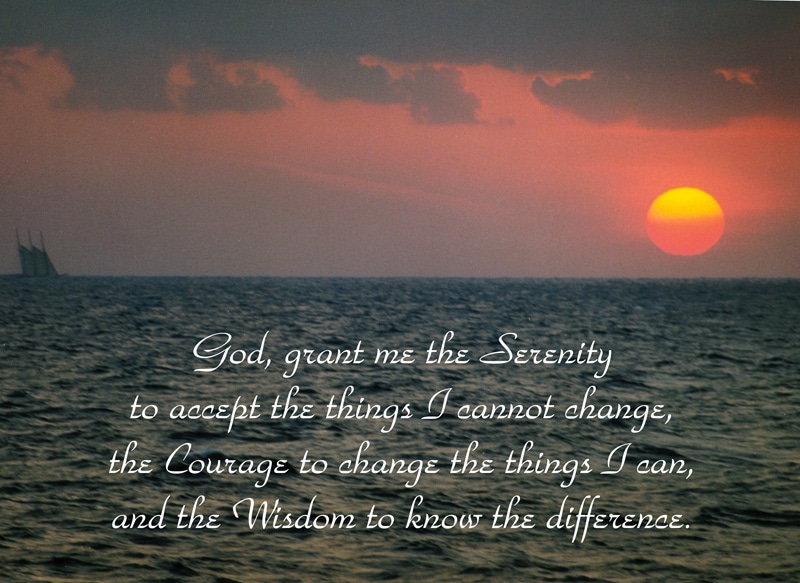
The Serenity Prayer expresses the same sentiment and is something we recited at every Al-anon meeting.

God grant me the serenity
to accept the things I cannot change; 
courage to change the things I can;
and wisdom to know the difference.

Serenity Prayer

Although the prayer and the quote make it seem easy to change ourselves, it is the most challenging pivot any of us will make in our lives.

My time in Al-anon helped me during my grief journey. As much as I would like to change that Jan died sixteen weeks ago, that is something I cannot change. If I could have done that, I would have done it. But it is not possible. All that I can do is change myself and create a new and meaningful life.

Thus, I have started to focus on what I can and must change through the groups, writing, walking, and friends’ support.

Among the ways I am changing include but are not limited to:

  • My writings help me understand my love for Jan. Each word I write not only reflects the love we shared but helps me to love her more than ever, 
  • My walking has given me a daily activity that keeps me physically healthy but also provides me the opportunity to clear my mind,
  • My facilitation of the Saturday Grief Group has allowed me to give back to others who are also grieving,
  • My focus on Jan’s memory and legacy has helped me understand that giving her love away is what I must do to remember her and heal.

On the last point, I have written about this in another post, Why Am I Giving Her Love Away

As I wrote at the end of that post, Jan and I both liked Merrit Malloy’s poem Epitaph. It was read at her funeral and will be at mine. The last stanza explains why I am taking my actions to preserve her memory and legacy. 

Love doesn’t die,
People do.
So, when all that’s left of me
Is love,
Give me away.

Merrit Malloy, Epitaph

To avoid living on an island of grief, I need to share her love. I do not do this because I no longer love her, and I do it because I love her more now than ever.


Click here to learn more about why sharing Jan’s love away is the true meaning of my love for her! 

Subscribe
Contact Us
Creative Commons License

This work is licensed under a Creative Commons Attribution-NonCommercial 4.0 International License.

About Richard W. Brown

After almost 48 years, I recently lost my wife, Jan Lilien. Like The Little Prince, Jan and I believed that “The most beautiful things in the world cannot be seen or touched, they are felt with the heart.” This blog is a collection of my random thoughts on love, grief, life, and all things considered.

3 comments add your comment

Share your thoughts and ideas

This site uses Akismet to reduce spam. Learn how your comment data is processed.

Previous Post:

Next Post:

The Jan Lilien Education Fund!

The School for Good Mothers

Read: February 2023

Get this book

The School for Good Mothers

by Jessamine Chan

The School for Good Mothers by Jessamine Chan is a searing page-turner that is also a transgressive novel of ideas about the perils of “perfect” upper-middle-class parenting; the violence enacted upon women by both the state and, at times, one another; the systems that separate families; and the boundlessness of love, The School for Good Mothers introduces, in Frida, an everywoman for the ages.

Although it has been forty-two years since I became a parent, I still remember the anxiety of being a father. What if I could not be a good dad? Fortunately, I never had a bad like Frida. or lived in an age where parents would be sent to “a Big Brother-like institution that measures the success or failure of a mother’s devotion.”

Reading The School for Good Mothers was a reminder that solutions like this are possible unless we are willing to invest in families so that the skills and support are there to resolve any issues in the home. As a widow, I found Frida’s inner dialogue comparable to the early stages of my grief journey—the total isolation and fear of failing dominated my first months of mourning.

The School for Good Mothers had been on my book list since the middle of last year. I recommend it without reservations! Jan would have already read it, and we would be debating its fine points.

The Goodreads summary provides an overview,

In this taut and explosive debut novel, one lapse in judgement lands a young mother in a government reform program where custody of her child hangs in the balance.

Frida Liu is struggling. She doesn’t have a career worthy of her Chinese immigrant parents’ sacrifices. She can’t persuade her husband, Gust, to give up his wellness-obsessed younger mistress. Only with Harriet, their cherubic daughter, does Frida finally attain the perfection expected of her. Harriet may be all she has, but she is just enough.

Until Frida has a very bad day.

The state has its eyes on mothers like Frida. The ones who check their phones, letting their children get injured on the playground; who let their children walk home alone. Because of one moment of poor judgment, a host of government officials will now determine if Frida is a candidate for a Big Brother-like institution that measures the success or failure of a mother’s devotion.

Faced with the possibility of losing Harriet, Frida must prove that a bad mother can be redeemed. That she can learn to be good.

Using dark wit to explore the pains and joys of the deepest ties that bind us, Chan has written a modern literary classic.


The Jan Lilien Education Fund sponsors ongoing sustainability and environmental awareness programs. Gifts made this month; I will match dollar-for-dollar. All donations are tax-deductible.

Subscribe

Contact Us

I receive a commission when you buy a book or product using a link on this page. Thank you for supporting Sharing Jan’s Love blog.


×
The Letter Carrier

Read: July 2025

Get this book

The Letter Carrier: A Novel

by Francesca Giannone

In the bestselling novel that has captivated readers in Italy, The Letter Carrier by Francesca Giannone depicts a small town in southern Italy that reflects the experiences of many others. It portrays the lives of women and men—husbands and wives, fathers and sons, mothers and daughters—as they strive to navigate the world while remaining true to their hearts. The Letter Carrier explores the universal theme of connection and examines the consequences that arise when those connections occur at the wrong time.

Salento, Italy, June 1934: A coach stops in the main square of Lizzanello, a tight-knit village where everyone knows each other. A couple gets off: The man, Carlo, a Southerner, is happy to be back home after a long time away; the woman, Anna—his wife—is a Northerner. Carlo’s brother is there to meet them, and he, along with everyone else, can’t help but notice that Anna is as beautiful as a Greek statue.

But Anna is not like the other wives. She doesn’t gossip or attend church. She reads books no one else has ever heard of, exploring ideas that some find threatening. She even wears pants, just like a man, and thinks a woman should have rights, just like a man.

There aren’t many options for a woman with Anna’s sensibilities, so when she learns that the post office is hiring, she leaps at the opportunity. A female letter carrier? It is unthinkable! But Anna passes the postal exam and soon becomes the invisible thread connecting the town as she delivers letters between clandestine lovers, families waiting to hear news of loved ones away at war, and even helps those who can’t read.

Letters connect people, conveying both information and emotion. But for some in Lizzanello, letters are too little and too late.


Francesca Giannone holds a degree in communication science and studied at the CSC, the oldest film school in Europe, located in Rome. She has published several short stories in literary magazines, both in print and online. Currently, Giannone resides in Milan, but her heart remains in her hometown of Lizzanello, a seaside town in the Salento region of Italy. She hopes to return there to live one day.


Elettra Pauletto translated The Letter Carrier. After earning her MFA from Columbia University, she has split her time between writing about her experiences in Africa—specifically in the Democratic Republic of the Congo, Rwanda, and Senegal—and translating fiction and nonfiction works from Italian and French into English. In both her writing and translations, she heavily relies on her background as a former political risk analyst who covered Sub-Saharan Africa, the Middle East, and Europe.


When you purchase a book through one of my links, I earn a small commission that helps support my passion for reading. This contribution allows me to buy even more books to share with you, creating an incredible cycle of discovering great reads together! Your support truly makes a difference!

Enjoy a limited-time offer of 20% off your next book purchase at Bookshop.org!


×
The Furrows- A Novel

Read: October 2022

Get this book

The Furrows: A Novel

by Namwali Serpell

The Furrows: A Novel by Namwali Serpell is a bold exploration of memory and mourning that twists unexpectedly into a story of mistaken identity, double consciousness, and the wishful—and sometimes willful—longing for reunion with those we’ve lost. Namwali Serpell’s remarkable new novel captures the uncanny experience of grief, the way the past breaks over the present like waves in the sea. I highly recommend this book.

The Furrows: A Novel reminded me of my longing to be reunited with Jan. I know it is impossible, but that does not keep me from desiring the unattainable. Reading this novel helped me remind me that Jan is still with me in spirit and that is far better than reuniting with her.

The Goodreads summary provides an overview,

Cassandra Williams is twelve, and her little brother Wayne is seven. One day, an accident happens when they’re alone together, and Wayne is lost forever. Or so it seems. Though his body is never recovered, their mother, unable to give up hope, launches an organization dedicated to missing children. Their father leaves and starts another family somewhere else.

As C grows older, she sees her brother everywhere: in coffee shops, airplane aisles, subway cars, and cities on either coast. Here is her brother’s more aging face, the light in his eyes, his lanky limbs, the way he seems to recognize her too. But it can’t be, of course. Or can it? Disaster strikes again, and C meets a man, both mysterious and strangely familiar, who is also searching for someone and his place in the world. His name is Wayne.

Namwali Serpell’s remarkable novel captures the ongoing and uncanny experience of grief–the past breaking over the present like waves in the sea. The Furrows is a bold and beautiful exploration of memory and mourning that twists unexpectedly into a masterful story of black identity, double consciousness, and the wishful and sometimes willful longing for reunion with those we’ve lost.


The Jan Lilien Education Fund sponsors ongoing sustainability and environmental awareness programs. Gifts made this month; I will match dollar-for-dollar. All donations are tax-deductible.

Subscribe

Contact Us

I receive a commission when you buy a book or product using a link on this page. Thank you for supporting Sharing Jan’s Love blog.

×
Kairos

Read: June 2023

Get this book

Kairos by Jenny Erpenbeck

by Jenny Erpenbeck

I’ve recently delved into the captivating novel Kairos by Jenny Erpenbeck, which has left a lasting impression on me. The book tells the story of a young woman named Katharina who falls in love with a married writer named Hans, whom she met in East Berlin during the late 1980s. The historical context of Germany’s reunification is already an intriguing topic, but the addition of a love story made this book a must-read.

As their intense and complicated relationship plays out against the backdrop of a declining GDR, the novel offers a unique perspective on the tumultuous period following the country’s dissolution in 1989. Erpenbeck’s writing style is unmistakable, and her sweeping portrayal of the two lovers’ journey is truly remarkable. We witness Katharina’s growth as she tries to reconcile the reality of her lousy romance with the disappearance of an entire world and its ideologies.

The Times Literary Supplement has praised Erpenbeck’s ability to capture the weight of history and the influence of cultural and subjective memory on individual identity. Her work acknowledges the complexity of the human experience and the nuances of historical events.

Jenny Erpenbeck is an epic storyteller and a highly respected voice in contemporary German literature. Her translator, Michael Hofmann, has described Kairos as a great post-Unification novel, and his translation has been praised for being both faithful to the original text and beautifully written. I highly recommend this book to anyone seeking a thought-provoking and engaging read.


The Jan Lilien Education Fund sponsors ongoing sustainability and environmental awareness programs. Gifts made this month; I will match dollar-for-dollar. All donations are tax-deductible.

Subscribe

Contact Us

I receive a commission when you buy a book or product using a link on this page. Thank you for supporting Sharing Jan’s Love blog.


×
Grief Is the Thing with Feathers

Read: May 2026

Get this book

Grief Is the Thing with Feathers

Max Porter‘s extraordinary debut, “Grief Is the Thing with Feathers,” is a unique blend of novella, polyphonic fable, and essay about grief. Combining compassion with a bold writing style, it delivers a powerful impact. Filled with sharp humor and deep insights, this haunting and original work introduces an important new talent. The book will be released as a major motion picture titled “The Thing with Feathers,” starring Benedict Cumberbatch.

Here he is, husband and father, scruffy romantic, a shambolic scholar–a man adrift in the wake of his wife’s sudden, accidental death. And there are his two sons, who, like him, struggle in their London apartment to face the unbearable sadness that has engulfed them. The father imagines a future of well-meaning visitors and emptiness, while the boys wander, savage and unsupervised.

In this moment of violent despair, they are visited by Crow–antagonist, trickster, goad, protector, therapist, and babysitter. This self-described “sentimental bird,” at once wild and tender, who “finds humans dull except in grief,” threatens to stay with the wounded family until they no longer need him. As weeks turn to months and the pain of loss lessens with the balm of memories, Crow’s efforts are rewarded, and the little unit of three begins to recover: Dad resumes his book about the poet Ted Hughes; the boys get on with it, grow up.


Max Porter is a publishing professional who lives in South London with his wife and children. “Grief Is the Thing with Feathers” is his debut book.


Discover your next favorite book and dive into a world of curated, exciting reads by purchasing through my links. You’ll have access to a diverse selection of books I’ve personally vetted for quality and enjoyment. Supporting these selections not only helps me continue to provide you with personalized recommendations but also ensures you have access to meaningful stories that enrich your life. Your support truly makes a difference in helping me share more books and insights with you!


×
Bluff: Poems

Read: December 2024

Get this book

Bluff: Poems

by Danez Smith

Today, I began reading Bluff: Poems by Danez Smith, which was selected as one of The New York Times 100 Notable Books of 2024. This collection emerged after two years of artistic silence, during which the world slowed due to the COVID-19 pandemic, and Minneapolis became the epicenter of protests following the murder of George Floyd. In Bluff, Danez Smith powerfully reflects on their role and responsibilities as a poet and their connection to their hometown of the Twin Cities.

This book addresses the awakening from violence, guilt, shame, and critical pessimism to a sense of wonder, envisioning how we might strive for a new existence in a world that seems to be descending into desolate futures.

Smith infuses these poems with a startling urgency; their questions demand a new language, deep self-scrutiny, and virtuosic textual shapes. A series of ars poetica gives way to “anti-poetica” and “ars America,” implicating poetry in collusion with unchecked capitalism. A photographic collage builds across a sequence, illustrating the consequences of America’s acceptance of mass shootings. Additionally, a brilliant long poem—part map, part annotation, part visual argument—offers the history of Saint Paul’s vibrant Rondo neighborhood before and after officials decided to route an interstate directly through it.

Bluff is a manifesto of artistic resilience, even when time feels fleeting and the places we hold dear—both given and created—are in turmoil. In this powerful collection, Smith turns to honesty, hope, rage, and imagination to envision possible futures.


When you purchase a book through one of my links, I earn a small commission that helps support my passion for reading. This contribution allows me to buy even more books to share with you, creating an incredible cycle of discovering great reads together! Your support truly makes a difference!


×

Discover more from Sharing Jan’s Love

Subscribe now to keep reading and get access to the full archive.

Continue reading