

Temple Sha'arey Shalom

Grief Has Made Me a Better Person

Grief is a Great Teacher and Has Helped Me Discover Who I Am!

Estimated reading time: 3 minutes, 24 seconds

As I sit here tonight at Temple Sha’arey Shalom, I can’t help but reflect on the past three years since my wife passed away. I remember the first time I came to Friday night services after Jan died, feeling lost and alone in my grief. But now, after attending all but three of the one hundred fifty-six services held since her death, I feel a sense of belonging and comfort in this place of worship.

Rabbi Renee and Rav Uri have been excellent sources of encouragement and support for me. They recognized the good work I had been doing by helping people experiencing homelessness and widows, and they even told me that during the times I missed, I was still performing mitzvahs. Their kind words have given me a sense of purpose and fulfillment, even when I am dealing with my pain.

Sitting among the other worshippers, I am struck by the service’s beauty and the community’s warmth. The soft glow of the candles, the harmonious melodies of the prayers, and the feeling of togetherness all make me feel grateful to be here.

It’s hard to believe that I never would have imagined myself in a place of worship just three years ago. But now, coming here each week has become a meaningful part of my life, and I am grateful for the solace it brings me.

Cantor Jason M Rosenman‘s voice resonated through the synagogue, pulling me out of my meandering thoughts. He was reading a piece about the pain of missing those we have lost. The Psalmist said that in his affliction, he learned the law of God. In truth, grief is a great teacher when it sends us back to serve and bless the living…” His words struck a chord with me, reminding me of my journey through grief.
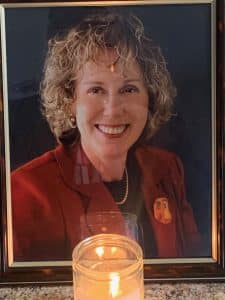
Jan's Second YahrtzeitAs I listened to the cantor’s beautiful voice, I reflected on what I have learned since losing Jan. Three years ago, I cried uncontrollably every time I thought of her, but today, I can’t even remember the last time I cried about her—the anniversary of her passing had already come and gone without me even realizing it.

During my morning walks, I often encounter people struggling with their sorrows. They open up to me as if I am a trusted confidant, pouring their hearts into me. I offer them words of love and concern, and they react like I’ve given them a precious treasure. Your words are so inspiring; they’ve given me hope,” one new friend tells me. When I bump into another walking buddy on my way home, we share stories of our struggles and encourage each other to keep going.

My friend Roger and I carpool to services every week. As we enter the synagogue, the sweet smell of freshly baked challah wafts through the air. Roger lifts the towel off the bread and announces, “It’s matzo!” He cuts the bread and recites the Hamotzi, and we all join in. The Oneg begins, and I chat with Brian, a fellow congregant who has recently lost his brother-in-law. He speaks calmly about his loss and his visit to his sister. I offer him the same comfort and support that I received during my own time of grief. If there’s anything I can do to help, please let me know,” I say, hoping my words can bring him some solace.

Upon my return home, I was greeted by my friend Chris, owner of Ambelis, who was waiting outside his restaurant. I shared with him that it had been three years since my tragedy and expressed gratitude for his support. But Chris gave me all the credit. He said, “Richard, you were the one who kept her memory alive, offered help to everyone you met, and became a better man because of it.” His words made me realize that my journey of self-discovery and growth had made me an inspiration to others. Although I may sometimes question my faith, I knew that my grief experience had taught me invaluable lessons and helped me become the best version of myself.
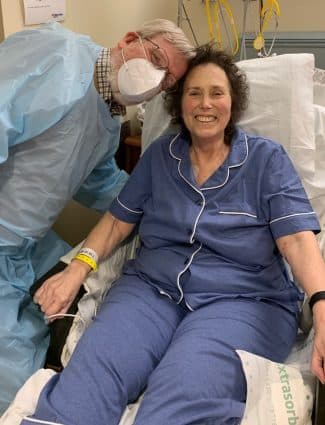
Learning From Grief

Though grief was a challenging experience, I found the courage to move forward and learn more about myself and the world around me. As a result, I gained a greater appreciation for my resilience and growth potential as I navigated the world alone.

Show thread (1)

My Apolytus Moment

Grief is a Great Teacher and Has Helped Me Discover Who I Am!

Estimated reading time: 3 minutes, 24 seconds

My Apolytus Moment

Despite the deep and abiding pain of missing my beloved wife daily, I have come to understand that it is essential that I continue living and finding joy in the present moment.

1 comment add your comment

Share your thoughts and ideas

This site uses Akismet to reduce spam. Learn how your comment data is processed.

The Jan Lilien Education Fund!

Temple Sha'arey Shalom
×
The Singing Word

Read: September 2025

Get this book

The Singing Word

by Walt Hunter

The Singing Word: 168 Years of Atlantic Poetry, edited by Walt Hunter, celebrates the people, land, and spirit of America. This remarkable collection showcases a wide range of contemporary and historical poetry from the 168-year archive of The Atlantic magazine. Since its first issue in 1857, the poetry published in The Atlantic has drawn attention to the nation’s ongoing journey of self-discovery.

The magazine’s verse has featured odes to American leaders and landscapes, laments for the dead, and calls for change, appealing to the enduring ideals of Atlantic readers.

This one-of-a-kind collection selects poems of rousing optimism, clear-eyed realism, and moving lyricism—poems infused with the language of America’s songs, myths, and history, from the Civil War up through the present in three rich parts: National Anthems, Natural Lines, and Personal Mythologies.

Curated by The Atlantic’s Poetry Editor, this anthology features both world-famous poets—from Longfellow to Limón, including Robert Frost, W. S. Merwin, Sylvia Plath, and Adrienne Rich—as well as poets whose work has never before been published outside of the magazine.

Offering readers an essential understanding of American canon and the evolving nation, its poets have yearned to capture—the poetry of The Atlantic is the poetry of America.


Walt Hunter is a professor of twentieth- and twenty-first-century literature and chair of the English department at Case Western Reserve University. He is also the fiction and poetry editor for The Atlantic.


Discover your next favorite book and dive into a world of curated, exciting reads by purchasing through my links. You’ll have access to a diverse selection of books that I’ve personally vetted to ensure quality and enjoyment. Additionally, by supporting these selections, you’ll help me continue to provide you with more personalized recommendations. I earn a small commission from your purchase, which allows me to buy and share even more books with you. Your support truly makes a difference!


×
Salvation

Read: March 2026

Get this book

Salvation: A Novel

by C. William Lanksfield

Salvation by C. William Lanksfield is a remarkable debut novel that explores profound themes through evocative prose and a compelling plot, all set against the breathtaking yet often intimidating backdrop of the Rocky Mountain West. This emotionally charged Western noir examines father-son relationships, masculinity, and spirituality, centering around a shocking event: the murder of one man’s best friend by another.

A small rural Colorado town is in crisis at the height of winter. Tom Horak has just murdered his best friend, Rust Hawkins. Morris Green, the town’s Lutheran pastor, is experiencing a profound crisis of faith, questioning the very existence of God. And Marshal Thomlison, the local peace officer, looking forward to retirement, is now thrown into the middle of a murder investigation.

Following his violent act, Tom retreats to a cabin in the hills, remembering the events of his hardscrabble childhood—a rural upbringing on a ranch with a distant mother and abusive father.

Pastor Green takes in Rust Hawkins’s son, since the boy has nowhere else to go. Thomlison’s murder investigation acts as a kind of Greek chorus commenting on the various threads of this moving novel: What could cause a man to commit such a violent act? What does this isolated community owe to one another? Can Tom find the peace he is searching for, even with blood on his hands? Can Pastor Green find enough faith in our human condition to help Rust’s orphaned son, and can their growing bond perhaps offer the family life each sorely lacks?


C. William Langsfeld lives in a small town on the Western Slope of Colorado.


Discover your next favorite book and dive into a world of curated, exciting reads by purchasing through my links. You’ll have access to a diverse selection of books I’ve personally vetted for quality and enjoyment. Supporting these selections not only helps me continue to provide you with personalized recommendations but also ensures you have access to meaningful stories that enrich your life. Your support truly makes a difference in helping me share more books and insights with you!


×
Reluctantly Home

Read: June 2022

Get this book

Reluctantly Home

by Imogen Clark

Reluctantly Home by Imogen Clark is about dealing with the past—and finally facing the future-a topic that was appealing to me. Thirteen months into my grief journey, I live between a perfect past and an unknowable future. Will Reluctantly Home by Imogen Clark help me manage these two worlds?

Surprisingly it did. Unlike the two protagonists, I am mourning losing Jan, the love of my life. However, the neuromapping in my brain made it impossible to understand how to continue to love Jan and separate that from the time and space connections that made me believe she would return at any moment.

Reluctantly Home by Imogen Clark helped me understand that grief should and cannot define us forever. I recommend this book to all readers, not only those on a grief journey like mine.

The Goodreads summary provides an overview.

Pip Appleby seems to have it all, with her prestigious job as a human rights lawyer and her enviable London home. But then a tragic accident stops her life in its tracks, and everything changes instantly. Retreating to her family’s rural farm and the humble origins she has been trying to hide, Pip is haunted by what she has done.

When she discovers the diary of actress Evelyn Mountcastle in a box of old books, Pip revels in the opportunity to lose herself in someone else’s life rather than focus on the disaster that is her own. But soon, she sees parallels—Evelyn’s life was also beset by tragedy, and, like Pip, she returned to Southwold under a dark cloud.

When Pip and Evelyn’s paths cross in real life, they slowly begin to reveal the hidden stories holding them back. Can they help each other forgive what happened in the past and, perhaps, find happiness in the future?


Subscribe

Contact Us

When you buy a book or product using a link on this page, I receive a commission. Thank you for supporting Sharing Jan’s Love blog.

×
Black Sun

Read: November 2021

Get this book

Black Sun – Between the Earth and Sky

by Rebecca Roanhorse

Black Sun by Rebecca Roanhorse.  Black Sun is the first book in the Between Earth and Sky trilogy, inspired by the civilizations of the Pre-Columbian Americas and woven into a tale of celestial prophecies, political intrigue, and forbidden magic.

I have always enjoyed fantasy novels like Black Sun, and this is the first one set in the Pre-Columbian Americas.

A god will return
When the earth and sky converge
Under the black sun

In the holy city of Tova, the winter solstice is usually a time for celebration and renewal, but this year, it coincides with a solar eclipse, a rare celestial event proscribed by the Sun Priest as an unbalancing of the world.

Meanwhile, a ship launches from a distant city bound for Tova and set to arrive on the solstice. The captain of the ship, Xiala, is a disgraced Teek whose song can calm the waters around her as quickly as it can warp a man’s mind. Her ship carries one passenger. Described as harmless, the passenger, Serapio, is a young man, blind, scarred, and cloaked in destiny. As Xiala well knows, when a man is described as harmless, he usually ends up being a villain.

Will Serapio be harmless or a villain? The answer, my friend, will be known when you read this book or perhaps the second one in the trilogy.

Before meeting and falling forever in love with Jan, I had dreamed of the life of an American Studies professor. Thousands of students are relieved to know I did not pursue that life. If I had opened that door, an area of focus would have been on Pre-Columbian Americas.

I recommend this book and will read the next two in the Between Earth and Sky trilogy.

Subscribe

Contact Us

When you buy a book or product using a link on this page, I receive a commission. Thank you for supporting Sharing Jan’s Love blog.

×
Stony The Road

Read: October 2019

Get this book

Stony the Road

by Henry Louis Gates Jr

Stony the Road: Reconstruction, White Supremacy, and the Rise of Jim Crow by Henry Louis Gates Jr. is a must-read book, especially with white nationalism on the rise.

I read this book when Jan began her chemotherapy. Although the book’s subject – the retreat from reconstruction – was one I studied in college, at times, I found it hard to focus on the material and my wife’s health at the same time. I stayed on the stony road as it is a subject we need to understand if we are going to correct the past failures.

As The New York Times wrote,

Henry Louis Gates Jr.’s “Stony the Road: Reconstruction, White Supremacy, and the Rise of Jim Crow,” an indispensable guide to the making of our times, addresses 2017’s mystifications. The book sets the Obama era beside Reconstruction and the Trump era beside the white supremacist terrorism of Redemption, the period beginning in 1877 during which Reconstruction’s nascent, biracial democracy was largely dismantled. Gates juxtaposes the optimism of Reconstruction, the despair of Redemption, and the promise of the New Negro movement — the effort by black Americans, starting around the turn of the 20th century, to craft a counternarrative to white supremacy. In doing so, “Stony the Road” presents a bracing alternative to Trump-era white nationalism.

Growing up in the Jim Crow south, I was well aware of white nationalism. This book is an essential read if we are going to make America a multi-racial democracy.

Subscribe

Contact Us

×
Kala: A Novel

Read: June 2024

Get this book

Kala: A Novel

by Colin Walsh

Today, I started reading “Kala: A Novel” by Colin Walsh, a gripping literary page-turner from a rising Irish talent. Former friends, estranged for twenty years, reckon with the terrifying events of the summer that changed their lives. Three old friends are reunited in the seaside town of Kinlough, on Ireland’s west coast, for the first time in years.

Helen, Joe, and Mush were part of an original group of six inseparable teenagers in the summer of 2003, with motherless, reckless Kala Lanann as their group’s white-hot center. Soon after that summer’s peak, Kala disappeared without a trace.

Now it’s fifteen years later:

  • Helen has reluctantly returned to Ireland for her father’s wedding.
  • Joe is a world-famous musician who is newly back in town.
  • Mush has never left, too scared to venture beyond the counter of his mother’s café.

But human remains are discovered in the woods. Two more girls have gone missing. As past and present begin to collide, the estranged friends are forced to confront their involvement in the events that led to Kala’s disappearance.

Against the backdrop of a town suffocating on its secrets, in a story that builds from a smolder to a stunning climax, Kala brilliantly examines the sometimes brutal costs of belonging and the battle in the human heart between vengeance and forgiveness, despair and redemption.

×