
A Dancing Yahrzeit Candle

Estimated reading time: 12 minutes, 12 seconds
On Jan Lilien’s 3rd Yahrzeit,
A Ritual Helps Me Embrace the Future!

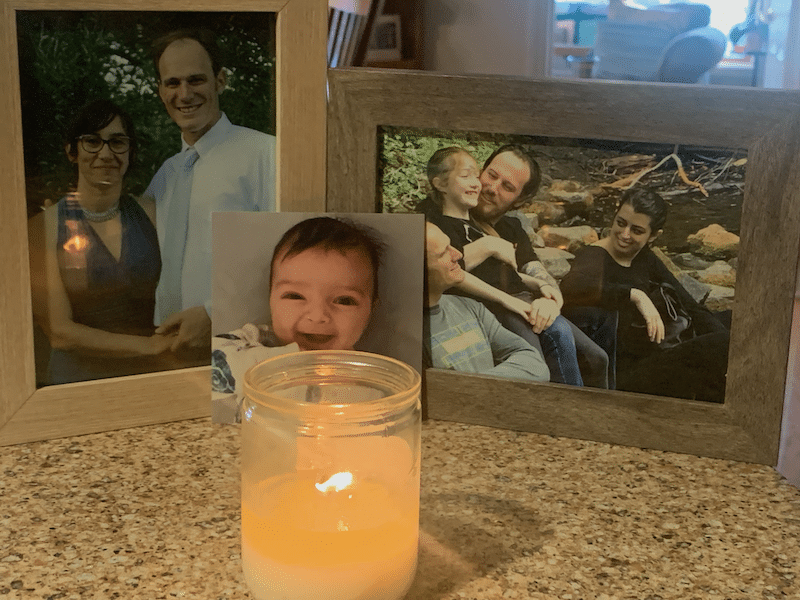
The soft, flickering glow of the Yahrzeit Candle paints a poignant tableau on the walls, ceiling, and floor of my kitchen, creating a serene atmosphere. For the last two years, I’ve placed this candle before a photo of my beloved wife, Jan. Tonight, I’ve encircled it with three images that capture precious moments of our sons, their wives, and our two grandchildren. Each image is a gateway to a cherished memory, stirring a deep nostalgia and a profound love that defies time constraints. Have you ever found yourself lost in a sea of photos, searching for the perfect ones? As I was doing so, I realized that I still had thousands of digital pictures of Wes waiting to be printed and framed. Keeping up with the life changes requires time and effort.

Half an hour after sunset, I took a moment to switch off all the lights and gazed at the photos and the gentle, flickering glow of the Yahrzeit Candle. In the room’s stillness, the dancing light no longer seemed like a carefully choreographed performance but more like the dots and dashes of Morse Code. It brought back memories of my attempts, as a young Scout, to decipher those same patterns into English, albeit with little success. The thought that the flickering light might be trying to convey a message beyond my understanding lingered in my mind. Like any widow, I longed for it to be a love letter from my late wife, Jan, reaching out to me from the beyond. If only such a miraculous connection were possible.

My stubborn streak kept trying to fathom meaning from the candlelight. After an hour, I was about to turn the lights on and proceed with relaxing and reading when it dawned on me that the message might be more substantive than an “I love you” from Jan. On the day before lighting the candle, I observed Cranford’s Memorial Day ceremony. A high school student recited the Gettysburg Address, a task I did myself decades ago. With its powerful words, this address always reminds me of the importance of unity and the need to carry on the legacy of those who came before us.

One powerful excerpt from the speech resonated deeply when Lincoln stated, “It is for us the living, rather, to be dedicated here to the unfinished work.” This phrase underscored the importance of ensuring that “government of the people, by the people, for the people, shall not perish from the earth.” While this is undeniably important, those of us who have experienced the loss of loved ones also feel a profound sense of duty, responsibility, and unfinished business to attend to. Could it be that God is reminding me of my unfinished work? If this aligns with Lincoln’s sentiments, I must focus more on Tikun Olam, the Jewish concept of repairing the world. This commitment, made in my youth, fills me with a renewed sense of hope and purpose, guiding me through the darkest of days.
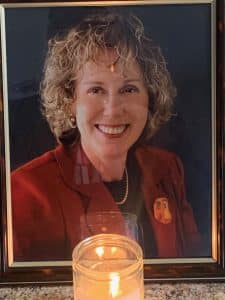
Jan's Second Yahrtzeit

Sitting in the dark, I pondered the message God might be sending me. In preparation for the Yahrzeit, by selecting photos, I intended to pay tribute to Jan’s memory while navigating a future in which she no longer physically exists yet continues to shape our lives through the enduring impact she has made in our hearts and memories. In the initial stages of widowhood, I discovered that while tears may provide some relief for the pain in my heart, they cannot bring her back. All I can do is look ahead, strive to become the best version of myself, and ensure that our sons, their partners, grandchildren, friends, and neighbors continue to cherish her memory. If I can accomplish this as an ordinary individual, it will be a testament to the love and happiness she brought into our lives.

Standing up from the comfort of the couch, I was astonished by my bold conviction as a man who had grappled with agnosticism for most of his life, now interpreting a divine message. In the three years since Jan’s passing, I have embarked on a personal journey of faith, becoming a regular attendee of Friday night services and acknowledging God’s existence despite lacking a rational explanation. Now, two pressing questions weigh heavily on my mind. How have I managed to discover faith amidst my lingering uncertainties? Furthermore, having accepted that God has bestowed upon me the ability to hear, embrace, and walk into the future, how should I approach the remaining days and nights of my life? This introspection, born from my journey, fills me with wonder and contemplation.

Driving Home From the Farewell Dinner

A gentle spring drizzle caressed us as Jan and I left the Forsgate County Club after the Monarch Farewell Dinner. I kissed Jan and suggested she wait under the awning while I fetched the car. Stepping away, I realized the rain was warm, light, and refreshing. When I returned to the awning, Jan quickly seated herself in her Prius. “Thanks,” she said as she fastened her seat belt. Before I started the car, I took her hand and said, “Thanks for being by my side tonight!”
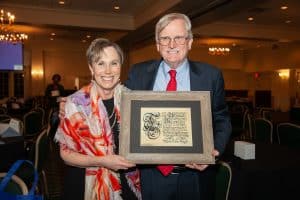
Jan Lilien and Richard W. Brown
Jan Lilien and Richard W. Brown.

You did an amazing job. Many people told me it was the best speech they had ever heard.” Though uncertain about the assessment, I was relieved that the formal dinner was over. The nervousness that had plagued me since I woke up had dissipated, much like the rain that no longer necessitated the use of windshield wipers.

I learned a lot I did not know about you,” she said. I do have some questions, but for now, there is one we can talk about on the way home.”

I shrugged, and she continued, “You’ve been attending services with me for decades, but you never mentioned that you’re Jewish.”

Merging onto the NJ Turnpike northbound car lanes, I explained that I was a man of faith, and then, to lower the tension, I said, “I am also faithful.” Jan responded that she knew I had been faithful but reminded me that was not the question she asked.

Even though I wasn’t born into the Jewish faith, I’ve always been someone who questions and seeks to understand rather than blindly accept things,” I explained. Faith has constantly guided me in life, empowering me to overcome challenges, experience personal growth, and strive to positively impact the world around me.

I’m aware of that, but you never mentioned being Jewish before tonight.

I identify as Jewish because the only place I have worshiped for decades is in a synagogue.

Have you thought about converting?

We had arrived in Cranford, and I dropped her off at the door to our home. We can talk more when I return from parking the car.

The stroll back to my place was peaceful, and I took slower steps than usual. Upon reaching home, I went upstairs to the bedroom, only to find Jan undressed.

I was just about to put on my nightgown,” she smiled.

I smiled and embraced her as Jan dropped the nightgown. That night, and on every subsequent occasion, we never finished that conversation, as her diagnosis of lymphoma completely altered the course of our lives.

Three years after her passing, I wonder what Jan would think about my consistent attendance at Friday night services.

Pages: 1 2 3

17 comments add your comment

Share your thoughts and ideas

This site uses Akismet to reduce spam. Learn how your comment data is processed.

Previous Post:

Next Post:

The Jan Lilien Education Fund!

The missing hours

Read: February 2022

Get this book

The Missing Hours

by Julia Dahl

The Missing Hours by Julia Dahl is a novel I chose to read as I was looking for something different from the recent books I have read, and a fellow reader recommended this one. The Missing Hours is a novel about obsession, privilege, and the explosive consequences of one violent act. Like a bomb exploding, the ripple effects of the novel’s primary event impact the victim and her family, friends, and the larger community.

A trigger warning to all readers, the violent act in the novel is a sexual assault that is filmed and shared. Claudia, the victim, has no memory initially of what happened. She had been drinking and wearing clothes that she liked to wear. None of her choices is an excuse for those who victimized her.

She cannot remember what happened until a friend receives the video.

Being wealthy and social media savvy, she is aware that reporting the assault before or after the video is released would only allow her to be re-victimized. Her choices and how she seeks to secure justice make this a book I enjoyed and highly recommended.

This is the Goodreads overview.

From a distance, Claudia Castro has it all: a famous family, a trust fund, thousands of Instagram followers, and a spot in NYU’s first-year class. But look closer, and things are messier: her parents are separating, she’s just been humiliated by a sleazy documentary, and her sister is about to have a baby with a man she barely knows.

Claudia starts the school year resolved to find a path toward something positive, maybe even meaningful – and then, one drunken night, everything changes. Reeling, her memory hazy, Claudia cuts herself off from her family, seeking solace in a new friendship. But when the rest of school comes back from spring break, Claudia is missing.

Suddenly, the whole city is trying to piece together the hours of that terrible night.

From the critically acclaimed author of Invisible City and Conviction, The Missing Hours is a novel about obsession, privilege, and the explosive consequences of one violent act.

Subscribe

Contact Us

When you buy a book or product using a link on this page, I receive a commission. Thank you for supporting Sharing Jan’s Love blog.

×
When No One is Watching

Read: February 2022

Get this book

When No One is Watching

by Alyssa Cole

When No One Is Watching by Alyssa Cole is a novel where the gentrification of a Brooklyn neighborhood takes on a sinister new meaning.

Sydney Green is Brooklyn-born and raised, but her beloved neighborhood seems to change every time she blinks. Condos are sprouting like weeds, FOR SALE signs are popping up overnight, and the neighbors she’s known all her life are disappearing. To hold onto her community’s past and present, Sydney channels her frustration into a walking tour and finds an unlikely and unwanted assistant in one of the new arrivals to the block—her neighbor Theo.

But Sydney and Theo’s deep dive into history quickly becomes a dizzying descent into paranoia and fear. After all, their neighbors may not have moved to the suburbs, and the push to revitalize the community may be more deadly than advertised.

When does coincidence become a conspiracy? Where do people go when gentrification pushes them out? Can Sydney and Theo trust each other—or themselves—long enough to find out before they too disappear?

Having lived in Brooklyn and seen the impacts of gentrification, redlining, and other practices, I found this book one that I truly enjoyed. The book will provide a detailed history lesson if you are like Theo and have no thought of these issues.

I enjoyed the visit to Weeksville, as I have been there on several professional occasions. The history of that community needs to be told.

I recommend this book.

Subscribe

Contact Us

When you buy a book or product using a link on this page, I receive a commission. Thank you for supporting Sharing Jan’s Love blog.

×
Invisible Child

Read: December 2021

Get this book

Invisible Child: Poverty, Survival & Hope in an American City

by Andrea Elliott

Invisible Child: Poverty, Survival & Hope in an American City by Andrea Elliott was a gift from my son Jon. The New York Times selected “Invisible Child” as one of the best books published this year. It is indeed one of the top books on my all-time list.

GoodReads summary provides a good overview,

The riveting, unforgettable story of a girl whose indomitable spirit is tested by homelessness, poverty, and racism in an unequal America—from Pulitzer Prize-winning journalist Andrea Elliott of The New York Times

Invisible Child follows eight dramatic years in the life of Dasani Coates, a child with imagination as soaring as the skyscrapers near her Brooklyn homeless shelter. Born at the turn of a new century, Dasani is named for the bottled water that comes to symbolize Brooklyn’s gentrification and the shared aspirations of a divided city. As Dasani grows up, moving with her tight-knit family from shelter to shelter, this story goes back to trace the passage of Dasani’s ancestors from slavery to the Great Migration north. When Dasani comes of age, New York City’s homeless crisis explodes as the chasm deepens between rich and poor.

In the shadows of this new Gilded Age, Dasani must lead her seven siblings through a thicket of problems: hunger, parental drug addiction, violence, housing instability, segregated schools, and the constant monitoring of the child-protection system. When, at age thirteen, Dasani enrolls at a boarding school in Pennsylvania, her loyalties are tested like never before. As she learns to “code switch” between the culture she left behind and the norms of her new town, Dasani starts to feel like a stranger in both places. Ultimately, she faces an impossible question: What if leaving poverty means abandoning the family you love?

By turns heartbreaking and revelatory, provocative and inspiring, Invisible Child tells an astonishing story about the power of resilience, the importance of family, and the cost of inequality. Based on nearly a decade of reporting, this book vividly illuminates some of the most critical issues in contemporary America through the life of one remarkable girl.

Jan and I were involved and knew that child poverty and homelessness needed repair. In addition, Jan lived on Washington Park across from Ft. Greene Park in 1974-75. We knew the neighborhood where much of the book’s story takes place. 

Before meeting Jan in 1973, I was both a community/tenant organizer and a youth worker. In the latter role, I made weekly hostel trips for eight to ten young boys from East Williamsburg during 1973. The trips were the first the boys had ever been outside of their neighborhood.

Many of them had imaginations like Dasani. They also had her instinct to fight. One of my first tasks was to check for any weapons.

Decades later, when I would see any of them, now adults, they would ask when we were going on another trip. I wish I had met Jan when I made those trips. She would have helped me improve them and document the impact. If I could re-write history, I would have her join me as the second adult on the hostel trips.

After that summer, it was clear my primary skills were as a community/tenant organizer. Over the next few years, my work focused on creating affordable and supportive housing.

Jan and I did meaningful work that made a difference, yet the need for a permanent solution to the crisis remains. The book highlights the crucial role of resilience, the importance of family, and the cost of inequality. As a nation, we cannot undermine those values by breaking up families, impeding resilience, and maintaining racial and economic inequality. 

The current debate in Washington over the Build Back Better legislation needs to focus not on how much we spend but on its impact on children and families

David Brooks, a conservative commentator, has supported these expenditures for what they can do to address this country’s cultural and economic crisis. 

These packages say to the struggling parents and the warehouse workers: I see you. Your work has dignity. You are paving your way. You are at the center of our national vision.

This is how you fortify a compelling moral identity, which is what all of us need if we’re going to be able to look in the mirror with self-respect. This is the cultural transformation that good policy can sometimes achieve. Statecraft is soulcraft.

If you can only read one book this year, this is the one to read. Child poverty, homelessness, and inequality impact all of us. Ending child poverty and homelessness will make us a healthier and more inclusive nation. It is time for a compelling moral call to action!

Subscribe

Contact Us

When you buy a book or product using a link on this page, I receive a commission. Thank you for supporting Sharing Jan’s Love blog.

×
Kala: A Novel

Read: June 2024

Get this book

Kala: A Novel

by Colin Walsh

Today, I started reading “Kala: A Novel” by Colin Walsh, a gripping literary page-turner from a rising Irish talent. Former friends, estranged for twenty years, reckon with the terrifying events of the summer that changed their lives. Three old friends are reunited in the seaside town of Kinlough, on Ireland’s west coast, for the first time in years.

Helen, Joe, and Mush were part of an original group of six inseparable teenagers in the summer of 2003, with motherless, reckless Kala Lanann as their group’s white-hot center. Soon after that summer’s peak, Kala disappeared without a trace.

Now it’s fifteen years later:

  • Helen has reluctantly returned to Ireland for her father’s wedding.
  • Joe is a world-famous musician who is newly back in town.
  • Mush has never left, too scared to venture beyond the counter of his mother’s café.

But human remains are discovered in the woods. Two more girls have gone missing. As past and present begin to collide, the estranged friends are forced to confront their involvement in the events that led to Kala’s disappearance.

Against the backdrop of a town suffocating on its secrets, in a story that builds from a smolder to a stunning climax, Kala brilliantly examines the sometimes brutal costs of belonging and the battle in the human heart between vengeance and forgiveness, despair and redemption.

×
The Breakaway: A Novel

Read: November 2023

Get this book

The Breakaway: A Novel

by Jennifer Weiner

Today, I started reading The Breakaway: A Novel by Jennifer Weiner, an inspiring new book about love, family, friendship, secrets, and a life-changing journey. The story revolves around 33-year-old Abby Stern, who is content with her life despite not having a steady career and living in a college-like apartment.

She cherishes her good friends, her bike, and the bicycling club in Philadelphia. Abby is comfortable with her plus-size body most of the time and is engaged to Mark Medoff, her childhood sweetheart, whom she met at a weight-loss camp that her mother dragged her to.

However, Abby can’t shake off the feeling that something is amiss, and she can’t forget the breathtaking night she spent with Sebastian two years ago. When Abby gets an unexpected invitation to lead a cycling trip from NYC to Niagara Falls, she gladly accepts, hoping to get away from Mark and reflect on her life. But things get complicated when she spots Sebastian in the group, and her mother, Eileen, whom Abby blames for her body insecurities, joins the trip at the last minute.

The strangers on the journey soon become friends, hidden truths come to light, and a teenage girl with a secret brings the riders together in ways they never imagined. As they travel over 700 miles, Abby must re-evaluate everything she thought she knew about herself, her mother, and the nature of love.


The Jan Lilien Education Fund sponsors ongoing sustainability and environmental awareness programs. Gifts made this month; I will match dollar-for-dollar. All donations are tax-deductible.

Subscribe

Contact Us

I receive a commission when you buy a book or product using a link on this page. Thank you for supporting Sharing Jan’s Love blog.


×
The Singing Word

Read: September 2025

Get this book

The Singing Word

by Walt Hunter

The Singing Word: 168 Years of Atlantic Poetry, edited by Walt Hunter, celebrates the people, land, and spirit of America. This remarkable collection showcases a wide range of contemporary and historical poetry from the 168-year archive of The Atlantic magazine. Since its first issue in 1857, the poetry published in The Atlantic has drawn attention to the nation’s ongoing journey of self-discovery.

The magazine’s verse has featured odes to American leaders and landscapes, laments for the dead, and calls for change, appealing to the enduring ideals of Atlantic readers.

This one-of-a-kind collection selects poems of rousing optimism, clear-eyed realism, and moving lyricism—poems infused with the language of America’s songs, myths, and history, from the Civil War up through the present in three rich parts: National Anthems, Natural Lines, and Personal Mythologies.

Curated by The Atlantic’s Poetry Editor, this anthology features both world-famous poets—from Longfellow to Limón, including Robert Frost, W. S. Merwin, Sylvia Plath, and Adrienne Rich—as well as poets whose work has never before been published outside of the magazine.

Offering readers an essential understanding of American canon and the evolving nation, its poets have yearned to capture—the poetry of The Atlantic is the poetry of America.


Walt Hunter is a professor of twentieth- and twenty-first-century literature and chair of the English department at Case Western Reserve University. He is also the fiction and poetry editor for The Atlantic.


Discover your next favorite book and dive into a world of curated, exciting reads by purchasing through my links. You’ll have access to a diverse selection of books that I’ve personally vetted to ensure quality and enjoyment. Additionally, by supporting these selections, you’ll help me continue to provide you with more personalized recommendations. I earn a small commission from your purchase, which allows me to buy and share even more books with you. Your support truly makes a difference!


×

Discover more from Sharing Jan’s Love

Subscribe now to keep reading and get access to the full archive.

Continue reading