
Meliorism Changes the World With Small Step

Meliorism: Small Steps Change the World!

improving the World With Acts of Love, Creativity, Compassion, and Kindness

Estimated reading time: 2 minutes, 14 seconds

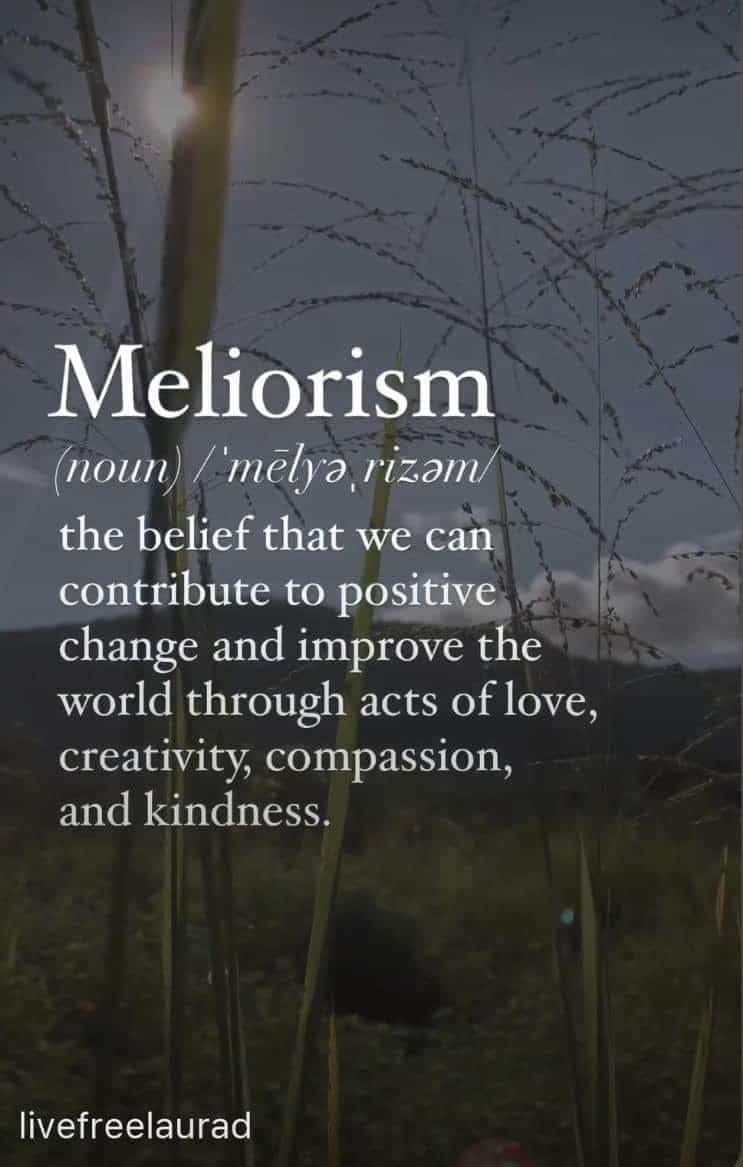
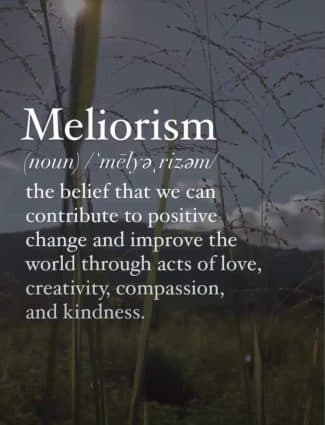
“Ever since we met, you have been an incredible person. The love you shared with Jan is evident in your dedication to the many acts you have completed in her honor, and it has fueled you to live each day with purpose. You have kept her memory alive and well!” wrote a friend of mine in response to my expressing gratitude for what he had helped me to accomplish since Jan died. As much as I was pleased by his comments, they raised an issue that continues to define me and what I have done. Are we independent actors, or do we work in collaboration? Or are we meliorists who contribute to positive change and improve the world through acts of love, creativity, compassion, and kindness?
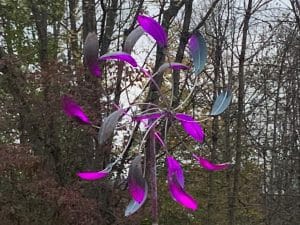
Wind SculptureIn my apartment, I relax and care for myself. But my life extends beyond these walls, and I am part of a diverse and vibrant community. When I talk about my community, I’m not just talking about one group but a complex network of interconnected and overlapping groups. This includes my involvement in the faith community at Temple Sha’arey Shalom, my contributions to the Hanson Park Conservancy and Bridges Board, and my interactions with their staff. I consider companions, local store owners, neighbors, friends, and family important to my extended community.

The idea to plant a tree in Jan’s Memorial Garden was mine, but the garden’s completion was a testament to the power of collective effort. The invaluable inspiration and suggestions from conservancy members, Jan’s family, and friends transformed the garden into what it is today.

  • We were fortunate to receive donations from 173 friends, which allowed us to purchase two beautiful memorial benches.
  • With the support of the Hanson Park Conservancy, the triangular garden was reimagined by adding flower beds and a wind sculpture, creating a space for meditation, contemplation, and reflection.
  • Thanks to the generosity of our donors, we not only raised more funds than needed for the benches but created a lasting legacy. The surplus money was channeled into the Jan Lilien Education Fund, a beacon of support for sustainability and environmental awareness programs.

As a meliorist, I believe in our ability to contribute to positive change and improve the world through love, creativity, compassion, and kindness. We thrive and achieve more when we unite to support one another. Jan’s Memorial Garden has brought immense value to the Cranford community, inspiring the Hanson Park Conservancy and the Jan Lilien Education Fund to engage more individuals in the park, leaving a lasting impression. It’s a testament to the power of small steps and collaborative efforts, showing that working together can build something extraordinary and enchanting for present and future generations.
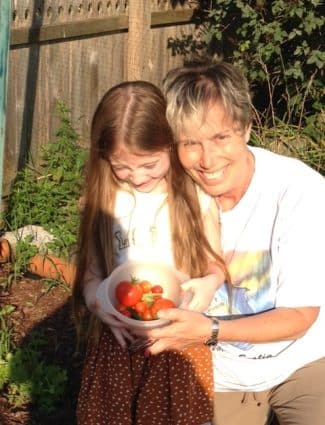
Jan’s Memorial Garden

Working with the Hanson Park Conservancy, we have taken significant steps in building Jan's Memorial Triangle Garden at Hanson Park including installing the Wind Sculpture.

Show thread (1)

Health, Community, Novelty, Purpose

improving the World With Acts of Love, Creativity, Compassion, and Kindness

Estimated reading time: 2 minutes, 14 seconds
Health, Community, Novelty, Purpose

I am fully aware that, eventually, my body will falter. My legs will cease to bear me with ease, my eyes will lose their sharpness, and the words on the page will blur. However, until that moment arrives, I pledge not to age gracefully but with unyielding determination to make the most out of my life.

4 comments add your comment

Share your thoughts and ideas

This site uses Akismet to reduce spam. Learn how your comment data is processed.

The Jan Lilien Education Fund!

Meliorism Changes the World With Small Step
×
The Hidden Habits of Genius

Read: September 2019

Get this book

The Hidden Habits of Genius

by Craig Wright

The Hidden Habits of Genius: Beyond Talent, IQ, and Grit―Unlocking the Secrets of Greatness by Craig Wright, Ph.D., I got through my membership in One Day University.

Dr. Wright raises many important questions as he analyses fourteen (14) critical traits of genius. Professor Craig Wright, creator of Yale University’s famous “Genius Course,” explores what we can learn from brilliant minds that have changed the world.

What we often presume about a genius does not match reality. Among other interesting observations, Dr. Wright reminds the reader that Picasso could not pass a fourth-grade math test, and Steve Jobs’s high school GPA was 2.65. He questions why to teach children to behave and play by the rules when transformative geniuses do not.

Examining the lives of transformative individuals ranging from Charles Darwin and Marie Curie to Leonardo Da Vinci and Andy Warhol to Toni Morrison and Elon Musk, Wright identifies more than a dozen drivers of genius, characteristics and patterns of behavior common to great minds throughout history. He argues that genius is about more than intellect and work ethic and that the famed “eureka” moment is a Hollywood fiction. Brilliant insights that change the world are never sudden, but rather, they are the result of unique modes of thinking and lengthy gestation.

I found the book to be a fascinating read and raised more questions for future thought and reading. Professor Wright argues that the habits of mind that produce great thinking and discovery can be actively learned and cultivated. In the book, he explains how. He notes that reading the book will not make you a genius but can “make you more strategic, creative, and successful, and, ultimately, happier.

Subscribe

Contact Us

×
Monkey Grip: A Novel

Read: February 2024

Get this book

Monkey Grip: A Novel

by Helen Garner

Today, I began reading Monkey Grip: A Novel by Helen Garner. It’s a book that launched the career of one of Australia’s most celebrated writers. The story follows the infatuations of a young, single mother fascinated by the excesses of Melbourne’s late-70s counterculture. Monkey Grip is a seminal novel about Australia’s turbulent 1970s, including communal households, music, friendships, children, love, drugs, and sex.

Helen Garner is a renowned novelist, short-story writer, and journalist. She’s best known for her frank, unsparing, and intricate portrayals of Australian life, often drawn from the pages of her journals and diaries. A new US edition of her debut novel, which establishes Garner’s masterful and quietly radical literary voice, is now available.

The novel is set in Australia during the late 1970s and tells the story of Nora, a single mother and writer. Nora navigates Melbourne’s bohemian underground with her young daughter, Gracie, in tow. Nora falls in love with Javo, a flighty man trapped in his addiction. As their relationship disintegrates, Nora struggles to wean off a love that feels impossible to live without.

When Monkey Grip was first published in 1977, it caused a sensation. Critics praised Garner for her craft, but many criticized her gritty depictions of the human body, frankness about sex and drugs, the mess of motherhood, and her unabashed use of her own life as inspiration. Today, such criticism feels old-fashioned and glaringly gendered, and Monkey Grip is considered a modern masterpiece.

×
History Lessons: A Mystery

Read: July 2025

Get this book

History Lessons: A Mystery

by Zoe B. Wallbrook

In another life, I dreamed of becoming a history professor. When I opened “History Lessons: A Mystery” by Zoe B. Wallbrook, I discovered a story about a college history professor who must solve the murder of her renowned colleague before she becomes the next target. This humorous and romantic debut mystery, filled with witty banter and clever plot twists, is perfect for fans of Janet Evanovich, Kellye Garrett, and Ali Hazelwood.

As a newly minted junior professor, Daphne Ouverture spends her days giving lectures on French colonialism, working on her next academic book, and going on atrocious dates. Her small world suits her just fine until Sam Taylor dies.

The rising star of Harrison University’s anthropology department was never one of Daphne’s favorites, despite his popularity. But that doesn’t prevent Sam’s killer from believing Daphne has something that belonged to Sam—something the killer will stop at nothing to get.

Between grading papers and navigating her disastrous love life, Daphne embarks on her investigation to find out what connects her to Sam’s murder. With the help of an alluring former detective-turned-bookseller, she unravels a deadly cover-up on campus.

This well-crafted, voice-driven mystery introduces an unforgettable heroine in the crime fiction genre.


Zoe B. Wallbrook is a recently tenured professor whose academic research has appeared in outlets such as the New York Times and The New Yorker. She was selected for mentorship by LA Times bestseller Elizabeth Little, and History Lessons, her first novel, was a runner-up for the Eleanor Taylor Bland Award. Zoe’s hobbies include beginning all emails with “My sincerest apologies for my slow reply,” pretending to understand how astrological signs work, and crying at the end of every Call the Midwife episode. She and her husband live with their stalker, a black lab/pittie mix named Sophie.


When you purchase a book through one of my links, I earn a small commission that helps support my passion for reading. This contribution allows me to buy even more books to share with you, creating an incredible cycle of discovering great reads together! Your support truly makes a difference!

Enjoy a limited-time offer of 20% off your next book purchase at Bookshop.org!


×
The Testaments: The Sequel to The Handmaid's Tale

Read: September 2021

Get this book

The Testaments

by Margaret Atwood

The Testaments: The Sequel to The Handmaid’s Tale by Margaret Atwood is a sequel worth reading.

The novel alternates between the perspectives of three women presented as portions of a manuscript written by one (the Ardua Hall Holograph) and testimonies by the other two. Being an amateur historian, I found this a fascinating way for Ms. Atwood to write this book.

Aunt Lydia is the author of the Ardua Hall Holograph, which is a surprise based on her role in The Handmaid’s Tale. It is a surprise that she is a mole who despises Gilead and works for the resistance.

The other characters are young women who, along with Aunt Lydia, are forced to come to terms with who she is and how far she will go for what she believes.

Agnes Jemima was born in Gilead and is being educated not to be literate but to be a wife. She finds out her parents are not who she thought they were when Agnes discovers she is the daughter of a Handmaid.

Daisy was raised in Toronto, lives with her adoptive parents, and is an educated woman. As noted in most reviews, Daisy is also the daughter of a Handmaid. She is Baby Nicole from the original book, and Gilead wants her to return.

Read the book! It is a moving and engaging sequel! The testimonies in the book combine these three women’s stories to undermine Gilead.

Subscribe

Contact Us

×
The School for Good Mothers

Read: February 2023

Get this book

The School for Good Mothers

by Jessamine Chan

The School for Good Mothers by Jessamine Chan is a searing page-turner that is also a transgressive novel of ideas about the perils of “perfect” upper-middle-class parenting; the violence enacted upon women by both the state and, at times, one another; the systems that separate families; and the boundlessness of love, The School for Good Mothers introduces, in Frida, an everywoman for the ages.

Although it has been forty-two years since I became a parent, I still remember the anxiety of being a father. What if I could not be a good dad? Fortunately, I never had a bad like Frida. or lived in an age where parents would be sent to “a Big Brother-like institution that measures the success or failure of a mother’s devotion.”

Reading The School for Good Mothers was a reminder that solutions like this are possible unless we are willing to invest in families so that the skills and support are there to resolve any issues in the home. As a widow, I found Frida’s inner dialogue comparable to the early stages of my grief journey—the total isolation and fear of failing dominated my first months of mourning.

The School for Good Mothers had been on my book list since the middle of last year. I recommend it without reservations! Jan would have already read it, and we would be debating its fine points.

The Goodreads summary provides an overview,

In this taut and explosive debut novel, one lapse in judgement lands a young mother in a government reform program where custody of her child hangs in the balance.

Frida Liu is struggling. She doesn’t have a career worthy of her Chinese immigrant parents’ sacrifices. She can’t persuade her husband, Gust, to give up his wellness-obsessed younger mistress. Only with Harriet, their cherubic daughter, does Frida finally attain the perfection expected of her. Harriet may be all she has, but she is just enough.

Until Frida has a very bad day.

The state has its eyes on mothers like Frida. The ones who check their phones, letting their children get injured on the playground; who let their children walk home alone. Because of one moment of poor judgment, a host of government officials will now determine if Frida is a candidate for a Big Brother-like institution that measures the success or failure of a mother’s devotion.

Faced with the possibility of losing Harriet, Frida must prove that a bad mother can be redeemed. That she can learn to be good.

Using dark wit to explore the pains and joys of the deepest ties that bind us, Chan has written a modern literary classic.


The Jan Lilien Education Fund sponsors ongoing sustainability and environmental awareness programs. Gifts made this month; I will match dollar-for-dollar. All donations are tax-deductible.

Subscribe

Contact Us

I receive a commission when you buy a book or product using a link on this page. Thank you for supporting Sharing Jan’s Love blog.


×
1944: FDR and the Year That Changed History

Read: October 2019

Get this book

1944: FDR and the Year That Changed History

by Jay Winik

1944: FDR and the Year That Changed History by Jay Winik is a book that I had put off reading several times. When I finally did read it, I could not remember why I had not read it sooner. Had I gone to graduate school and become a professor, it might have been the type of book I might write, and I certainly would have had on my list of books for my classes. 

As The NY Times wrote, “Jay Winik brings to life in gripping detail the year 1944, which determined the outcome of World War II and put more pressure than any other on an ailing yet determined President Roosevelt.” Reading a book about events five years before my birth that transformed the world I live in becomes an easy page-turner.

It was not inevitable that World War II would end as it did or that it would even end well. Nineteen forty-four was a year that could have stymied the Allies and cemented Hitler’s waning power. Instead it saved those democracies – but with a fateful cost. Now, in a superbly told story, Jay Winik, the acclaimed author of April 1865 and The Great Upheaval, captures the epic images and extraordinary history as never before.

1944 witnessed a series of titanic events: FDR at the pinnacle of his wartime leadership as well as his reelection, the planning of Operation Overlord with Churchill and Stalin, the unprecedented D-Day invasion, the liberation of Paris, and the horrific Battle of the Bulge, and the tumultuous conferences that finally shaped the coming peace. But on the way, millions of more lives were still at stake as President Roosevelt was exposed to mounting evidence of the most grotesque crime in history, the Final Solution. Just as the Allies were landing in Normandy, the Nazis were accelerating the killing of millions of European Jews.

Winik shows how escalating pressures fell on an all but dying Roosevelt, whose rapidly deteriorating health was a closely guarded secret. Here then, as with D-Day, was a momentous decision for the president. Was winning the war the best way to rescue the Jews? Was a rescue even possible? Or would it get in the way of defeating Hitler? In a year when even the most audacious undertakings were within the world’s reach, including the liberation of Europe, one challenge – saving Europe’s Jews – seemed to remain beyond Roosevelt’s grasp.

I recommend this book.

Subscribe

Contact Us

×