
Embracing Life After Loss!

Estimated reading time: 3 minutes, 16 seconds
After 1,000 Days of Walking Solo, I Have Crossed Into The Future!

Over a thousand days, I have walked daily since I laid my wife to rest. It’s hard to believe, but if I had a penny for each day I walked, I would have $10, which would not even pay for the multiple walking shoes I purchase every six months. It all started on May 6, 2021, after the funeral. I remember waking up that morning with a profound sense of loss and no idea what to do with myself. Then, I saw my walking shoes on the walk-in closet floor.

Without a second thought, I put on my sweats and boots and stepped out of Apartment 3D. The soles of my shoes were like Swiss cheese, and I could feel the dampness and hard ground with every step. Initially, I thought I would walk only when I felt up to it, but slowly, it became a morning routine.

Even walking in snow, ice, and rain didn’t deter me. I remember waking up on the bathroom floor once, but every walk after that became more manageable. It’s been a daily ritual for me now, and it’s helped me cope with the loss of my wife.

As I look back on my journey of grief, I realize that it has not been an easy one. However, grief has been a great teacher and taught me things I never thought I would learn. Before my loss, I thought I understood the purpose of ears, arms, and feet – to listen, embrace, and move forward. However, it was only after I lost my loved one that I realized the true meaning behind these actions.

Throughout my life, I have always considered myself a good listener. Still, when I experienced the sounds of silence and the beauty of nature, I truly appreciated the power of listening. I found solace in the stillness and peace of the world around me, which helped me process my thoughts and emotions.

While I appreciate the support of my family and friends, I have only ever experienced the feeling of embracing my wife. Since her passing, I have focused on embracing the unknown future with each step I take. It is not always easy, but I have learned to walk confidently into the future, knowing that I am not alone in my journey of grief.

One particular reading during Friday night services has been very helpful in guiding me.

THIS IS AN HOUR of Change.
Within it we stand uncertain on the border of light.
Shall we draw back or cross over?
Where shall our hearts turn?
Shall we draw back, my brother, my sister, or cross over?
Baruch atah, Adonai, hamaariv aravim.
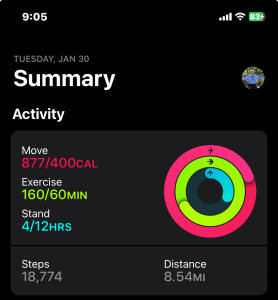
Day 1000 Walking Statistics

Reflecting on my journey, I realize I have chosen to embrace life and all its mysteries, even though I do not know what lies ahead. My commitment to living life to the fullest is reflected in my daily walking habit, which has led me to travel more than 8,000 miles, according to my trusty Apple Watch.

Despite the uncertainty of tomorrow, I remain steadfast in my resolve to keep moving forward. The future is like a beacon, shining brightly and beckoning me to choose life and all it offers.

Love is a mighty and enduring force that empowers us to overcome life’s adversities. It possesses the power to transform us forever and is capable of staying with us long after our loved ones have gone. Jan’s love transformed me entirely fifty years ago, and though she may no longer be with me, her spirit remains by my side every step of the way, reminding me that love is eternal and transcends all boundaries of time and space.


The Jan Lilien Education Fund sponsors ongoing sustainability and environmental awareness programs. All donations are tax-deductible.


Contact Us
Subscribe

Creative Commons License

This work is licensed under a Creative Commons Attribution-NonCommercial 4.0 International License.

15 comments add your comment

  1. Richard, such encouragement and inspiration in your writings and posts. May you continue to find the strength to write and share with others. Warm regards,

    • Diana, I am grateful for your kind words. My words come from deep within me as a reminder that love never dies. Even when faced with loss, we must choose to live life to the fullest. Although my heart still aches for my beloved wife, I decide to wake up each day with enthusiasm for the new opportunities it brings. I take time to appreciate the beauty of nature and listen to my heart, growing stronger and more resilient with each passing day. This journey has taught me that even in the darkest times, there is always light to find.

  2. Hello Richard:

    Walking is the best exercise to keep your brain and body healthy. The best part is that it has helped you to overcome your grieving. People should follow your steps. It may be time to write a book about grieving guidance.

    • Thanks, Hugo. Walking has helped me find peace and tranquility and allowed me to contemplate life, love, and the grieving process. When I tell people about my walks, they often ask me what I listen to. While I do listen to nature, I also listen to my soul. By paying attention to the innermost essence of my being, I can walk farther than my old body should allow. This practice also helps me clear my mind and envision a future.

      Some readers have focused on the number of days and miles as if that were the goal. While it’s true that I may not always be able to walk as long or as far, I can still embrace life fully and contribute to making the world a better place for everyone.

      I appreciate your suggestion and am touched that you think I could write a book. It’s something that I’ve always dreamed of, but I’m not sure if I have what it takes to be a writer. You see, I’m just an average man trying to manage the loss of the love of my life. It’s been a challenging road, but I’ve moved past the initial stages of grief. However, the emptiness and loneliness I feel daily are sometimes unbearable. It’s like a constant ache in my heart that never goes away, no matter how hard I try to distract myself. Writing a book would allow me to process my emotions and hopefully connect with others going through a similar experience. I know it won’t be easy, but I will try.

Share your thoughts and ideas

This site uses Akismet to reduce spam. Learn how your comment data is processed.

Previous Post:

Next Post:

The Jan Lilien Education Fund!

Small Things Like These

Read: July 2024

Get this book

Small Things Like These

by Claire Keegan

Today, I read “Small Things Like These” by Claire Keegan, one of the New York Times’s 100 Best Books of the 21st Century, and the seventeenth book I have read from that list. “Small Things Like These” is award-winning author Claire Keegan‘s landmark new novel, a tale of one man’s courage and a remarkable portrait of love and family.

The story is set in 1985 in a small Irish town. During the weeks leading up to Christmas, Bill Furlong, a coal merchant and family man, faces his busiest season. Early one morning, while delivering an order to the local convent, Bill makes a discovery that forces him to confront his past and the complicit silences of a town controlled by the church.

I found this short but well-written novel very impactful. The following quote explains the powerful impact of the need for meaning and purpose in our lives, as Furlong walks in the snow after taking action to bring home a young girl from a Magdalen laundry. How often can we ignore the small things like these and still look ourselves in the mirror?

“As they carried on along and met more people Furlong did and did not know, he found himself asking was there any point in being alive without helping one another? Was it possible to carry on along through all the years, the decades, through an entire life, without once being brave enough to go against what was there and yet call yourself a Christian, and face yourself in the mirror?”

As an international bestseller, ‘Small Things Like These‘ is a profoundly moving story of hope and quiet heroism. It’s a narrative that will make you admire the characters and stir your empathy, all crafted by one of our most critically acclaimed and iconic writers. The characters in the story are so relatable that you will feel understood and deeply invested in their journey.


Discover your next favorite book and dive into a world of curated, exciting reads by purchasing through my links. You’ll have access to a diverse selection of books that I’ve personally vetted to ensure quality and enjoyment. Supporting these selections not only helps me continue providing you with personalized recommendations but also ensures you get access to meaningful stories that enrich your life. Your support truly makes a difference in helping me share more books and insights with you!


×
The Hidden Life of Trees

Read: August 2021

Get this book

The Hidden Life of Trees

by Peter Wohlleben

The Hidden Life of Trees: What They Feel, How They Communicate ― Discoveries from A Secret World is a book I have wanted but had not had the time to read. In July of this year, when I was still in the early stages of my recovery journey, I talked to a friend of my wife’s (whom I now count as my friend) about our plans to plant a tree in Hanson Park.

As I talked about our plans, my friend suggested I read this book as it would help me understand the importance of trees. I will forever be grateful for her recommendation, as it made me read this book sooner than later.

To read that trees have a social network with more prominent, healthier trees concerned about the smaller, weaker ones. How is it that humans, a supposedly advanced species, have a social network that divides and weakens our community?

Are trees social beings? In The Hidden Life of Trees forester and author Peter Wohlleben convincingly makes the case that, yes, the forest is a social network. He draws on groundbreaking scientific discoveries to describe how trees are like human families: tree parents live together with their children, communicate with them, support them as they grow, share nutrients with those who are sick or struggling, and even warn each other of impending dangers. Wohlleben also shares his deep love of woods and forests, explaining the amazing processes of life, death, and regeneration he has observed in his woodland.

Having read this book, I am more sensitive to trees and have enjoyed my walks more than ever. In addition, when we plant Jan’s tree in Hanson Park, I will now have even more reasons to talk about the importance of trees to Jan, myself, and the community.

Subscribe

Contact Us

×
Flashlight

Read: August 2025

Get this book

Flashlight: A Novel

by Susan Choi

A monumental new novel by National Book Award winner Susan Choi, Flashlight spans decades and continents in a captivating and emotional exploration of family, loss, memory, and the ways we are influenced by what remains hidden. Longlisted for the 2025 Booker Prize, the novel follows the journey of a father’s disappearance over time, across nations, and within the realm of memory. This work comes from the author of Trust Exercise.

On a summer night, Louisa and her father take a walk along the breakwater. Her father is carrying a flashlight, but he cannot swim. Later, Louisa is found on the beach, soaked to the skin and barely alive. Her father is missing. She is only ten years old.

Louisa is the only child of parents who have distanced themselves from their pasts. Her father, Serk, is Korean but was born and raised in Japan. He lost touch with his family after they embraced the promises of postwar Pyongyang and relocated to North Korea. Her American mother, Anne, is estranged from her Midwestern family due to a reckless adventure in her youth. Then there’s Tobias, Anne’s illegitimate son, whose unexpected return will have profound consequences.

For now, it is just Anne and Louisa—Louisa and Anne—adrift and facing the challenges of everyday life in the aftermath of their immense loss. Bound together yet estranged, they struggle to cope with their shared grief and attempt to move forward. However, they cannot escape the haunting memories of that fateful night. What happened to Louisa’s father?

With shifting perspectives across time and character, and repeatedly revisiting that night by the sea, Flashlight explores the shockwaves of one family’s tragedy while also engaging with the invisible currents of history.


Susan Choi is the author of Trust Exercise, which won the National Book Award for fiction. She has also written the novels The Foreign Student, American Woman, A Person of Interest, and My Education.

Choi has received several prestigious awards, including the Asian American Literary Award for fiction, the PEN/W. G. Sebald Award, a Lambda Literary Award, and the Sunday Times Audible Short Story Award. Additionally, she has been awarded fellowships from the National Endowment for the Arts and the Guggenheim Foundation.

Currently, she teaches in the Writing Seminars at Johns Hopkins University and resides in Brooklyn, New York.


When you purchase a book through one of my links, I earn a small commission that helps support my passion for reading. This contribution allows me to buy even more books to share with you, creating an incredible cycle of discovering great reads together! Your support truly makes a difference!

Enjoy a limited-time offer of 20% off your next book purchase at Bookshop.org!


×
The Night Swim

Read: January 2022

Get this book

The Night Swim

by Megan Goldin

The Night Swim by Megan Goldin is a book that I thought would be different from the last two books – Sarah’s Key and Send for Me – that I had read. Both of those were directly or indirectly about the Holocaust. I often selected this book from the e-library based on reviews and reading the sample section.

The Night Swim was a page-turner, but it also was about numerous social issues that Jan ad I had spent our lives working to resolve.

Among these are male violence and its impact directly and indirectly on women. Rachel Krall, a podcaster, spoke about how male violence had impacted her. Two of the other female characters were either a victim or the sister of a victim. Having spent my life trying not to exhibit male violence, I was reminded while reading his novel of how painful it can be and the impact of micro-aggressions.

I knew that the author had done her research when I realized that. Ms. Goldin set the story in Neapolis, a fictional town on the outer banks of North Carolina. Neapolis, which in Latin means “New Town,” is also the old Roman name for the biblical city of Sheechem, where the rape of Dinah took place.

I missed the role of the Nightingale as it appears more as a background piece and not a primary role. Of course, this is a subtle reference by the author to Greek mythology and the rape of Philomela by her sisters’ husband. Her assailant cut out her tongue to prevent her from speaking of the crime. She was turned into a nightingale to escape. That is why female nightingales cannot sing. The one in the novel never sings and is rescued by Rachel at the end of the book.

Rachel narrates two sections of the novel, first with her on-the-ground work at the trial and second with her podcasts.

Hannah’s narrative is initially only in letters and then emails.

This format helped move the story along and make the story unfold in unique ways.

The following is a summary from Goodreads.

After the first season of her true-crime podcast became an overnight sensation and set an innocent man free, Rachel Krall is now a household name―and the last hope for thousands of people seeking justice. But she’s used to being recognized for her voice, not her face. Which makes it all the more unsettling when she finds a note on her car windshield, addressed to her, begging for help.

The small town of Neapolis is being torn apart by a devastating rape trial. The town’s golden boy, a swimmer, destined for Olympic greatness, has been accused of raping a high school student, the beloved granddaughter of the police chief. Under pressure to make Season Three a success, Rachel throws herself into interviewing and investigating―but the mysterious letters keep showing up in unexpected places. Someone is following her, and she won’t stop until Rachel finds out what happened to her sister twenty-five years ago. Officially, Jenny Stills tragically drowned, but the letters insist she was murdered―and when Rachel starts asking questions, nobody seems to want to answer. The past and present start to collide as Rachel uncovers startling connections between the two cases that will change the course of the trial and the lives of everyone involved.

Electrifying and propulsive, The Night Swim asks: What is the price of a reputation? Can a small town ever right the wrongs of its past? And what happened to Jenny?

I highly recommend this novel and look forward to reading more of Ms. Goldin’s work.

×
Flesh

Read: May 2025

Get this book

Flesh: A Novel

by David Szalay

David Szalay, a finalist for the Booker Prize, has written a gripping and mesmerizing novel, Flesh, which follows a man whose life is turned upside down by events beyond his control. Concise and thought-provoking, Flesh delves into the subtle yet lasting effects of unresolved trauma amid the instability and violence of an increasingly globalized Europe. The novel offers sharp insights, unwavering emotional depth, and a remarkable portrayal of humanity.

Teenaged István lives with his mother in a quiet apartment complex in Hungary. Shy and new to the area, he struggles to engage with the social rituals of his classmates and soon becomes isolated. His only companion is his neighbor, a married woman of a similar age to his mother, whom he begrudgingly assists with errands. As their periodic encounters evolve into a clandestine relationship that István can barely comprehend, his life spirals out of control, culminating in a violent accident that results in a man’s death.

A tumultuous journey unfolds as István emigrates from Hungary to London, navigating a series of jobs before securing steady employment as a driver for London’s affluent elite. At each stage, his life is influenced by the goodwill or self-interest of strangers. Throughout it all, István remains a calm, detached observer of his existence. Through his perspective, we experience a tragic twist on the immigrant “success story,” lit by moments of sensitivity, softness, and Szalay’s keen observations.

Fast-paced and immersive, Flesh reveals István’s life through intimate moments with lovers, employers, and family members, charting his experiences over several decades. As the story unfolds, the tension between what is seen and unseen, and what can and cannot be expressed, intensifies until, ultimately, a sudden tragedy jeopardizes István’s life yet again.


David Szalay is the author of Turbulence, London and the South-East, and All That Man Is. He has been awarded the Gordon Burn Prize and the Paris Review Plimpton Prize for Fiction, and has been shortlisted for the Man Booker Prize. Born in Canada, he grew up in London and now lives in Vienna. His most recent novel is Flesh.


When you purchase a book through one of my links, I earn a small commission that helps support my passion for reading. This contribution allows me to buy even more books to share with you, creating an incredible cycle of discovering great reads together! Your support truly makes a difference!

Enjoy a limited-time offer of 20% off your next book purchase at Bookshop.org!


×
Ghostroots: Stories

Read: October 2024

Get this book

Ghostroots: Stories

by ’Pemi Aguda

Today, I started reading Ghostroots: Stories by ‘Pemi Aguda, a finalist for the 2024 National Book Award for Fiction. This collection features twelve imaginative stories set in Lagos, Nigeria, in which ‘Pemi Aguda explores the tension between our desire to be individuals and the influence of our past. One of the stories, “Breastmilk,” was shortlisted for the 2024 Caine Prize for African Writing.

The story “Manifest” depicts a woman who sees the ghost of her abusive mother in her daughter’s face, which leads to her daughter exhibiting destructive behavior. In “Breastmilk,” a wife forgives her husband for infidelity. Still, she later struggles with producing milk for her newborn, feeling like she’s failed to uphold her mother’s feminist values and doubts her ability as a mother. Things Boys Do” follows a trio of fathers who sense something unnatural about their infant sons, leading to their lives falling apart as they fear their sons are the cause of their troubles. Lastly, “24, Alhaji Williams Street” tells the story of a teenage boy living in the shadow of a mysterious disease that’s killing the boys on his street.

These stories in “Ghostroots” delve into the emotional and physical worlds, unveiling the profound impact of family, myth, tradition, gender, and modernity in Nigerian society. Pemi Aguda’s storytelling, infused with empathy and humor, showcases her as a significant new literary talent. Her deep understanding of human emotions and thorough exploration of these societal influences will leave you feeling enlightened and informed, eager to explore more of her work.


When you purchase a book through one of my links, I earn a small commission that helps support my passion for reading. This contribution allows me to buy even more books to share with you, creating an incredible cycle of discovering great reads together! Your support truly makes a difference!


×

Discover more from Sharing Jan’s Love

Subscribe now to keep reading and get access to the full archive.

Continue reading