
My new wings

The Worn Soles of My Shoes

Not the Cause of My Pain, But an Aggravator

Estimated reading time: 2 minutes, 7 seconds

“These are my walking shoes,” I said to Dr. Janice M. Meyer, my physical therapist at Keating Physical Therapy, as I pointed out the substantial padding on my Brooks Glycerin 22 shoes. I sat down to untie them, and Dr. Meyer admired the thickness of the sole, especially around my heel. After tucking my socks into my shoes, I stood up, but she asked me to bring them to her before we began our session.
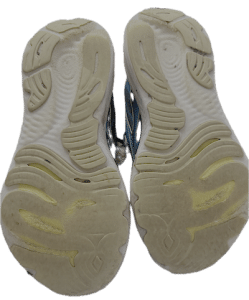
The Worn Soles of My Shoes“You have excellent shoes,” she remarked, “but the soles are very worn.” My body slumped like a deflated balloon as I realized the truth in her observation. She pointed out the worn cushioning, especially on the heel of my left shoe. How often do you buy new walking shoes?” she asked. I explained that I usually replace them every six months, but she suggested that I should consider replacing them three times a year. I appreciated her advice, but I had already ordered specialized slippers for plantar fasciitis, and adding another purchase to my tight budget would be challenging.

As I sat on the treatment table, I told her I would buy new shoes that week, and she began to massage my heel and calf. “With a rainy week ahead and the possibility of flooding, you could wait until the weekend,” she suggested.

To change the topic, I asked if she had read Atul Gawande‘s book, Being Mortal. She mentioned that she had not heard of it before. To jog my memory, I attempted to quote Gawande, who describes his book as “riveting, honest, and humane.” I explained that he emphasizes that the ultimate goal is not just a good death, but a good life, all the way to the very end.

Feeling comfortable on the topic, I mentioned that he had conducted research with gerontologists. “One of the ways they can assess the health of their patients is by examining the condition of their toenails,” I explained, pointing at mine. If the toenails are uncut or breaking, it can indicate that the person is unable to care for themselves or lacks the necessary resources to do so.

“Last fall, I started to get pedicures because I found it difficult to bend over and cut my toenails,” I continued. As we wrapped up the session, she remarked, “Your toenails look better than mine.” I joked that I wouldn’t share the name of my pedicurist.

I think I would like to read that book,” she said as I was leaving. “What is the name again?” I replied, “Being Mortal by Atul Gawande.”


Let Me Watch You Walk

As Dr. Limido stepped into Curalta Health's examination room, I couldn't help but smile. "It's a pleasure to meet you finally," I said, feeling a rush of anticipation after four long days confined to slow, diminutive walks. The thought of getting a proper assessment from a podiatrist was like a glimmer of hope for my foot health. The anticipation was palpable, and I was ready to take the next step towards recovery.

The Jan Lilien Education Fund!

My new wings
×
Man's Search for Meaning

Read: January 2022

Get this book

Man’s Search for Meaning

by Viktor E. Frankl

I recall reading portions of Man’s Search for Meaning by Viktor E. Frankl at various times, but I never completed the book. However, recently, eight and a half months after Jan’s passing, my wife and I were discussing in one of my groups. Frankl’s theory of logotherapy, which derives from the Greek word for “meaning,” centers around the idea that the primary human drive is not pleasure, as Freud believed, but rather the search for what gives life meaning. I now have a framework for my life without Jan.

For those like me who are widows, Frankl understands suffering,

In some ways, suffering ceases to be suffering at the moment it finds a meaning, such as the meaning of a sacrifice.

Jan and I lived meaningful lives. My challenge now is to continue to find meaning in my life without Jan.

As Frankl writes,

Those who have a ‘why’ to live can bear with almost any ‘how.

The love Jan and I shared was one of my primary sources of meaning. In addition, I stopped working full-time at the end of 2018 and struggled to replace the purpose I had gained from repairing the world. After Jan died, I suffered the “provisional existence of an unknown limit, ” which Frankl experienced when he was in the concentration camps.

I have replaced the loss of meaning and purpose with a series of activities:

  1. Planning to celebrate Jan Day on her birthday this year.
  2. Writing my random thoughts on Jan, love, grief, life, and all things considered;
  3. Reading more than ever, including my Goodreads 2022 Reading Challenge; and
  4. Walking more than I probably should.

I am also beginning to serve on the board of a few non-profits. It is time to transition from hands-on work to providing leadership in a different way.

Will this be enough to give my life meaning?

Ultimately, man should not ask what the meaning of his life is, but rather must recognize that it is he who is asked. In a word, each man is questioned by life, and he can only answer to life by answering for his own life; to life, he can only respond by being responsible.

I must continue to focus on my search for meaning, as life will inevitably change over time.

My grief journey has taught me that love never dies,

For the first time in my life, I saw the truth as it is set into song by so many poets, proclaimed as the final wisdom by so many thinkers. The truth – that Love is the ultimate and highest goal to which man can aspire. Then I grasped the meaning of the greatest secret that human poetry, thought, and belief have to impart: The salvation of man is through love and in love.

My path forward is to keep Jan’s love alive and continue to share it with others.

I recommend this book without reservation.


When you purchase a book through one of my links, I earn a small commission that helps support my passion for reading. This contribution allows me to buy even more books to share with you, creating an incredible cycle of discovering great reads together! Your support truly makes a difference!

Enjoy a limited-time offer of 20% off your next book purchase at Bookshop.org!


×
A Gentleman in Moscow

Read: November 2022

Get this book

A Gentleman in Moscow

by Amor Towles

A Gentleman in Moscow by Amor Towles is a transporting novel about a man sentenced by the government to spend the rest of his life inside a luxury hotel. In 1922, a Bolshevik tribunal deemed Count Alexander Rostov an unrepentant aristocrat. His house arrest in the Metropol, a grand hotel across the street from the Kremlin. Rostov, an indomitable man of erudition and wit, has never worked a day and must now live in an attic room while some of the most tumultuous decades in Russian history are unfolding outside the hotel’s doors.

During my grief journey, I have on occasion felt as if I was a prisoner in my apartment, so I found this novel to be one that provided me an alternative to understanding what it would have been like to be under house arrest as Count Rostov was.

A Gentleman in Moscow was a page-turner. The plot captures a unique historical time and how Count Rostov makes the best of a bad situation. I highly recommend this novel.

The Goodreads summary provides an overview.

With his breakout debut novel, Rules of Civility, Amor Towles established himself as a master of absorbing, sophisticated fiction, bringing late 1930s Manhattan to life with a splendid atmosphere and an excellent command of style. As NPR commented, readers and critics were enchanted, “Towles writes with grace and verve about the mores and manners of a society on the cusp of radical change.”

A Gentleman in Moscow immerses us in another elegantly drawn era with the story of Count Alexander Rostov. When, in 1922, he is deemed an unrepentant aristocrat by a Bolshevik tribunal, the count is sentenced to house arrest in the Metropol, a grand hotel across the street from the Kremlin. Rostov, an indomitable man of erudition and wit, has never worked a day. He must now live in an attic room while some of the most tumultuous decades in Russian history are unfolding outside the hotel’s doors. Unexpectedly, his reduced circumstances provide him a doorway into a much larger world of emotional discovery.

Brimming with humor, a glittering cast of characters, and one beautifully rendered scene after another, this singular novel casts a spell as it relates to the count’s endeavor to gain a deeper understanding of what it means to be a man of purpose.


The Jan Lilien Education Fund sponsors ongoing sustainability and environmental awareness programs. Gifts made this month; I will match dollar-for-dollar. All donations are tax-deductible.

Subscribe

Contact Us

I receive a commission when you buy a book or product using a link on this page. Thank you for supporting Sharing Jan’s Love blog.

×
A Parish Chronicle

Read: February 2026

Get this book

A Parish Chronicle

by Halldór Laxness

In “A Parish Chronicle,” celebrated novelist Halldór Laxness weaves an essayistic tale about the unlikely miracles that keep a church—destined to disappear time and again—rooted on the same hillside. Laxness explores the minutiae of history, from the location of the ancient burial mound of national hero Egill Skallagrímsson to the end of the 19th century, where weak-sighted Ólafur and boisterous farmhand Gunna each play unexpected roles in the parish’s enduring survival.

1882. In the still of morning, Ólafur sharpens his scythe on the bone-dry pavestones that separate his farmhouse from the rest of Mosfell Valley, where life revolves around sheep. The sound of his hammer rings out like a high-pitched bell over the tussocky fields. Across the valley, perched on a hill that receives more sunshine than others, stands Mosfell Church. Nearby, the parish priest’s maid Gunna pours her “slosh,” a weak cup of coffee. Further afield in Reykjavík (“down south” as the locals say), the general assembly decides to revisit an old plan to cut costs by consolidating small parishes and calls for the demolition of Mosfell. Yet today a church stands on that same hillside—its sharp steeple silhouetted against the clouds, its crown bell hanging to the left of the altar.

This intimate tribute to life in Laxness‘s home valley also offers a thoughtful commentary on how the peculiarities of certain individuals can shape history. “A Parish Chronicle” is rich with life and detail.


Halldór Laxness (1902-1998) is the undisputed master of modern Icelandic fiction. He was awarded the Nobel Prize in Literature in 1955, “for his vivid epic power which has renewed the great narrative art of Iceland.” His body of work includes novels, essays, poems, plays, stories, and memoirs: more than sixty books in all. His works available in English include Independent People, The Fish Can Sing, World Light, Under the Glacier, Iceland’s Bell, and Paradise Reclaimed.

Philip Roughton has translated the work of Halldór Laxness, Jón Kalman Stefánsson, Kristín Marja Baldursdóttir, and many others. He has twice been awarded the American-Scandinavian Foundation Translation Prize for his renderings of Halldór Laxness‘s work, in 2001 for Iceland’s Bell and in 2015 for Wayward Heroes. He also received the 2016 Oxford-Weidenfeld Prize for his translation of Jón Kalman Stefánsson’s The Heart of Man. He lives in Iceland. Translator Residence: Akureyri, Iceland

Salvatore Scibona is the recipient of a Mildred and Harold Strauss Living Award from the American Academy of Arts and Letters. His first novel, The End, was a finalist for the National Book Award and winner of the Young Lions Fiction Award. His second novel, The Volunteer, was called a “masterpiece” by the New York Times and won the Ohioana Book Award. His books have been translated into ten languages. His work has won a Guggenheim Fellowship, a Pushcart Prize, an O. Henry Award, and a Whiting Award, and the New Yorker named him one of its “20 Under 40” fiction writers. He is the Sue Ann and John Weinberg Director of the Cullman Center for Scholars and Writers at the New York Public Library.


Discover your next favorite book and dive into a world of curated, exciting reads by purchasing through my links. You’ll have access to a diverse selection of books I’ve personally vetted for quality and enjoyment. Additionally, by supporting these selections, you’ll help me continue to provide you with more personalized recommendations. I earn a small commission from your purchase, which allows me to buy and share even more books with you. Your support truly makes a difference!


×
Nobody Gets Out Alive- Stories

Read: February 2023

Get this book

Nobody Gets Out Alive: Stories

by Leigh Newman

Nobody Gets Out Alive: Stories by Leigh Newman, set in Newman’s home state of Alaska and an exciting virtuosic story collection about women navigating the wilds of a male-dominated society. Nobody Gets Out Alive is a collection of dazzling, courageous stories about women struggling to survive, not just grizzly bears and charging moose but the raw, exhausting legacy of their marriages and families.

There are moments when characters in a story leap off the page and become, for a few moments, our soul mates. Ms. Newman, in each of these memorable stories, engages so fully that each character becomes so alive that I wanted to know more about their lives.

The stores span both the recent past and the founding of Anchorage. I found all of them to be stories I would happily read again. The recent stories highlight the common desire for a freer, more inclusive world for women. A woman forced to sell her home or a new bride testing limits on her return home resonates as themes of the modern world.

The final story is set in 1915 in a railroad camp. The story highlights the founding of Anchorage. As one who likes historical fiction, I was so engaged that I could not take a break. I was not expecting the outspoken heiress would stage an elaborate theatrical to seduce the wife of her husband’s employer.

I may never visit Alaska at my age, but I now know enough to feel I have lived in Seward’s Folly.

I decided to read this book after reading Ms. Newman wrote a review of The Faraway World. Ms. Newman is a skilled writer, and I highly recommend this collection and look forward to reading more of her stories in the future.

The Goodreads summary provides an overview,

In “Howl Palace”—winner of The Paris Review’s Terry Southern Prize, a Best American Short Story, and Pushcart Prize selection—an aging widow struggles with a rogue hunting dog and the memories of her five ex-husbands while selling her house after bankruptcy. In the title story, “Nobody Gets Out Alive,” newly married Katrina visits her hometown of Anchorage. She blows up her wedding reception by flirting with the host and running off with an enormous mastodon tusk.

Alongside stories set in today’s Last Frontier—rife with suburban sprawl, global warming, and opioid addiction—Newman delves into the remote wilderness of the 1970s and 80s, bringing to life young girls and single moms in search of a wilder, more accessible, more adventurous America. The final story takes place in a railroad camp in 1915, where an outspoken heiress stages an elaborate theatrical to seduce the wife of her husband’s employer, revealing how this masterful storyteller is “not only writing unforgettable, brilliantly complex characters, she’s somehow inventing souls” (Kimberly King Parsons, author of Black Light).


The Jan Lilien Education Fund sponsors ongoing sustainability and environmental awareness programs. Gifts made this month; I will match dollar-for-dollar. All donations are tax-deductible.

Subscribe

Contact Us

I receive a commission when you buy a book or product using a link on this page. Thank you for supporting Sharing Jan’s Love blog.


×
The Testaments: The Sequel to The Handmaid's Tale

Read: September 2021

Get this book

The Testaments

by Margaret Atwood

The Testaments: The Sequel to The Handmaid’s Tale by Margaret Atwood is a sequel worth reading.

The novel alternates between the perspectives of three women presented as portions of a manuscript written by one (the Ardua Hall Holograph) and testimonies by the other two. Being an amateur historian, I found this a fascinating way for Ms. Atwood to write this book.

Aunt Lydia is the author of the Ardua Hall Holograph, which is a surprise based on her role in The Handmaid’s Tale. It is a surprise that she is a mole who despises Gilead and works for the resistance.

The other characters are young women who, along with Aunt Lydia, are forced to come to terms with who she is and how far she will go for what she believes.

Agnes Jemima was born in Gilead and is being educated not to be literate but to be a wife. She finds out her parents are not who she thought they were when Agnes discovers she is the daughter of a Handmaid.

Daisy was raised in Toronto, lives with her adoptive parents, and is an educated woman. As noted in most reviews, Daisy is also the daughter of a Handmaid. She is Baby Nicole from the original book, and Gilead wants her to return.

Read the book! It is a moving and engaging sequel! The testimonies in the book combine these three women’s stories to undermine Gilead.

Subscribe

Contact Us

×
How to Read a Book: A Novel

Read: May 2024

Get this book

How to Read a Book: A Novel

by Monica Wood

I started reading Monica Wood‘s “How to Read a Book: A Novel” today. It’s a heartfelt and uplifting story about a chance encounter at a bookstore—the novel delves into themes of redemption, unlikely friendships, and the life-changing power of sharing stories. With Monica Wood’s characteristic heart, wit, grace, and understanding, the novel illuminates the decisions that shape a life and the kindnesses that make life meaningful.

The story revolves around three characters: Violet Powell, a twenty-two-year-old from rural Abbott Falls, Maine, who is being released from prison after serving twenty-two months for a drunk-driving crash that killed a local kindergarten teacher; Harriet Larson, a retired English teacher who runs the prison book club and is facing the prospect of an empty nest; and Frank Daigle, a retired machinist who is struggling to come to terms with the complexities of his marriage to the woman Violet killed.

Their lives unexpectedly intersect one morning in a bookstore in Portland, Maine. Violet buys the novel she read in the prison book club before her release, Harriet selects the following title for the remaining women, and Frank fulfills his duties as the store handyman. Their encounters set off a chain of events that will profoundly change them.

How to Read a Book is a candid and hopeful story about releasing guilt, embracing second chances, and the profound impact of books on our lives.

×