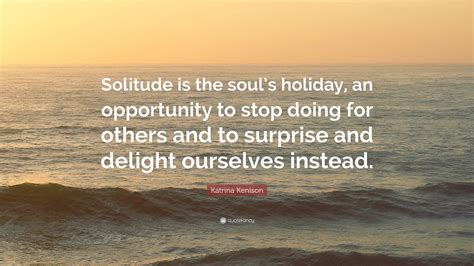

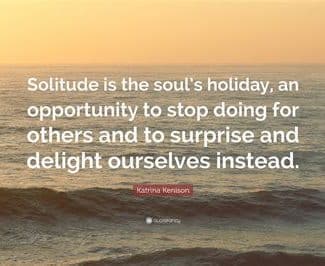
Soulitude of the Soul

Solitude of the Soul

Being Alone Has Its Limits

Estimated reading time: 2 minutes, 23 seconds

As I walk, I prefer to immerse myself in the world’s sounds rather than listen to music or a podcast. By using my ears to listen, I can connect with others and extend warm greetings by wishing them a good day. Occasionally, I encounter walkers or runners wearing AirPods, and I wonder if they know my presence. Recently, a woman asked if I was speaking to her. When I confirmed talking with her, she commented that many people have become accustomed to bringing the outside world wherever they go rather than cherishing moments of solitude.

The tranquility of silence has always been comforting to me, but lately, I find myself questioning if there can be such a thing as too much quiet. With Memorial Day approaching and marking the official start of summer, I can’t help but feel a sense of unease. The anticipation of a tranquil weekend weighs heavily on me as calls and texts dwindle, with everyone escaping to the shores or mountains. Usually, a quiet Friday afternoon would signal the beginning of my preparations for Shabbat, but today, it feels more like a foreshadowing of the unraveling of my life.

As Jancee Dunn wrote in “The Surprising Joy of Being Alone” in The New York Times, “Solitude is different from loneliness, said Virginia Thomas, an assistant professor of psychology at Middlebury College. The latter is the feeling that we’re not as connected to others as we would like, producing emotional distress. On the other hand, intentionally seeking out some time to spend alone, she said, is ‘almost always experienced positively.’

Sitting on Jan's Bench in Hanson ParkI echo Ms. Dunn’s sentiments as there are moments when I feel fully immersed in life and yearn for an afternoon spent in a good book, writing in my journal, or simply sitting on a bench in Hanson Park. However, now I find myself longing for meaningful connections with others beyond just exchanging pleasantries. As a caregiver, I used to cherish the rare moments when I could have time to myself. I truly valued those occasions and recognized that I felt more robust and resilient when I returned to care for Jan.

Striking a balance between solitude and companionship is a constant contemplation for me. While I enjoy volunteering with Bridges, Hanson Park, and other groups, those moments are fleeting. Attending plays, jazz concerts, and sharing meals with friends also brings me happiness, but these experiences are limited. Sometimes, it’s not just about choosing between being alone and being with others; it’s about finding contentment in solitude without feeling lonely. While I can love again, I’m uncertain if I can be loved a second time. I’m hesitant to settle for friendship because what I have differs from what I truly need. I’m curious if I’ll ever find a companion to share my life with or if I’ll reside in a secluded garden of solitude.

The End of Suffering From Grief

My experiences with grief have taught me that it can be an influential teacher. Despite having many skilled instructors throughout my life, it was only when I fully embraced the pain of loss that I learned how to truly live, love, and become the best version of myself. Each step into the unknown future, I reconnect with my soul and hear it singing. I am not a new person, but I have become a better person because of my experiences with grief.

Show thread (1)

My Life is a Work in Progress!

Being Alone Has Its Limits

Estimated reading time: 2 minutes, 23 seconds

My Life is a Work in Progress!

The essence of life lies in living it to the fullest, but what if we find ourselves living it all alone? The words of Lauren Groff from her book "The Vaster Wilds" resonate with my situation, as she rightly pointed out that to exist alone and survive is not the same as being alive. Although I strive to make the most of my life by reading, writing, walking, offering help to others, and serving as the board chair for Bridges, I still feel that I am merely surviving from one day to the next.

34 comments add your comment

Share your thoughts and ideas

This site uses Akismet to reduce spam. Learn how your comment data is processed.

The Jan Lilien Education Fund!

Soulitude of the Soul
×
The Shadow King: A Novel

Read: April 2022

Get this book

The Shadow King: A Novel

by Maaza Mengiste

The Shadow King: A Novel by Maaza Mengiste is a book happened to offer two often overlooked threads of history. The first is Mussolini’s 1935 invasion of Ethiopia. The second one I am most interested in is the women soldiers who were left out of the historical record. I highly recommend The Shadow King. It is a gorgeously crafted and unputdownable exploration of female power and what it means to be a woman at war.

Hirut and Aster come alive in Maaza Mengiste talented writing. Their struggles to be seen as equal in a society at war is engaging. Hirut’s plan to create a shadow kingpin the absence of Emperor Haile Selassie is one that turns defeat into victory.

Goodreads provides a good overview of the book.

With the threat of Mussolini’s army looming, recently orphaned Hirut struggles to adapt to her new life as a maid in Kidane and his wife Aster’s household. Kidane, an officer in Emperor Haile Selassie’s army, rushes to mobilize his most muscular men before the Italians invaded. His initial kindness to Hirut shifts into flinty cruelty when she resists his advances. Hirut finds herself tumbling into a new world of thefts and violations, betrayals, and overwhelming rage. Meanwhile, Mussolini’s technologically advanced army prepared for an easy victory. Hundreds of thousands of Italians―Jewish photographer Ettore among them―march on Ethiopia seeking adventure.

As the war begins in earnest, Hirut, Aster, and the other women long to do more than care for the wounded and bury the dead. When Emperor Haile Selassie goes into exile and Ethiopia quickly loses hope, Hirut offers a plan to maintain morale. She helps disguise a gentle peasant as the emperor and soon becomes his guard, inspiring other women to take arms against the Italians. But how could she have predicted her war as a prisoner of one of Italy’s most vicious officers, who would force her to pose before Ettore’s camera?

What follows is a gorgeously crafted and unputdownable exploration of female power, with Hirut as the fierce, original, and brilliant voice at its heart. In incandescent, lyrical prose, Maaza Mengiste breathes life into complicated characters on both sides of the battle line, shaping a heartrending, unforgettable exploration of what it means to be a woman at war.

Subscribe

Contact Us

When you buy a book or product using a link on this page, I receive a commission. Thank you for supporting Sharing Jan’s Love blog.

×
Intermezzo: A Novel

Read: February 2025

Get this book

Intermezzo: A Novel

by Sally Rooney

Today, I dove into Sally Rooney‘s latest novel, “Intermezzo: A Novel,” which instantly captivated me. It’s a profoundly moving exploration of grief, love, and the intricacies of family life, with love at its heart. Reflecting on my journey through grief, I remember how Ms. Rooney‘s earlier work, “Beautiful World, Where Are You,” resonated with me during my second year of processing loss.

It beautifully highlighted love’s enduring nature and reminded me that, even in the depths of sorrow, love’s essence never truly fades. Intermezzo focuses on the fact that, aside from being brothers, Peter and Ivan Koubek seem to have little in common.

Peter is a Dublin lawyer in his thirties—successful, competent, and unassailable. But in the wake of their father’s death, he’s medicating himself to sleep and struggling to manage his relationships with two very different women—his enduring first love, Sylvia, and Naomi, a college student for whom life is one long joke.

Ivan is a twenty-two-year-old competitive chess player. He has always seen himself as socially awkward, a loner, the antithesis of his glib elder brother. Now, in the early weeks of his bereavement, Ivan meets Margaret, an older woman emerging from her turbulent past, and their lives become rapidly and intensely intertwined.

In this poignant interlude, we delve into the lives of two brothers grappling with their profound grief, accompanied by those who care for them. It’s a raw journey woven with threads of longing, heartbreak, and the flickering light of hope. Together, they navigate the uncharted territory of loss, uncovering how much the human spirit can withstand before it shatters.


When you purchase a book through one of my links, I earn a small commission that helps support my passion for reading. This contribution allows me to buy even more books to share with you, creating an incredible cycle of discovering great reads together! Your support truly makes a difference!


×
The Worst Hard Time

Read: September 2019

Get this book

The Worst Hard Time

by Timothy Egan

The Worst Hard Time: The Untold Story of Those Who Survived the Great American Dust Bowl by Timothy Egan was initially a book I selected from the e-library because nothing else I wanted to read was available. Once I started reading the book, I could not put it down.

Now that we have had the warmest summer since 1936 during the dust bowl, the book has even more meaning.

According to The New York Times,

The dust storms that terrorized the High Plains in the darkest years of the Depression were like nothing ever seen before or since. Timothy Egan’s critically acclaimed account rescues this iconic chapter of American history from the shadows in a tour de force of historical reportage. Following a dozen families and their communities through the rise and fall of the region, Egan tells of their desperate attempts to carry on through blinding black dust blizzards, crop failure, and the death of loved ones. Brilliantly capturing the terrifying drama of catastrophe, Egan does equal justice to the human characters who become his heroes, “the stoic, long-suffering men and women whose lives he opens up with urgency and respect.”

With the likelihood of more ecological catastrophes in the immediate future, this is a book I highly recommend.

Subscribe

Contact Us

×
Seduction Theory

Read: September 2025

Get this book

Seduction Theory

by Emily Adrian

Seduction Theory by Emily Adrian is a captivating exploration of the complex interplay between power and attraction. This thought-provoking narrative beautifully illustrates how love and betrayal can intertwine. As two married professors navigate the delicate path toward infidelity, a graduate student’s compelling thesis project unveils their hidden struggles, creating a fascinating tale of desire and consequence.

Simone is a shining star in the creative writing department at Edwards University, celebrated for her scholarship on Woolf, her poignant memoirs of grief, and her captivating presence on campus. Her husband, Ethan, although not as widely recognized, is a dedicated lecturer and author whose work has a quietly impactful impact. Together, they portray a picture of marital bliss that everyone admires—until an unexpected turn shakes their world when Ethan has an affair with Abigail, the department’s administrative assistant.

As summer unfolds, Simone faces her own struggles. With Ethan away, she becomes increasingly close to her talented advisee, graduate student Roberta “Robbie” Green. They share runs, secrets, and dreams. Still, unbeknownst to Simone, Robbie is crafting an MFA thesis that delves into the complexities of Simone’s marriage, weaving a narrative that may reveal more than Simone anticipates.

Through Robbie’s unique lens, the intricacies of relationships, truth, and self-discovery come to the fore, creating a captivating story that promises to explore the delicate threads binding their lives together in unexpected ways.


Emily Adrian is the author of Everything Here is Under Control and The Second Season, as well as the memoir Daughterhood and two critically acclaimed novels for young adults. Her work has appeared in Granta, Joyland, The Point, EPOCH, Alta Journal, and Los Angeles Review of Books. Originally from Portland, Oregon, Adrian currently lives in New Haven, Connecticut.


Discover your next favorite book and dive into a world of curated, exciting reads by purchasing through my links. You’ll have access to a diverse selection of books that I’ve personally vetted to ensure quality and enjoyment. Additionally, by supporting these selections, you’ll help me continue to provide you with more personalized recommendations. I earn a small commission from your purchase, which allows me to buy and share even more books with you. Your support truly makes a difference!


×
Autocracy, Inc.: The Dictators Who Want to Run the World

Read: January 2025

Get this book

Autocracy, Inc.

by Anne Applebaum

Today, I plunged into the captivating world of “Autocracy, Inc.: The Dictators Who Want to Run the World” by Anne Applebaum. I listened to an engaging discussion between her and the Executive Director of the YIVO Institute for Jewish Research, Jonathan Brent. Their insights left me eager for more, and I couldn’t resist making this book my next read. I’m thrilled to dive deeper into her thought-provoking perspective!

This compelling New York Times bestseller by the Pulitzer Prize-winning author paints a chilling picture of how autocratic regimes join forces to erode democracy globally. Applebaum sheds light on this pressing issue and offers insights on how we can unite to fight back.

We think we know what an autocratic state looks like: An all-powerful leader is at the top. He controls the police. The police threaten the people with violence. There are evil collaborators and maybe some brave dissidents.

But in the 21st century, that bears little resemblance to reality. Nowadays, autocracies are underpinned not by one dictator but by sophisticated networks composed of kleptocratic financial structures, surveillance technologies, and professional propagandists, all of which operate across multiple regimes, from China to Russia to Iran. Corrupt companies in one country do business with corrupt companies in another. The police in one country can arm and train the police in another, and propagandists share resources and themes, pounding home the same messages about the weakness of democracy and the evil of America.

International condemnation and economic sanctions cannot move the autocrats. Even popular opposition movements, from Venezuela to Hong Kong to Moscow, don’t stand a chance. The members of Autocracy, Inc. aren’t linked by a unifying ideology, like communism, but rather by a common desire for power, wealth, and impunity. In this urgent treatise, which evokes George Kennan’s essay calling for “containment” of the Soviet Union, Anne Applebaum calls for the democracies to reorient their policies to fight a new threat fundamentally.


In the video, Jonathan Brent asks Anne Applebaum to read the last paragraph of “Autocracy, Inc.: The Dictators Who Want to Run the World.”

There is no liberal world order anymore, and the aspiration to create one no longer seems real. But there are liberal societies, open and free countries that offer a better chance for people to live useful lives than closed dictatorships do. They are hardly perfect. Those that exist have deep flaws, profound divisions, and terrible historical scars. But that’s all the more reason to defend and protect them. So few of them have existed across human history; so many have existed for a short time and then failed. They can be destroyed from the outside and from the inside, too, by division and demagogues. Or they can be saved. But only if those of us who live in them are willing to make the effort to save them.

After finishing Autocracy, Inc.: The Dictators Who Want to Run the World,” this closing paragraph should be a call to action. Failure to respond to the challenge will doom our future to an unacceptable one. I recommend this book and encourage people to read it, discuss its contents, and take action to save our collective future.


When you purchase a book through one of my links, I earn a small commission that helps support my passion for reading. This contribution allows me to buy even more books to share with you, creating an incredible cycle of discovering great reads together! Your support truly makes a difference!


×
How the Word is Passed

Read: December 2021

Get this book

How the Word Is Passed: A Reckoning with the History of Slavery Across America

by Clint Smith

How the Word Is Passed: A Reckoning with the History of Slavery Across America by Clint Smith. This book was a gift from my son Jon. The New York Times selected How the Word is Passed as one of the best books published this year. Beginning in his hometown of New Orleans, Clint Smith leads the reader on an unforgettable tour of monuments and landmarks—those that are honest about the past and those that are not—that offer an intergenerational story of how slavery has been central in shaping our nation’s collective history, and ourselves.

How the Word is Passed is one of the best books I have read in 2021. I had read an excerpt in The Atlantic on the Whitney Plantation, one of the only former plantations devoted to preserving the experience of the enslaved people whose lives and work sustained it. Like most of us, I had placed the book on my to-read list, where it remained lost in the cobwebs. Fortunately, my son Jon purchased the book for me.

Secondly, the book rekindled my long-lost dream of being an American Studies professor. As soon as Jan and I met, I dropped plans to leave Brooklyn and start graduate school in the fall of 1974. I made that decision primarily because of how much I loved Jan. But it was also partly that I did not have a clear vision of what my life would be like as a professor. The book provided clear examples of people like Yvonne Holden at The Whitney Plantation redefining history to be more accurate and inclusive. I probably could not have done as well as she did, but I can now see that it might have resulted in a career for me that could have been impactful.

Goodreads provides this overview for those who still need to be convinced to read this book.

It is the story of the Monticello Plantation in Virginia, the estate where Thomas Jefferson wrote letters espousing the urgent need for liberty while enslaving over 400 people on the premises. It is the story of the Whitney Plantation, one of the only former plantations devoted to preserving the experience of the enslaved people whose lives and work sustained it. It is the story of Angola Prison in Louisiana, a former plantation named for the country from which most of its enslaved people arrived and which has since become one of the most gruesome maximum-security prisons in the world. And it is the story of Blandford Cemetery, the final resting place of tens of thousands of Confederate soldiers.

In a deeply researched and transporting exploration of the legacy of slavery and its imprint on centuries of American history, How the Word Is Passed illustrates how some of our country’s most essential stories are hidden in plain view-whether in places we might drive by on our way to work, holidays such as Juneteenth, or entire neighborhoods—like downtown Manhattan—on which the brutal history of the trade in enslaved men, women and children has been deeply imprinted.

Informed by scholarship and brought alive by the story of people living today, Clint Smith’s debut work of nonfiction is a landmark work of reflection and insight that offers a new understanding of the hopeful role that memory and history can play in understanding our country.

How the Word is Passed is one of the best books I have read this year and many prior ones. I encourage you to read it and share your comments.

Subscribe

Contact Us

When you buy a book or product using a link on this page, I receive a commission. Thank you for supporting Sharing Jan’s Love blog.

×