
A Mercy a Novel

Estimated reading time: 0 minutes, 57 seconds

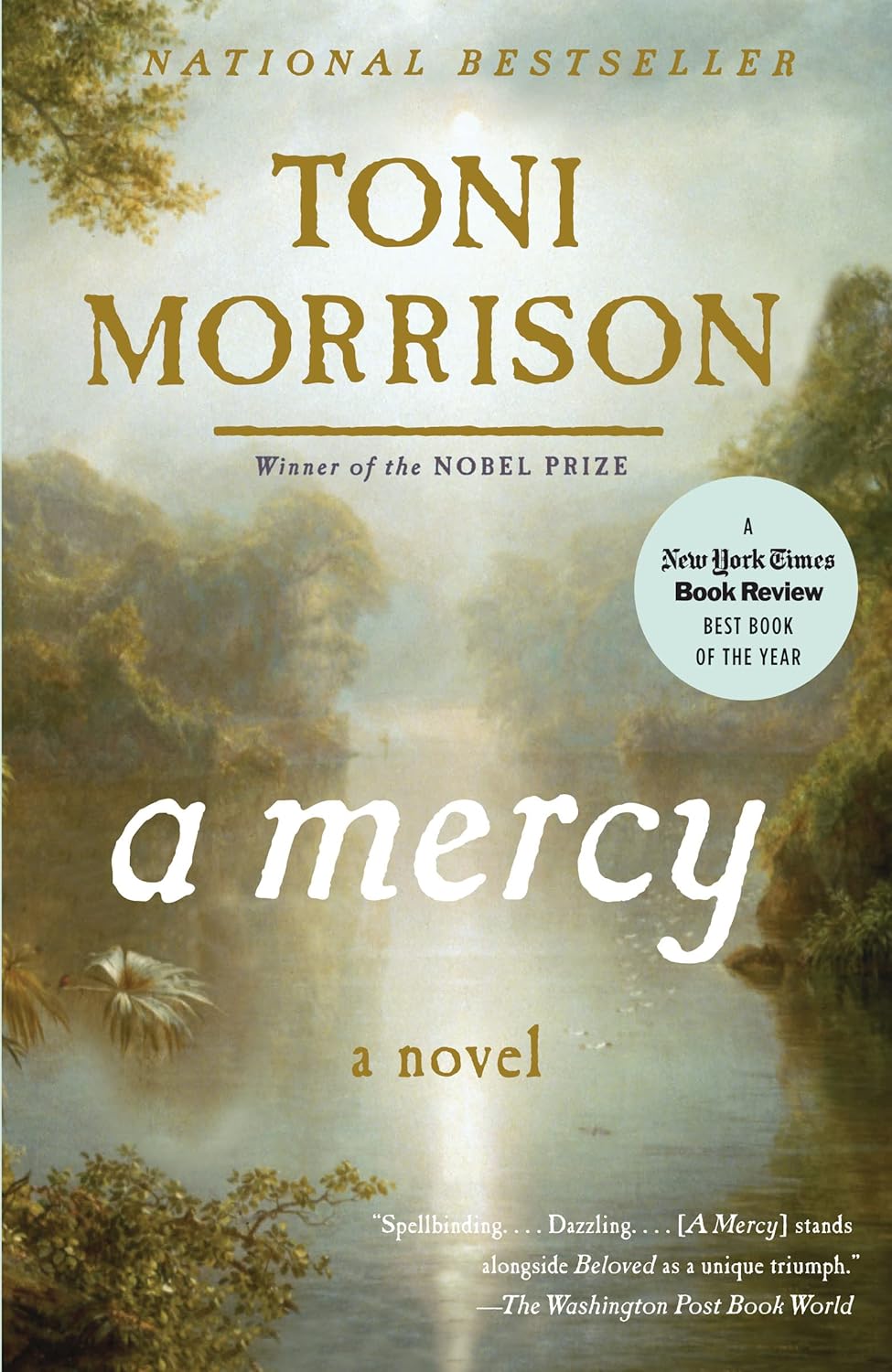
Today, I started reading “A Mercy” by Toni Morrison. The acclaimed Nobel Prize winner explores the complexities of slavery in this novel. Like “Beloved,” it tells the poignant story of a mother and her daughter—a mother who abandons her child to protect her and a daughter who struggles with that abandonment. “A Mercy” is also recognized as one of The New York Times’s 100 Best Books of the 21st Century.

In the 1680s, a tumultuous period in the Americas, the slave trade is still in its infancy. Jacob Vaark, an Anglo-Dutch trader and adventurer, navigates this harsh landscape with a small holding in the North. Despite his distaste for dealing in “flesh,” he takes a small slave girl in part payment for a bad debt from a plantation owner in Catholic Maryland. She is Florens, a girl who can read and write and might be helpful on his farm. Rejected by her mother, Florens embarks on a journey for love, first seeking it from Lina, an older servant woman at her new master’s house, and later from the handsome blacksmith, an African, never enslaved, who comes riding into their lives.

The Jan Lilien Education Fund!

Victory City: A Novel

Read: February 2023

Get this book

Victory City: A Novel

by Salman Rushdie

Victory City: A Novel by Salman Rushdie is an epic tale of a woman who breathes a fantastical empire into existence, only to be consumed by it over the centuries from the transcendent imagination of Booker Prize-winning, internationally bestselling author Salman Rushdie. It is well written and was a page-turner from page one to the end. I highly recommend this novel and encourage everyone to read it.

Brilliantly styled as a translation of an ancient epic, this is a saga of love, adventure, and myth that is a testament to storytelling’s power. After witnessing her mother’s death, the grief-stricken Pampa Kampana becomes a vessel for the goddess Parvati, who begins to speak out of the girl’s mouth. I was hooked when Pampa Kampana provided the seeds that created Victory City out of thin air.

David Remnick’s interview with Salman Rushdie in The New Yorker provided background I would have missed.

“The first kings of Vijayanagara announced, quite seriously, that they were descended from the moon,” Rushdie said. “So when these kings, Harihara and Bukka, announce that they’re members of the lunar dynasty, they’re associating themselves with those great heroes. It’s like saying, ‘I’ve descended from the same family as Achilles.’ Or Agamemnon. And so I thought, Well, if you could say that, I can say anything.”

Above all, the book is buoyed by the character of Pampa Kampana, who, Rushdie says, “just showed up in my head” and gave him his story, his sense of direction. Rushdie’s pleasure in writing the novel was in “world building” and, at the same time, writing about a character building that world: “It’s me doing it, but it’s also her doing it.” The pleasure is infectious. “Victory City” is an immensely enjoyable novel. It is also an affirmation. At the end, with the great city in ruins, what is left is not the storyteller but her words:

I, Pampa Kampana, am the author of this book.
I have lived to see an empire rise and fall.
How are they remembered now, these kings, these queens?
They exist now only in words . . .
I myself am nothing now. All that remains is this city of words.
Words are the only victors.

The Goodreads summary provides a brief overview,

In the wake of an insignificant battle between two long-forgotten kingdoms in fourteenth-century southern India, a nine-year-old girl has a divine encounter that will change the course of history. After witnessing her mother’s death, the grief-stricken Pampa Kampana becomes a vessel for the goddess Parvati, who begins to speak out of the girl’s mouth. Granting her powers beyond Pampa Kampana’s comprehension, the goddess tells her that she will be instrumental in the rise of a great city called Bisnaga–literally victory city–the wonder of the world.

Over the next two hundred and fifty years, Pampa Kampana’s life becomes deeply interwoven with Bisnaga’s, from its literal sowing out of a bag of magic seeds to its tragic ruination in the most human of ways: the hubris of those in power. Whispering Bisnaga and its citizens into existence, Pampa Kampana attempts to make good on Parvati’s task: giving women equal agency in a patriarchal world. But all stories have a way of getting away from their creator, and Bisnaga is no exception. As years pass, rulers come and go, battles are won and lost, and allegiances shift, the very fabric of Bisnaga becomes an ever more complex tapestry–with Pampa Kampana at its center.


The Jan Lilien Education Fund sponsors ongoing sustainability and environmental awareness programs. Gifts made this month; I will match dollar-for-dollar. All donations are tax-deductible.

Subscribe

Contact Us

I receive a commission when you buy a book or product using a link on this page. Thank you for supporting Sharing Jan’s Love blog.


×
Never Forget Our People Were Always Free

Read: March 2024

Get this book

Never Forget Our People Were Always Free

by Ben Jealous

Today, I started reading “Never Forget Our People Were Always Free: A Parable of American Healing” by Ben Jealous, the Executive Director of the Sierra Club. The book highlights how the path to healing America’s broken heart begins with each of us having the courage to heal ourselves. According to Mr. Jealous, it would be transformative if every American treated each other as cousins.

Ben Jealous is the son of parents who had to leave Maryland because their cross-racial marriage was illegal.

I briefly met Ben Jealous last May when I went to Washington with the Religious Action Center of Reform Judaism‘s Day of Action. When I saw Mr. Jealous speaking at Temple Emanu-El in neighboring Westfield, I immediately signed up to attend in person. He is an inspiration as an advocate for the environment, civil rights, and the healing of America’s broken heart.

His lively, courageous, and empathetic storytelling calls on every American to look past deeply cut divisions and recognize that we are all in the same boat now. Along the way, Jealous grapples with hidden American mysteries, including:

  • Why do white men die from suicide more often than black men die from murder?
  • How did racial profiling kill an American president?
  • What happens when a Ku Klux Klansman wrestles with what Jesus said?
  • How did Dave Chappelle know the DC Snipers were Black?
  • Why shouldn’t the civil rights movement give up on rednecks?
  • When is what we have collectively forgotten about race more important than what we know?
  • What do the most indecipherable things our elders say tell us about ourselves?

The book Never Forget Our People Were Always Free is told through parables. It features intimate glimpses of political and faith leaders such as Jack Kemp, Stacey Abrams, and the late Archbishop Desmond Tutu. The book also highlights unlikely heroes such as a retired constable, a female pirate from Madagascar, a long-lost Irishman, a death row inmate, and a man with a Confederate flag over his heart.

Never Forget Our People Were Always Free offers readers hope that America’s oldest wounds can heal and her oldest divisions can be overcome.

Although I have only read a handful of pages of the book, I highly recommend it!

×
The Last White Man

Read: August 2022

Get this book

The Last White Man: A Novel

by Mohsin Hamid

The Last White Man by Mohsin Hamid is a story of love, loss, and rediscovery in a time of unsettling change. One morning, Anders, the novel’s protagonist,  wakes to find that his skin has turned dark, his reflection a stranger to him. At first, he tells only Oona, an old friend, newly a lover. Soon, reports of similar occurrences surface across the land.

In Mohsin Hamid’s “lyrical and urgent” prose (O Magazine), The Last White Man powerfully uplifts our capacity for empathy and the transcendence over bigotry, fear, and anger it can achieve.

I highly recommend this book. It was a page-turner that kept me thinking about love, loss, and rediscovery. All three are subjects close to my heart since Jan’s death.

I decided to read the book after hearing an interview with the author on All of It on WNYC.

The Goodreads summary provides a good overview,

One morning, Anders wakes to find that his skin has turned dark, his reflection a stranger to him. At first he tells only Oona, an old friend, newly a lover. Soon, reports of similar occurrences surface across the land. Some see in the transformations the long-dreaded overturning of an established order, to be resisted to a bitter end. In many, like Anders’s father and Oona’s mother, a sense of profound loss wars with profound love. As the bond between Anders and Oona deepens, change takes on a different shading: a chance to see one another, face to face, anew.

Hamid’s The Last White Man invites us to envision a future – our future – that dares to reimagine who we think we are, and how we might yet be together.


The Jan Lilien Education Fund sponsors ongoing sustainability and environmental awareness programs. Gifts made this month; I will match dollar-for-dollar. All donations are tax-deductible.

Subscribe

Contact Us

I receive a commission when you buy a book or product using a link on this page. Thank you for supporting Sharing Jan’s Love blog.

×
Hello Beautiful

Read: March 2023

Get this book

Hello Beautiful

by Ann Napolitano

Hello Beautiful by Ann Napolitano is a gorgeous, profoundly moving portrait of what’s possible when we choose to love someone, not despite who they are but because of it. Although several sources recommended Hello Beautiful, I chose the novel based on the title as it is how I always greeted Jan. I highly recommend this book as it is one of the best I have ever read.

Hello Beautiful is an exquisite homage to Louisa May Alcott’s timeless classic, Little Women. Knowing it was not him, William Waters’s experience growing up as an only child was an engaging character in the early portion of the novel. However, my hero was Sylvie, the dreamer who pursued true love and found it in a place one would less expect to find it. The consequences of her love reverberate over decades in their families

The following passage is one example of a well-written book.

We’re separated from the world by our own edges,” Charlie Padavano says to Sylvie in “Hello Beautiful.” He continues, “We’re all interconnected, and when you see that, you see how beautiful life is.

The interconnections of the characters make this novel one of the best I have read. If only more of us could learn the lessons that Charlie Padavano shared with Sylvie.

As a man on a lifetime grief journey, this exchange echoes my experience.

When an old person dies,” Kent said, “even if that person is wonderful, he or she is still somewhat ready, and so are the people who loved them. They’re like old trees, whose roots have loosened in the ground. They fall gently. But when someone like your aunt Sylvie dies—before her time—her roots get pulled out and the ground is ripped up. Everyone nearby is in danger of being knocked over.”

Grief is love.” Now Alice thought: Forgiveness is too.

The Goodreads summary provides an overview,

William Waters grew up in a house silenced by tragedy, where his parents could hardly bear to look at him, much less love him. So it’s a relief when his skill on the basketball court earns him a scholarship to college, far away from his childhood home. He soon meets Julia Padavano, a spirited and ambitious young woman who surprises William with her appreciation of his quiet steadiness. With Julia comes her family; she is inseparable from her three younger sisters: Sylvie, the dreamer, is happiest with her nose in a book and imagines a future different from the expected path of wife and mother; Cecelia, the family’s artist; and Emeline, who patiently takes care of all of them. Happily, the Padavanos fold Julia’s new boyfriend into their loving, chaotic household.

But then darkness from William’s past surfaces, jeopardizing not only Julia’s carefully orchestrated plans for their future, but the sisters’ unshakeable loyalty to one another. The result is a catastrophic family rift that changes their lives for generations. Will the loyalty that once rooted them be strong enough to draw them back together when it matters most?


The Jan Lilien Education Fund sponsors ongoing sustainability and environmental awareness programs. Gifts made this month; I will match dollar-for-dollar. All donations are tax-deductible.

Subscribe

Contact Us

I receive a commission when you buy a book or product using a link on this page. Thank you for supporting Sharing Jan’s Love blog.


×
Aftermirth

Read: August 2022

Get this book

Aftermirth by Hillary Jordan

by Hillary Jordan

Aftermirth by Hillary Jordan is a book about grief as the two protagonists take a road trip that is a darkly funny journey of healing that takes them deep into the heart of their suffering and others, and then beyond it, to a place of peace and laughter. I had just finished reading When She Woke by Ms. Jordan and having enjoyed that book, reading a second one by the same author seemed reasonable.

When I selected this short novel to read, I questioned if it was a good choice for me.

I found it easier to read and, in some ways, helpful. It was like meeting fellow widows from my Zoom grief groups in person at Camp Widow. The ability to laugh about our loss and cry openly is essential to meeting fellow benefits.

Michael Larssen, the narrator, raised a question I have not and still do not want to consider. What if I am still alive, Jan was a great love but is not the love of my life?

“You can’t know that he was the love of your life, and do you know why? Because guess what, you aren’t dead yet. You may feel dead right now, and believe me I’ve been there, but the fact is, until you’re lying under a tombstone of your own you can’t be sure about anything. You could prick your finger on one of your roses tomorrow, and as you’re climbing the stairs to get a Band-Aid, you trip over one of the pugs and tumble to your death. Or you could meet a man in the checkout line at the grocery store–hell, you could meet a woman even and fall madly in love with her and end up with six kids and twenty grandkids. Michael looks over at Elena, then back at George. You just don’t know, George. That’s the thing. None of us does.”— Aftermirth (Kindle Single) by Hillary Jordan

Despite my anxiety about considering this disturbing question, I highly recommend Aftermirth by Hillary Jordan.

The Goodreads summary provides an overview.

I stopped being funny the day my wife was electrocuted by her underwire bra.” So begins “Aftermirth,” a dark comedy that explores the absurdity of death through the eyes of thirty-one-year-old comedian, writer, and actor Michael Larssen. What is funny to the rest of the world is devastating to Michael, who loves his wife deeply, exceptionally her bright, rippling, abandoned laughter, which captivated him from the first time he heard it. In the aftermath of her death, he loses his sense of humor and his career.

Then, after two years of mourning her, he sees an article in the paper about a factory worker named Julio Santiago who fell into a giant vat of dough and was kneaded to death. For reasons Michael doesn’t understand, he decides to go to the man’s wake. There he meets and bonds with Julio’s twenty-nine-year-old daughter Elena, a law student who is reeling from her father’s unexpected and preposterous death.

Three months later, she calls him out of the blue and suggests that the two of them drive to North Carolina to speak with another survivor like themselves Elena has found on the Internet. Their road trip is a darkly funny journey of healing that takes them deep into the heart of their grief and others and then beyond it to a place of peace and laughter.


The Jan Lilien Education Fund sponsors ongoing sustainability and environmental awareness programs. All donations are tax-deductible.

Subscribe

Contact Us

I receive a commission when you buy a book or product using a link on this page. Thank you for supporting Sharing Jan’s Love blog.

×
The Amen Effect

Read: March 2025

Get this book

The Amen Effect

by Sharon Brous

Sharon Brous, a prominent American rabbi, argues in The Amen Effect: Ancient Wisdom to Heal Our Hearts and Mend Our Broken World that the essential spiritual work of our time—though instinctual and often countercultural—focuses on connecting through celebration, sorrow, and solidarity. We must support one another in times of joy and pain, embracing vulnerability and possibility, nurturing relationships with shared purposes, and creating communities centered on care.

From one of our country’s most prominent rabbis comes this inspiring book about the power of community, based on one of her most impactful sermons. What will it take to mend our broken hearts and rebuild our society in a time of loneliness, isolation, social rupture, and alienation?

Brous contends that honoring our most basic human instinct—the yearning for authentic connection—is the way to reawaken our shared humanity and begin the healing process. This kind of sacred presence is captured by the word amen, a powerful ancient idea that we affirm the fullness of one another’s experience by demonstrating, in body and word: “I see you. You are not alone.”

An acclaimed preacher and storyteller, Brous pairs heart-driven anecdotes from her experience building and pastoring to a leading-edge faith community over the past two decades with ancient Jewish wisdom and contemporary science. The result is a clarion call: the sense of belonging engendered by our genuine presence is both a social and biological need, as well as a moral and spiritual necessity.

With original insights and practical tools, The Amen Effect translates foundational ideas into simple practices that connect us to our better angels, offering a blueprint for a more meaningful life and a more connected and caring world.

As she writes in the preface, after listing the joys and pains of life, weddings, births, and death,

It’s in these times that I feel the weight of the work, the privilege of being alive, the blessing of being so close to such raw beauty and pain. It’s there that I have learned the power of saying ‘Amen‘ to one another’s grief and joy, sorrow and celebration with our very presence. Of bearing witness to profound suffering and protesting injustice with our very presence. Of comforting and consoling, surviving and thriving with our very presence. What I’ve learned, during the years, is the meaning of sacred companionship. I have seen, in ways subtle and pronounced, a longing to connect with others who can help hold the pain, a need to share what we’ve learned in the trenches, and a desire to give, even when we ourselves have barely caught our breath. And I have seen how knowing that we’re not alone can both heighten our joy and help us endure unimaginable hardship.

Click here to read about my experience listening to Rabbi Brous at the Kol Tzedek Speakers Series at Temple Emanu-El in Westfield.


Sharon Brous is the senior and founding rabbi of IKAR, a leading-edge Jewish community based in Los Angeles, and the author of The Amen Effect: Ancient Wisdom to Heal Our Hearts and Mend Our Broken World, a national bestseller.

In 2013, Brous blessed President Obama and Vice President Biden at the Inaugural National Prayer Service, and in 2021, returned to bless President Biden and Vice President Harris and then led the White House Passover Seder 2021 and the Hanukkah candle lighting with the Vice President and Second Gentleman in 2023. She was ranked as the number one most influential Rabbi in America by Newsweek/The Daily Beast. She has also been recognized by The Forward and the Jerusalem Post as one of the most influential Jews alive today. Her work has appeared in prominent publications, including The New York Times, The Los Angeles Times, and The Washington Post. Additionally, her TED talk, “Reclaiming Religion,” has been viewed by over 1.5 million people.

Brous is part of the inaugural cohort of Auburn Seminary’s Senior Fellows program, which brings together top faith leaders working on the frontlines for justice. She sits on the faculty of REBOOT and serves on the International Council of the New Israel Fund, as well as the national steering committee for the Poor People’s Campaign.

A Columbia University graduate (holding both undergraduate and M.A. degrees in Human Rights), she was ordained by the Jewish Theological Seminary and resides in Los Angeles with her husband and children.


When you purchase a book through one of my links, I earn a small commission that helps support my passion for reading. This contribution allows me to buy even more books to share with you, creating an incredible cycle of discovering great reads together! Your support truly makes a difference!


×