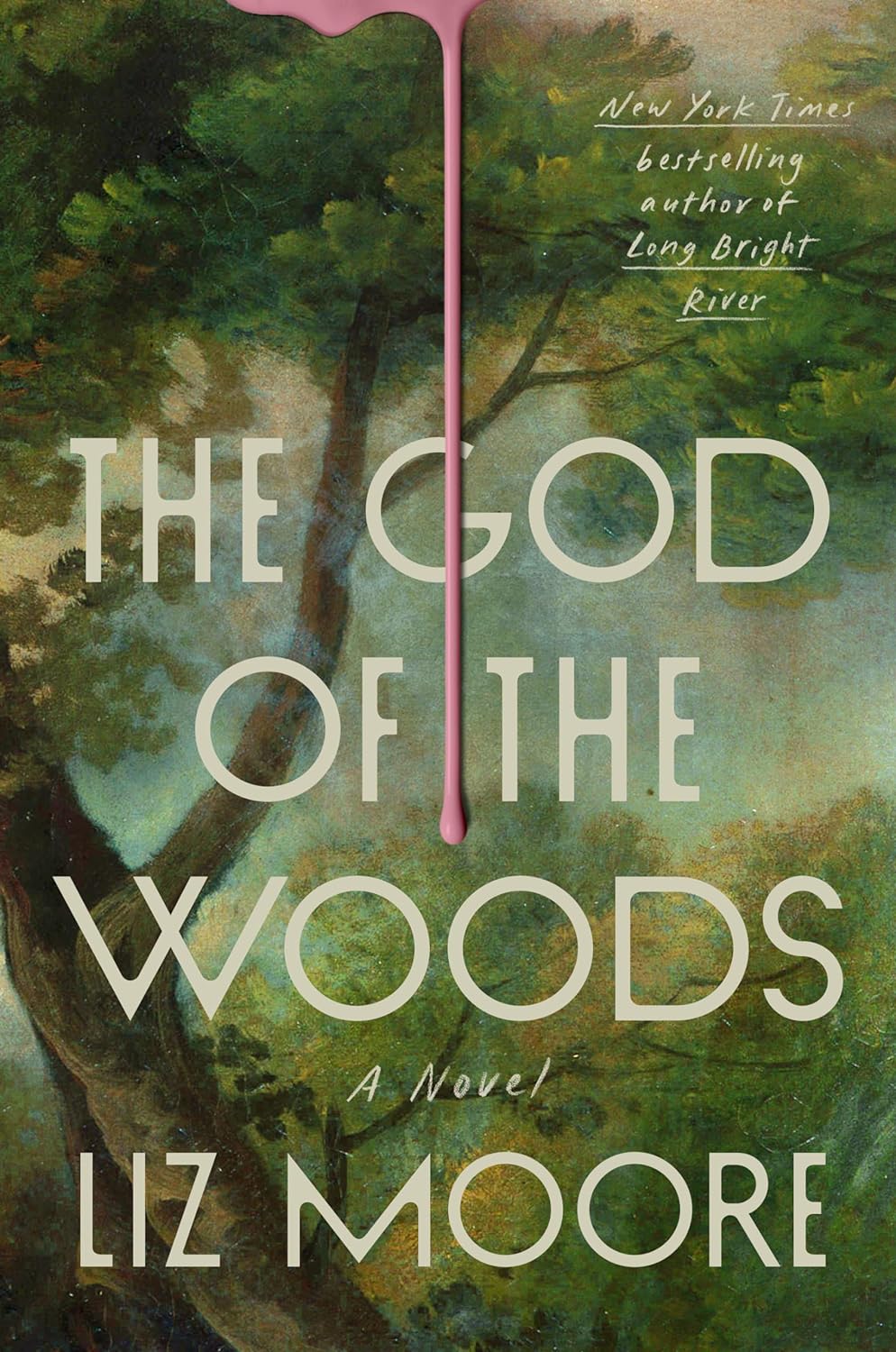
The God of the Woods: A Novel

Estimated reading time: 0 minutes, 52 seconds

I started reading “The God of the Woods: A Novel” by Liz Moore today. Several reviews recommended it as a great summer read. The story is set in August 1975, the same month and year my spouse Jan and I married. Liz Moore weaves a multi-threaded story, inviting readers into a rich and gripping dynasty of secrets and second chances.

The novel begins with a camp counselor discovering an empty bunk at an Adirondack summer camp belonging to thirteen-year-old Barbara Van Laar, who has mysteriously vanished. Barbara is not just any teenager; she is the daughter of the family that owns the camp and employs many residents. What makes this disappearance even more intriguing is that Barbara’s older brother went missing similarly fourteen years ago and was never found.

As the search for Barbara begins, the novel unfolds into a thrilling drama, delving into the deeply buried secrets of the Van Laar family and the blue-collar community working in its shadow. This novel is said to be Liz Moore’s most ambitious and wide-reaching work yet.

The Jan Lilien Education Fund!

The Field of Blood: Violence in Congress and the Road to Civil War

Read: March 2019

Get this book

The Field of Blood

by Joanne B. Freeman

The Field of Blood: Violence in Congress and the Road to Civil War by Joanne B. Freeman, Professor of History and American Studies at Yale University, is a must-read in our hyper-partisan times. The partisanship and divisiveness of the period before the Civil War have many parallels to our time, and the difference is the violence of the Civil War era. Professor Freeman recovers the long-lost story of physical violence on the floor of the U.S. Congress.

She can do this by first source materials from Benjamin Brown French. He was never elected to office but was an acquaintance of twelve consecutive presidents, from Andrew Jackson to Ulysses S. Grant. In addition, he maintained a diary for forty years that highlighted the violence and his and the nation’s political transformation.

During much of this period, he was the Clerk in the House.  His diary documents the violence that did not get covered by the press. Legislative sessions included mortal threats, canings, flipped desks, and all-out slugfests. When debate broke down, members of Congress drew pistols and waved Bowie knives. One representative even killed another in a duel. Many were beaten and bullied in an attempt to intimidate them into compliance, particularly on the issue of slavery.

The Field of Blood is one of four books I purchased after my first One Day University class.

Subscribe

Contact Us

×
The Essential Hamilton: Letters & Other Writings: A Library of America Special Publication

Read: February 2019

Get this book

The Essential Hamilton: Letters & Other Writings

by Edited by Joanne B. Freeman

The Essential Hamilton: Letters & Other Writings, edited by Joanne B. Freeman, Professor of History and American Studies at Yale University, is a must-read in our times when a constitutional crisis is the watchword of our day. Compared to reading all 27 volumes of Hamilton’s writings, this book provides the essential texts that offer a clear understanding of both the revolutionary era, the debates over the constitution, Hamilton’s impact as Secretary of the Treasury, and his downfall and eventual downfall death in Weehawken.

Professor Freeman’s introductions and chronology help place the writings into a historical context.

The Essential Hamilton is one of four books that I purchased after my first One Day University class.

Subscribe

Contact Us

×
Lila: A Novel

Read: April 2022

Get this book

Lila: A Novel

by Marilynne Robinson

Lila: A Novel by Marilynne Robinson is an unusual but believable love story. Although different than how I met Jan, this novel is about love and romance that, on the surface, should never have happened. Lila, homeless and alone after years of roaming the countryside, steps inside a small-town Iowa church – the only available shelter from the rain- ignites a romance and a debate that will reshape her life. She becomes the wife of a minister, John Ames, and begins a new existence while trying to make sense of the life that preceded her newfound security.

Lila is the third novel in the Gilead series. Previously I read Home, the second in the series, and Jack, the fourth. I highly recommend all three books.

Hopefully, one day I will read the Gilead and complete the series.

The Goodreads summary of the book provides an excellent overview.

Neglected as a toddler, Lila was rescued by Doll, a canny young drifter, and brought up by her in a hardscrabble childhood. Together they crafted a life on the run, living hand to mouth with nothing but their sisterly bond and a ragged blade to protect them. Despite bouts of petty violence and moments of desperation, their shared life was laced with moments of joy and love. When Lila arrives in Gilead, she struggles to reconcile the life of her makeshift family and their days of hardship with the gentle Christian worldview of her husband which paradoxically judges those she loves.

Revisiting the beloved characters and setting of Robinson’s Pulitzer Prize-winning Gilead and Home, a National Book Award finalist, Lila is a moving expression of the mysteries of existence that is destined to become an American classic.

Register to Attend Celebrate Jan Day

Subscribe

Contact Us

When you buy a book or product using a link on this page, I receive a commission. Thank you for supporting Sharing Jan’s Love blog.

×
The Vegetarian: A Novel

Read: October 2024

Get this book

The Vegetarian: A Novel

by Han Kang

Today, I started reading The Vegetarian: A Novel by Han Kang, Winner of the 2024 Nobel Prize in Literature. The novel also won The International Booker Prize and is one of The New York Times’s 100 Best Books of the 21st Century. Celebrated by critics worldwide, The Vegetarian is a darkly allegorical, Kafka-esque tale of power, obsession, and one woman’s struggle to break free from the violence both without and within her.

Before the nightmares began, Yeong-hye and her husband lived an ordinary, controlled life. But the dreams—invasive images of blood and brutality—torture her, driving Yeong-hye to purge her mind and renounce eating meat altogether. It’s a small act of independence, but it interrupts her marriage and sets into motion an increasingly grotesque chain of events at home.

As her husband, her brother-in-law, and her sister each fight to reassert their control, Yeong-hye obsessively defends the choice that’s become sacred to her. Soon, their attempts turn desperate, subjecting first her mind and then her body to ever more intrusive and perverse violations, sending Yeong-hye spiraling into a dangerous, bizarre estrangement, not only from those closest to her but also from herself.


Han Kang was born in 1970 in South Korea. She is the author of The Vegetarian, which I have read, and winner of the International Booker Prize,  Human ActsThe White BookGreek Lessons, and We Do Not Part. In 2024, she received the Nobel Prize in Literature.


When you purchase a book through one of my links, I earn a small commission that helps support my passion for reading. This contribution allows me to buy even more books to share with you, creating an incredible cycle of discovering great reads together! Your support truly makes a difference!


×
1944: FDR and the Year That Changed History

Read: October 2019

Get this book

1944: FDR and the Year That Changed History

by Jay Winik

1944: FDR and the Year That Changed History by Jay Winik is a book that I had put off reading several times. When I finally did read it, I could not remember why I had not read it sooner. Had I gone to graduate school and become a professor, it might have been the type of book I might write, and I certainly would have had on my list of books for my classes. 

As The NY Times wrote, “Jay Winik brings to life in gripping detail the year 1944, which determined the outcome of World War II and put more pressure than any other on an ailing yet determined President Roosevelt.” Reading a book about events five years before my birth that transformed the world I live in becomes an easy page-turner.

It was not inevitable that World War II would end as it did or that it would even end well. Nineteen forty-four was a year that could have stymied the Allies and cemented Hitler’s waning power. Instead it saved those democracies – but with a fateful cost. Now, in a superbly told story, Jay Winik, the acclaimed author of April 1865 and The Great Upheaval, captures the epic images and extraordinary history as never before.

1944 witnessed a series of titanic events: FDR at the pinnacle of his wartime leadership as well as his reelection, the planning of Operation Overlord with Churchill and Stalin, the unprecedented D-Day invasion, the liberation of Paris, and the horrific Battle of the Bulge, and the tumultuous conferences that finally shaped the coming peace. But on the way, millions of more lives were still at stake as President Roosevelt was exposed to mounting evidence of the most grotesque crime in history, the Final Solution. Just as the Allies were landing in Normandy, the Nazis were accelerating the killing of millions of European Jews.

Winik shows how escalating pressures fell on an all but dying Roosevelt, whose rapidly deteriorating health was a closely guarded secret. Here then, as with D-Day, was a momentous decision for the president. Was winning the war the best way to rescue the Jews? Was a rescue even possible? Or would it get in the way of defeating Hitler? In a year when even the most audacious undertakings were within the world’s reach, including the liberation of Europe, one challenge – saving Europe’s Jews – seemed to remain beyond Roosevelt’s grasp.

I recommend this book.

Subscribe

Contact Us

×
The Cemetery of Untold Stories

Read: April 2024

Get this book

The Cemetery of Untold Stories

by Julia Alvarez

Today, I began reading Julia Alvarez‘s novel “The Cemetery of Untold Stories.” The book explores whose stories deserve to be told and whose should remain buried. In the end, Alma, the main character, finds meaning in the power of storytelling. Julia Alvarez reminds us that our stories are never truly finished, even at the end.

Alma Cruz, a famous writer, doesn’t want to suffer the same fate as her friend, who became mentally unstable after struggling to finish a book. So, when Alma inherits a small plot of land in her native Dominican Republic, she turns it into a cemetery for her unfinished stories. She hopes her characters will finally be able to rest in peace.

However, they have other ideas and soon begin to rewrite and revise themselves, even talking and interacting with one another. Fortunately, Filomena, a local woman hired as the groundskeeper, becomes a listener to Alma’s characters’ secret tales. These tales include those of Bienvenida, the abandoned wife of dictator Rafael Trujillo, who was erased from official history, and Manuel Cruz, a doctor who fought in the Dominican underground and escaped to the United States.

×