
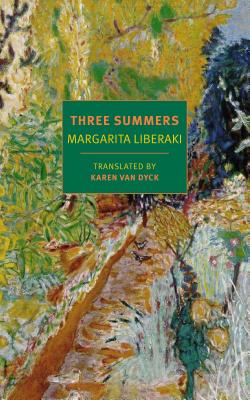
Three Summers: A Novel

Estimated reading time: 2 minutes, 5 seconds

Today, I began reading Margarita Liberaki‘s Three Summers, translated by Karen Van Dyck. This edition features a detailed introduction by Ms. Van Dyck, in which she shares her experiences meeting Ms. Liberaki and collaborating with her on the translation. The original novel, written in Greek, was titled The Straw Hats, but Ms. Van Dyck felt that this title would not resonate with foreign readers similarly.

Three Summers is the story of three sisters who grew up in the countryside near Athens before the outbreak of the Second World War. The sisters live in a large, old house surrounded by a beautiful garden. The oldest sister, Maria, is adventurous and eager to settle down and start her own family. The middle sister, Infanta, is gorgeous but emotionally distant. Katerina, the narrator, and the youngest sister is dreamy and rebellious.

Throughout three summers, the sisters share and keep secrets, fall in and out of love, and try to understand their parents and other adult figures. They also observe the peculiar behaviors of friends and neighbors while worrying about and discovering their identities. Karen Van Dyck’s translation beautifully captures the light and warmth of this modern Greek classic.

Margarita Liberaki (1919-2001) was born in Athens and raised by her grandparents, who owned the Fexis bookstore and publishing house. In addition to her novel Three Summers, she authored The Other Alexander (1950) and The Mystery (1976). She also wrote several plays, including Candaules’ Wife (1955) and The Danaïds (1956), part of a cycle she called Mythical Theater. Furthermore, she contributed screenplays, such as Jules Dassin’s Phaedra (1962) and Diaspora (1999), which focused on Greek intellectuals in exile in Paris during the junta. Her novel Three Summers is now a standard part of public education in Greece and Cyprus and was adapted into a television miniseries in 1995.

Karen Van Dyck is the Kimon A. Doukas Professor of Modern Greek Literature at Columbia University. Her research focuses on modern Greek literature, diaspora literature, gender studies, and translation. She has edited or co-edited several poetry anthologies, including A Century of Greek Poetry (2004), The Greek Poets: Homer to the Present (2010), and Austerity Measures: The New Greek Poetry (2017) for NYRB Poets. Additionally, her translations have appeared in Brooklyn Rail, Asymptote, and The Baffler.


When you purchase a book through one of my links, I earn a small commission that helps support my passion for reading. This contribution allows me to buy even more books to share with you, creating an incredible cycle of discovering great reads together! Your support truly makes a difference!


The Jan Lilien Education Fund!

10/7: 100 Human Stories

Read: September 2025

Get this book

10/7: 100 Human Stories

by Lee Yaron

The speaker at the Selichot Service with VAAD at Congregation Beth Israel on September 13, 2025, will be Lee Yaron, the author of 10/7: 100 Human Stories. Yaron is the recipient of the National Jewish Book Awards’ 2024 Jewish Book of the Year and The Natan Fund’s Winter 2025 Notable Book Award. This book provides a definitive account of the 10/7 attacks, sharing the stories of the victims and the communities they called home.

On October 7, 2023—the Sabbath and the final day of the holiday of Sukkot—the Gaza-based terror group Hamas launched an unprecedented assault on the people of Israel. Crashing through the border, attacking from the sea and air, militants indiscriminately massacred civilians in what became one of the worst terror attacks in modern history, and the most lethal day for the Jewish people since the Holocaust.

A radically passionate work of investigative journalism and political critique by acclaimed Haaretz reporter Lee Yaron, 10/7 chronicles the massacre that ignited a war through the stories of more than 100 civilians. These stories are the result of extensive interviews with survivors, bereaved individuals, and first responders in Israel and around the world. The victims run the gamut from left-wing kibbutzniks and Burning Man-esque partiers to radical right-wingers, from Bedouins and Israeli Arabs to Thai and Nepalese guest workers, peace activists, elderly Holocaust survivors, refugees from Ukraine and Russia, pregnant women, and babies.

At a time when people are seeking a deeper understanding of the history of the Israeli-Palestinian conflict and how internal political turmoil in Israel has affected it, they predominantly encounter perspectives from the powerful—from politicians and military officers. 10/7 takes a fresh approach, offering answers through the stories of everyday people, those who lived tenuously on the border with Gaza.

Yaron profiles victims from a wide range of communities—depicting the fullness of their lives, not just their final moments—to honor their memories and reveal the way the attack ripped open Israeli society and put the entire Middle East on the precipice of disaster. Each chapter begins with a portrait of a community, interweaving history with broader political analysis of the Israeli-Palestinian conflict to provide context for the narratives that follow. Ultimately, 10/7 shows that the tragedy is much greater than the violence of the attacks, and in fact extends back through the entire Netanyahu era, which propagated a false image of Israel as a technologically advanced, militarily formidable powerhouse so essential to the region that it could continue to ignore and undermine Palestinian statehood indefinitely.


Lee Yaron has been a journalist with Haaretz, Israel’s oldest and most award-winning newspaper, for nearly a decade. Her investigative reporting has led to the establishment of state-level commissions and the revision of substantial bodies of Israeli policy and law. She is an elected member and representative of the Executive Committee of the Union of Israeli Journalists. She has also written and directed acclaimed theater productions notable for their use of found materials, including official governmental texts, to bring attention to marginalized communities both in Israel and throughout the Middle East. Born in Tel Aviv, Yaron splits her time between her native city and New York.

Joshua Cohen is the author of ten books, including the novels Book of Numbers, Moving Kings, and Witz. Called “a major American writer” by the New York Times and “an extraordinary prose stylist, surely one of the most prodigious at work in American fiction today” by the New Yorker, Cohen was awarded Israel’s 2013 Matanel Prize, and in 2017 was named one of Granta’s Best Young American Novelists. His book, The Netanyahus, won the 2021 National Jewish Book Award for Fiction and the 2022 Pulitzer Prize for Fiction.


Discover your next favorite book and dive into a world of curated, exciting reads by purchasing through my links. You’ll have access to a diverse selection of books that I’ve personally vetted to ensure quality and enjoyment. Additionally, by supporting these selections, you’ll help me continue to provide you with more personalized recommendations. I earn a small commission from your purchase, which allows me to buy and share even more books with you. Your support truly makes a difference!

×
Sing, Unburied, Sing

Read: October 2024

Get this book

Sing, Unburied, Sing

by Jesmyn Ward

I started reading Jesmyn Ward‘s novel Sing, Unburied, Sing today. The New York Times selected it as one of the best books of the 21st century and awarded it the National Book Award. According to The New York Times, Jesmyn Ward‘s historic second National Book Award winner is “perfectly poised for the moment.” It’s an intimate portrait of three generations of a family and an epic tale of hope and struggle.

Jojo is thirteen years old and is trying to understand what it means to be a man. He has several father figures to learn from, including his Black grandfather, Pop. However, Jojo’s understanding is complicated by other men in his life: his absent White father, Michael, who is being released from prison; his absent White grandfather, Big Joseph, who refuses to acknowledge him; and the memories of his deceased uncle, Given, who died as a teenager.

His mother, Leonie, is inconsistent in her and her toddler daughter’s lives. She is a flawed mother in constant conflict with herself and those around her. She is Black, and her children’s father is White. She wants to be a better mother but struggles to prioritize her children over her own needs, particularly her drug use. Tormented and comforted by visions of her deceased brother, which only come to her when she’s high, Leonie is embattled in ways that reflect the harsh reality of her circumstances.

When their father is released from prison, Leonie takes her kids and a friend in her car and drives north to Mississippi and Parchman Farm, the State Penitentiary. At Parchman, there is another thirteen-year-old boy, the ghost of a deceased inmate who carries the ugly history of the South with him in his wanderings. With his supernatural presence, this ghostly figure also has something to teach Jojo about fathers and sons, legacies, violence, and love.

Described as a majestic and unforgettable family story, ‘Sing, Unburied, Sing‘ is rich with Ward‘s distinctive, lyrical language. As noted by The Philadelphia Inquirer, her unique narrative style takes readers on ‘an odyssey through rural Mississippi’s past and present.’

×
An Assassin in Utopia: The True Story of a Nineteenth-Century Sex Cult and a President's Murder

Read: February 2023

Get this book

An Assassin in Utopia

by Susan Wels

An Assassin in Utopia: The True Story of a Nineteenth-Century Sex Cult and a President’s Murder by Susan Wels is a true crime odyssey that explores a forgotten, astonishing chapter of American history, leading the reader from a free-love community in upstate New York to the shocking assassination of President James Garfield. I had read about this historical period in several other books, most recently Civil War by Other Means.

Susan Wels has written an excellent historical overview of a period we often overlook. I highly recommend An Assassin in Utopia: The True Story of a Nineteenth-Century Sex Cult and a President’s Murder.

The Oneida Community, even though it was the most successful utopian community, is often overlooked. Ms. Wels connects the dots and places the experiment in the center of a transitional period. It is not merely the connection between Charles Julius Guitea and his assassination of President James Garfield, albeit a brutal crime, that shook America to its core, but all of the other linkages. These include “John Humphrey Noyes; his idol, the eccentric newspaper publisher Horace Greeley (founder of the New Yorker and the New York Tribune).”

She also resurrects the importance of the Wormely Compromise and the African-American family that was an instrumental part of public society.

I have found fiction to be something I enjoy, but I knew it was time for a non-fiction book to balance my reading. The New York Times and other publications highly rated An Assassin in Utopia.

The Goodreads summary provides an overview,

It was heaven on earth—and, some whispered, the devil’s garden.

Thousands came by trains and carriages to see this new Eden, carved from hundreds of acres of wild woodland. They marveled at orchards bursting with fruit, thick herds of Ayrshire cattle and Cotswold sheep, and whizzing mills. They gaped at the people who lived in this place—especially the women, with their queer cropped hair and shamelessly short skirts. The men and women of this strange outpost worked and slept together—without sin, they claimed.

From 1848 to 1881, a small utopian colony in upstate New York—the Oneida Community—was known for its shocking sexual practices, from open marriage and free love to the sexual training of young boys by older women. And in 1881, a one-time member of the Oneida Community—Charles Julius Guiteau—assassinated President James Garfield in a brutal crime that shook America to its core.

An Assassin in Utopia is the first book that weaves together these explosive stories in a tale of utopian experiments, political machinations, and murder. This deeply researched narrative—by bestselling author Susan Wels—tells the true, interlocking stories of the Oneida Community and its radical founder, John Humphrey Noyes; his idol, the eccentric newspaper publisher Horace Greeley (founder of the New Yorker and the New York Tribune); and the gloomy, indecisive President James Garfield—who was assassinated after his first six months in office.

Juxtaposed to their stories is the odd tale of Garfield’s assassin, the demented Charles Julius Guiteau, who was connected to all of them in extraordinary, surprising ways.

Against a vivid backdrop of ambition, hucksterism, epidemics, and spectacle, the book’s interwoven stories fuse together in the climactic murder of President Garfield in 1881—at the same time as the Oneida Community collapsed.

Colorful and compelling, An Assassin in Utopia is a page-turning odyssey through America’s nineteenth-century cultural and political landscape.


The Jan Lilien Education Fund sponsors ongoing sustainability and environmental awareness programs. Gifts made this month; I will match dollar-for-dollar. All donations are tax-deductible.

Subscribe

Contact Us

I receive a commission when you buy a book or product using a link on this page. Thank you for supporting Sharing Jan’s Love blog.


×
Breathe

Read: September 2021

Get this book

Breathe

by Joyce Carol Oates

Celebrate JanReading Breathe by Joyce Carol Oates was a book I knew I needed to read once Jan was diagnosed. Although the book might trigger negative memories, I finally read Breathe. It was what I needed to read at this point in my journey.

Ms. Oates wrote the book in 2019 after her husband, Charlie Gross, died. The novel is a story of love, loss, and loneliness, topics that I write about on this blog. I needed to read the book both for my mental health and for the readers of Sharing Jan’s Love.

The protagonist, Michaela, loses her husband while they are on a sabbatical in New Mexico. Her husband, Gerard, writes a book and teaches a class on memories. Jan and I never considered relocating before her illness, but this book convinced me that it would have aggravated my grief journey.

One of the parallels I observed while reading the novel is the similarity between Gerard’s reluctance to let family, friends, and co-workers know of his illness. Jan shared that reluctance in the early days, but I convinced her that the only chance of beating cancer was with the help of family and friends.

This dialogue could easily be one that Jan and I had.

Of course you want to summon his family—his (adult) children—but quickly, he says no.

Still waiting.

But – When?

Just not yet.

He is not an alarmist. (You are the alarmist.)

The novel is written in two parts – The Vigil and the Post-Mortem.

The opening paragraphs set the tone.

A Hand is gripping yours. Warm, dry hand gripping your slippery, humid hand.

Whoever it is urging you – Breathe!

Leaning over you begging you – Breathe!

As one mourning the death of the love of his life, I found several phrases in the book helpful in understanding what I have gone through and will continue to confront.

Among them is grief-vise, which I have written about in this stream.

In the grip of the grief vise, all that you will do, all that you even imagine doing, will require many times more effort.. Hardly daring to breathe for the grief-vise will tighten around your chest, squeezing the very air out of your lungs.

In the early stages of grief, the vise was strangling me. Breathing was impossible, and weeping was constant at times.

Michaela struggles with her grief. Seeing her husband every time she sees a man alone, even if they are older or younger than he was. I know I have felt Jan’s presence and still expect her to walk into our apartment.

Her struggles with a grief counselor and overly helpful friends are an experience I have not had but are familiar to those suffering from losing a loved one.

The last chapters are ones in which time becomes confusing and chaotic. At times, I was uncertain about which were real or imagined. The end, like all good novels, was ambiguous.

These are some of the other phrases I have found useful and will include in posts.

  • If there is no one to love, do we merit existence?
  • Never come to the end of kissing.
  • The first principle of life is; Breathe.
  • Shy in the language of intimacy.
  • As if a life lived with strangers could compensate for the emptiness in your heart.
  • No purpose in your life. No compass.

What you love most, that you will lose. The price of your love is your loss.

I recommend this book to all readers, even those struggling with grief.

Subscribe

Contact Us

When you buy a book or product using a link on this page, I receive a commission. Thank you for supporting Sharing Jan’s Love blog.

×
Let Us Descend: A Novel

Read: November 2023

Get this book

Let Us Descend: A Novel

by Jesmyn Ward

Today, I started reading Let Us Descend: A Novel by Jesmyn Ward. She is a two-time National Book Award winner, the youngest winner of the Library of Congress Prize for American Fiction, and a MacArthur Fellow. The book is a haunting masterpiece that is sure to become an instant classic. It tells the story of an enslaved girl in the years before the Civil War.

The book’s title is from Dante Alighieri’s Inferno: “‘Let us descend,’ the poet now began, ‘and enter this blind world.” Let Us Descend is a reimagining of American slavery, beautifully rendered yet heart-wrenching. The novel takes us on a journey from the rice fields of the Carolinas to the slave markets of New Orleans and into the fearsome heart of a Louisiana sugar plantation.

Annis is the reader’s guide through this hellscape, sold south by the white enslaver who fathered her. As Annis struggles through the miles-long march, she turns inward, seeking comfort from memories of her mother and stories of her African warrior grandmother. Throughout the journey, she opens herself to a world beyond this world, one teeming with spirits: of earth and water, of myth and history, spirits who nurture and give, and those who manipulate and take. While Ward leads readers through the descent, this, her fourth novel, is ultimately a story of rebirth and reclamation.

Let Us Descend is a magnificent novel that inscribes Black American grief and joy in the very land of the American South. Ward’s writing takes you through the rich but unforgiving forests, swamps, and rivers of the South, making this novel a masterwork for the ages.


The Jan Lilien Education Fund sponsors ongoing sustainability and environmental awareness programs. Gifts made this month; I will match dollar-for-dollar. All donations are tax-deductible.

Subscribe

Contact Us

I receive a commission when you buy a book or product using a link on this page. Thank you for supporting Sharing Jan’s Love blog.


×
Light to the Hills

Read: January 2023

Get this book

Light to the Hills: A Novel

by Bonnie Blaylock

Light to the Hills: A Novel by Bonnie Blaylock is about Amanda Rye, a young widowed mother and traveling packhorse librarian who comes through a mountain community struck by the nation’s economic collapse in the 1930s. I recommend this page-turner as it highlights the importance of family and community. From this foundation, truth lights a path toward survival, mountain justice, forgiveness, and hope.

The novel was recommended by Olivia Hawker, bestselling author of The Fire and the Ore, who said, “Light to the Hills is a touching meditation on motherhood and the importance of community, especially during difficult times.”

Last year I read a modern tale about Appalachia, Demon Copperhead. Both are good novels but very different.

Light to the Hills was a feel-good read despite the problems faced by Ms. Rye and the MacInteer family. It was precisely the book I needed to read this week.

The Goodreads summary provides an overview,

The folks in the Kentucky Appalachians are scraping by. Coal mining and hardscrabble know-how are a way of life for these isolated people. But when Amanda Rye, a young widowed mother and traveling packhorse librarian, comes through a mountain community walloped by the nation’s economic collapse, she brings with her hope, courage, and apple pie. Along the way, Amanda takes a shine to the MacInteer family, especially to the gentle Rai, her quick-study daughter, Sass, and Finn, the eldest son who’s easy to warm to. They remind Amanda of her childhood and her parents with whom she longs to be reconciled.

Her connection with the MacInteers deepens, and Amanda shares with them a dangerous secret from her past. When that secret catches up with Amanda in the present, she, Rai, Sass, and Finn find their lives intersecting—and threatened—in the most unexpected ways. Now, they must come together as the truth lights a path toward survival, mountain justice, forgiveness, and hope.


The Jan Lilien Education Fund sponsors ongoing sustainability and environmental awareness programs. Gifts made this month; I will match dollar-for-dollar. All donations are tax-deductible.

Subscribe

Contact Us

I receive a commission when you buy a book or product using a link on this page. Thank you for supporting Sharing Jan’s Love blog.


×