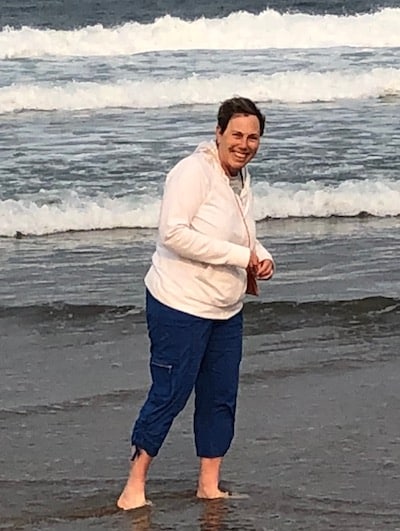

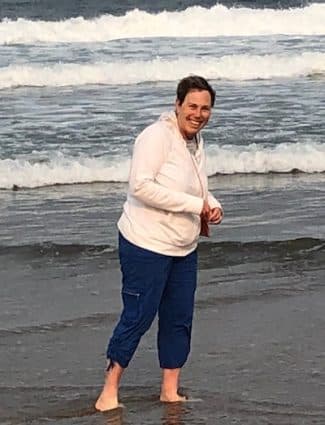
Jan at the Beach

Crushed Ice for Jan

Estimated reading time: 0 minutes, 46 seconds

My landlord installed a new refrigerator and stove. Now I can make ice as well as drink cold water directly. Walking downstairs, I am still determining if I am in the correct apartment. The ice maker would have been beneficial when Jan was treated for lymphoma. I will be in a new apartment next to my current one by May. I will miss the interior stairs. However, knowing how difficult it was for Jan to maneuver them last year, it is the best option.

Moving will not be easy, but Jan will be with me wherever I live. One day at a time, I will learn from grief how to live alone.

Subscribe

Contact Us

When you buy a book or product using a link on this page, I receive a commission. Thank you for supporting Sharing Jan’s Love blog.

Show thread (1)

Jan at the Beach

Banana Bread

Estimated reading time: 0 minutes, 46 seconds

One of the unanticipated pleasures of getting a new refrigerator is discovering hidden jewels buried deep in the freezer.

Almost lost was a loaf of banana bread, not just any banana bread but the last one that Jan and I baked together.

We baked this loaf only a month after we knew she had Lymphoma. It brought back memories of when we were first married and living in a railroad apartment on the fourth floor on Lorimer Street in Williamsburg.

We had a tattered paperback copy of The Tassajara Bread Book. Being unemployed but very much in love, we fancied ourselves as bakers who could sell bread to buy food and flour. RAJA failed, but our love lasted forever.

I hunger for a slice of the bread, knowing it tastes as sweet as Jan’s kisses. But I leave it frozen so that Mike and Jon will find it when they clean out the apartment one day. A small gift from RAJA.

4 comments add your comment

Share your thoughts and ideas

This site uses Akismet to reduce spam. Learn how your comment data is processed.

The Jan Lilien Education Fund!

Jan at the Beach
×
Jan at the Beach
×
The Witch: A Novel

Read: April 2026

Get this book

The Witch: A Novel

by Marie Ndiaye

The Witch” by Marie Ndiaye, the recipient of the Gold Medal in the Arts from the Kennedy Center International Committee on the Arts, is shortlisted for the International Booker Prize. In a small, sleepy town, a mediocre witch in a lackluster marriage attempts to pass on her gifts to her twin daughters, who quickly prove to possess abilities far greater than her own.

Lucie comes from a long line of witches, with powers passed down from mother to daughter. Many of them have hidden or repressed their gifts to appease disgusted or fearful men. But against the wishes of her controlling husband, Lucie initiates her twins into their family’s peculiar womanhood when they reach the age of twelve. In a few short months, Maud and Lise are crying rich crimson tears, their powers quickly becoming more potent than their mother’s, opening them to liberation and euphoria beyond what Lucie and her foremothers ever considered.

Equal parts dreamlike and disquieting, The Witch tells a tale as old as time, with a dark twist: Without looking back, children fly the nest, laying bare the tenuous threads of family that have long threatened to snap. With simmering tension and increasing panic, NDiaye’s latest novel in English captures the terror and precarity of motherhood and marriage, and the uncertainty of slowly realizing that your progeny are more dangerous—to the world and to your heart—and freer than you ever could have dreamed.


Marie Ndiaye was born in Pithiviers, France. She is the author of Rosie Carpe, winner of the Prix Femina, and of Three Strong Women, winner of the Prix Goncourt. Her recent novel, Vengeance is Mine, was a finalist for the National Book Critics Circle Award for Fiction. She is also the recipient of the Kennedy Center International Committee on the Arts Gold Medal. She lives in Paris.

Translated by Jordan Stump.


Discover your next favorite book and dive into a world of curated, exciting reads by purchasing through my links. You’ll have access to a diverse selection of books I’ve personally vetted for quality and enjoyment. Supporting these selections not only helps me continue to provide you with personalized recommendations but also ensures you have access to meaningful stories that enrich your life. Your support truly makes a difference in helping me share more books and insights with you!


×
The White Hot

Read: November 2025

Get this book

The White Hot: A Novel

by Quiara Alegría Hudes

The White Hot” by Quiara Alegría Hudes is a letter from a mother to her daughter, reflecting on a moment of abandonment that stretches from ten days to ten years. It offers an explanation rather than an apology. Hudes tells April’s story—spiritual and sensual, fierce and humorous—using delicate lyricism and tough love. Through this narrative, Hudes transforms April’s struggle for self-discovery into an unforgettable short epic.

April is a young mother raising her daughter in a multigenerational home filled with unspoken secrets and loud arguments. Her only refuge is the locked bathroom, where she plugs her ears into an ambient soundscape and repeats a mantra: “dead inside.” This continues until one day, as she feels herself spiraling toward the volcanic rage she calls “the white hot,” an inner voice tells her to simply walk away.

She goes to a bus station and asks for a one-way ticket to the furthest destination. This ticket takes her from her Philadelphia home to the threshold of a wilderness, marking the start of a nameless quest—an accidental journey that awakens her, nearly kills her, and leads her to an impossible choice.

As April discovers the key to freeing herself and her family from a cycle of generational trauma through her painful and absurd journey,


Quiara Alegría Hudes is a Pulitzer Prize-winning playwright known for her plays “Water by the Spoonful” and “In the Heights,” the latter of which won the Tony Award for Best Musical. She also adapted this musical for the screen.

Her memoir, “My Broken Language,” was longlisted for the Andrew Carnegie Medal. Hudes has written essays published in prominent outlets, including The New York Times, The Washington Post, The Cut, The Nation, and American Theater Magazine. Additionally, she co-founded the prison writing program Emancipated Stories with her cousin Sean.


Discover your next favorite book and dive into a world of curated, exciting reads by purchasing through my links. You’ll have access to a diverse selection of books that I’ve personally vetted to ensure quality and enjoyment. Additionally, by supporting these selections, you’ll help me continue to provide you with more personalized recommendations. I earn a small commission from your purchase, which allows me to buy and share even more books with you. Your support truly makes a difference!


×
Kairos

Read: June 2023

Get this book

Kairos by Jenny Erpenbeck

by Jenny Erpenbeck

I’ve recently delved into the captivating novel Kairos by Jenny Erpenbeck, which has left a lasting impression on me. The book tells the story of a young woman named Katharina who falls in love with a married writer named Hans, whom she met in East Berlin during the late 1980s. The historical context of Germany’s reunification is already an intriguing topic, but the addition of a love story made this book a must-read.

As their intense and complicated relationship plays out against the backdrop of a declining GDR, the novel offers a unique perspective on the tumultuous period following the country’s dissolution in 1989. Erpenbeck’s writing style is unmistakable, and her sweeping portrayal of the two lovers’ journey is truly remarkable. We witness Katharina’s growth as she tries to reconcile the reality of her lousy romance with the disappearance of an entire world and its ideologies.

The Times Literary Supplement has praised Erpenbeck’s ability to capture the weight of history and the influence of cultural and subjective memory on individual identity. Her work acknowledges the complexity of the human experience and the nuances of historical events.

Jenny Erpenbeck is an epic storyteller and a highly respected voice in contemporary German literature. Her translator, Michael Hofmann, has described Kairos as a great post-Unification novel, and his translation has been praised for being both faithful to the original text and beautifully written. I highly recommend this book to anyone seeking a thought-provoking and engaging read.


The Jan Lilien Education Fund sponsors ongoing sustainability and environmental awareness programs. Gifts made this month; I will match dollar-for-dollar. All donations are tax-deductible.

Subscribe

Contact Us

I receive a commission when you buy a book or product using a link on this page. Thank you for supporting Sharing Jan’s Love blog.


×
Atonement: A Novel

Read: August 2024

Get this book

Atonement: A Novel

by Ian McEwan

Today, I started reading “Atonement: A Novel” by Ian McEwan, an acclaimed Booker Prize-winning author. This symphonic novel explores complex themes, including love and war, childhood and class, guilt and forgiveness. It has been recognized as one of the New York Times’s 100 Best Books of the 21st Century, making it a must-read for those interested in these profound themes.

The story begins on a scorching summer day in 1935, when thirteen-year-old Briony Tallis witnesses a moment of flirtation between her older sister, Cecilia, and Robbie Turner, the son of a servant and Cecilia’s childhood friend. Briony’s incomplete understanding of adult motives and her literary gifts lead to a crime that significantly impacts their lives, taking them on an emotional journey of love, guilt, and forgiveness.

The narrative tracks the repercussions of this crime through the chaos and carnage of World War II, a vivid historical backdrop that immerses the reader into the twentieth century’s close. “Atonement” has been acclaimed for engaging readers on multiple levels, marking it a genuine masterpiece from the Booker Prize-winning, internationally bestselling author Ian McEwan.


Ian McEwan is a critically acclaimed author known for his nineteen novels and two short story collections. His first published work, a collection of short stories titled “First Love, Last Rites,” won the Somerset Maugham Award.

His notable novels include “The Child in Time,” which won the Whitbread Novel of the Year Award in 1987; “The Cement Garden“; “Enduring Love;” “Amsterdam;” which won the Booker Prize in 1998; “Atonement;” “Saturday;” “On Chesil Beach;” “Solar;” “Sweet Tooth;” “The Children Act;” “Nutshell;” and “Machines Like Me,” which became a number-one bestseller.

Several of his works, including “Atonement,” “Enduring Love,” “The Children Act;,” and “On Chesil Beach,” have been adapted into films.


Discover your next favorite book and dive into a world of curated, exciting reads by purchasing through my links. You’ll have access to a diverse selection of books that I’ve personally vetted to ensure quality and enjoyment. Additionally, by supporting these selections, you’ll help me continue to provide you with more personalized recommendations. I earn a small commission from your purchase, which allows me to buy and share even more books with you. Your support truly makes a difference!


×
How Democracies Die

Read: January 2021

Get this book

How Democracies Die: What History Reveals About Our Future

by Steven Levitsky and Daniel Ziblatt

How Democracies Die: What History Reveals About Our Future by Steven Levitsky and Daniel Ziblatt was on my reading list for almost a year. In late December of last year, I started reading it and was in the final chapter on January 6, 2021. Like many of us, I never in my life expected to see a day like that in our country.

This type of event is one the authors talk about in their book.

According to the overview in GoodReads,

Donald Trump’s presidency has raised a question that many of us never thought we’d be asking: Is our democracy in danger? Harvard professors Steven Levitsky and Daniel Ziblatt have spent more than twenty years studying the breakdown of democracies in Europe and Latin America, and they believe the answer is yes. Democracy no longer ends with a bang–in a revolution or military coup–but with a whimper: the slow, steady weakening of critical institutions, such as the judiciary and the press, and the gradual erosion of long-standing political norms. The good news is that there are several exit ramps on the road to authoritarianism. The bad news is that, by electing Trump, we have already passed the first one.

Drawing on decades of research and a wide range of historical and global examples, from 1930s Europe to contemporary Hungary, Turkey, and Venezuela, to the American South during Jim Crow, Levitsky and Ziblatt show how democracies die–and how ours can be saved.

Our democracy is too valuable for us to have it die. We all need to work to preserve and strengthen it. How Democracies Die is a book that everyone needs to read!

Subscribe

Contact Us

×
Breathe

Read: September 2021

Get this book

Breathe

by Joyce Carol Oates

Celebrate JanReading Breathe by Joyce Carol Oates was a book I knew I needed to read once Jan was diagnosed. Although the book might trigger negative memories, I finally read Breathe. It was what I needed to read at this point in my journey.

Ms. Oates wrote the book in 2019 after her husband, Charlie Gross, died. The novel is a story of love, loss, and loneliness, topics that I write about on this blog. I needed to read the book both for my mental health and for the readers of Sharing Jan’s Love.

The protagonist, Michaela, loses her husband while they are on a sabbatical in New Mexico. Her husband, Gerard, writes a book and teaches a class on memories. Jan and I never considered relocating before her illness, but this book convinced me that it would have aggravated my grief journey.

One of the parallels I observed while reading the novel is the similarity between Gerard’s reluctance to let family, friends, and co-workers know of his illness. Jan shared that reluctance in the early days, but I convinced her that the only chance of beating cancer was with the help of family and friends.

This dialogue could easily be one that Jan and I had.

Of course you want to summon his family—his (adult) children—but quickly, he says no.

Still waiting.

But – When?

Just not yet.

He is not an alarmist. (You are the alarmist.)

The novel is written in two parts – The Vigil and the Post-Mortem.

The opening paragraphs set the tone.

A Hand is gripping yours. Warm, dry hand gripping your slippery, humid hand.

Whoever it is urging you – Breathe!

Leaning over you begging you – Breathe!

As one mourning the death of the love of his life, I found several phrases in the book helpful in understanding what I have gone through and will continue to confront.

Among them is grief-vise, which I have written about in this stream.

In the grip of the grief vise, all that you will do, all that you even imagine doing, will require many times more effort.. Hardly daring to breathe for the grief-vise will tighten around your chest, squeezing the very air out of your lungs.

In the early stages of grief, the vise was strangling me. Breathing was impossible, and weeping was constant at times.

Michaela struggles with her grief. Seeing her husband every time she sees a man alone, even if they are older or younger than he was. I know I have felt Jan’s presence and still expect her to walk into our apartment.

Her struggles with a grief counselor and overly helpful friends are an experience I have not had but are familiar to those suffering from losing a loved one.

The last chapters are ones in which time becomes confusing and chaotic. At times, I was uncertain about which were real or imagined. The end, like all good novels, was ambiguous.

These are some of the other phrases I have found useful and will include in posts.

  • If there is no one to love, do we merit existence?
  • Never come to the end of kissing.
  • The first principle of life is; Breathe.
  • Shy in the language of intimacy.
  • As if a life lived with strangers could compensate for the emptiness in your heart.
  • No purpose in your life. No compass.

What you love most, that you will lose. The price of your love is your loss.

I recommend this book to all readers, even those struggling with grief.

Subscribe

Contact Us

When you buy a book or product using a link on this page, I receive a commission. Thank you for supporting Sharing Jan’s Love blog.

×