
Thriving By Changing

Thriving By Changing

Evolving One Day at a Time to Be a Better Person

Estimated reading time: 3 minutes, 6 seconds

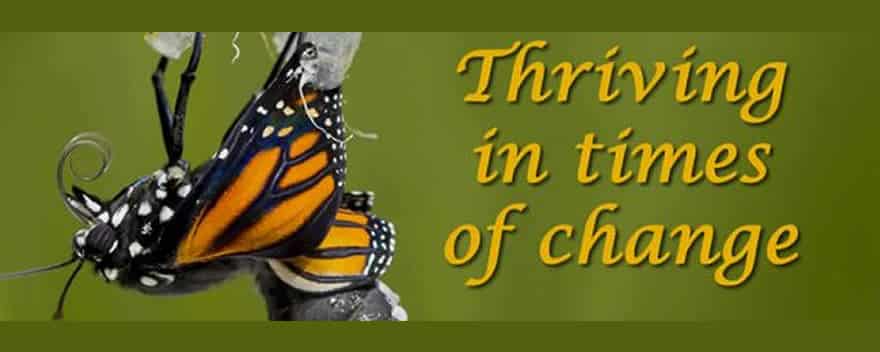
“A self that continues to evolve continues to thrive,” Virginia Woolf stated. This quote has been a guiding principle in my journey of personal growth. The ability to change is crucial, and it involves the uncomfortable but essential act of changing one’s mind – refusing to become fixed in one’s ways, being brave enough to evolve one’s perspectives, and continuously reassessing one’s priorities. Change, whether in your thoughts or your life, is also challenging because it involves letting go of something—a way of thinking, a way of living—to make room for something new to grow along the path of a fully experienced life, ultimately leading to a complete version of oneself.

I read an article by Maria Popova in The Marginalian titled ‘Middle Age and the Art of Self-Renewal: An Extraordinary Letter from Pioneering Education Reformer Elizabeth Peabody.’ This article sparked a profound reflection on how different my life is now compared to three or even twenty years ago. Until half a decade ago, I focused on nurturing my relationship with my wife and our goal of improving the world. Like most long-married couples, we had fallen into certain routines where specific responsibilities belonged to each of us. My wife enjoyed gardening and caring for the houseplants, and while I helped as much as possible, I knew that was her area of expertise.

As my wife’s primary caregiver, our once solid foundation began to crumble. I shouldered all responsibilities, a stark contrast to our previous dynamic. After following her instructions to prepare dinner one evening, I cleared the table and washed the dishes. She questioned if I thought she was inadequate because she used to leave the dishes until late at night. As I loaded the last dish into the dishwasher, I glanced at the loveseat where I had helped her lie down. I reassured her, explaining that I wanted to spend more time with her. As I kissed her, I realized how disorienting her new role as an observer must be, no longer an active participant in her life.
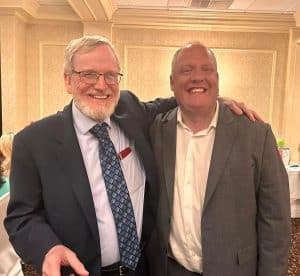
Steve ClaytonOver the past three years, I’ve adapted and thrived in my new roles. While my culinary expertise could improve, I prepare three meals daily, ensuring that dinner is always hot. Surprisingly, despite my lack of gardening skills, my house plants are flourishing. Additionally, I’ve expanded my circle of friends and actively participate in neighborhood activities such as Bridges and Hanson Park.

I’ve undergone a transformative journey, evolving into a more capable version of myself. I’ve learned to navigate life’s challenges with confidence. For instance, I could easily let the dishes pile up in the sink for days, but I’ve developed a habit of cleaning up right after each meal. Despite my lack of gardening skills, my houseplants are thriving under my care. I’ve even started to develop a green thumb. Yet, despite all this growth, I can’t shake the feeling that something is missing. I examine myself and see my whole physical form, but I sense I need something different, even without fully understanding it.
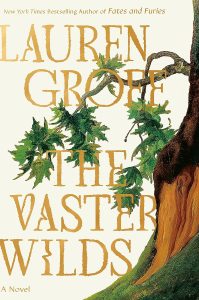
The Vaster Wilds: A NovelI enjoy the little things that bring me joy throughout my daily routine. But sometimes, I feel a deep, profound longing for companionship, as reminded by a quote from “The Vaster Wilds: A Novel” by Lauren Groff – “To be alone and surviving is not the same as being alive.” Although loneliness can sometimes be overwhelming, I remind myself that I am the only one who can create happiness for me. Despite finding renewed purpose and fulfillment in my activities, I cannot help but yearn for the warmth and tenderness of a partner’s love. To experience love once again would be a blessing, allowing me to feel truly alive in a way that nothing else can.
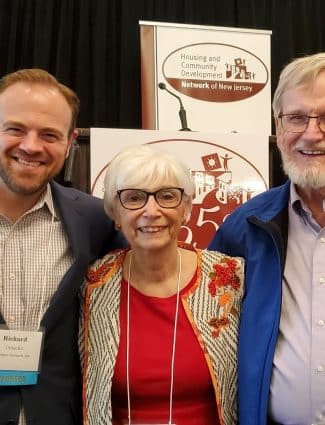
My Apolytus Moment

Despite the deep and abiding pain of missing my beloved wife daily, I have come to understand that it is essential that I continue living and finding joy in the present moment.

Show thread (1)

Meliorism: Small Steps Change the World!

Evolving One Day at a Time to Be a Better Person

Estimated reading time: 3 minutes, 6 seconds
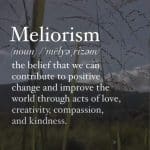
Meliorism: Small Steps Change the World!

As a meliorist, I believe in our ability to contribute to positive change and improve the world through acts of love, creativity, compassion, and kindness. We thrive and achieve more when we unite to support one another. Jan's Memorial Garden has brought immense value to the Cranford community, inspiring the Hanson Park Conservancy and the Jan Lilien Education Fund to engage more individuals in the park, leaving a lasting impression. It's a testament to the power of small steps and collaborative efforts, showing that working together can build something extraordinary and enchanting for present and future generations.

26 comments add your comment

Share your thoughts and ideas

This site uses Akismet to reduce spam. Learn how your comment data is processed.

The Jan Lilien Education Fund!

Thriving By Changing
×
The White Hot

Read: November 2025

Get this book

The White Hot: A Novel

by Quiara Alegría Hudes

The White Hot” by Quiara Alegría Hudes is a letter from a mother to her daughter, reflecting on a moment of abandonment that stretches from ten days to ten years. It offers an explanation rather than an apology. Hudes tells April’s story—spiritual and sensual, fierce and humorous—using delicate lyricism and tough love. Through this narrative, Hudes transforms April’s struggle for self-discovery into an unforgettable short epic.

April is a young mother raising her daughter in a multigenerational home filled with unspoken secrets and loud arguments. Her only refuge is the locked bathroom, where she plugs her ears into an ambient soundscape and repeats a mantra: “dead inside.” This continues until one day, as she feels herself spiraling toward the volcanic rage she calls “the white hot,” an inner voice tells her to simply walk away.

She goes to a bus station and asks for a one-way ticket to the furthest destination. This ticket takes her from her Philadelphia home to the threshold of a wilderness, marking the start of a nameless quest—an accidental journey that awakens her, nearly kills her, and leads her to an impossible choice.

As April discovers the key to freeing herself and her family from a cycle of generational trauma through her painful and absurd journey,


Quiara Alegría Hudes is a Pulitzer Prize-winning playwright known for her plays “Water by the Spoonful” and “In the Heights,” the latter of which won the Tony Award for Best Musical. She also adapted this musical for the screen.

Her memoir, “My Broken Language,” was longlisted for the Andrew Carnegie Medal. Hudes has written essays published in prominent outlets, including The New York Times, The Washington Post, The Cut, The Nation, and American Theater Magazine. Additionally, she co-founded the prison writing program Emancipated Stories with her cousin Sean.


Discover your next favorite book and dive into a world of curated, exciting reads by purchasing through my links. You’ll have access to a diverse selection of books that I’ve personally vetted to ensure quality and enjoyment. Additionally, by supporting these selections, you’ll help me continue to provide you with more personalized recommendations. I earn a small commission from your purchase, which allows me to buy and share even more books with you. Your support truly makes a difference!


×
The Invisible Hour: A Novel

Read: August 2023

Get this book

The Invisible Hour: A Novel

by Alice Hoffman

Today I started reading The Invisible Hour by Alice Hoffman. It’s a story about love, heartbreak, self-discovery, and the magic of books. The Invisible Hour is the story of one woman’s dream. For a little while, it came true. Nathaniel Hawthorne wrote: “A single dream is more powerful than a thousand realities.

Mia Jacob finds hope in the power of words on a brilliant June day. She reads The Scarlet Letter, a novel written almost two hundred years earlier, which mirrors her life. Mia and her mother, Ivy, live inside an oppressive cult in western Massachusetts called the Community, where contact with the outside world is forbidden, and books are considered evil. Nathaniel Hawthorne’s words perfectly capture the pain and loss that Mia carries inside her.

As Mia journeys through heartbreak and time, she breaks free from the rules of her Community. Along the way, she discovers the power of reading to transport and connect people, the fluidity of time, and the strength of love to overcome any obstacle.

As a young girl, Mia fell in love with a book. Now as a woman, she falls for a writer as she travels back in time. But what if Nathaniel Hawthorne never wrote “The Scarlet Letter”? What if Mia never found the book on the day she planned to end her life?


The Jan Lilien Education Fund sponsors ongoing sustainability and environmental awareness programs. Gifts made this month; I will match dollar-for-dollar. All donations are tax-deductible.

Subscribe

Contact Us

I receive a commission when you buy a book or product using a link on this page. Thank you for supporting Sharing Jan’s Love blog.


×
Fourteen Days: A Collaborative Novel

Read: February 2024

Get this book

Fourteen Days: A Collaborative Novel

by Authors Guild

I started reading Fourteen Days: A Collaborative Novel today. It is set in a Lower East Side tenement during the early days of the COVID-19 lockdowns. Fourteen Days is a unique collaborative novel from the Authors Guild with a twist. A different, prominent literary voice has secretly written each character in this diverse cast of New York neighbors. These voices range from Margaret Atwood and Celeste Ng to Tommy Orange and John Grisham.

The novel’s story begins one week into the COVID-19 shutdown, where tenants of a Lower East Side apartment building in Manhattan have gathered on the rooftop to tell stories. As the nights pass, more and more neighbors join in, bringing chairs, milk crates, and overturned pails. Gradually, the tenants, some of whom have barely spoken to each other, become neighbors.

In this Decameron-like serial novel, general editors Margaret Atwood and Douglas Preston and a star-studded list of contributors create a beautiful ode to those trapped when the pandemic hit. Fourteen Days is a dazzling, heartwarming, and ultimately surprising narrative that reveals how some communities managed to become stronger despite the loss and suffering brought about by the pandemic.

Includes writing from: Charlie Jane Anders, Margaret Atwood, Joseph Cassara, Jennine Capó Crucet, Angie Cruz, Pat Cummings, Sylvia Day, Emma Donoghue, Dave Eggers, Diana Gabaldon, Tess Gerritsen, John Grisham, Maria Hinojosa, Mira Jacob, Erica Jong, CJ Lyons, Celeste Ng, Tommy Orange, Mary Pope Osborne, Douglas Preston, Alice Randall, Ishmael Reed, Roxana Robinson, Nelly Rosario, James Shapiro, Hampton Sides, R.L. Stine, Nafissa Thompson-Spires, Monique Truong, Scott Turow, Luis Alberto Urrea, Rachel Vail, Weike Wang, Caroline Randall Williams, De’Shawn Charles Winslow, and Meg Wolitzer!

×
Civil War by Other Means: America’s Long and Unfinished Fight for Democracy

Read: November 2022

Get this book

Civil War by Other Means

by Jeremi Suri

Civil War by Other Means: America’s Long and Unfinished Fight for Democracy by Jeremi Suri is the perfect book to help us understand our failures at creating a multi-racial democracy in the nineteenth century and how this has weakened and divided our nation. Jeremi Suri chronicles the events after the civil war, from Lincoln’s assassination to Garfield’s, and how they were a continuation of the war by other means.

I purchased a signed copy and watched a video presentation by Dr. Suri due to my membership at One Day University. Civil War by Other Means is a vivid and unsettling portrait of a country striving to rebuild itself but unable to compromise on or adhere to the most basic democratic tenets. 

I highly recommend Civil War by Other Means: America’s Long and Unfinished Fight for Democracy by Jeremi Suri.

In addition, the documentary, on Apple TV+, Lowndes County and the Road to Black Power is a companion piece that illustrates the continued failure to create a multi-racial democracy. Jeremi Suri makes a convincing case that the eternal struggle for democracy continues in our time.

The Goodreads summary provides an overview,

In 1865, the Confederacy was comprehensively defeated, its economy shattered, its leaders in exile or in jail. Yet in the years that followed, Lincoln’s vision of a genuinely united country never took root. Apart from a few brief months, when the presence of the Union army in the South proved liberating for newly freed Black Americans, the military victory was squandered. Old white supremacist efforts returned, more ferocious than before.

In Civil War by Other Means, Jeremi Suri shows how resistance to a more equal Union began immediately. From the first postwar riots to the return of Confederate exiles, to the impeachment of Andrew Johnson, to the highly contested and consequential election of 1876, Suri explores the conflicts and questions Americans wrestled with as competing visions of democracy, race, and freedom came to a vicious breaking point.

What emerges is a vivid and, at times, unsettling portrait of a country striving to rebuild itself but unable to compromise on or adhere to the most basic democratic tenets. What should have been a moment of national renewal was ultimately wasted, with reverberations still felt today. The recent shocks to American democracy are rooted in this forgotten, urgent history.


The Jan Lilien Education Fund sponsors ongoing sustainability and environmental awareness programs. Gifts made this month; I will match dollar-for-dollar. All donations are tax-deductible.

Subscribe

Contact Us

I receive a commission when you buy a book or product using a link on this page. Thank you for supporting Sharing Jan’s Love blog.


×
Demon Copperhead: A Novel

Read: December 2022

Get this book

Demon Copperhead: A Novel

by Barbara Kingsolver

Demon Copperhead: A Novel by Barbara Kingsolver is a must-read page-turner! Set in the mountains of southern Appalachia, this is the story of a boy born to a teenage single mother in a single-wide trailer, with no assets beyond his dead father’s good looks and copper-colored hair, a caustic wit, and a fierce talent for survival. Demon Copperhead speaks for a new generation of lost boys and all those born into beautiful, cursed places they can’t imagine leaving behind.

With more knowledge about the devastation of an economy that works for a few and the opioid crisis, I felt as if I was reading about people I knew. Although the book focuses on the impact on boys, it also details the devastation that girls experience.

If Jan had read Demon Copperhead, she would have encouraged me to read it. It reminds us of the work we must do to repair the world.

As a widow, it was a reminder of the long road that we must all take even after we have hit bottom.

WNYC’s All of it hosted an interview with Barbara Kingsolver in which she speaks about Demon Copperhead and her writing.

Demon Copperhead is one of the NYTimes’ top five fiction books of 2022. I have read three of them, The Candy House, The Furrows, and Checkout 19.

The Goodreads summary provides an overview.

In a plot that never pauses for breath, relayed in his unsparing voice, he braves the modern perils of foster care, child labor, derelict schools, athletic success, addiction, disastrous loves, and crushing losses. Through all of it, he reckons with his invisibility in a popular culture where even the superheroes have abandoned rural people in favor of cities.

Many generations ago, Charles Dickens wrote David Copperfield from his experience as a survivor of institutional poverty and its damage to children in his society. Those problems have yet to be solved in ours. Dickens is not a prerequisite for readers of this novel, but he provided its inspiration. In transposing a Victorian epic novel to the contemporary American South, Barbara Kingsolver enlists Dickens’ anger and compassion and, above all, his faith in the transformative powers of a good story. Demon Copperhead speaks for a new generation of lost boys and all those born into beautiful, cursed places they can’t imagine leaving behind.


The Jan Lilien Education Fund sponsors ongoing sustainability and environmental awareness programs. Gifts made this month; I will match dollar-for-dollar. All donations are tax-deductible.

Subscribe

Contact Us

I receive a commission when you buy a book or product using a link on this page. Thank you for supporting Sharing Jan’s Love blog.


×
What Kind of Paradise

Read: July 2025

Get this book

What Kind of Paradise: A Novel

by Janelle Brown

What Kind of Paradise is a captivating and suspenseful novel by bestselling author Janelle Brown. It follows a young woman on her quest to understand self-identity. The story boldly explores complex themes, including the relationships between parents and children, the balance between nature and technology, the tension between innocence and knowledge, the losses we experience in our past, and our aspirations for the future.

This unforgettable narrative delves into what shapes us as individuals. The first thing you have to understand is that my father was my entire world, says Jane, the narrator.

Growing up in an isolated cabin in Montana in the mid-1990s, Jane knows only the world that she and her father live in: the woodstove that heats their home, the vegetable garden where they try to eke out a subsistence, the books of nineteenth-century philosophy that her father gives her to read instead of going to school. Her father is elusive about their pasts, giving Jane little beyond the fact that they once lived in the Bay Area and that her mother died in a car accident, the crash propelling him to move Jane off the grid to raise her in a Walden-esque utopia.

As Jane becomes a teenager, she begins to push against the boundaries of her restricted world. She begs to accompany her father on his occasional trips away from the cabin. But when Jane realizes that her devotion to her father has made her an accomplice to a horrific crime, she flees Montana to the only place she knows to look for answers about her mysterious past and her mother’s death: San Francisco. It is a city amid a seismic change, where her quest to understand herself will force her to reckon with both the possibilities and the perils of the fledgling internet, and where she will come to question everything she values.


Janelle Brown is the New York Times bestselling author of I’ll Be You, Pretty Things, Watch Me Disappear, All We Ever Wanted Was Everything, and This Is Where We Live. An essayist and journalist, she has written for Vogue, The New York Times, Elle, Wired, Self, Los Angeles Times, Salon, and more. She lives in Los Angeles with her husband and their two children.


When you purchase a book through one of my links, I earn a small commission that helps support my passion for reading. This contribution allows me to buy even more books to share with you, creating an incredible cycle of discovering great reads together! Your support truly makes a difference!

Enjoy a limited-time offer of 20% off your next book purchase at Bookshop.org!


×