
I Completed LLS's Big Climb NJ 2023!

Why I Took the Stairway to the Train Platform

Preparing for the Big Climb One Step at a Time

Estimated reading time: 0 minutes, 59 seconds

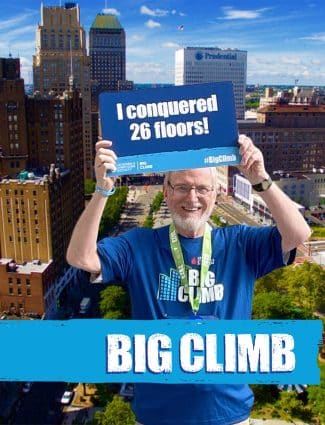
On April 20th, I will be participating in The Leukemia & Lymphoma Society’s Big Climb for the second time. Last year and again this year, I will have to climb twenty-six stories of One Gateway Center in Newark. Although I walked last year, I was scared that I wouldn’t be able to reach the top.

To help manage my anxiety and stay active, I decided to add stair climbing to my daily walks at Cranford Train Station. I started by walking up to the westbound platform and then heading south. On my way back, around the three-mile mark, I would climb the stairs to the platform for Newark-bound trains. There were forty stairs with two landing on each side, and I could feel my leg muscles strengthening with each climb.

On the day of the Big Climb, I faced a challenge with the interior stairs in the skyscraper. Despite their short length and 180-degree turn, I was determined to succeed. My meticulous preparation paid off, and I emerged victorious. This year, I am ready to take on the challenge again confidently. Would you like to support my cause and donate towards cancer research?
Donate to My Big Climb

Support My Big Climb for Jan!

With a dedicated goal of raising $700 for LLS, I have already donated half personally to show my commitment to this cause. I am confident in my ability to raise the remaining funds, and I am inviting my family, friends, and neighbors to support me by matching my donation. .

4 comments add your comment

Share your thoughts and ideas

This site uses Akismet to reduce spam. Learn how your comment data is processed.

The Jan Lilien Education Fund!

I Completed LLS's Big Climb NJ 2023!
×
My Friends: A Novel

Read: October 2024

Get this book

My Friends: A Novel

by Hisham Matar'

Today, I started reading Hisham Matar’s “My Friends: A Novel.” It is a finalist for the 2024 National Book Award for Fiction and the winner of the Orwell Prize for Political Fiction. This novel explores themes of friendship, family, and the harsh realities of exile. Hisham Matar is also the Pulitzer Prize-winning author of “The Return.” The pages on my Kindle App on my iPad fly like autumn’s falling leaves.

One evening, a young boy named Khaled, growing up in Benghazi, hears a captivating short story read aloud on the radio. The story, about a man being eaten alive by a cat, leaves an indelible mark on Khaled, igniting a lifelong fascination with the power of words and the enigmatic author, Hosam Zowa. This transformative experience sets Khaled on a journey that will lead him far from home to the University of Edinburgh to pursue a life of the mind.

In a new and unfamiliar environment, Khaled finds himself far from his familiar life in Libya. His resilience is tested when he attends a protest against the Qaddafi regime in London. The event turns into a tragedy, leaving Khaled injured and unable to leave Britain. Despite the danger posed by monitored phone lines, his determination to communicate his situation to his parents is a testament to his strength.

When Khaled has a chance encounter with Hosam Zowa, the author of a life-changing short story, at a hotel, Khaled begins the most profound friendship of his life. This friendship sustains him and eventually compels him, as the Arab Spring unfolds, to confront complex tensions between revolution and safety, family and exile, and how to define his sense of self concerning those closest to him.

A profound exploration of friendship and family and how time can test and fray these bonds, ‘My Friends‘ is a work of literature that resonates with its readers. Hisham Matar’s novel is not just a story but an achingly beautiful reflection on life and relationships crafted by an author at the peak of his powers.


When you purchase a book through one of my links, I earn a small commission that helps support my passion for reading. This contribution allows me to buy even more books to share with you, creating an incredible cycle of discovering great reads together! Your support truly makes a difference!


×
The Amen Effect

Read: March 2025

Get this book

The Amen Effect

by Sharon Brous

Sharon Brous, a prominent American rabbi, argues in The Amen Effect: Ancient Wisdom to Heal Our Hearts and Mend Our Broken World that the essential spiritual work of our time—though instinctual and often countercultural—focuses on connecting through celebration, sorrow, and solidarity. We must support one another in times of joy and pain, embracing vulnerability and possibility, nurturing relationships with shared purposes, and creating communities centered on care.

From one of our country’s most prominent rabbis comes this inspiring book about the power of community, based on one of her most impactful sermons. What will it take to mend our broken hearts and rebuild our society in a time of loneliness, isolation, social rupture, and alienation?

Brous contends that honoring our most basic human instinct—the yearning for authentic connection—is the way to reawaken our shared humanity and begin the healing process. This kind of sacred presence is captured by the word amen, a powerful ancient idea that we affirm the fullness of one another’s experience by demonstrating, in body and word: “I see you. You are not alone.”

An acclaimed preacher and storyteller, Brous pairs heart-driven anecdotes from her experience building and pastoring to a leading-edge faith community over the past two decades with ancient Jewish wisdom and contemporary science. The result is a clarion call: the sense of belonging engendered by our genuine presence is both a social and biological need, as well as a moral and spiritual necessity.

With original insights and practical tools, The Amen Effect translates foundational ideas into simple practices that connect us to our better angels, offering a blueprint for a more meaningful life and a more connected and caring world.

As she writes in the preface, after listing the joys and pains of life, weddings, births, and death,

It’s in these times that I feel the weight of the work, the privilege of being alive, the blessing of being so close to such raw beauty and pain. It’s there that I have learned the power of saying ‘Amen‘ to one another’s grief and joy, sorrow and celebration with our very presence. Of bearing witness to profound suffering and protesting injustice with our very presence. Of comforting and consoling, surviving and thriving with our very presence. What I’ve learned, during the years, is the meaning of sacred companionship. I have seen, in ways subtle and pronounced, a longing to connect with others who can help hold the pain, a need to share what we’ve learned in the trenches, and a desire to give, even when we ourselves have barely caught our breath. And I have seen how knowing that we’re not alone can both heighten our joy and help us endure unimaginable hardship.

Click here to read about my experience listening to Rabbi Brous at the Kol Tzedek Speakers Series at Temple Emanu-El in Westfield.


Sharon Brous is the senior and founding rabbi of IKAR, a leading-edge Jewish community based in Los Angeles, and the author of The Amen Effect: Ancient Wisdom to Heal Our Hearts and Mend Our Broken World, a national bestseller.

In 2013, Brous blessed President Obama and Vice President Biden at the Inaugural National Prayer Service, and in 2021, returned to bless President Biden and Vice President Harris and then led the White House Passover Seder 2021 and the Hanukkah candle lighting with the Vice President and Second Gentleman in 2023. She was ranked as the number one most influential Rabbi in America by Newsweek/The Daily Beast. She has also been recognized by The Forward and the Jerusalem Post as one of the most influential Jews alive today. Her work has appeared in prominent publications, including The New York Times, The Los Angeles Times, and The Washington Post. Additionally, her TED talk, “Reclaiming Religion,” has been viewed by over 1.5 million people.

Brous is part of the inaugural cohort of Auburn Seminary’s Senior Fellows program, which brings together top faith leaders working on the frontlines for justice. She sits on the faculty of REBOOT and serves on the International Council of the New Israel Fund, as well as the national steering committee for the Poor People’s Campaign.

A Columbia University graduate (holding both undergraduate and M.A. degrees in Human Rights), she was ordained by the Jewish Theological Seminary and resides in Los Angeles with her husband and children.


When you purchase a book through one of my links, I earn a small commission that helps support my passion for reading. This contribution allows me to buy even more books to share with you, creating an incredible cycle of discovering great reads together! Your support truly makes a difference!


×
Light to the Hills

Read: January 2023

Get this book

Light to the Hills: A Novel

by Bonnie Blaylock

Light to the Hills: A Novel by Bonnie Blaylock is about Amanda Rye, a young widowed mother and traveling packhorse librarian who comes through a mountain community struck by the nation’s economic collapse in the 1930s. I recommend this page-turner as it highlights the importance of family and community. From this foundation, truth lights a path toward survival, mountain justice, forgiveness, and hope.

The novel was recommended by Olivia Hawker, bestselling author of The Fire and the Ore, who said, “Light to the Hills is a touching meditation on motherhood and the importance of community, especially during difficult times.”

Last year I read a modern tale about Appalachia, Demon Copperhead. Both are good novels but very different.

Light to the Hills was a feel-good read despite the problems faced by Ms. Rye and the MacInteer family. It was precisely the book I needed to read this week.

The Goodreads summary provides an overview,

The folks in the Kentucky Appalachians are scraping by. Coal mining and hardscrabble know-how are a way of life for these isolated people. But when Amanda Rye, a young widowed mother and traveling packhorse librarian, comes through a mountain community walloped by the nation’s economic collapse, she brings with her hope, courage, and apple pie. Along the way, Amanda takes a shine to the MacInteer family, especially to the gentle Rai, her quick-study daughter, Sass, and Finn, the eldest son who’s easy to warm to. They remind Amanda of her childhood and her parents with whom she longs to be reconciled.

Her connection with the MacInteers deepens, and Amanda shares with them a dangerous secret from her past. When that secret catches up with Amanda in the present, she, Rai, Sass, and Finn find their lives intersecting—and threatened—in the most unexpected ways. Now, they must come together as the truth lights a path toward survival, mountain justice, forgiveness, and hope.


The Jan Lilien Education Fund sponsors ongoing sustainability and environmental awareness programs. Gifts made this month; I will match dollar-for-dollar. All donations are tax-deductible.

Subscribe

Contact Us

I receive a commission when you buy a book or product using a link on this page. Thank you for supporting Sharing Jan’s Love blog.


×
The Last White Man

Read: August 2022

Get this book

The Last White Man: A Novel

by Mohsin Hamid

The Last White Man by Mohsin Hamid is a story of love, loss, and rediscovery in a time of unsettling change. One morning, Anders, the novel’s protagonist,  wakes to find that his skin has turned dark, his reflection a stranger to him. At first, he tells only Oona, an old friend, newly a lover. Soon, reports of similar occurrences surface across the land.

In Mohsin Hamid’s “lyrical and urgent” prose (O Magazine), The Last White Man powerfully uplifts our capacity for empathy and the transcendence over bigotry, fear, and anger it can achieve.

I highly recommend this book. It was a page-turner that kept me thinking about love, loss, and rediscovery. All three are subjects close to my heart since Jan’s death.

I decided to read the book after hearing an interview with the author on All of It on WNYC.

The Goodreads summary provides a good overview,

One morning, Anders wakes to find that his skin has turned dark, his reflection a stranger to him. At first he tells only Oona, an old friend, newly a lover. Soon, reports of similar occurrences surface across the land. Some see in the transformations the long-dreaded overturning of an established order, to be resisted to a bitter end. In many, like Anders’s father and Oona’s mother, a sense of profound loss wars with profound love. As the bond between Anders and Oona deepens, change takes on a different shading: a chance to see one another, face to face, anew.

Hamid’s The Last White Man invites us to envision a future – our future – that dares to reimagine who we think we are, and how we might yet be together.


The Jan Lilien Education Fund sponsors ongoing sustainability and environmental awareness programs. Gifts made this month; I will match dollar-for-dollar. All donations are tax-deductible.

Subscribe

Contact Us

I receive a commission when you buy a book or product using a link on this page. Thank you for supporting Sharing Jan’s Love blog.

×
Invisible Child

Read: December 2021

Get this book

Invisible Child: Poverty, Survival & Hope in an American City

by Andrea Elliott

Invisible Child: Poverty, Survival & Hope in an American City by Andrea Elliott was a gift from my son Jon. The New York Times selected “Invisible Child” as one of the best books published this year. It is indeed one of the top books on my all-time list.

GoodReads summary provides a good overview,

The riveting, unforgettable story of a girl whose indomitable spirit is tested by homelessness, poverty, and racism in an unequal America—from Pulitzer Prize-winning journalist Andrea Elliott of The New York Times

Invisible Child follows eight dramatic years in the life of Dasani Coates, a child with imagination as soaring as the skyscrapers near her Brooklyn homeless shelter. Born at the turn of a new century, Dasani is named for the bottled water that comes to symbolize Brooklyn’s gentrification and the shared aspirations of a divided city. As Dasani grows up, moving with her tight-knit family from shelter to shelter, this story goes back to trace the passage of Dasani’s ancestors from slavery to the Great Migration north. When Dasani comes of age, New York City’s homeless crisis explodes as the chasm deepens between rich and poor.

In the shadows of this new Gilded Age, Dasani must lead her seven siblings through a thicket of problems: hunger, parental drug addiction, violence, housing instability, segregated schools, and the constant monitoring of the child-protection system. When, at age thirteen, Dasani enrolls at a boarding school in Pennsylvania, her loyalties are tested like never before. As she learns to “code switch” between the culture she left behind and the norms of her new town, Dasani starts to feel like a stranger in both places. Ultimately, she faces an impossible question: What if leaving poverty means abandoning the family you love?

By turns heartbreaking and revelatory, provocative and inspiring, Invisible Child tells an astonishing story about the power of resilience, the importance of family, and the cost of inequality. Based on nearly a decade of reporting, this book vividly illuminates some of the most critical issues in contemporary America through the life of one remarkable girl.

Jan and I were involved and knew that child poverty and homelessness needed repair. In addition, Jan lived on Washington Park across from Ft. Greene Park in 1974-75. We knew the neighborhood where much of the book’s story takes place. 

Before meeting Jan in 1973, I was both a community/tenant organizer and a youth worker. In the latter role, I made weekly hostel trips for eight to ten young boys from East Williamsburg during 1973. The trips were the first the boys had ever been outside of their neighborhood.

Many of them had imaginations like Dasani. They also had her instinct to fight. One of my first tasks was to check for any weapons.

Decades later, when I would see any of them, now adults, they would ask when we were going on another trip. I wish I had met Jan when I made those trips. She would have helped me improve them and document the impact. If I could re-write history, I would have her join me as the second adult on the hostel trips.

After that summer, it was clear my primary skills were as a community/tenant organizer. Over the next few years, my work focused on creating affordable and supportive housing.

Jan and I did meaningful work that made a difference, yet the need for a permanent solution to the crisis remains. The book highlights the crucial role of resilience, the importance of family, and the cost of inequality. As a nation, we cannot undermine those values by breaking up families, impeding resilience, and maintaining racial and economic inequality. 

The current debate in Washington over the Build Back Better legislation needs to focus not on how much we spend but on its impact on children and families

David Brooks, a conservative commentator, has supported these expenditures for what they can do to address this country’s cultural and economic crisis. 

These packages say to the struggling parents and the warehouse workers: I see you. Your work has dignity. You are paving your way. You are at the center of our national vision.

This is how you fortify a compelling moral identity, which is what all of us need if we’re going to be able to look in the mirror with self-respect. This is the cultural transformation that good policy can sometimes achieve. Statecraft is soulcraft.

If you can only read one book this year, this is the one to read. Child poverty, homelessness, and inequality impact all of us. Ending child poverty and homelessness will make us a healthier and more inclusive nation. It is time for a compelling moral call to action!

Subscribe

Contact Us

When you buy a book or product using a link on this page, I receive a commission. Thank you for supporting Sharing Jan’s Love blog.

×
We Were Eight Years in Power

Read: September 2020

Get this book

We Were Eight Years in Power

by Ta-Nehisi Coates

We Were Eight Years in Power by Ta-Nehisi Coates is a collection featuring the landmark essay The Case for Reparations he wrote for The Atlantic. Even though I am a subscriber to The Atlantic and have read many of the pieces, this is a must-read book as it reflects on race, Barack Obama’s presidency, and its jarring aftermath, including the election of Donald Trump.

We were eight years in power as the lament of Reconstruction-era black politicians as the American experiment in multiracial democracy ended with the return of white supremacist rule in the South. In this sweeping collection of new and selected essays, Ta-Nehisi Coates explores the tragic echoes of that history in our own time: the unprecedented election of a black president followed by a vicious backlash that fueled the election of the man Coates argues is America’s first white president.

But the story of these present-day eight years is not just about presidential politics. This book also examines the new voices, ideas, and movements for justice that emerged over this period and the effects of the persistent, haunting shadow of our nation’s old and unreconciled history. Coates powerfully examines the events of the Obama era from his intimate and revealing perspective:” the point of view of a young writer who begins the journey in an unemployment office in Harlem and ends it in the Oval Office, interviewing a president.

We Were Eight Years in Power features Coatesa’s iconic essays first published in The Atlantic, including Fear of a Black President, The Case for Reparations, and The Black Family in the Age of Mass Incarceration, along with eight fresh essays that revisit each year of the Obama administration through Coate’s own experiences, observations, and intellectual development, capped by a bracingly original assessment of the election that fully illuminated the tragedy of the Obama era. We Were Eight Years in Power is a vital account of modern America, from one of the definitive voices of this historic moment.

I recommend this book to all readers.

Subscribe

Contact Us

×