
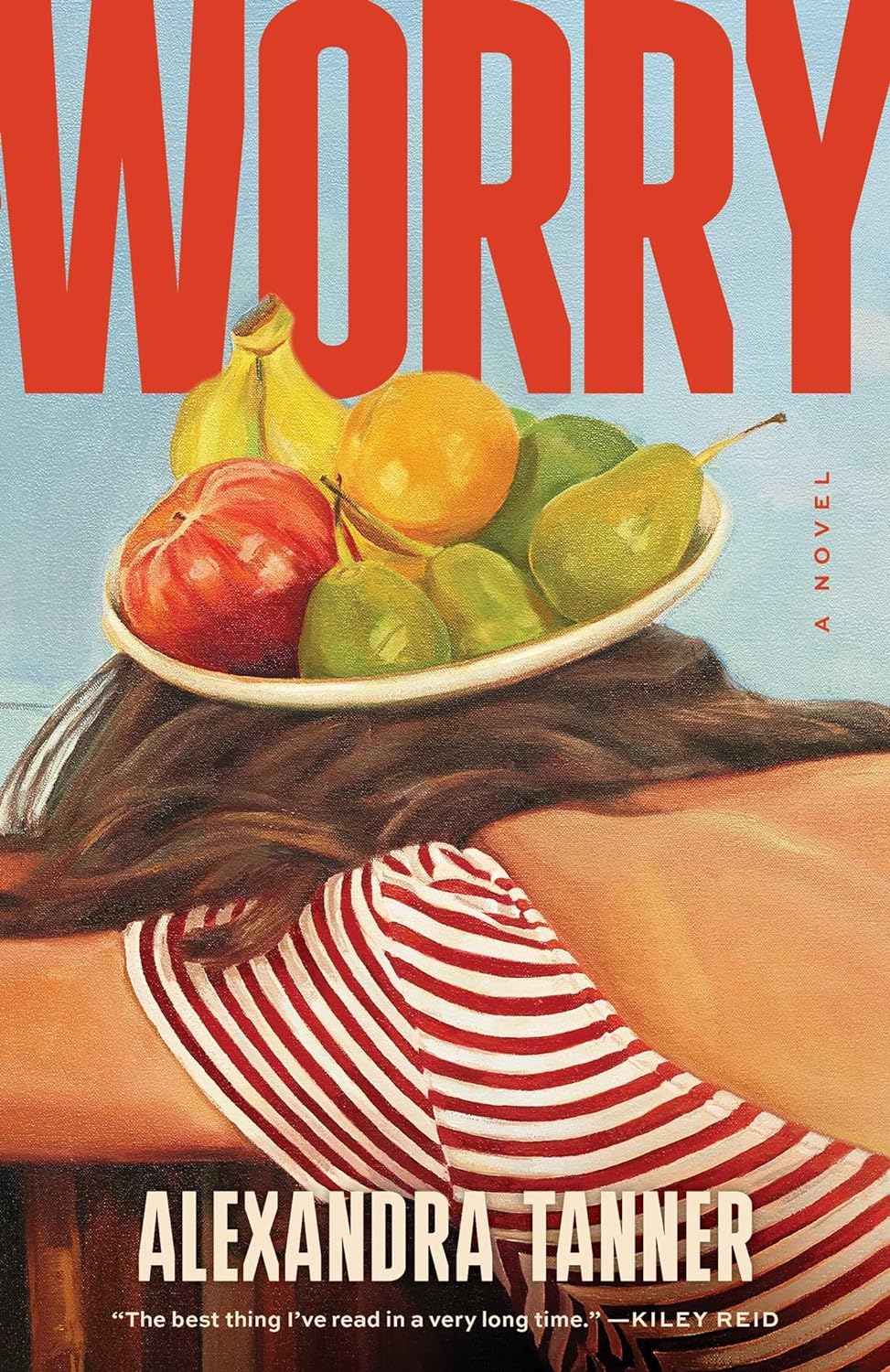
Worry: A Novel

Estimated reading time: 1 minute, 20 seconds

Today, I began reading Alexandra Tanner‘s debut novel, Worry: A Novel. The New Yorker praised it as “dryly witty,” The New York Times Book Review called it “fabulously revealing.” The story follows two siblings-turned-roommates who try to navigate an absurd world on the verge of calamity. It explores existentialism and sisterhood in a Seinfeldian style.

In March 2019, Jules Gold, a 28-year-old woman, felt anxious, frustrated with her art, and addicted to the internet. She lives alone in the apartment she used to share with her ex-fiancé. Her younger sister Poppy unexpectedly comes to stay with her indefinitely. Poppy, who attempted suicide a year and a half ago, is looking for work and purpose in Brooklyn. Meanwhile, Jules spends her days scrolling through the feeds of Mormon mommy bloggers and waiting for something to happen in her life.

Poppy’s hives, which she has had since childhood, flare up again. Jules has health problems with her uterus. Poppy adopts a poorly behaved-rescue dog named Amy Klobuchar. Poppy’s mother, who recently became a devout Messianic Jew, starts believing in the same deep-state conspiracy theories as Jules’ online mommies. Jules half-heartedly tries to find the source of her ennui and cruelly blames Poppy for not being a good enough friend, writer, or sister. As the year progresses and a new decade approaches, a disastrous trip back to Florida forces Jules and Poppy to question their futures and whether they want to spend them together or apart.

Worry is a darkly funny and deadpan portrayal of two sisters struggling through anxiety and uncertainty in America. A bold new voice in contemporary fiction writes it.

The Jan Lilien Education Fund!

There Is No Place for Us

Read: April 2025

Get this book

There Is No Place for Us

by Brian Goldstone

Today, I delved into There Is No Place for Us by Brian Goldstone, a poignant exploration of America’s escalating homelessness crisis. Goldstone’s examination of the issue’s scale, root causes, and consequences is a wake-up call, passionately arguing that housing must be recognized as a fundamental human right. His compelling narrative demands our immediate attention and action.

The phrase “the working homeless” serves as a stark reminder of the urgency of America’s homelessness crisis. In a country where hard work and determination are expected to lead to success, it is scandalous that individuals with full-time jobs struggle to maintain stable housing. Rising rents, low wages, and insufficient tenant rights have contributed to this alarming trend. Families are facing homelessness not due to a failing economy but because of a thriving one.

In his compelling and thoroughly researched book, Brian Goldstone explores the lives of five families in Atlanta. Maurice and Natalia attempt to rebuild their lives in the country’s “Black Mecca” after being priced out of Washington, D.C. Kara aspires to become an entrepreneur while working at a public hospital. Britt has secured a much-coveted housing voucher. Michelle is studying to become a social worker. Celeste works tirelessly at her warehouse job while battling ovarian cancer. Each of these individuals strives to provide a decent life for their children. Yet, one by one, they find themselves among the nation’s working homeless, demonstrating their resilience and the system’s failures.

Through intimate, novelistic portrayals, Goldstone exposes the human cost of this crisis, following parents and their children as they sleep in cars or squalid extended-stay hotel rooms, then head to their jobs and schools the next day. These are the nation’s hidden homeless—people often omitted from official statistics—showing that overflowing shelters and street encampments represent only the most visible aspects of a much larger problem.


Brian Goldstone is a journalist whose long-form reporting and essays have appeared in The New York Times, Harper’s Magazine, The New Republic, The California Sunday Magazine, and Jacobin, among other publications. He has a PhD in anthropology from Duke University and was a Mellon Research Fellow at Columbia University. In 2021, he was a National Fellow at New America. He lives in Atlanta with his family.


When you purchase a book through one of my links, I earn a small commission that helps support my passion for reading. This contribution allows me to buy even more books to share with you, creating an incredible cycle of discovering great reads together! Your support truly makes a difference!

Enjoy a limited-time offer of 20% off your next book purchase at Bookshop.org!


×
We Were Eight Years in Power

Read: September 2020

Get this book

We Were Eight Years in Power

by Ta-Nehisi Coates

We Were Eight Years in Power by Ta-Nehisi Coates is a collection featuring the landmark essay The Case for Reparations he wrote for The Atlantic. Even though I am a subscriber to The Atlantic and have read many of the pieces, this is a must-read book as it reflects on race, Barack Obama’s presidency, and its jarring aftermath, including the election of Donald Trump.

We were eight years in power as the lament of Reconstruction-era black politicians as the American experiment in multiracial democracy ended with the return of white supremacist rule in the South. In this sweeping collection of new and selected essays, Ta-Nehisi Coates explores the tragic echoes of that history in our own time: the unprecedented election of a black president followed by a vicious backlash that fueled the election of the man Coates argues is America’s first white president.

But the story of these present-day eight years is not just about presidential politics. This book also examines the new voices, ideas, and movements for justice that emerged over this period and the effects of the persistent, haunting shadow of our nation’s old and unreconciled history. Coates powerfully examines the events of the Obama era from his intimate and revealing perspective:” the point of view of a young writer who begins the journey in an unemployment office in Harlem and ends it in the Oval Office, interviewing a president.

We Were Eight Years in Power features Coatesa’s iconic essays first published in The Atlantic, including Fear of a Black President, The Case for Reparations, and The Black Family in the Age of Mass Incarceration, along with eight fresh essays that revisit each year of the Obama administration through Coate’s own experiences, observations, and intellectual development, capped by a bracingly original assessment of the election that fully illuminated the tragedy of the Obama era. We Were Eight Years in Power is a vital account of modern America, from one of the definitive voices of this historic moment.

I recommend this book to all readers.

Subscribe

Contact Us

×
The Hidden Habits of Genius

Read: September 2019

Get this book

The Hidden Habits of Genius

by Craig Wright

The Hidden Habits of Genius: Beyond Talent, IQ, and Grit―Unlocking the Secrets of Greatness by Craig Wright, Ph.D., I got through my membership in One Day University.

Dr. Wright raises many important questions as he analyses fourteen (14) critical traits of genius. Professor Craig Wright, creator of Yale University’s famous “Genius Course,” explores what we can learn from brilliant minds that have changed the world.

What we often presume about a genius does not match reality. Among other interesting observations, Dr. Wright reminds the reader that Picasso could not pass a fourth-grade math test, and Steve Jobs’s high school GPA was 2.65. He questions why to teach children to behave and play by the rules when transformative geniuses do not.

Examining the lives of transformative individuals ranging from Charles Darwin and Marie Curie to Leonardo Da Vinci and Andy Warhol to Toni Morrison and Elon Musk, Wright identifies more than a dozen drivers of genius, characteristics and patterns of behavior common to great minds throughout history. He argues that genius is about more than intellect and work ethic and that the famed “eureka” moment is a Hollywood fiction. Brilliant insights that change the world are never sudden, but rather, they are the result of unique modes of thinking and lengthy gestation.

I found the book to be a fascinating read and raised more questions for future thought and reading. Professor Wright argues that the habits of mind that produce great thinking and discovery can be actively learned and cultivated. In the book, he explains how. He notes that reading the book will not make you a genius but can “make you more strategic, creative, and successful, and, ultimately, happier.

Subscribe

Contact Us

×
Creation Lake: A Novel

Read: November 2024

Get this book

Creation Lake: A Novel

by Rachel Kushner

Today, I started reading Creation Lake: A Novel by Rachel Kushner, a two-time finalist for the Booker Prize and the National Book Award. This novel follows a seductive and cunning American woman who infiltrates an anarchist collective in France. It is a gripping page-turner filled with dark humor. Creation Lake is Kushner‘s finest achievement—a work of high art, comedy, and unforgettable pleasure.

The story revolves around a secret agent, a thirty-four-year-old American woman who employs ruthless tactics and possesses striking beauty. She is sent to carry out covert operations in France. The narrator introduces herself as “Sadie Smith” when she arrives at a rural commune of French subversives, whom she is secretly monitoring, and to her lover, Lucien, a young and well-to-do Parisian whom she meets by so-called “cold bump”—making him believe their encounter was accidental. Like everyone else she targets, Lucien is helpful to her and ultimately manipulated by her. Sadie operates with strategy and deception, following instructions from her “contacts”—shadowy figures in business and government. Initially, these contacts want her to provoke reactions. As the story progresses, their demands become more complex.

In this region filled with ancient farms and prehistoric caves, Sadie becomes captivated by a mysterious figure named Bruno Lacombe. Bruno mentors young activists who believe that the path to emancipation lies not in revolt but in a return to the ancient past. Just as Sadie thinks she is the seductress and puppet master of those she surveils, Bruno enchants her with his ingenious counter-histories, poignant laments, and tragic narrative.

In brief, striking sections, Rachel Kushner‘s interpretation of “noir” is taut and dazzling.


When you purchase a book through one of my links, I earn a small commission that helps support my passion for reading. This contribution allows me to buy even more books to share with you, creating an incredible cycle of discovering great reads together! Your support truly makes a difference!


×
We Do Not Part

Read: March 2025

Get this book

We Do Not Part: A Novel

by Han Kang

Today, I explored “We Do Not Part,” the latest novel by Han Kang, the 2024 Nobel Prize in Literature laureate. Translated by the talented e. yaewon and Paige Aniyah Morris, this book offers a remarkable journey. The New York Times has called it Kang’s most revealing work since her acclaimed novel, “The Vegetarian.” What captivates me the most is how it intricately weaves the story of two women’s friendship while shedding light on a hidden chapter of Korean history.

One winter morning, Kyungha receives an urgent message from her friend Inseon, asking her to visit a hospital in Seoul. Inseon has injured herself in an accident and begs Kyungha to return to Jeju Island, where she lives, to save her beloved pet—a white bird named Ama. A snowstorm hits the island when Kyungha arrives. At all costs, she must reach Inseon’s house, but the icy wind and blizzards slow her down as night falls. She wonders if she will arrive in time to save the animal—or even survive the terrible cold that envelops her with every step. Lost in a world of snow, she does not yet suspect the vertiginous plunge into darkness that awaits her at her friend’s house.

Blurring the boundaries between dream and reality, “We Do Not Part” powerfully illuminates a forgotten chapter of Korean history buried for decades, bringing to light the lost voices of the past to prevent them from fading into oblivion. It is both a tribute to enduring friendship and a plea for remembrance. The novel tells a story of profound love in the face of unspeakable violence and celebrates life, however fragile.


Han Kang was born in 1970 in South Korea. She is the author of The Vegetarian, which I have read, and winner of the International Booker Prize,  Human ActsThe White BookGreek Lessons, and We Do Not Part. In 2024, she received the Nobel Prize in Literature.

e. yaewon is based in Korea and translates from and into Korean, including titles by Hwang Jungeun, Deborah Levy, and Samuel Beckett.

Paige Aniyah Morris divides her time between the United States and Korea. Recent translations include works by Pak Kyongni, Ji-min Lee, and Chang Kang-myoung.


When you purchase a book through one of my links, I earn a small commission that helps support my passion for reading. This contribution allows me to buy even more books to share with you, creating an incredible cycle of discovering great reads together! Your support truly makes a difference!


×
Summer a Novel

Read: October 2021

Get this book

Summer: A Novel

by Ali Smith

Summer: A Novel by Ali Smith is a fascinating book about the times in which we live.

In the present, Sacha knows the world’s in trouble. Her brother Robert just is trouble. Their mother and father are having trouble. Meanwhile the world’s in meltdown – and the real meltdown hasn’t even started yet.

In the past, a lovely summer. A different brother and sister know they’re living on borrowed time.

This is a story about people on the brink of change.

They’re family, but they think they’re strangers.

So: where does family begin? And what do people who think they’ve got nothing in common have in common?

Summer.

Because of the two different periods and the multiple characters, I had some difficulty following the plot until about halfway to the end. Suddenly it all fit together and made sense.

The book revealed information about the internments during World War II in England that I had not fully comprehended.

Sacha’s focus on the environmental degradation augmented by the COVID pandemic provided an emotional undertow in the book.

I now must begin to read the other three novels in this Seasonal Quartet.

Subscribe

Contact Us

×