
Walking for 1097 Days

Estimated reading time: 11 minutes, 15 seconds
I Am OK Walking Into the
Unknowable Future

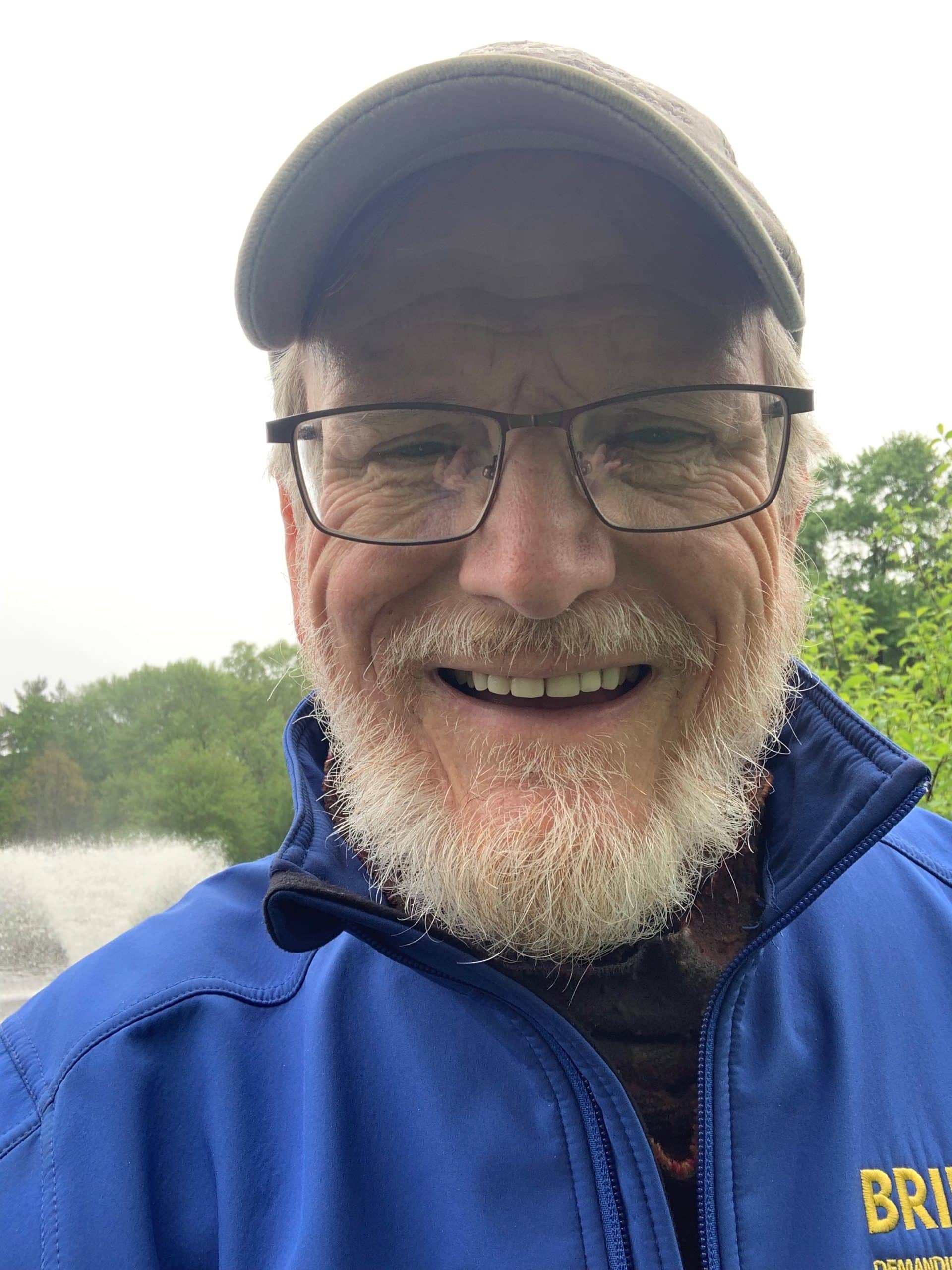
I woke up at 5:30 AM this morning, just like my Apple Watch alarm rings daily. As I left bed, my watch greeted me with a friendly “Good Morning, Richard” message. Since I live alone, I responded to my watch and put on my walking clothes. Even though the sky was dark and dismal, the predicted rain did not arrive, and it was dry outside. I’ve been doing this for three years and never let the weather affect my mood.

I went to the kitchen and poured myself a glass of orange juice. I took a vitamin pill and selected a banana and yogurt, which I placed on the table. While waiting for the English muffin to toast, I asked Siri for my morning NPR update. Although I listened to the news in the background, I couldn’t help but think that yesterday marked three years since I buried the love of my life, Jan. Her absence is an unfillable void, and every day without her is a reminder of the life we had together.

After finishing the first phase of breakfast with a banana, muffin, and two spoons of Chobani’s Monterrey Strawberry yogurt, I returned the unfinished juice and yogurt to the refrigerator. I put on my Brooks Ghost shoes and made a mental note to order new ones this week, as I have walked in these since November. Then, I put on three layers to be safe if it feels colder than the 50 degrees the weather app claims. I picked up yesterday’s recycling and headed out for my morning walk.

First Step

I have always enjoyed walking, but it wasn’t until the day after my wife Jan’s funeral that I began a consistent, daily walking routine. That day, I was busy talking to mourners and tapping car windows. Looking back, I realize this was the turning point that started my three-year walking journey on May 6, 2021.

I Conquered Twenty-Six Floors for Jan

After completing The Big Climb, my friend Hugo asked me where I found the strength to keep up my daily walks. I told him that I would choose to walk over driving any day. But why do I walk, even on rainy or snowy days? I don’t have an answer. I could make up a story, but the truth is that the reason still eludes me.

Three years ago, I explained to Hugo that I woke up feeling tired and tempted to sleep in until noon. “I’d do the same,” Hugo said. But instead of giving in to that temptation, I went to the bathroom, splashed cold water on my face, and put on my walking shoes. I went for a walk to clear my head. Hugo shook his head, and I knew most people would have chosen to sleep instead of taking an early morning walk.

The following day, I went for another walk. I told Hugo I didn’t plan to walk daily for three years, but it has become essential to my routine. I asked if he knew about the bumpers they install in bowling alleys to keep the ball out of the gutters. He said yes, he knew about the bumpers, but what did that have to do with my walking? It’s a way to ensure that I stay focused on living my best life as a widow. I need to walk; my other habit is to avoid falling into the gutter. With each step, I get closer to achieving physical, mental, and emotional wellness.

“It’s made a difference,” Hugo said. You look great and are a better person and friend.” I laughed. “Hugo, I’m just an ordinary guy who lost his wife and is trying to be the best version of himself,” I explained. I hope that someday I’ll be able to figure out who I am without Jan. But until then, even though I don’t know what the future holds, I’ll keep listening, embracing it, and walking into it with strength and courage.”

Today’s Morning Walk

I set my Apple Watch to track an outdoor walk as I left the room to take out the recycling and garbage. Though the mist was irritating, I was determined to continue. Walking past my old office, now turned gym, I took in my surroundings, feeling the cool air on my skin and a light mist on my face. Memories of my beloved Jan flooded my mind, but I knew she would want me to keep moving forward.

Turning right, I took the alleyway adjacent to my apartment building. As I approached Alden Street, I saw Karyn, the owner of Keating Physical Therapy. We exchanged pleasantries, and her warm smile was a small but significant part of my daily routine, reminding me that I was starting my walk on time. I picked up my NY Times, walked into the lobby, and put the paper in my mailbox for safekeeping. In January, I left it by the couch, and when I returned, it was gone.
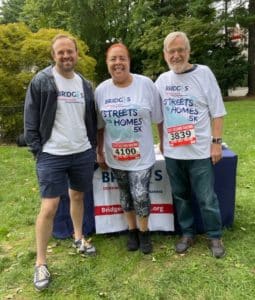
Bridges Street to Homes 5K
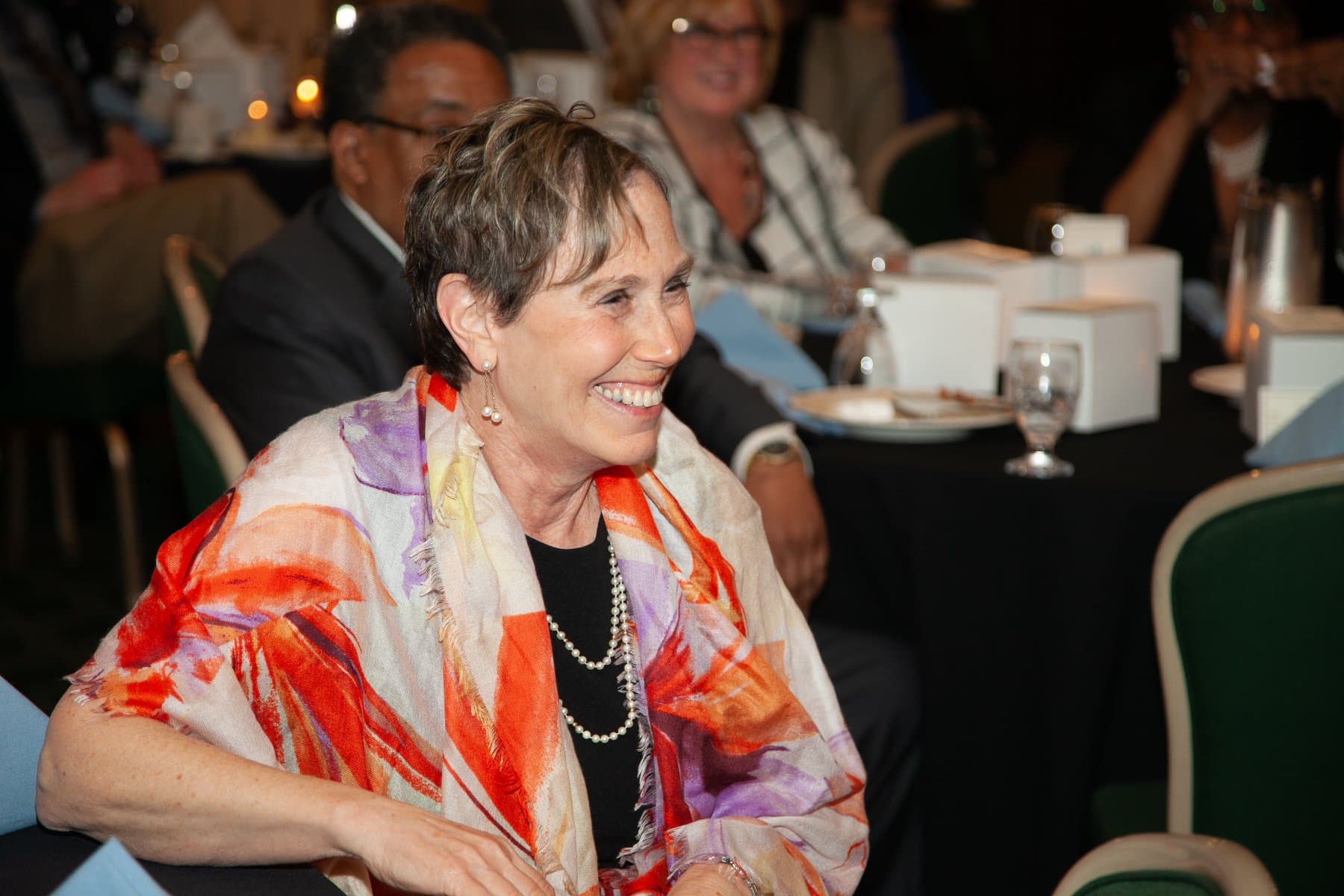
From left to Right: Richard J. Uniacke, President of Bridges; Alison Bryant, Secretary of Bridges.

Continuing along Alden Street towards Miln, I saw my friends perched on the steps of St. Michael’s Church, patiently waiting for the morning mass. Their presence, even from a distance, was a comfort. I waved at them before moving forward, my steps steady and resolute. Most of my hometown was still asleep, so the world around me remained quiet for the next half hour as I walked.

As my path left downtown and paralleled the Rahway River, I saw more people. When I started my walking routine, I greeted everyone I saw with a hello and a wish for a good day. I extended those hopes for a good day for months, even when I knew I would not have a good day. In three years of walking, I had greeted many people. Some had become friends, but all were people I looked forward to seeing.

As I carefully stepped over puddles, I realized how life always had obstacles and challenges, but with each passing day, I was getting better at overcoming them. Taking a deep breath and holding my head up high, I moved forward into the future with renewed hope and determination. The future was unknown, but it was the only option I had.

Pages: 1 2 3

13 comments add your comment

Share your thoughts and ideas

This site uses Akismet to reduce spam. Learn how your comment data is processed.

Previous Post:

Next Post:

The Jan Lilien Education Fund!

The Unfolding

Read: October 2022

Get this book

The Unfolding: A Novel

by A.M. Homes

The Unfolding by A.M. Homes is a darkly comic political parable braided with a Bildungsroman that takes us inside the heart of a divided country. The Unfolding is an alternative history that is terrifyingly prescient, profoundly tender, and devastatingly funny. Will this novel help me to understand how we became a nation that no longer shares the same definitions of truth, freedom, and democracy, much less a shared vision of the future?

Although I understand more clearly the crisis facing the US, I highly recommend this novel.

Ms. Homes has written a must-read book that compliments the January 6th Committee report and should make us all more vigilant.

The characters are so well defined that at the end of the novel, I wanted to continue to read about them, especially Meghan.

The Goodreads summary provides an overview,

The Big Guy loves his family, money, and country. Undone by the 2008 presidential election results, he taps a group of like-minded men to reclaim their version of the American Dream. As they build a scheme to disturb and disrupt, the Big Guy also faces turbulence within his family. His wife, Charlotte, grieves a life not lived, while his 18-year-old daughter, Meghan, realizes that her favorite subject–history–is not exactly what her father taught her.

In a story that is as much about the dynamics within a family as it is about the desire for those in power to remain in force, Homes presciently unpacks a dangerous rift in American identity, prompting a reconsideration of the definition of truth, freedom, and democracy–and exploring the explosive consequences of what happens when the exact words mean such different things to people living together under one roof.

In her first novel since the Women’s Prize award-winning May We Be Forgiven, A.M. Homes delivers us back to ourselves in this stunning alternative history that is both terrifyingly prescient, deeply tender, and devastatingly funny.


The Jan Lilien Education Fund sponsors ongoing sustainability and environmental awareness programs. Gifts made this month; I will match dollar-for-dollar. All donations are tax-deductible.

Subscribe

Contact Us

I receive a commission when you buy a book or product using a link on this page. Thank you for supporting Sharing Jan’s Love.

×
What We Can Know

Read: September 2025

Get this book

What We Can Know: A Novel

by Ian McEwan

What We Can Know” by Ian McEwan, the critically acclaimed author of nineteen novels and two short story collections, is a remarkable work of fiction and a love story that celebrates both individuals and the words they leave behind. This literary detective story reclaims the present from our sense of impending catastrophe and envisions a future world where not everything is lost.

In 2014, during a dinner for close friends and colleagues, renowned poet Francis Blundy honored his wife’s birthday by reading aloud a new poem dedicated to her, titled “A Corona for Vivien.” As the guests enjoy a delicious meal and drink plenty of wine, little do they know that people will speculate about the meaning of this poem for generations to come. A copy of the poem was never published, and it remains an enduring mystery.

Fast forward to 2119: over one hundred years in the future, rising seas following a catastrophic nuclear accident have submerged much of the Western world. The survivors tormented by the memory of the vibrant world research the world that once existed. In the waterlogged south of what was once England, Thomas Metcalfe, a lonely scholar and researcher, longs for the early twenty-first century as he searches for the elusive poem “A Corona for Vivien.”

Thomas reflects on how wild and full of risk their lives were, captivated by the freedoms and possibilities of human life at its zenith. When he stumbles upon a clue that may lead to the poem’s discovery, he uncovers a story of entangled loves and a brutal crime that shatters his assumptions about people he thought he knew intimately.


Ian McEwan is a critically acclaimed author known for his nineteen novels and two short story collections. His first published work, a collection of short stories titled “First Love, Last Rites,” won the Somerset Maugham Award.

His notable novels include “The Child in Time,” which won the Whitbread Novel of the Year Award in 1987; “The Cement Garden“; “Enduring Love;” “Amsterdam;” which won the Booker Prize in 1998; “Atonement;” “Saturday;” “On Chesil Beach;” “Solar;” “Sweet Tooth;” “The Children Act;” “Nutshell;” and “Machines Like Me,” which became a number-one bestseller.

Several of his works, including “Atonement,” “Enduring Love,” “The Children Act;,” and “On Chesil Beach,” have been adapted into films.


Discover your next favorite book and dive into a world of curated, exciting reads by purchasing through my links. You’ll have access to a diverse selection of books that I’ve personally vetted to ensure quality and enjoyment. Additionally, by supporting these selections, you’ll help me continue to provide you with more personalized recommendations. I earn a small commission from your purchase, which allows me to buy and share even more books with you. Your support truly makes a difference!


×
Revolutionary Mothers

Read: February 2019

Get this book

Revolutionary Mothers

by Carol Berkin

Revolutionary Mothers by Carol Berkin, Presidential Professor of American Colonial and Revolutionary History; Women’s History Professor at Baruch College, is one of four books I purchased after my first One Day University Class on February 9, 2019. It should be required reading!

The book explains how women of the Revolution were most active at home, organizing boycotts of British goods, raising funds for the fledgling nation, and managing the family business while struggling to maintain a modicum of normalcy as husbands, brothers, and fathers died.

It was not just the men who fought on the front lines, as in the story of Margaret Corbin, who was crippled for life when she took her husband’s place beside a cannon at Fort Monmouth. She explains the mystery of Molly Pitcher (she was not a person but a group of women), camp followers, women who spied for their country, Loyalist women, and the impact on African American and Native women.

This intelligent and comprehensive history brings these forgotten stories to their rightful place in the struggle for American independence. Dr. Birkin also highlights how their efforts set the stage for the continuing campaign for gender equality.

Subscribe

Contact Us

×
The Hidden Life of Trees

Read: August 2021

Get this book

The Hidden Life of Trees

by Peter Wohlleben

The Hidden Life of Trees: What They Feel, How They Communicate ― Discoveries from A Secret World is a book I have wanted but had not had the time to read. In July of this year, when I was still in the early stages of my recovery journey, I talked to a friend of my wife’s (whom I now count as my friend) about our plans to plant a tree in Hanson Park.

As I talked about our plans, my friend suggested I read this book as it would help me understand the importance of trees. I will forever be grateful for her recommendation, as it made me read this book sooner than later.

To read that trees have a social network with more prominent, healthier trees concerned about the smaller, weaker ones. How is it that humans, a supposedly advanced species, have a social network that divides and weakens our community?

Are trees social beings? In The Hidden Life of Trees forester and author Peter Wohlleben convincingly makes the case that, yes, the forest is a social network. He draws on groundbreaking scientific discoveries to describe how trees are like human families: tree parents live together with their children, communicate with them, support them as they grow, share nutrients with those who are sick or struggling, and even warn each other of impending dangers. Wohlleben also shares his deep love of woods and forests, explaining the amazing processes of life, death, and regeneration he has observed in his woodland.

Having read this book, I am more sensitive to trees and have enjoyed my walks more than ever. In addition, when we plant Jan’s tree in Hanson Park, I will now have even more reasons to talk about the importance of trees to Jan, myself, and the community.

Subscribe

Contact Us

×
The True True Story of Raja the Gullible (and His Mother)

Read: October 2025

Get this book

The True True Story of Raja the Gullible (and His Mother)

by Rabih Alameddine

The True True Story of Raja the Gullible (and His Mother)” is a wonderfully unique and vibrant celebration of love. Written by Rabih Alameddine, a National Book Award finalist and winner of the PEN/Faulkner Award for Fiction, “The True True Story of Raja the Gullible (and His Mother)” is a tragicomic love story set in Lebanon. It explores the modern saga of family, memory, and the unbreakable bond between a son and his mother.

In a small apartment in Beirut, sixty-three-year-old Raja and his mother live side by side. A beloved high school philosophy teacher and “the neighborhood homosexual,” Raja enjoys books, meditative walks, order, and solitude. Meanwhile, his octogenarian mother, Zalfa, feels that Raja’s desire for privacy is a personal affront. She demands to know every detail of his work and love life, disregarding his boundaries.

When Raja receives an invitation to an all-expenses-paid writing residency in America, it couldn’t come at a better time. It arrives on the heels of a series of personal and national disasters that have left him longing for peace, away from his mother and the turmoil of Lebanon. However, what initially seems like a stroke of luck soon forces Raja to confront and relive the very disasters and past betrayals he wishes to forget.

Told in Raja’s irresistible, wickedly funny voice, the novel traverses six decades, narrating the unforgettable story of a singular life and its absurdities—a tale of mistakes, self-discovery, trauma, and perhaps even forgiveness.


Rabih Alameddine is the author of several acclaimed works, including the novels “The Wrong End of the Telescope“, “Angel of History“, “An Unnecessary Woman“, “The Hakawati“, “I, the Divine“, and “Koolaids“. He also wrote a collection of stories titled “The Perv” and a nonfiction work called “Comforting Myths”.

Alameddine has received numerous awards for his writing, including the PEN/Faulkner Award for Fiction, and he was a finalist for the National Book Award. In 2019, he was honored with the Dos Passos Prize, received a Lannan Award in 2021, and was awarded the Bill Whitehead Lifetime Achievement Award in 2025.


Discover your next favorite book and dive into a world of curated, exciting reads by purchasing through my links. You’ll have access to a diverse selection of books that I’ve personally vetted to ensure quality and enjoyment. Additionally, by supporting these selections, you’ll help me continue to provide you with more personalized recommendations. I earn a small commission from your purchase, which allows me to buy and share even more books with you. Your support truly makes a difference!


×
The New Wilderness

Read: October 2021

Get this book

The New Wilderness

by Diane Cook

The New Wilderness by Diane Cook. The New Wilderness is a timely book and one that resonated with me. When Jan and I met in 1973, it was a revolutionary time with movements encouraging communes and returning to the farm. Neither Jan nor I were interested in living in a commune. Reading this book helped reassure me that we made the correct choice.

The summary of the book is:

Margaret Atwood meets Miranda July in this wildly imaginative debut novel of a mother’s battle to save her daughter in a world ravaged by climate change; A prescient and suspenseful book from the author of the acclaimed story collection, Man V. Nature.

Bea’s five-year-old daughter, Agnes, is slowly wasting away, consumed by the smog and pollution of the overdeveloped metropolis that most of the population now calls home. If they stay in the city, Agnes will die. There is only one alternative: the Wilderness State, the last swath of untouched, protected land, where people have always been forbidden. Until now.

Bea, Agnes, and eighteen others volunteer to live in the Wilderness State, guinea pigs in an experiment to see if humans can exist in nature without destroying it. Living as nomadic hunter-gatherers, they slowly and painfully learn to survive in an unpredictable, dangerous land, bickering and battling for power and control as they betray and save one another. But as Agnes embraces the wild freedom of this new existence, Bea realizes that saving her daughter’s life means losing her in a different way. The farther they get from civilization, the more their bond is tested in astonishing and heartbreaking ways.

At once a blazing lament of our contempt for nature and a deeply humane portrayal of motherhood and what it means to be human, The New Wilderness is an extraordinary novel from a one-of-a-kind literary force.

When I finished this book, I read Pompeii Still Has Buried Secrets by  in The New Yorker. It reminded me of all of the threats to civilization that we face, who will be Pliny the Younger to be “the only surviving eyewitness account of the disaster.” Fleeing our cities for the wilderness is no longer an option!

Subscribe

Contact Us

When you buy a book or product using a link on this page, I receive a commission. Thank you for supporting Sharing Jan’s Love blog.

×

Discover more from Sharing Jan’s Love

Subscribe now to keep reading and get access to the full archive.

Continue reading