NY-NJ Meetup

NY-NJ Meetup

Estimated reading time: 0 minutes, 26 seconds

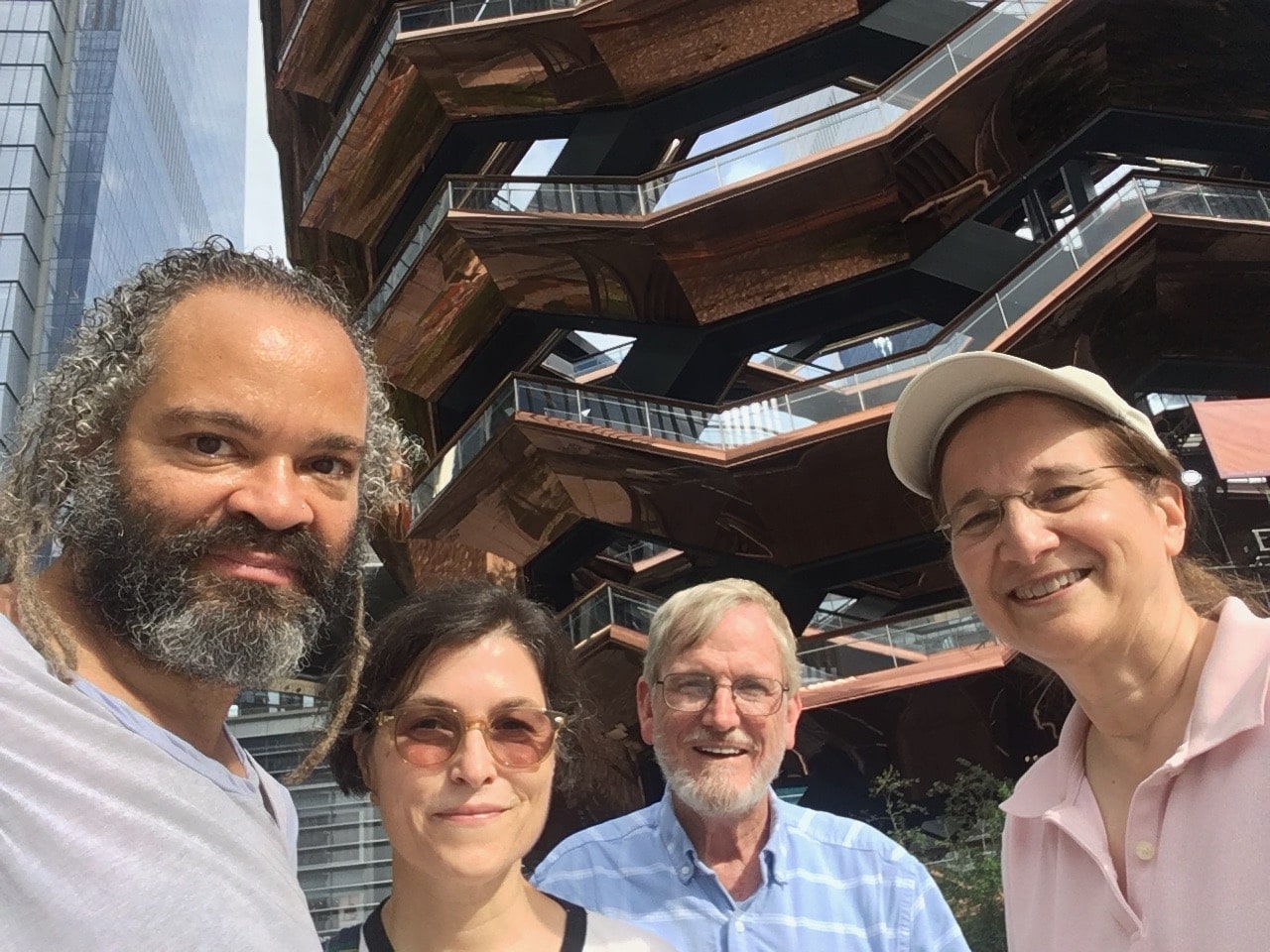
After the morning grief group I facilitated, I took the train into NYC to meet three people who had lost their spouses. All are part of Soaring Spirits. One was also from NJ, and the other two were from Park Slope in Brooklyn.  We walked on the High Line and had dinner at the Chelsea Market. We have agreed to do this on the third Saturday of every month.

Subscribe

Contact Us

2 comments add your comment

Share your thoughts and ideas

This site uses Akismet to reduce spam. Learn how your comment data is processed.

The Jan Lilien Education Fund!

NY-NJ Meetup
×
20 Under 40

Read: January 2019

Get this book

20 Under 40 Fiction

by Various Writers Under 40

Short Stories that Will Define the Future of American Letters

The New Yorker’s collection of short stories – 20 Under 40 – is a collection of twenty writers “whose work will help define the future of American letters.”

Some of these I had read in The New Yorker and others I had missed. Either way, they were a pleasure to read.

As The New Yorker wrote,

The range of voices is extraordinary. There is the lyrical realism of Nell Freudenberger, Philipp Meyer, C. E. Morgan, and Salvatore Scibona; the satirical comedy of Joshua Ferris and Gary Shteyngart; and the genre-bending tales of Jonathan Safran Foer, Nicole Krauss, and Téa Obreht. David Bezmozgis and Dinaw Mengestu offer clear-eyed portraits of immigration and identity; Sarah Shun-lien Bynum, ZZ Packer, and Wells Tower offer voice-driven, idiosyncratic narratives. Then there are the haunting sociopolitical stories of Chimamanda Ngozi Adichie, Daniel Alarcón, and Yiyun Li, and the metaphysical fantasies of Chris Adrian, Rivka Galchen, and Karen Russell.

Each of these writers reminds us why we read. And each is aiming for greatness: fighting to get and to hold our attention in a culture that is flooded with words, sounds, and pictures; fighting to surprise, to entertain, to teach, and to move not only us but generations of readers to come. A landmark collection, 20 Under 40 stands as a testament to the vitality of fiction today.

I recommend this collection of short stories.

Subscribe

Contact Us

×
Sing, Unburied, Sing

Read: October 2024

Get this book

Sing, Unburied, Sing

by Jesmyn Ward

I started reading Jesmyn Ward‘s novel Sing, Unburied, Sing today. The New York Times selected it as one of the best books of the 21st century and awarded it the National Book Award. According to The New York Times, Jesmyn Ward‘s historic second National Book Award winner is “perfectly poised for the moment.” It’s an intimate portrait of three generations of a family and an epic tale of hope and struggle.

Jojo is thirteen years old and is trying to understand what it means to be a man. He has several father figures to learn from, including his Black grandfather, Pop. However, Jojo’s understanding is complicated by other men in his life: his absent White father, Michael, who is being released from prison; his absent White grandfather, Big Joseph, who refuses to acknowledge him; and the memories of his deceased uncle, Given, who died as a teenager.

His mother, Leonie, is inconsistent in her and her toddler daughter’s lives. She is a flawed mother in constant conflict with herself and those around her. She is Black, and her children’s father is White. She wants to be a better mother but struggles to prioritize her children over her own needs, particularly her drug use. Tormented and comforted by visions of her deceased brother, which only come to her when she’s high, Leonie is embattled in ways that reflect the harsh reality of her circumstances.

When their father is released from prison, Leonie takes her kids and a friend in her car and drives north to Mississippi and Parchman Farm, the State Penitentiary. At Parchman, there is another thirteen-year-old boy, the ghost of a deceased inmate who carries the ugly history of the South with him in his wanderings. With his supernatural presence, this ghostly figure also has something to teach Jojo about fathers and sons, legacies, violence, and love.

Described as a majestic and unforgettable family story, ‘Sing, Unburied, Sing‘ is rich with Ward‘s distinctive, lyrical language. As noted by The Philadelphia Inquirer, her unique narrative style takes readers on ‘an odyssey through rural Mississippi’s past and present.’

×
The School for Good Mothers

Read: February 2023

Get this book

The School for Good Mothers

by Jessamine Chan

The School for Good Mothers by Jessamine Chan is a searing page-turner that is also a transgressive novel of ideas about the perils of “perfect” upper-middle-class parenting; the violence enacted upon women by both the state and, at times, one another; the systems that separate families; and the boundlessness of love, The School for Good Mothers introduces, in Frida, an everywoman for the ages.

Although it has been forty-two years since I became a parent, I still remember the anxiety of being a father. What if I could not be a good dad? Fortunately, I never had a bad like Frida. or lived in an age where parents would be sent to “a Big Brother-like institution that measures the success or failure of a mother’s devotion.”

Reading The School for Good Mothers was a reminder that solutions like this are possible unless we are willing to invest in families so that the skills and support are there to resolve any issues in the home. As a widow, I found Frida’s inner dialogue comparable to the early stages of my grief journey—the total isolation and fear of failing dominated my first months of mourning.

The School for Good Mothers had been on my book list since the middle of last year. I recommend it without reservations! Jan would have already read it, and we would be debating its fine points.

The Goodreads summary provides an overview,

In this taut and explosive debut novel, one lapse in judgement lands a young mother in a government reform program where custody of her child hangs in the balance.

Frida Liu is struggling. She doesn’t have a career worthy of her Chinese immigrant parents’ sacrifices. She can’t persuade her husband, Gust, to give up his wellness-obsessed younger mistress. Only with Harriet, their cherubic daughter, does Frida finally attain the perfection expected of her. Harriet may be all she has, but she is just enough.

Until Frida has a very bad day.

The state has its eyes on mothers like Frida. The ones who check their phones, letting their children get injured on the playground; who let their children walk home alone. Because of one moment of poor judgment, a host of government officials will now determine if Frida is a candidate for a Big Brother-like institution that measures the success or failure of a mother’s devotion.

Faced with the possibility of losing Harriet, Frida must prove that a bad mother can be redeemed. That she can learn to be good.

Using dark wit to explore the pains and joys of the deepest ties that bind us, Chan has written a modern literary classic.


The Jan Lilien Education Fund sponsors ongoing sustainability and environmental awareness programs. Gifts made this month; I will match dollar-for-dollar. All donations are tax-deductible.

Subscribe

Contact Us

I receive a commission when you buy a book or product using a link on this page. Thank you for supporting Sharing Jan’s Love blog.


×
Autocracy, Inc.: The Dictators Who Want to Run the World

Read: January 2025

Get this book

Autocracy, Inc.

by Anne Applebaum

Today, I plunged into the captivating world of “Autocracy, Inc.: The Dictators Who Want to Run the World” by Anne Applebaum. I listened to an engaging discussion between her and the Executive Director of the YIVO Institute for Jewish Research, Jonathan Brent. Their insights left me eager for more, and I couldn’t resist making this book my next read. I’m thrilled to dive deeper into her thought-provoking perspective!

This compelling New York Times bestseller by the Pulitzer Prize-winning author paints a chilling picture of how autocratic regimes join forces to erode democracy globally. Applebaum sheds light on this pressing issue and offers insights on how we can unite to fight back.

We think we know what an autocratic state looks like: An all-powerful leader is at the top. He controls the police. The police threaten the people with violence. There are evil collaborators and maybe some brave dissidents.

But in the 21st century, that bears little resemblance to reality. Nowadays, autocracies are underpinned not by one dictator but by sophisticated networks composed of kleptocratic financial structures, surveillance technologies, and professional propagandists, all of which operate across multiple regimes, from China to Russia to Iran. Corrupt companies in one country do business with corrupt companies in another. The police in one country can arm and train the police in another, and propagandists share resources and themes, pounding home the same messages about the weakness of democracy and the evil of America.

International condemnation and economic sanctions cannot move the autocrats. Even popular opposition movements, from Venezuela to Hong Kong to Moscow, don’t stand a chance. The members of Autocracy, Inc. aren’t linked by a unifying ideology, like communism, but rather by a common desire for power, wealth, and impunity. In this urgent treatise, which evokes George Kennan’s essay calling for “containment” of the Soviet Union, Anne Applebaum calls for the democracies to reorient their policies to fight a new threat fundamentally.


In the video, Jonathan Brent asks Anne Applebaum to read the last paragraph of “Autocracy, Inc.: The Dictators Who Want to Run the World.”

There is no liberal world order anymore, and the aspiration to create one no longer seems real. But there are liberal societies, open and free countries that offer a better chance for people to live useful lives than closed dictatorships do. They are hardly perfect. Those that exist have deep flaws, profound divisions, and terrible historical scars. But that’s all the more reason to defend and protect them. So few of them have existed across human history; so many have existed for a short time and then failed. They can be destroyed from the outside and from the inside, too, by division and demagogues. Or they can be saved. But only if those of us who live in them are willing to make the effort to save them.

After finishing Autocracy, Inc.: The Dictators Who Want to Run the World,” this closing paragraph should be a call to action. Failure to respond to the challenge will doom our future to an unacceptable one. I recommend this book and encourage people to read it, discuss its contents, and take action to save our collective future.


When you purchase a book through one of my links, I earn a small commission that helps support my passion for reading. This contribution allows me to buy even more books to share with you, creating an incredible cycle of discovering great reads together! Your support truly makes a difference!


×
Look What You Made Me Do

Read: May 2026

Get this book

Look What You Made Me Do

by John Lanchester

Look What You Made Me Do” by John Lanchester is a darkly comedic tale that delves deep into the intricate web of love, trust, resentment, and entitlement. The narrative weaves the lives of two women from contrasting generations, drawing them into a thrilling conflict where wits and wills are tested to the limit. As tension mounts and secrets unravel, only one will rise to claim victory in this captivating showdown.

“Every successful marriage has its own private language.” So it is for baby boomer Kate and her beloved architect husband Jack, thirty years into their seemingly idyllic life in metropolitan North London. And so it is for spiky millennial screenwriter Phoebe and her charming loafer of a partner, Tony.

But when Phoebe’s steamy television series, Cheating, becomes the year’s most talked-about show, Kate thinks she sees details and intimacies of her marriage in it that only she and her husband could have known. Who has betrayed whom? Who has stolen whose story―and why?


John Lanchester is the author of five novels, including the best-selling *The Debt to Pleasure* and *Capital*. His works have received several accolades, including the Hawthornden Prize, the Whitbread First Novel Award, and the E. M. Forster Award. His books have also been longlisted for the Booker Prize and translated into more than twenty-five languages. Lanchester is a regular contributor to The New Yorker and The New York Review of Books. He resides in London.


Discover your next favorite book and dive into a world of curated, exciting reads by purchasing through my links. You’ll have access to a diverse selection of books I’ve personally vetted for quality and enjoyment. Supporting these selections not only helps me continue to provide you with personalized recommendations but also ensures you have access to meaningful stories that enrich your life. Your support truly makes a difference in helping me share more books and insights with you!


×
Three Summers

Read: February 2025

Get this book

Three Summers: A Novel

by Margarita Liberaki

Today, I began reading Margarita Liberaki‘s Three Summers, translated by Karen Van Dyck. This edition features a detailed introduction by Ms. Van Dyck, in which she shares her experiences meeting Ms. Liberaki and collaborating with her on the translation. The original novel, written in Greek, was titled The Straw Hats, but Ms. Van Dyck felt that this title would not resonate with foreign readers similarly.

Three Summers is the story of three sisters who grew up in the countryside near Athens before the outbreak of the Second World War. The sisters live in a large, old house surrounded by a beautiful garden. The oldest sister, Maria, is adventurous and eager to settle down and start her own family. The middle sister, Infanta, is gorgeous but emotionally distant. Katerina, the narrator, and the youngest sister is dreamy and rebellious.

Throughout three summers, the sisters share and keep secrets, fall in and out of love, and try to understand their parents and other adult figures. They also observe the peculiar behaviors of friends and neighbors while worrying about and discovering their identities. Karen Van Dyck’s translation beautifully captures the light and warmth of this modern Greek classic.

Margarita Liberaki (1919-2001) was born in Athens and raised by her grandparents, who owned the Fexis bookstore and publishing house. In addition to her novel Three Summers, she authored The Other Alexander (1950) and The Mystery (1976). She also wrote several plays, including Candaules’ Wife (1955) and The Danaïds (1956), part of a cycle she called Mythical Theater. Furthermore, she contributed screenplays, such as Jules Dassin’s Phaedra (1962) and Diaspora (1999), which focused on Greek intellectuals in exile in Paris during the junta. Her novel Three Summers is now a standard part of public education in Greece and Cyprus and was adapted into a television miniseries in 1995.

Karen Van Dyck is the Kimon A. Doukas Professor of Modern Greek Literature at Columbia University. Her research focuses on modern Greek literature, diaspora literature, gender studies, and translation. She has edited or co-edited several poetry anthologies, including A Century of Greek Poetry (2004), The Greek Poets: Homer to the Present (2010), and Austerity Measures: The New Greek Poetry (2017) for NYRB Poets. Additionally, her translations have appeared in Brooklyn Rail, Asymptote, and The Baffler.


When you purchase a book through one of my links, I earn a small commission that helps support my passion for reading. This contribution allows me to buy even more books to share with you, creating an incredible cycle of discovering great reads together! Your support truly makes a difference!


×