
Wedding Roadblocks

Estimated reading time: 16 minutes, 1 second

Interfaith Option

“I talked with Fr. John this morning,” I said to Jan. “He was going to the subway. He asked about how you are, and if it was true, we are planning to get married. I gave him a synopsis of where we are.” I knew Jan did not like me to reveal family matters to others. “He offered to marry us if we could not find anyone else.”

That is very kind, but he is not a Rabbi.

I chuckled. “Both Fr. John and I knew it would not help. When I worked for him, I attended Sunday services regularly until we met; he is someone I like and trust fully.

Jan looked into my eyes with a surprised look and asked, “You went to church regularly?”

I nodded my head. “When I met you at your party, I was planning to leave so I could make it back in time for church. Once I kissed your sweet lips, I gave up on that plan.”

You always said my kisses were powerful,” Jan giggled. “I just never knew they were that strong.”

Being an incurable romantic, I reached over and kissed her sweet lips.

“I presumed you were going to services regularly when we met.”

“No, I have not been in years and years.”

“Oh? Why is your family holding up the wedding for the lack of a rabbi?

Jan put on her shoes so we could go out for dinner.

It would be humorous if it was not so absurd.

A NY Rabbi

I found this classified ad in the Village Voice,” Jan said. Need a Rabbi for an Interfaith Marriage?” She handed the paper to me. I am going to call and see if we can meet with him before Sunday; that way, if they suggest postponing the wedding, we will have a solution in our pocket!

I smiled at her and was optimistic we would marry this year for the first time in months. 

“Let’s call now,” I said. An interfaith service would be nice if we could get your parents to agree.

Jan dialed the phone but said, “I have thought about that since you told me about going to services at St. John’s. My parents would be upset, but I want our wedding to reflect that we are two people joining together.

Can I speak with the Rabbi,” Jan asked?

She provided an overview of our plans for our wedding. 

“When can we meet with you?”

We agreed to meet the following afternoon. 

The Rabbi Says Yes!

Getting off of the elevator on the top floor, I stopped and kissed Jan. “I love you so much. If he says yes and can marry us in August, I will be the happiest man in NY City!” We had held hands on the train to the Upper West Side and tried not to get too excited. I could no longer hold back my excitement that we could be married in four months!

Jan knocked on the door. A woman in her thirties welcomed us and directed us to the Rabbi’s study. 

We stood up and greeted the Rabbi when he entered the room.

“So the two of you want to get married but cannot find anyone to officiate.”

Yes, that is correct,” Jan said and then gave an overview of our interviews in NJ. 

“Like most Jews, I would like it if you raised your children Jewish, but I believe that is a choice the two of you will need to make when and if you become parents.”

Wow, I said to myself, did he say yes?

Which one of you is Jewish and which one is not?

Jan explained our backgrounds. “Richard might be more observant than I am,” Jan said with a smile

We talked about the wedding and the date, and everything was going so smoothly that I could not imagine any issue derailing our plans.

“Richard, would you want an officiant from your faith community to participate,” the Rabbi asked.

Ideally, yes,” I said as tears welled up in my eyes. “But I do not want to do anything that would make it impossible for us to get married in August and love each other forever.”

“I have done several weddings with a pastor. I believe it makes for a stronger marriage as it combines both families and their traditions.

I could see Jan nodding her head. 

“Jan and I can talk about it and get back to you,” I said. “We are both so pleased you will marry us!”


Next Page

Pages: 1 2 3 4 5

14 comments add your comment

Share your thoughts and ideas

This site uses Akismet to reduce spam. Learn how your comment data is processed.

Previous Post:

Next Post:

The Jan Lilien Education Fund!

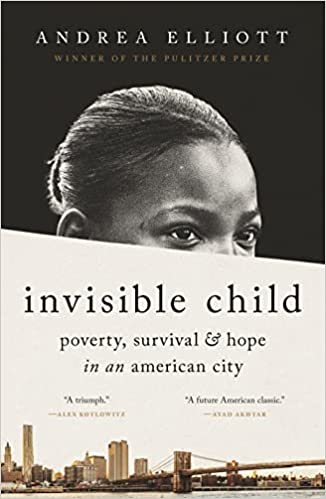
Invisible Child

Read: December 2021

Get this book

Invisible Child: Poverty, Survival & Hope in an American City

by Andrea Elliott

Invisible Child: Poverty, Survival & Hope in an American City by Andrea Elliott was a gift from my son Jon. The New York Times selected “Invisible Child” as one of the best books published this year. It is indeed one of the top books on my all-time list.

GoodReads summary provides a good overview,

The riveting, unforgettable story of a girl whose indomitable spirit is tested by homelessness, poverty, and racism in an unequal America—from Pulitzer Prize-winning journalist Andrea Elliott of The New York Times

Invisible Child follows eight dramatic years in the life of Dasani Coates, a child with imagination as soaring as the skyscrapers near her Brooklyn homeless shelter. Born at the turn of a new century, Dasani is named for the bottled water that comes to symbolize Brooklyn’s gentrification and the shared aspirations of a divided city. As Dasani grows up, moving with her tight-knit family from shelter to shelter, this story goes back to trace the passage of Dasani’s ancestors from slavery to the Great Migration north. When Dasani comes of age, New York City’s homeless crisis explodes as the chasm deepens between rich and poor.

In the shadows of this new Gilded Age, Dasani must lead her seven siblings through a thicket of problems: hunger, parental drug addiction, violence, housing instability, segregated schools, and the constant monitoring of the child-protection system. When, at age thirteen, Dasani enrolls at a boarding school in Pennsylvania, her loyalties are tested like never before. As she learns to “code switch” between the culture she left behind and the norms of her new town, Dasani starts to feel like a stranger in both places. Ultimately, she faces an impossible question: What if leaving poverty means abandoning the family you love?

By turns heartbreaking and revelatory, provocative and inspiring, Invisible Child tells an astonishing story about the power of resilience, the importance of family, and the cost of inequality. Based on nearly a decade of reporting, this book vividly illuminates some of the most critical issues in contemporary America through the life of one remarkable girl.

Jan and I were involved and knew that child poverty and homelessness needed repair. In addition, Jan lived on Washington Park across from Ft. Greene Park in 1974-75. We knew the neighborhood where much of the book’s story takes place. 

Before meeting Jan in 1973, I was both a community/tenant organizer and a youth worker. In the latter role, I made weekly hostel trips for eight to ten young boys from East Williamsburg during 1973. The trips were the first the boys had ever been outside of their neighborhood.

Many of them had imaginations like Dasani. They also had her instinct to fight. One of my first tasks was to check for any weapons.

Decades later, when I would see any of them, now adults, they would ask when we were going on another trip. I wish I had met Jan when I made those trips. She would have helped me improve them and document the impact. If I could re-write history, I would have her join me as the second adult on the hostel trips.

After that summer, it was clear my primary skills were as a community/tenant organizer. Over the next few years, my work focused on creating affordable and supportive housing.

Jan and I did meaningful work that made a difference, yet the need for a permanent solution to the crisis remains. The book highlights the crucial role of resilience, the importance of family, and the cost of inequality. As a nation, we cannot undermine those values by breaking up families, impeding resilience, and maintaining racial and economic inequality. 

The current debate in Washington over the Build Back Better legislation needs to focus not on how much we spend but on its impact on children and families

David Brooks, a conservative commentator, has supported these expenditures for what they can do to address this country’s cultural and economic crisis. 

These packages say to the struggling parents and the warehouse workers: I see you. Your work has dignity. You are paving your way. You are at the center of our national vision.

This is how you fortify a compelling moral identity, which is what all of us need if we’re going to be able to look in the mirror with self-respect. This is the cultural transformation that good policy can sometimes achieve. Statecraft is soulcraft.

If you can only read one book this year, this is the one to read. Child poverty, homelessness, and inequality impact all of us. Ending child poverty and homelessness will make us a healthier and more inclusive nation. It is time for a compelling moral call to action!

Subscribe

Contact Us

When you buy a book or product using a link on this page, I receive a commission. Thank you for supporting Sharing Jan’s Love blog.

×
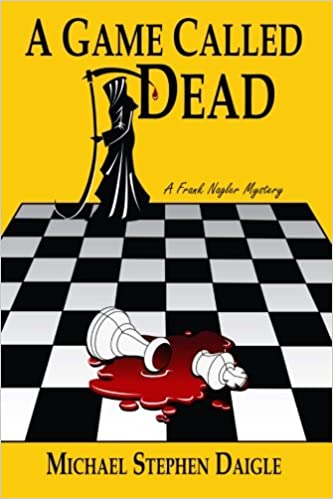
A Game Called Dead

Read: November 2021

Get this book

A Game Called Dead

by Michael Stephen Daigle

A Game Called Dead by Michael Stephen Daigle is the sequel to “The Swamps of Jersey,” the first Frank Nagler Mystery. Having read the fourth one – The Red Hand, I recently read the first one and thought this was an excellent time to read the second in this impressive deceptive series.

Reading the Frank Nagler Mysteries is rare when this reviewer knows the author. Mr. Daigle wrote this is the overview of A Game Called Dead.

Nagler is called to investigate the brutal attack on two women at the local college. It begins a tale of urban terror, which seems to be directed at Nagler and his associates.

The story introduces the mysterious terrorist #ARMEGEDDON, who taunted the police from cyberspace.

The story also digs deeper into Nagler’s past, especially the old Charlie Adams serial-killer case, and his relationship with Lauren Fox, who played a crucial role in exposing the political corruption in “Swamps.” She is back and steps into the front of Nagler’s life.

The story also introduced Harriet Waddley-Jones, a college dean, Nagler’s nemesis, and later ally.

Each book is a challenge to write a “better” book. In this case, I wanted tighter, faster action to develop a theme and flow to help carry the story. Sound and the description of sound are keys.

I also wanted Nagler to confront aspects of his past. Can he reconcile them, or will they always haunt him?

This reviewer’s opinion was a more substantial plot than the first book in the Frank Nagler Mysteries. Like all good mysteries, the suspense built page by page, and I figured out who the villain was late in the novel.

The one part that was difficult for me to read was the ending and the potential reigniting of the relationship with Lauren Fox. Having lost Jan, my wife, this year, I am aware of Frank Nagler’s pain in the first book about losing his wife. Ms. Fox only appeared in The Swamps of Jersey as a lost friend. I understand that some widows need to find love again to feel happy, which is not what I need or am seeking. The next book may provide some difficult moments on this topic, but I look forward to reading the next Frank Nagler Mystery.

Subscribe

Contact Us

When you buy a book or product using a link on this page, I receive a commission. Thank you for supporting Sharing Jan’s Love blog.

×
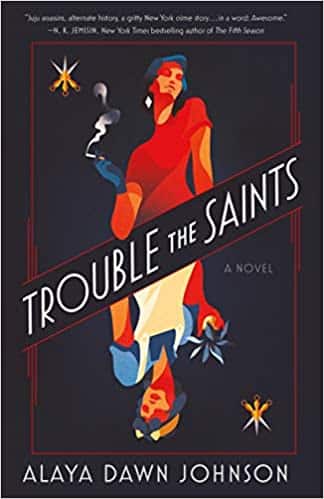
Trouble the Saints

Read: January 2022

Get this book

Trouble the Saints

by Alaya Dawn Johnson

Trouble the Saints by Alaya Dawn Johnson is one of NPR’s Books We Love from 2020. The dangerous magic of The Night Circus meets the powerful historical exploration of The Underground Railroad in this timely and unsettling novel, set against the darkly glamorous backdrop of New York City at the dawn of WWII. Amidst the whir of city life, a girl from Harlem is drawn into the glittering underworld of Manhattan, where she’s hired to use her knives to strike fear amongst its most dangerous denizens.

The book is written in three sections with different protagonists and voices. Phyllis, or Pea as her friends call her, is a black assassin for a white mob boss narrates the first section of the book. Her saint’s hands are the ability to use knives to commit murder. She can also pass as white as Phyllis, but she is a black woman from Harlem as Pea. The section she narrates is difficult at first to follow as she attempts to deal with the consequences of her actions. Can the past ever be the past?

Dev, Indian and Phyllis’s lover, narrates the second section. He is an undercover cop who protects her and helps her free herself from the mob boss. This section is located in the Hudson Valley and highlights the tensions before the war between whites and non-whites.

The third protagonist, Tamara, narrates this section. The war separates Phyllis and Dev. Phyllis is pregnant, and Dev and Tamara’s love interest are serving in the military. This section brings together the threads and reminds us that the past is never the past.

As Goodreads summarizes the book,

But the ghosts from her past are always by her side—and history has appeared on her doorstep to threaten the people she loves most.

Can one woman ever sacrifice enough to save an entire community?

Trouble the Saints is a dazzling, daring novel—a magical love story, a compelling chronicle of interracial tension, and an altogether brilliant and deeply American saga.

I recommend this book and encourage all readers to read it to the end.

Subscribe

Contact Us

When you buy a book or product using a link on this page, I receive a commission. Thank you for supporting Sharing Jan’s Love blog.

×
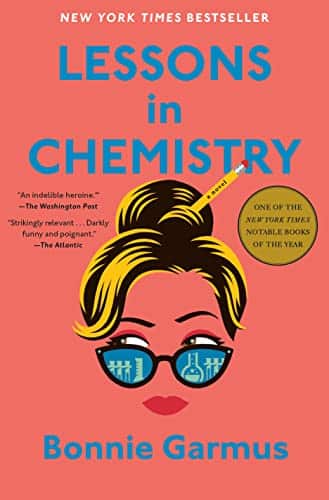
Lessons in Chemistry

Read: January 2023

Get this book

Lessons in Chemistry: A Novel

by Bonnie Garmus

Lessons in Chemistry: A Novel by Bonnie Garmus is a must-read book as it reimagines the gender dynamics of the 1950s and early 1960s. Elizabeth Zott, a chemist, struggles in a male-dominated world where her work is not taken seriously until she meets Calvin Evans. She describes their relationship, “Calvin and I were soulmates,” like Jan and I viewed ours.

What underlies their love affair was “a mutual respect for the other’s capabilities.” “Do you know how extraordinary that is?” she said. That a man would treat his lover’s work as seriously as his own?” Of course, every relationship should be based on the same dynamics, but even after seventy years, we still struggle to achieve equality in our society.

I highly recommend this novel. Reading the story, the Zott/Evans relationship reminded me of the love that Jan and I shared. I know that Jan would have loved this book.

Laugh-out-loud funny, shrewdly observant, and studded with a dazzling cast of supporting characters, Lessons in Chemistry is as original and vibrant as its protagonist. Like Jan, Elizabeth Zott, the protagonist, would be the first to point out that there is no such thing as an average woman. Chemist Elizabeth Zott is not your average woman.

Although Jan and Elizabeth had much in common, I felt Madeline (aka Mad), Elizabeth’s daughter, was Jan’s alter ego in this novel. Jan was smart and ahead of her classmates, just like Mad was. She was breaking barriers when she was Mad’s age.

I also connected to Six Thirty, the dog. Like Oscar, Six Thirty was more intelligent than the average dog.

Lessons in Chemistry has been the number one best-selling book in the New York Times for thirty-four weeks.

The Goodreads summary provides an overview,

It’s the early 1960s and Elizabeth Zott’s all-male team at Hastings Research Institute takes a very unscientific view of equality. Except for one: Calvin Evans, the lonely, brilliant, Nobel–prize-nominated grudge-holder who falls in love with—of all things—her mind. True chemistry results.

But like science, life is unpredictable. Which is why a few years later Elizabeth Zott finds herself not only a single mother, but the reluctant star of America’s most beloved cooking show Supper at Six. Elizabeth’s unusual approach to cooking (“combine one tablespoon acetic acid with a pinch of sodium chloride”) proves revolutionary. But as her following grows, not everyone is happy. Because as it turns out, Elizabeth Zott isn’t just teaching women to cook. She’s daring them to change the status quo.


The Jan Lilien Education Fund sponsors ongoing sustainability and environmental awareness programs. Gifts made this month; I will match dollar-for-dollar. All donations are tax-deductible.

Subscribe

Contact Us

I receive a commission when you buy a book or product using a link on this page. Thank you for supporting Sharing Jan’s Love blog.


×
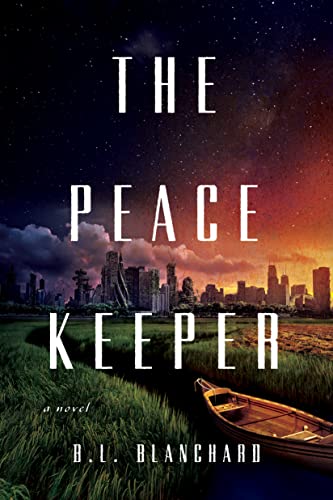
The Peacekeeper

Read: May 2022

Get this book

The Peacekeeper: A Novel

by B.L. Blanchard

The Peacekeeper: A Novel by B.L. Blanchard is about North America, where The United States and Canada do not exist. After reading about Ethiopia during the ill-fated Italian invasion, I looked for an alternative history of my continent. An independent Ojibwe nation surrounding the Great Lakes is the change in venue that I was seeking.

Although crime mysteries are not my preferred genre, I found The Peacekeeper: A Novel by B.L. Blanchard a pageturner and a highly recommended book. Chibenashi’s works resolve a second murder twenty years after his mothers. The victim is his mother’s best friend. The search for truth will change his life and those close to him.

The Goodreads summary:

Against the backdrop of a never-colonized North America, a broken Ojibwe detective embarks on an emotional and twisting journey toward solving two murders, rediscovering family, and finding himself.

In the village of Baawitigong, a Peacekeeper confronts his devastating past.

Twenty years ago, Chibenashi’s mother was murdered, and his father confessed. Ever since caring for his still-traumatized younger sister has been Chibenashi’s privilege and penance. Now, another woman is slain on the same night of the Manoomin harvest—his mother’s best friend. The murder leads to a seemingly impossible connection that takes Chibenashi far from the only world he’s ever known.

The central city of Shikaakwa is home to the victim’s cruelly estranged family—and to two people Chibenashi never wanted to see again: his imprisoned father and the lover who broke his heart. As the questions mount, the answers will change his and his sister’s lives forever because Chibenashi is about to discover that everything about those lives has been a lie.


Subscribe

Contact Us

When you buy a book or product using a link on this page, I receive a commission. Thank you for supporting Sharing Jan’s Love blog.

×
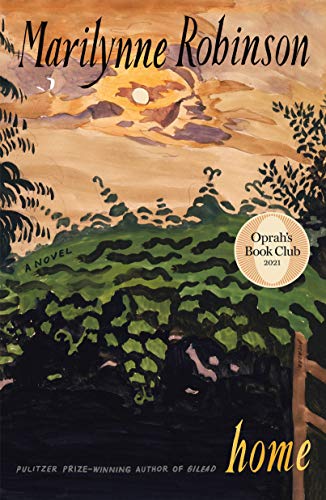
Home: A Novel

Read: February 2022

Get this book

Home: A Novel

by Marilynne Robinson

Home: A Novel by Marilynne Robinson is a moving and healing book about families, family secrets, the passing of the generations, love, death, and faith. Robinson’s most significant work is an unforgettable embodiment of the most profound and universal emotions. Although I have not read the other novels in this series, I plan to add them to my list. I highly recommend this book.

It is a moving and healing book about families, family secrets, the passing of generations, love, death, and faith. With the loss of the love of my life ten months ago, these are topics that I have spent time thinking about. Ms. Robinson’s powerful writing weaved a story that I could not stop reading.

Again, I highly recommend this novel.

This is the Goodreads summary.

Hundreds of thousands were enthralled by the luminous voice of John Ames in Gilead Marilynne Robinson’s Pulitzer Prize-winning novel. Home is an entirely independent, deeply affecting novel that takes place concurrently in the same locale, this time in the household of Reverend Robert Boughton, Ames’s closest friend.

Glory Boughton, aged thirty-eight, has returned to Gilead to care for her dying father. Soon her brother, Jack—the prodigal son of the family, gone for twenty years—comes home too, looking for refuge and trying to make peace with a past littered with tormenting trouble and pain.

Jack is one of the great characters in recent literature. A bad boy from childhood, an alcoholic who cannot hold a job, he is perpetually at odds with his surroundings and with his traditionalist father, though he remains Boughton’s most beloved child. Brilliant, lovable, and wayward, Jack forges an intense bond with Glory and engages painfully with Ames, his godfather and namesake.

Home is a moving and healing book about families, family secrets, the passing of the generations, love, death, and faith. Robinson’s most significant work is an unforgettable embodiment of the most profound and universal emotions.

Subscribe

Contact Us

When you buy a book or product using a link on this page, I receive a commission. Thank you for supporting Sharing Jan’s Love blog.

×

Discover more from Sharing Jan’s Love

Subscribe now to keep reading and get access to the full archive.

Continue reading