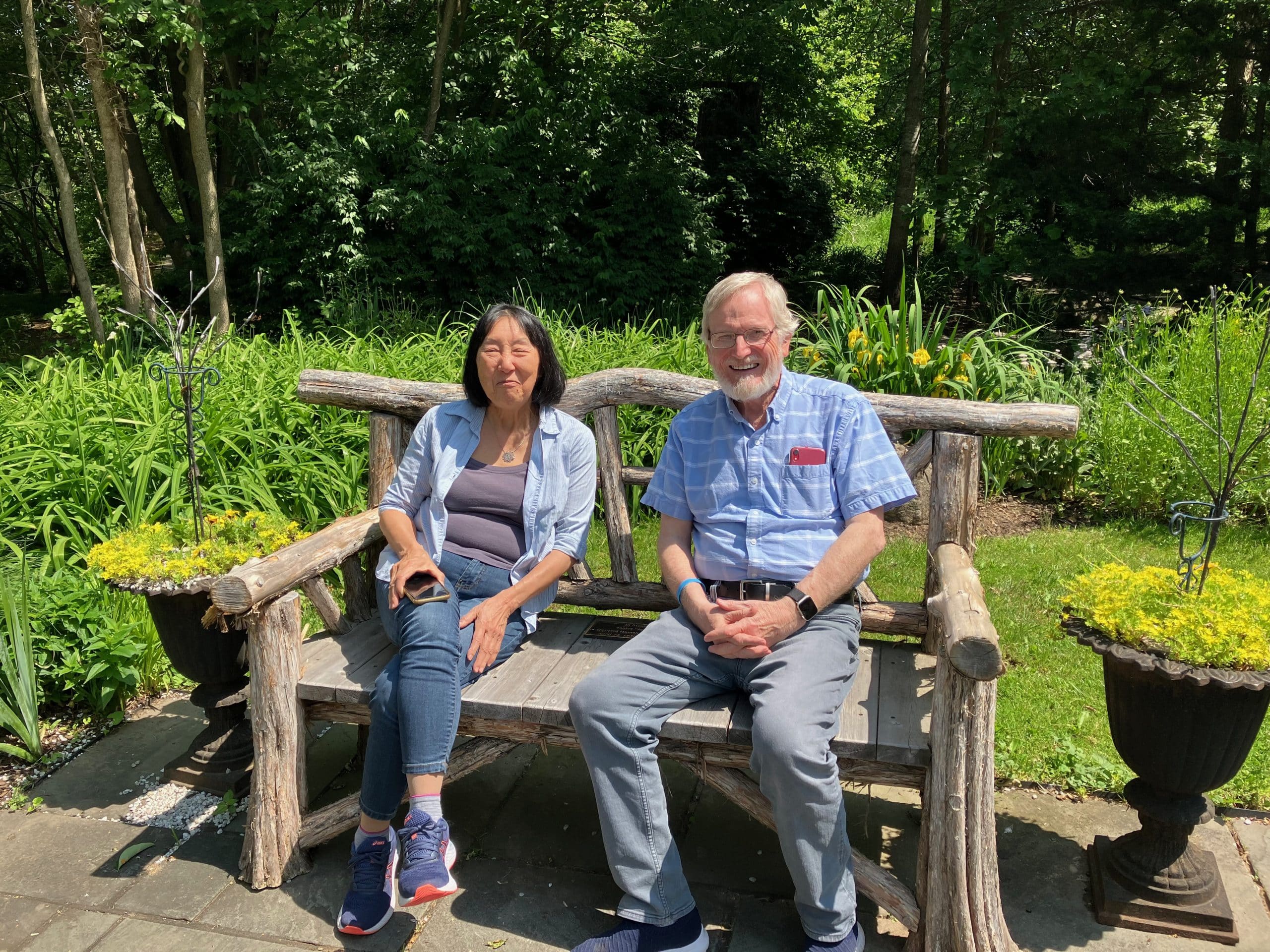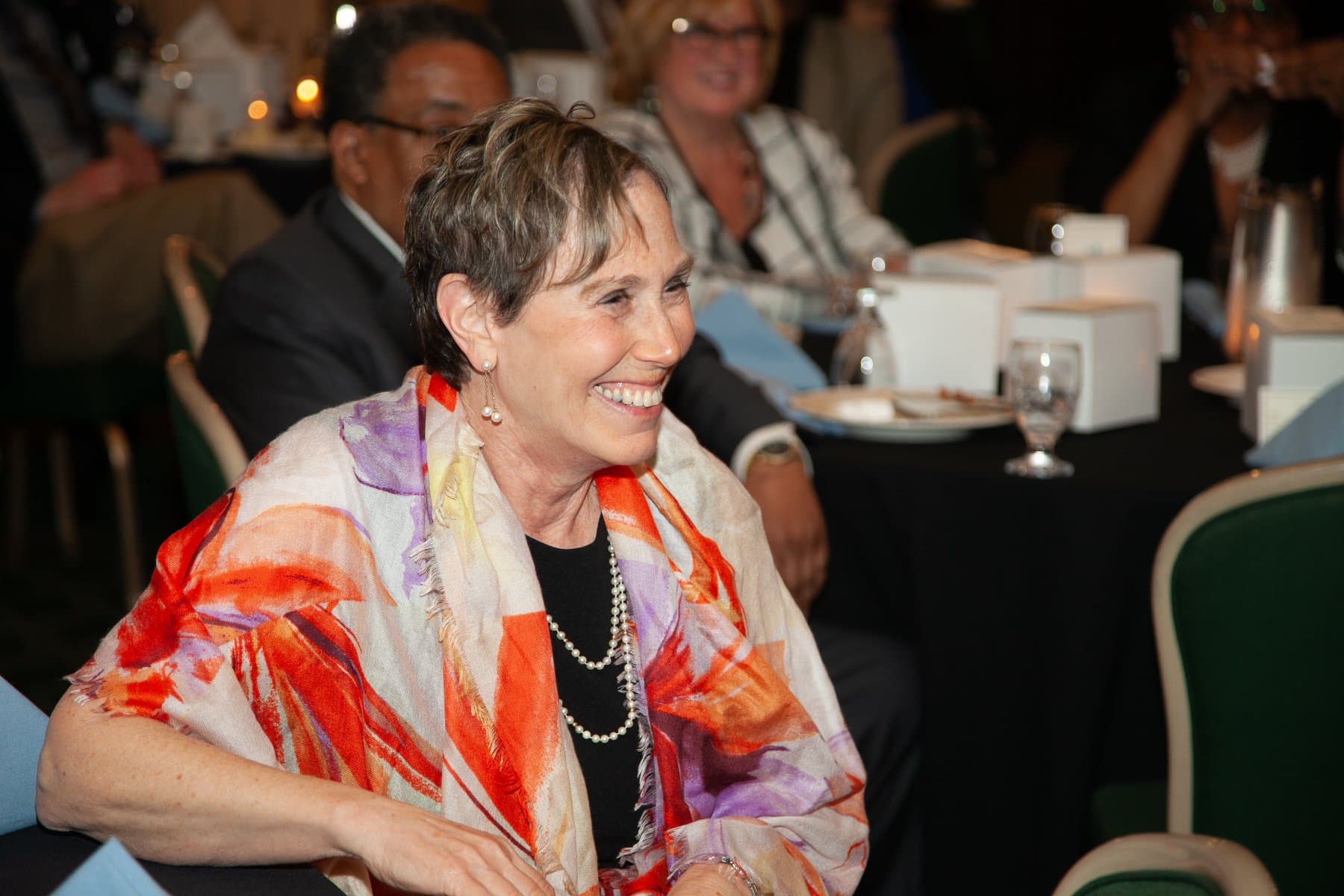

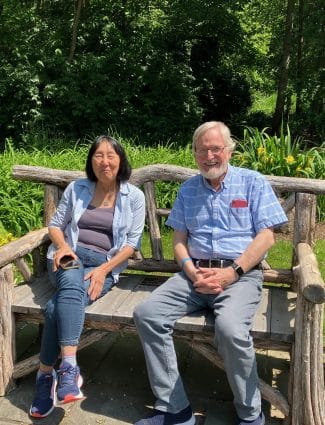
Donna and I Sitting on one of Jan's Benches

My Friends Validate My Progress

Jan Still Walks With Me in Hanson Park!

Estimated reading time: 2 minutes, 0 seconds
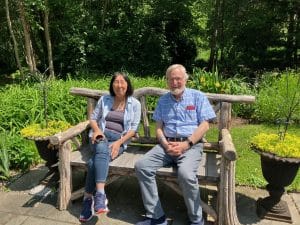
Donna and I are Sitting on one of Jan's Benches

Donna is Sitting Next to Me on One of Jan’s Benches.

Recently, I had two visitors from out of state who were friends in college with my late wife, Jan. I was excited to see them but also worried they might say something that would upset me about Jan. To avoid holiday parades; I took a longer route to pick them up from a friend’s house before arriving at Hanson Park.

As we approached Jan’s Garden and the Wind Sculpture, I was a tour guide and shared the park’s history with my guests. I explained why it was the perfect location for Jan’s living memorial. One of my guests remarked, “It’s much more impressive in person than in videos or pictures. Jan’s garden is so peaceful and beautiful!”

The sculpture’s arms were expanding and shrinking despite the slow wind. One of my guests observed that “It’s like an optical illusion. Our eyes are tricked into believing it’s getting smaller or larger, but it’s not.”

Sitting on the rocks in the amphitheater, my companions asked about my well-being and how I had been dealing with Jan’s passing two years ago. I shared with them how I’ve kept Jan’s memory alive and talked about the supportive communities I’ve found. I even mentioned how I felt Jan’s presence in her garden as if she was still with me and made a lighthearted joke about her watching us from behind a tree. My friends acknowledged my progress and reassured me that I was doing physically and mentally well. After not seeing them since the pandemic, receiving their kind words was comforting and unexpected.

Although I lost my beloved, I found a way to keep her memory alive. My guests complimented me on the beautiful living memorial I had created for Jan and told me I had inspired them. I felt flattered, but I knew my words were genuine and not self-interest-motivated.


The Jan Lilien Education Fund sponsors ongoing sustainability and environmental awareness programs. Gifts made this month; I will match dollar-for-dollar. All donations are tax-deductible.

Subscribe

Contact Us

I receive a commission when you buy a book or product using a link on this page. Thank you for supporting Sharing Jan’s Love blog.
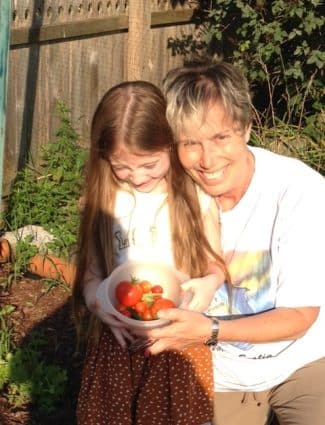


Jan’s Memorial Garden

Working with the Hanson Park Conservancy, we have taken significant steps in building Jan's Memorial Triangle Garden at Hanson Park including installing the Wind Sculpture.

Show thread (1)

The Wind Sculpture – A Poem

Jan's Memorial Triangle Garden in Hanson Park, featuring The Wind Sculpture by Lyman Whitaker Wind Sculptures, is truly a sight to behold. Its recent installation on November 4, 2022, has already become a source of inspiration.

My dear friend Mark Annett was so moved by its beauty that he penned a heartfelt poem during his visit on Saturday. The sculpture's impact is undeniable, even in its mere one-day existence.

2 comments add your comment

Share your thoughts and ideas

This site uses Akismet to reduce spam. Learn how your comment data is processed.

The Jan Lilien Education Fund!

Donna and I Sitting on one of Jan's Benches
×
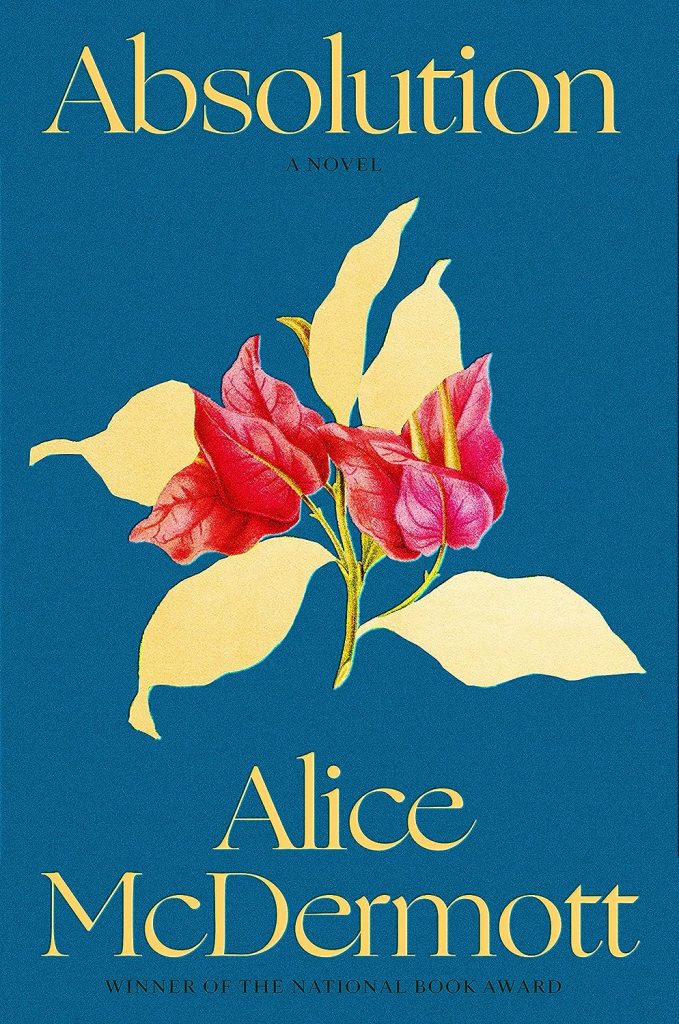
Absolution: A Novel

Read: November 2023

Get this book

Absolution: A Novel

by Alice McDermott

I started reading “Absolution: A Novel” by Alice McDermott today. The opening line immediately grabbed my attention: “You have no idea what it was like. For us. The women, I mean.” In most literature about the Vietnam War, American women, particularly wives, have been minor characters. However, in “Absolution,” they take center stage.

The book follows the story of two women, Tricia, a shy newlywed, and Charlene, a practiced corporate spouse and mother of three. They both found themselves in Saigon in 1963, forming a wary alliance. They balance the era’s mandate to be “helpmeets” to their ambitious husbands with their inchoate impulse to “do good” for the people of Vietnam.

Sixty years later, Charlene’s daughter reaches out to Tricia after encountering an aging Vietnam vet. Together, they look back at their time in Saigon, carefully considering that pivotal year and Charlene’s altruistic machinations. They discover how their lives as women on the periphery have been shaped and burdened by the same unintended consequences that followed America’s tragic interference in Southeast Asia.

This virtuosic new novel from Alice McDermott, one of our most observant and affecting writers, explores themes of folly and grace, obligation, sacrifice, and, finally, the quest for absolution in a broken world.


The Jan Lilien Education Fund sponsors ongoing sustainability and environmental awareness programs. Gifts made this month; I will match dollar-for-dollar. All donations are tax-deductible.

Subscribe

Contact Us

I receive a commission when you buy a book or product using a link on this page. Thank you for supporting Sharing Jan’s Love blog.


×
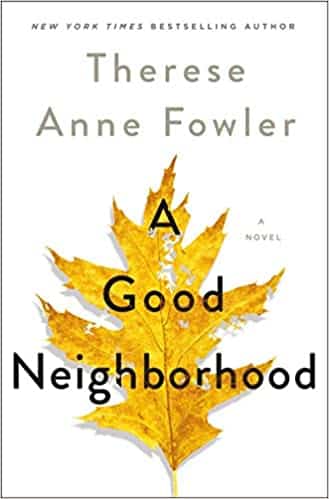
A Good Neighborhood

Read: September 2021

Get this book

A Good Neighborhood

by Therese Anne Fowler

A Good Neighborhood by Therese Anne Fowler is a book that was difficult to put down once I started it. A Good Neighborhood is a “gripping contemporary novel that examines the American dream through the lens of two families living side by side in an idyllic neighborhood, throughout one summer that changes their lives irrevocably.”

I selected the book as it focuses, among other issues, on gentrification and environmental degradation. But to say that is what it is about would be a disservice. It also includes a full range of the social issues of our time.

But with little in common except a property line, these two very different families quickly find themselves at odds: first, over an historic oak tree in Valerie’s yard, and soon after, the blossoming romance between their two teenagers. Told from multiple points of view, A Good Neighborhood asks big questions about life in America today ― what does it mean to be a good neighbor? How do we live alongside each other when we don’t see eye to eye? ― as it explores the effects of class, race, and heartrending star-crossed love in a story that’s as provocative as it is powerful.

Ms. Fowler narrates the book. Greek Chorus. By doing this, she ensures that we are part of the story as much as readers.

We need to find answers to the big questions if we are to be good neighbors.

  • What does it mean to be a good neighbor?
  • How do we live alongside each other when we don’t see eye to eye?

The effects of class, race, and heartrending star-crossed love make this a must-read book.

I recommend the book to all readers.

Subscribe

Contact Us

×
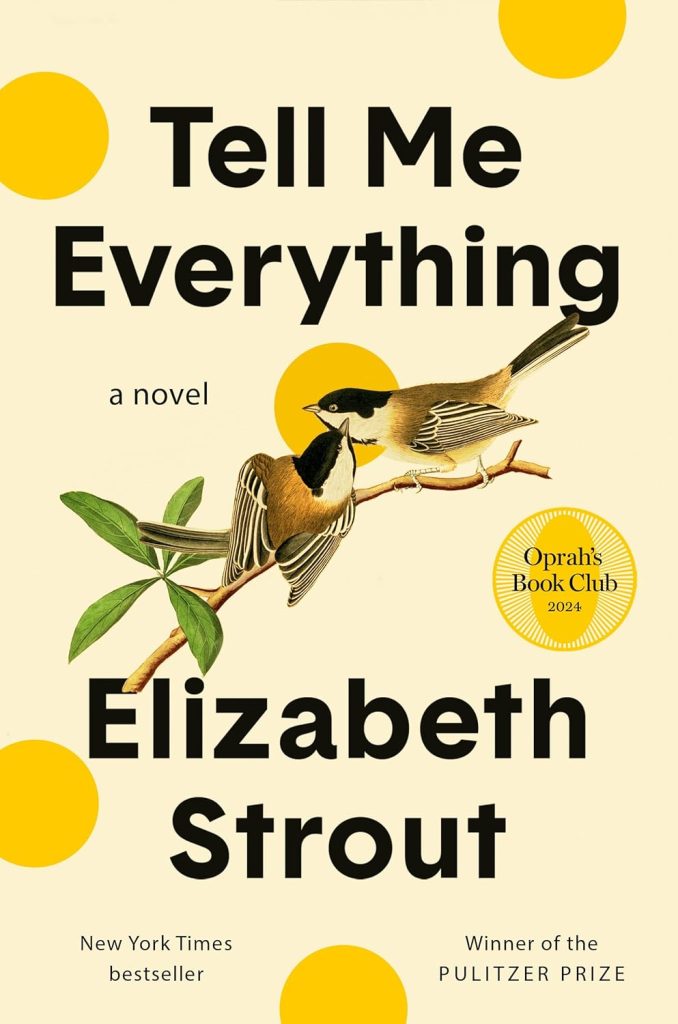
Tell Me Everything: A Novel

Read: January 2025

Get this book

Tell Me Everything: A Novel

by Elizabeth Strout

Today, I dived into “Tell Me Everything: A Novel” by Elizabeth Strout, and I’m already captivated. This book made it onto NPR’s best books list for 2024 and caught the eye of Oprah’s Book Club—no small feat! Strout writes with such empathy and emotional depth that it reflects her incredible talent. Lucy beautifully captures this sentiment by stating, “Love comes in many different forms, but it is always love.”

With her profound understanding of the human condition and silences that convey deep emotions, Elizabeth Strout returns to the town of Crosby, Maine, reuniting with her beloved characters—Lucy Barton, Olive Kitteridge, Bob Burgess, and others—as they confront a shocking crime, navigate love while choosing to remain apart, and ponder the question, as Lucy Barton puts it, “What does anyone’s life mean?”

It’s autumn in Maine, and the town lawyer, Bob Burgess, finds himself entangled in a murder investigation, defending a lonely, isolated man accused of killing his mother. He has also developed a deep and abiding friendship with the acclaimed writer Lucy Barton, who lives nearby in a house by the sea with her ex-husband, William.

Lucy and Bob take walks and discuss their lives, fears, regrets, and what could have been. Meanwhile, Lucy is finally introduced to the iconic Olive Kitteridge, who now resides in a retirement community on the outskirts of town. They spend afternoons in Olive’s apartment, sharing stories about people they have known—what Olive calls “unrecorded lives,” which reanimate their experiences and imbue their lives with meaning.


When you purchase a book through one of my links, I earn a small commission that helps support my passion for reading. This contribution allows me to buy even more books to share with you, creating an incredible cycle of discovering great reads together! Your support truly makes a difference!


×
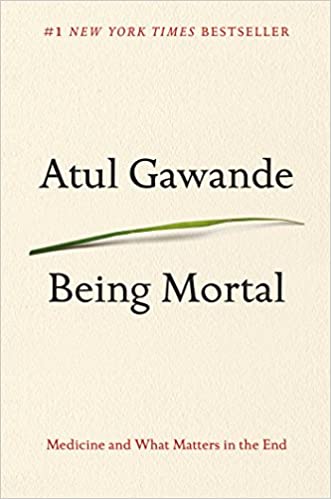
Being Mortal

Read: August 2019

Get this book

Being Mortal

by Atul Gawande

Before departing for Toronto to celebrate our 44th Wedding Anniversary, I went through the e-library. Everything on my list that I wanted to read was not available except for this book. Being Mortal by Atul Gawande is the book I read on our vacation before Jan’s diagnosis of non-Hodgkin Large B-cell Lymphoma.

Selecting Being Mortal might seem an accidental choice to some, and I believe it was a divine intervention. It prepared me to be a caregiver to my wife over the nineteen months of her fight with cancer. It helped me focus on the good life that my wife lived and not the pain and suffering.

Atul Gawande describes his book as “riveting, honest, and humane. Being Mortal shows that the ultimate goal is not a good death but a good life – to the very end.”

When I read the book, I wondered what I could have done to help my mother in her final years. The book offers an excellent overview of how nursing homes and assisted living facilities have struggled to meet the needs of their residents.

Dr. Gawande provides an in-depth overview of the benefits of hospice care. Although I knew of this option, reading this book helped me understand that I was ready for hospice when my wife came home for the last time.

He reminds us that “when it comes to the inescapable realities of aging and death, what medicine can do often runs counter to what it should.” As he writes in the book, the current system does not work and, in many cases, actually shortens life.

This book has had a lasting impact on my life. It allowed me to be a loving caregiver to my wife when she needed it more than anything else. I read it when it would be most beneficial to me.

I highly recommend this book.


Atul Gawande is the author of several bestselling books: Complications, a finalist for the National Book Award; Better; The Checklist Manifesto; and Being Mortal. He is also a surgeon at Brigham and Women’s Hospital in Boston, a staff writer for The New Yorker, and a professor at Harvard Medical School and the Harvard School of Public Health. He has won the Lewis Thomas Prize for Writing about Science, a MacArthur Fellowship, and two National Magazine Awards. In his work in public health, he is the Founder and Chair of Ariadne Labs, a joint center for health systems innovation, and Lifebox, a nonprofit organization dedicated to making surgery safer globally. He is also the chair of Haven, where he served as CEO from 2018 to 2020. He and his wife have three children and live in Newton, Massachusetts.


When you purchase a book through one of my links, I earn a small commission that helps support my passion for reading. This contribution allows me to buy even more books to share with you, creating an incredible cycle of discovering great reads together! Your support truly makes a difference!

Enjoy a limited-time offer of 20% off your next book purchase at Bookshop.org!


×
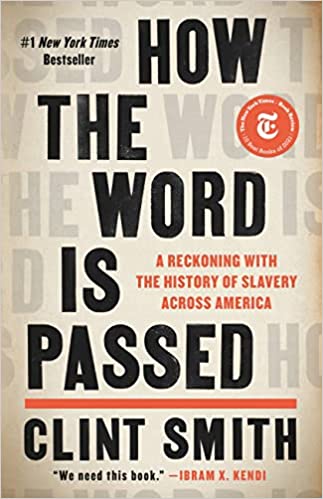
How the Word is Passed

Read: December 2021

Get this book

How the Word Is Passed: A Reckoning with the History of Slavery Across America

by Clint Smith

How the Word Is Passed: A Reckoning with the History of Slavery Across America by Clint Smith. This book was a gift from my son Jon. The New York Times selected How the Word is Passed as one of the best books published this year. Beginning in his hometown of New Orleans, Clint Smith leads the reader on an unforgettable tour of monuments and landmarks—those that are honest about the past and those that are not—that offer an intergenerational story of how slavery has been central in shaping our nation’s collective history, and ourselves.

How the Word is Passed is one of the best books I have read in 2021. I had read an excerpt in The Atlantic on the Whitney Plantation, one of the only former plantations devoted to preserving the experience of the enslaved people whose lives and work sustained it. Like most of us, I had placed the book on my to-read list, where it remained lost in the cobwebs. Fortunately, my son Jon purchased the book for me.

Secondly, the book rekindled my long-lost dream of being an American Studies professor. As soon as Jan and I met, I dropped plans to leave Brooklyn and start graduate school in the fall of 1974. I made that decision primarily because of how much I loved Jan. But it was also partly that I did not have a clear vision of what my life would be like as a professor. The book provided clear examples of people like Yvonne Holden at The Whitney Plantation redefining history to be more accurate and inclusive. I probably could not have done as well as she did, but I can now see that it might have resulted in a career for me that could have been impactful.

Goodreads provides this overview for those who still need to be convinced to read this book.

It is the story of the Monticello Plantation in Virginia, the estate where Thomas Jefferson wrote letters espousing the urgent need for liberty while enslaving over 400 people on the premises. It is the story of the Whitney Plantation, one of the only former plantations devoted to preserving the experience of the enslaved people whose lives and work sustained it. It is the story of Angola Prison in Louisiana, a former plantation named for the country from which most of its enslaved people arrived and which has since become one of the most gruesome maximum-security prisons in the world. And it is the story of Blandford Cemetery, the final resting place of tens of thousands of Confederate soldiers.

In a deeply researched and transporting exploration of the legacy of slavery and its imprint on centuries of American history, How the Word Is Passed illustrates how some of our country’s most essential stories are hidden in plain view-whether in places we might drive by on our way to work, holidays such as Juneteenth, or entire neighborhoods—like downtown Manhattan—on which the brutal history of the trade in enslaved men, women and children has been deeply imprinted.

Informed by scholarship and brought alive by the story of people living today, Clint Smith’s debut work of nonfiction is a landmark work of reflection and insight that offers a new understanding of the hopeful role that memory and history can play in understanding our country.

How the Word is Passed is one of the best books I have read this year and many prior ones. I encourage you to read it and share your comments.

Subscribe

Contact Us

When you buy a book or product using a link on this page, I receive a commission. Thank you for supporting Sharing Jan’s Love blog.

×
Godwin: A Novel

Read: February 2025

Get this book

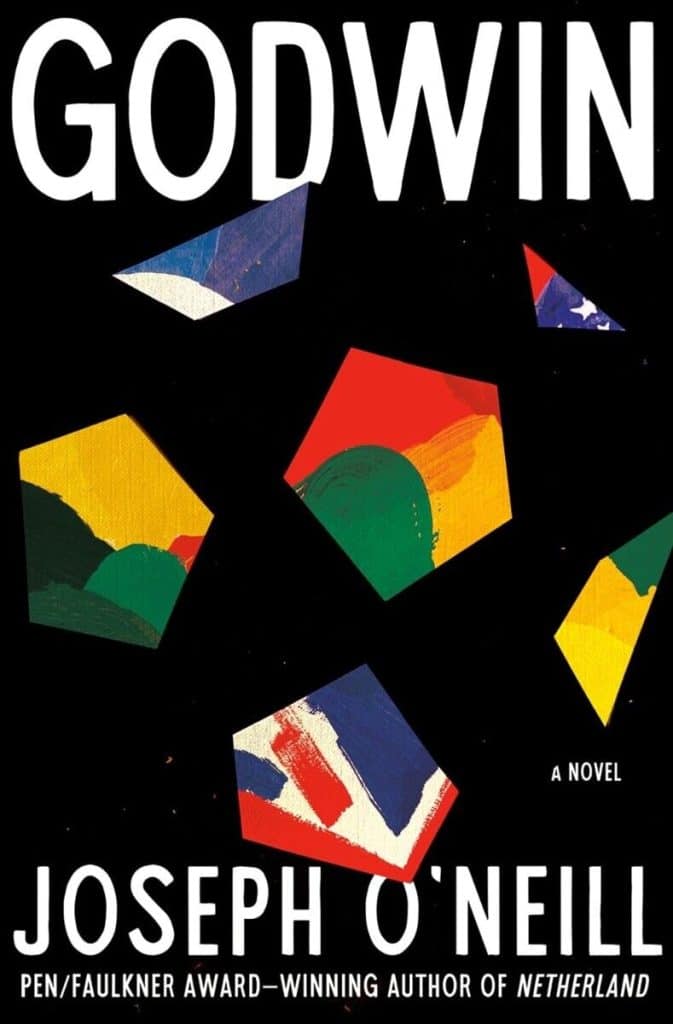
Godwin: A Novel

by Joseph O'Neill

Today, I dove into “Godwin” by Joseph O’Neill, the brilliant mind behind “Netherland,” which snagged the title of Best Book of the Year from the New York Times Book Review. This captivating tale follows the adventure of two brothers embarking on a globe-trotting quest to find an extraordinary African soccer prodigy—someone who might transform their lives forever. The thrill of their journey and the promise of discovery have me hooked!

Mark Wolfe, a brilliant self-thwarting technical writer, lives in Pittsburgh with his wife, Sushila, and their toddler daughter. Born and raised in the United Kingdom, his half-brother Geoff is a desperate young soccer agent. He pulls Mark across the ocean into a scheme to track down an elusive prospect known as “Godwin“—an African teenager Geoff believes could be the next Lionel Messi.

Narrated in turn by Mark and his work colleague Lakesha Williams, Godwin is a tale of family and migration as well as an international adventure story that implicates the brothers in the beauty and ugliness of soccer, the perils and promises of global business, and the dark history of transatlantic money-making.

As only he can do, Joseph O’Neill investigates the legacy of colonialism in the context of family love, global capitalism, and the dreaming individual.


Mr. O’Neill was born in Ireland and grew up in Mozambique, Iran, Turkey, and Holland. His previous novels include the PEN/Faulkner Award-winning Netherland and the Booker Prize long-listed The Dog. O’Neill’s short fiction appears regularly in The New Yorker and his political essays in The New York Review of Books. He lives in New York City.


When you purchase a book through one of my links, I earn a small commission that helps support my passion for reading. This contribution allows me to buy even more books to share with you, creating an incredible cycle of discovering great reads together! Your support truly makes a difference!


×