
What About the Kids?

Estimated reading time: 12 minutes, 20 seconds
Hospice Conversion?

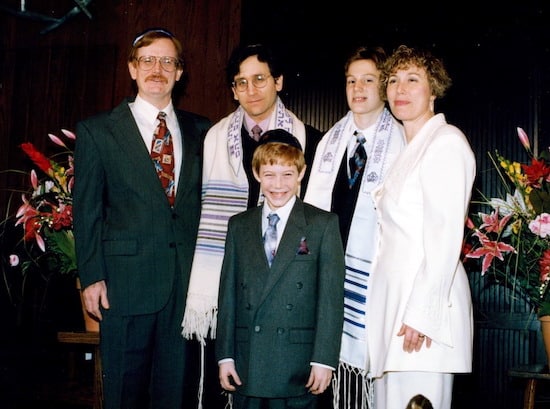
“Jan can be buried in the family plot in Beth Israel cemetery,” I explained to Rabbi Renee as she entered our apartment to visit Jan during hospice. It is where her parents and other family members are buried, and it is also where she wanted to be buried.

As I took Rabbi Renee’s coat, she said, “That’s good news!

“Yes,” said Jon. “The only concern is that our dad is not Jewish, and I know they want to be buried together.”

We can solve that,” said Rabbi Renee cheerfully. I do conversions and weddings,” she smiled at Jon knowing how much Jan wanted to see both of her sons happily married.

Rabbi Renee went to the bedside to be with Jan. As she did that, I thought about all of the times I might have converted but never did. Besides weddings and funerals, I could not remember when I had been to Christian service. For the last forty years, we have worshiped as a Jewish family

I stepped into the kitchen for a glass of water and remembered Jan’s comment after my retirement event five months before her cancer diagnosis. In my speech, I mentioned how as Jews, Jan and I shared a belief in Tikkun Olam, repairing the world. 

We finally had a chance to talk about the event when we arrived home that evening. 

Jan said, “I never heard you refer to yourself as Jewish before tonight.”

As I put my clothes away, I responded, “It is who I am. I check that box on forms. I say it proudly.”

Jan reached out and hugged me. 

“You will probably need to convert so we can be buried next to each other,” Jan reminded me. “I want us to be next to each other forever.”

Rabbi Renee interrupted my daydream and asked if she could talk to me alone

I nodded yes and led her upstairs to the sitting area in the main bedroom. 

“Jan would probably be upset with me bringing you into our bedroom,” I said. “She was always worried about someone seeing the bed unmade.”

“It looks fine to me.”

There is only one of me, and I do not sleep well, and I like to keep things tidy.

I offered Rabbi Renee the cushy brown chair that Jan liked and took the green rocking chair across from her. 

“I have a few questions,” she said. 

I was sure this was the beginning of my conversion, but she surprised me. 

I have heard parts of how you met, but maybe you can tell me the full story.

“Well, most people never want the whole story. They stop once I mention the wine being poured on my head as that seems either the punch line or confirmation that we were just two drunk kids.”

Slowly, I told Rabbi Renee the whole story, expecting she would ask me about conversion once I was done. She never did, but it was one of the most calming moments during hospice. For a few precious moments, I could tell our love story fully, honestly, and with the passion it deserved.


Next Page


Pages: 1 2 3 4 5

13 comments add your comment

Share your thoughts and ideas

This site uses Akismet to reduce spam. Learn how your comment data is processed.

Previous Post:

Next Post:

The Jan Lilien Education Fund!

A Parish Chronicle

Read: February 2026

Get this book

A Parish Chronicle

by Halldór Laxness

In “A Parish Chronicle,” celebrated novelist Halldór Laxness weaves an essayistic tale about the unlikely miracles that keep a church—destined to disappear time and again—rooted on the same hillside. Laxness explores the minutiae of history, from the location of the ancient burial mound of national hero Egill Skallagrímsson to the end of the 19th century, where weak-sighted Ólafur and boisterous farmhand Gunna each play unexpected roles in the parish’s enduring survival.

1882. In the still of morning, Ólafur sharpens his scythe on the bone-dry pavestones that separate his farmhouse from the rest of Mosfell Valley, where life revolves around sheep. The sound of his hammer rings out like a high-pitched bell over the tussocky fields. Across the valley, perched on a hill that receives more sunshine than others, stands Mosfell Church. Nearby, the parish priest’s maid Gunna pours her “slosh,” a weak cup of coffee. Further afield in Reykjavík (“down south” as the locals say), the general assembly decides to revisit an old plan to cut costs by consolidating small parishes and calls for the demolition of Mosfell. Yet today a church stands on that same hillside—its sharp steeple silhouetted against the clouds, its crown bell hanging to the left of the altar.

This intimate tribute to life in Laxness‘s home valley also offers a thoughtful commentary on how the peculiarities of certain individuals can shape history. “A Parish Chronicle” is rich with life and detail.


Halldór Laxness (1902-1998) is the undisputed master of modern Icelandic fiction. He was awarded the Nobel Prize in Literature in 1955, “for his vivid epic power which has renewed the great narrative art of Iceland.” His body of work includes novels, essays, poems, plays, stories, and memoirs: more than sixty books in all. His works available in English include Independent People, The Fish Can Sing, World Light, Under the Glacier, Iceland’s Bell, and Paradise Reclaimed.

Philip Roughton has translated the work of Halldór Laxness, Jón Kalman Stefánsson, Kristín Marja Baldursdóttir, and many others. He has twice been awarded the American-Scandinavian Foundation Translation Prize for his renderings of Halldór Laxness‘s work, in 2001 for Iceland’s Bell and in 2015 for Wayward Heroes. He also received the 2016 Oxford-Weidenfeld Prize for his translation of Jón Kalman Stefánsson’s The Heart of Man. He lives in Iceland. Translator Residence: Akureyri, Iceland

Salvatore Scibona is the recipient of a Mildred and Harold Strauss Living Award from the American Academy of Arts and Letters. His first novel, The End, was a finalist for the National Book Award and winner of the Young Lions Fiction Award. His second novel, The Volunteer, was called a “masterpiece” by the New York Times and won the Ohioana Book Award. His books have been translated into ten languages. His work has won a Guggenheim Fellowship, a Pushcart Prize, an O. Henry Award, and a Whiting Award, and the New Yorker named him one of its “20 Under 40” fiction writers. He is the Sue Ann and John Weinberg Director of the Cullman Center for Scholars and Writers at the New York Public Library.


Discover your next favorite book and dive into a world of curated, exciting reads by purchasing through my links. You’ll have access to a diverse selection of books I’ve personally vetted for quality and enjoyment. Additionally, by supporting these selections, you’ll help me continue to provide you with more personalized recommendations. I earn a small commission from your purchase, which allows me to buy and share even more books with you. Your support truly makes a difference!


×
Wild Houses: A Novel

Read: April 2024

Get this book

Wild Houses: A Novel

by Colin Barrett

Today, I started reading “Wild Houses: A Novel” by Colin Barrett and was impressed by the author’s ability to blend dark humor and intense emotions. Colin Barrett, the award-winning author of “Homesickness” and “Young Skins,” has crafted a debut novel that takes readers on a rollercoaster ride of crimes committed out of desperation, abandoned dreams, and small-town secrets that won’t stay hidden. The story is presented with a wry wit that adds to its appeal.

The story is set in the quaint town of Ballina, located in picturesque west Ireland, as it prepares for its biggest weekend of the year. The simmering feud between small-time dealer Cillian English and County Mayo’s fraternal enforcers, Gabe and Sketch Ferdia, spills over into violence and an ugly ultimatum, painting a vivid picture of the town’s underbelly.

The story’s protagonist, Dev, is a reclusive man unwillingly drawn into the Ferdias’ revenge fantasy when he answers the door and finds Doll, Cillian’s bruised, sullen teenage brother, in the clutches of Gabe and Sketch. With the help of his dead mother’s dog, Dev is jostled by his nefarious cousins and is struck by spinning lights as he is goaded into their plan.

Meanwhile, seventeen-year-old Nicky can’t shake the feeling that something terrible has happened to her boyfriend, Doll. Hungover, reeling from a fractious Friday night and plagued by ghosts, Nicky sets out to save Doll, even as she questions her future in Ballina.

Wild Houses is a beautifully crafted and thrillingly told story of two outsiders striving to find themselves as their worlds collapse in chaos and violence. It is the long-anticipated debut novel from award-winning and critically acclaimed short story writer Colin Barrett.

×
There Is No Place for Us

Read: April 2025

Get this book

There Is No Place for Us

by Brian Goldstone

Today, I delved into There Is No Place for Us by Brian Goldstone, a poignant exploration of America’s escalating homelessness crisis. Goldstone’s examination of the issue’s scale, root causes, and consequences is a wake-up call, passionately arguing that housing must be recognized as a fundamental human right. His compelling narrative demands our immediate attention and action.

The phrase “the working homeless” serves as a stark reminder of the urgency of America’s homelessness crisis. In a country where hard work and determination are expected to lead to success, it is scandalous that individuals with full-time jobs struggle to maintain stable housing. Rising rents, low wages, and insufficient tenant rights have contributed to this alarming trend. Families are facing homelessness not due to a failing economy but because of a thriving one.

In his compelling and thoroughly researched book, Brian Goldstone explores the lives of five families in Atlanta. Maurice and Natalia attempt to rebuild their lives in the country’s “Black Mecca” after being priced out of Washington, D.C. Kara aspires to become an entrepreneur while working at a public hospital. Britt has secured a much-coveted housing voucher. Michelle is studying to become a social worker. Celeste works tirelessly at her warehouse job while battling ovarian cancer. Each of these individuals strives to provide a decent life for their children. Yet, one by one, they find themselves among the nation’s working homeless, demonstrating their resilience and the system’s failures.

Through intimate, novelistic portrayals, Goldstone exposes the human cost of this crisis, following parents and their children as they sleep in cars or squalid extended-stay hotel rooms, then head to their jobs and schools the next day. These are the nation’s hidden homeless—people often omitted from official statistics—showing that overflowing shelters and street encampments represent only the most visible aspects of a much larger problem.


Brian Goldstone is a journalist whose long-form reporting and essays have appeared in The New York Times, Harper’s Magazine, The New Republic, The California Sunday Magazine, and Jacobin, among other publications. He has a PhD in anthropology from Duke University and was a Mellon Research Fellow at Columbia University. In 2021, he was a National Fellow at New America. He lives in Atlanta with his family.


When you purchase a book through one of my links, I earn a small commission that helps support my passion for reading. This contribution allows me to buy even more books to share with you, creating an incredible cycle of discovering great reads together! Your support truly makes a difference!

Enjoy a limited-time offer of 20% off your next book purchase at Bookshop.org!


×
The Sorrow Apartments

Read: June 2024

Get this book

The Sorrow Apartments

by Andrea Cohen

Today, I explored “The Sorrow Apartments,” the eighth collection of poems by poet Andrea Cohen. Renowned poet Christian Wiman accurately describes Cohen’s work as a “cumulative force,” showcasing her deep attention, genuine intelligence, and soul. Cohen’s distinctive talents are featured in this collection, complemented by her characteristic sly humor, unwavering conciseness, and surprising moments of profound wisdom.

It’s astonishing how swiftly Cohen transports us:

Bunker

What would I
think, coming

up after
my world

had evaporated?
I’d wish

I were water.

The Sorrow Apartments house a collection of sparse and haunting poetry, each piece a captivating narrative of mystery, grief, and awe. These poems transport us not just across time but also through a spectrum of emotions. Cohen’s unique approach to illumination is evident in “Acapulco,” where an unanticipated companion muses, “as men tend to, / the stars comprising Orion’s belt — / as if it were the lustrous sparks and not / the leveling dark that connects us.” For a poet often deemed unfashionable, Cohen’s work proves that unfashionable can be beautiful.

×
The Way of Integrity

Read: February 2025

Get this book

The Way of Integrity

by Martha Beck

Today, I started reading Martha Beck‘s “The Way of Integrity: Finding the Path to Your True Self,” a book recommended by my friend Mark. I always appreciate receiving book recommendations from friends and readers of my blog. In her self-help book, Ms. Beck asserts, “Integrity is the cure for psychological suffering. Period.” This book will be invaluable during my early period of grief. I purchased the eBook from Bookshop and plan to do so.

Bestselling author, life coach, and sociologist Martha Beck explains why “integrity”—needed now more than ever in these tumultuous times—is the key to a meaningful and joyful life. As she writes,

This book, as you may have gleaned from the title, is all about integrity. But I don’t mean this in a moralizing sense. The word integrity has taken on a slightly prim, judgmental nuance in modern English, but the word comes from the Latin integer, meaning “intact.” To be in integrity is to be one thing, whole and undivided. When a plane is in integrity, all its millions of parts work together smoothly and cooperatively. If it loses integrity, it may stall, falter, or crash. There’s no judgment here. Just physics.

In The Way of Integrity, Beck presents a four-stage process that anyone can use to find integrity, a sense of purpose, emotional healing, and a life free of mental suffering. Many issues, such as people-pleasing, staying in stale relationships, and maintaining unhealthy habits, arise from a disconnection from what truly makes us feel complete.

Inspired by The Divine Comedy, Beck uses Dante’s classic hero’s journey as a framework to break down the process of attaining personal integrity into small, manageable steps. She shows how to read the internal signals that lead us toward our true path and recognize what we yearn for versus what our culture sells us.

With techniques tested on hundreds of her clients, Beck brings her expertise as a social scientist, life coach, and human being to help readers uncover what integrity looks like in their lives. She takes us on a spiritual adventure that will change the direction of our lives and bring us to a place of genuine happiness.

Other books I have read with a similar theme, which I also recommend, include Man’s Search for Meaning, Climbing the Second Mountain, and The Pursuit of Happiness.


When you purchase a book through one of my links, I earn a small commission that helps support my passion for reading. This contribution allows me to buy even more books to share with you, creating an incredible cycle of discovering great reads together! Your support truly makes a difference!


×
My Brilliant Friend

Read: July 2024

Get this book

My Brilliant Friend

by Elena Ferrante

Today, I delved into Elena Ferrante‘s captivating novel My Brilliant Friend. This acclaimed book hailed as the #1 Book of the 21st Century by the New York Times, weaves a timeless tale of the enduring bond between two women from Naples. With its rich character development and evocative historical setting, it stands alongside other character-driven works of literary fiction.

Beginning in the 1950s in a poor but vibrant neighborhood on the outskirts of Naples, Elena Ferrante’s four-volume story spans almost sixty years. The main characters, the fiery and unforgettable Lila and the bookish narrator, Elena, are bound by an enduring friendship that withstands the test of time and life’s challenges. This first novel in the series follows Lila and Elena from their fateful meeting as ten-year-olds through their school years and adolescence, evoking a sense of enduring connection and emotional resonance.

Through the lives of these two women, Ferrante weaves a compelling narrative of a neighborhood, a city, and a country undergoing profound transformation. These societal changes, in turn, also reshape the relationship between the two women, adding a rich layer of historical and cultural context to the story. This context will enrich your reading experience and provide a deeper understanding of the characters and their journey.

×

Discover more from Sharing Jan’s Love

Subscribe now to keep reading and get access to the full archive.

Continue reading