
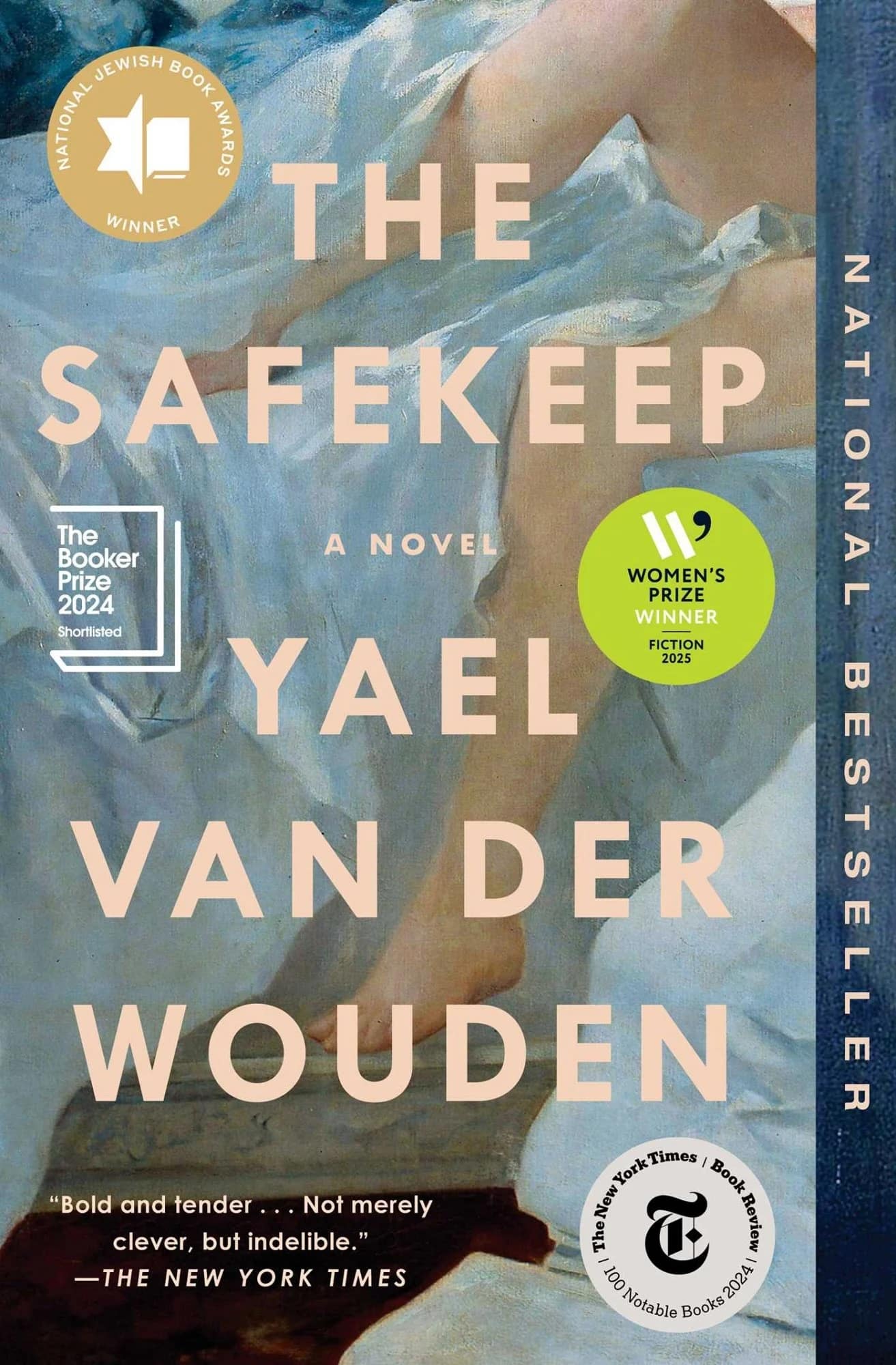
The Safekeep: A Novel

Estimated reading time: 1 minute, 59 seconds

A house is a treasured possession, and “The Safekeep,” a debut novel by Yael van der Wouden, presents a gripping story of desire, suspicion, and obsession between two women staying in the same house in the Dutch countryside during the summer of 1961. The novel provides a profound exploration of the legacy of World War II and the darker elements of our shared history.

It is 1961, and the rural Dutch province of Overijssel is quiet. Bomb craters have become lakes, buildings have been repaired or rebuilt, and the war is truly over. Living alone in her late mother’s country home, Isabel knows her life is as it should be—led by routine and discipline. But all is upended when her brother Louis brings his graceless new girlfriend Eva, leaving her at Isabel’s doorstep as a guest, to stay for the season.

Eva is the complete opposite of Isabel: she sleeps late, stomps around the house, and handles things she shouldn’t. In response, Isabel becomes increasingly obsessed and furious, especially as items begin to go missing around the house—a spoon, a knife, a bowl. As her suspicions grow, Isabel’s paranoia eventually leads to infatuation, culminating in a revelation that shatters everything she has ever known. It seems that the war might not truly be over, and neither Eva—nor the house they inhabit—is what they appear to be.

For my house will be called a house of devotion for all,” in Isaiah 56:7, serves as a closing that reminds us that a house not open to all is not a home.


Yael van der Wouden is a writer and a teacher. The Safekeep, her debut novel, was a finalist for the 2024 Booker Prize and has been longlisted for the 2025 Aspen Words Literary Prize. It was also named a New York Times Notable Book of the Year and a best book of the year by The Washington Post, Time, The Economist, Kirkus Reviews, The Times (London), The Independent, BookPage, and others. She lives in Utrecht, Netherlands.


When you purchase a book through one of my links, I earn a small commission that helps support my passion for reading. This contribution allows me to buy even more books to share with you, creating an incredible cycle of discovering great reads together! Your support truly makes a difference!

Enjoy a limited-time offer of 20% off your next book purchase at Bookshop.org!


The Jan Lilien Education Fund!

Prophet Song: A Novel

Read: January 2024

Get this book

Prophet Song: A Novel

by Paul Lynch

In 2024, I started my reading journey with the Booker Prize 2023 winner – Prophet Song, by Paul Lynch. The book presents a chilling and astonishing outlook of a nation sliding into authoritarianism while also painting a profoundly humane portrait of a mother’s struggle to keep her family together. I have not set a goal of the number of books to read in 2024, but this is an excellent first-day pageturner.

It all begins on a dark, rainy evening in Dublin when Eilish Stack, a scientist and mother of four, opens her front door to two officers from Ireland’s newly formed secret police. They are there to interrogate her husband, a trade unionist. Ireland is falling apart as the government is gradually turning towards tyranny. As her world crumbles and the people she loves disappear, Eilish faces the dystopian reality of her country. How far is Eilish willing to go to protect her family? And what, or who, is she ready to leave behind?


The Jan Lilien Education Fund sponsors ongoing sustainability and environmental awareness programs. Gifts made this month; I will match dollar-for-dollar. All donations are tax-deductible.

Subscribe

Contact Us

I receive a commission when you buy a book or product using a link on this page. Thank you for supporting Sharing Jan’s Love blog.


×
Interpreter of Maladies

Read: June 2022

Get this book

Interpreter of Maladies

by Jhumpa Lahiri

Interpreter of Maladies by Jhumpa Lahiri is an incredible book. Each short story is a page-turner that I will re-read many times. As Ms. Lahiri writes, “The question of identity is always a difficult one, but especially so for those who are culturally displaced, as immigrants are, or those who grow up in two worlds simultaneously, as is the case for their children.”

Since 2000, Interpreter of Maladies has been on my reading list. For what is a writer, if not an interpreter of maladies? Perhaps, I waited until now so that I would have grief to help guide me thru this collection of short stories. I highly recommend Interpreter of Maladies.

The Goodreads summary provides a concise overview.

Navigating between the Indian traditions they’ve inherited and the baffling new world, the characters in Jhumpa Lahiri’s elegant, touching stories seek love beyond the barriers of culture and generations. In “A Temporary Matter,” published in The New Yorker, a young Indian-American couple faces the heartbreak of a stillborn birth. At the same time, their Boston neighborhood copes with a nightly blackout. In the title story, an interpreter guides an American family through the India of their ancestors and hears an astonishing confession. Lahiri writes with deft cultural insight reminiscent of Anita Desai and a nuanced depth that recalls Mavis Gallant.


Subscribe

Contact Us

I receive a commission when you buy a book or product using a link on this page. Thank you for supporting Sharing Jan’s Love blog.

×
Mercy Street: A Novel

Read: February 2023

Get this book

Mercy Street: A Novel

by Jennifer Haigh

Mercy Street: A Novel by Jennifer Haigh is a tense, riveting story about the disparate lives intersecting at a Boston women’s clinic. The novel was named Best Book of the Year by the Washington Post, the New Yorker, and the Boston Globe. Mercy Street is a novel for right now, a story of the polarized American present. Ms. Haigh is a gifted storyteller who has written a very readable book. I highly recommend it. 

I truly enjoyed Mercy Street. I read her short story Zenith Man and enjoyed her storytelling skills. I wanted to read her most recent novel. Until the last few pages, I was unsure how Ms. Haigh‘s intricate storylines could conclude the story. Usually, I can predict how a story will unfold well before I finish reading it. Mercy Street was a rare exception to that rule.

I have never had to run the gauntlet in front of a women’s clinic, but Ms. Haigh has made that experience so real that I could taste it. The day-to-day work of the staff and the clients was detailed and believable. The male characters, Timmy, the affable pot dealer; Anthony, a lost soul; and Excelsior11, the screenname of Victor Prine, were drafted credibly.

As stated earlier, I highly recommend this book.


Jennifer Haigh is the author of seven best-selling, critically acclaimed works of fiction. Her first, Mrs. Kimble, won the PEN Hemingway Award for debut fiction. Her latest, Mercy Street, was named a Best Book of 2022 by the New Yorker and won the Mark Twain American Voice in Literature Award. A Guggenheim fellow and Iowa Writers’ Workshop graduate, she lives in Boston.


When you purchase a book through one of my links, I earn a small commission that helps support my passion for reading. This contribution allows me to buy even more books to share with you, creating an incredible cycle of discovering great reads together! Your support truly makes a difference!


×
The Pursuit of Happiness

Read: January 2025

Get this book

The Pursuit of Happiness

by Jeffrey Rosen

Today, I started reading Jeffrey Rosen‘s book, “The Pursuit of Happiness: How Classical Writers on Virtue Inspired the Lives of the Founders.” This New York Times bestseller examines what “the pursuit of happiness” meant to our nation’s Founders, how that iconic phrase influenced their lives, and how it provided the foundation for our democracy—a quest for being good rather than merely feeling good.

The Declaration of Independence identifies “the pursuit of happiness” as one of our unalienable rights, alongside life and liberty. Jeffrey Rosen, president of the National Constitution Center, profiles six of the most influential Founding Fathers—Benjamin Franklin, George Washington, John Adams, Thomas Jefferson, James Madison, and Alexander Hamilton—to explore what pursuing happiness meant to them. This work provides “the best and most readable introduction to the ideas of the Founders that we have” (Gordon Wood, author of “Power and Liberty“).

By examining the classical Greek and Roman moral philosophers who inspired the Founders, Rosen illustrates how they understood the pursuit of happiness as a quest for being good rather than simply feeling good. It is about striving for lifelong virtue instead of seeking short-term pleasures. Among these virtues were the habits of industry, temperance, moderation, and sincerity, which the Founders regarded as essential components of personal growth, character development, and self-mastery. They believed that self-governance in politics required self-governance on an individual level. For all six Founders, the pursuit of virtue was fundamentally incompatible with the enslavement of African Americans, although the Virginians failed to uphold their principles in this regard.

Ken Burns describes “The Pursuit of Happiness” as “immensely readable and thoughtful. It is more than just an analysis of the famous phrase in the Declaration. It is a revealing journey into the Founders’ minds, offering a deep and fresh understanding of the foundations of our democracy.


When you purchase a book through one of my links, I earn a small commission that helps support my passion for reading. This contribution allows me to buy even more books to share with you, creating an incredible cycle of discovering great reads together! Your support truly makes a difference!


×
How the Word is Passed

Read: December 2021

Get this book

How the Word Is Passed: A Reckoning with the History of Slavery Across America

by Clint Smith

How the Word Is Passed: A Reckoning with the History of Slavery Across America by Clint Smith. This book was a gift from my son Jon. The New York Times selected How the Word is Passed as one of the best books published this year. Beginning in his hometown of New Orleans, Clint Smith leads the reader on an unforgettable tour of monuments and landmarks—those that are honest about the past and those that are not—that offer an intergenerational story of how slavery has been central in shaping our nation’s collective history, and ourselves.

How the Word is Passed is one of the best books I have read in 2021. I had read an excerpt in The Atlantic on the Whitney Plantation, one of the only former plantations devoted to preserving the experience of the enslaved people whose lives and work sustained it. Like most of us, I had placed the book on my to-read list, where it remained lost in the cobwebs. Fortunately, my son Jon purchased the book for me.

Secondly, the book rekindled my long-lost dream of being an American Studies professor. As soon as Jan and I met, I dropped plans to leave Brooklyn and start graduate school in the fall of 1974. I made that decision primarily because of how much I loved Jan. But it was also partly that I did not have a clear vision of what my life would be like as a professor. The book provided clear examples of people like Yvonne Holden at The Whitney Plantation redefining history to be more accurate and inclusive. I probably could not have done as well as she did, but I can now see that it might have resulted in a career for me that could have been impactful.

Goodreads provides this overview for those who still need to be convinced to read this book.

It is the story of the Monticello Plantation in Virginia, the estate where Thomas Jefferson wrote letters espousing the urgent need for liberty while enslaving over 400 people on the premises. It is the story of the Whitney Plantation, one of the only former plantations devoted to preserving the experience of the enslaved people whose lives and work sustained it. It is the story of Angola Prison in Louisiana, a former plantation named for the country from which most of its enslaved people arrived and which has since become one of the most gruesome maximum-security prisons in the world. And it is the story of Blandford Cemetery, the final resting place of tens of thousands of Confederate soldiers.

In a deeply researched and transporting exploration of the legacy of slavery and its imprint on centuries of American history, How the Word Is Passed illustrates how some of our country’s most essential stories are hidden in plain view-whether in places we might drive by on our way to work, holidays such as Juneteenth, or entire neighborhoods—like downtown Manhattan—on which the brutal history of the trade in enslaved men, women and children has been deeply imprinted.

Informed by scholarship and brought alive by the story of people living today, Clint Smith’s debut work of nonfiction is a landmark work of reflection and insight that offers a new understanding of the hopeful role that memory and history can play in understanding our country.

How the Word is Passed is one of the best books I have read this year and many prior ones. I encourage you to read it and share your comments.

Subscribe

Contact Us

When you buy a book or product using a link on this page, I receive a commission. Thank you for supporting Sharing Jan’s Love blog.

×
The Singing Word

Read: September 2025

Get this book

The Singing Word

by Walt Hunter

The Singing Word: 168 Years of Atlantic Poetry, edited by Walt Hunter, celebrates the people, land, and spirit of America. This remarkable collection showcases a wide range of contemporary and historical poetry from the 168-year archive of The Atlantic magazine. Since its first issue in 1857, the poetry published in The Atlantic has drawn attention to the nation’s ongoing journey of self-discovery.

The magazine’s verse has featured odes to American leaders and landscapes, laments for the dead, and calls for change, appealing to the enduring ideals of Atlantic readers.

This one-of-a-kind collection selects poems of rousing optimism, clear-eyed realism, and moving lyricism—poems infused with the language of America’s songs, myths, and history, from the Civil War up through the present in three rich parts: National Anthems, Natural Lines, and Personal Mythologies.

Curated by The Atlantic’s Poetry Editor, this anthology features both world-famous poets—from Longfellow to Limón, including Robert Frost, W. S. Merwin, Sylvia Plath, and Adrienne Rich—as well as poets whose work has never before been published outside of the magazine.

Offering readers an essential understanding of American canon and the evolving nation, its poets have yearned to capture—the poetry of The Atlantic is the poetry of America.


Walt Hunter is a professor of twentieth- and twenty-first-century literature and chair of the English department at Case Western Reserve University. He is also the fiction and poetry editor for The Atlantic.


Discover your next favorite book and dive into a world of curated, exciting reads by purchasing through my links. You’ll have access to a diverse selection of books that I’ve personally vetted to ensure quality and enjoyment. Additionally, by supporting these selections, you’ll help me continue to provide you with more personalized recommendations. I earn a small commission from your purchase, which allows me to buy and share even more books with you. Your support truly makes a difference!


×