
Day Two Building Jan’s Memorial Garden
Estimated reading time: 0 minutes, 1 second
Day Two Building Jan’s Memorial Garden
Day Two Building Jan’s Memorial Garden
Subscribe to Sharing Jan's Love Newsletter!
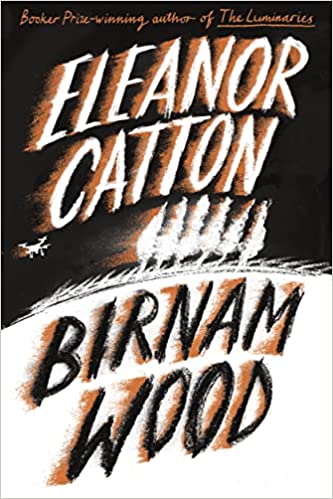
by Eleanor Catton
Birnam Wood: A Novel by Eleanor Catton is a gripping psychological thriller from the Booker Prize-winning author of The Luminaries. Birnam Wood is Shakespearean in its wit, drama, and immersion in character. A brilliantly constructed consideration of intentions, actions, and consequences is an unflinching examination of the human impulse to ensure our survival. I highly recommend this novel.
The review in The New Yorker and a personal recommendation made this novel my next read.
At first, the conflict between the guerrilla gardening group and a wealthy American billionaire seemed like a story that had been told too many times. However, Ms. Catton has created a page-turner that is a must-read during our current climate emergency and the growing income gap. Although the end is foretold, it may surprise the reader while confirming the conviction that we must find an alternate way forward.
The Goodreads summary provides an overview,
Five years ago, Mira Bunting founded a guerrilla gardening group: Birnam Wood. An undeclared, unregulated, sometimes-criminal, sometimes-philanthropic gathering of friends, this activist collective plants crops wherever no one will notice: on the sides of roads, in forgotten parks, and in neglected backyards. For years, the group has struggled to break even. Then Mira stumbles on an answer, a way to finally set the group up for the long term: a landslide has closed the Korowai Pass, cutting off the town of Thorndike. A natural disaster has created an opportunity, a sizable farm seemingly abandoned.
But Mira is not the only one interested in Thorndike. Robert Lemoine, the enigmatic American billionaire, has snatched it up to build his end-times bunker–or so he tells Mira when he catches her on the property. Intrigued by Mira, Birnam Wood, and their entrepreneurial spirit, he suggests they work this land. But can they trust him? And, as their ideals and ideologies are tested, can they trust each other?
The Jan Lilien Education Fund sponsors ongoing sustainability and environmental awareness programs. Gifts made this month; I will match dollar-for-dollar. All donations are tax-deductible.
I receive a commission when you buy a book or product using a link on this page. Thank you for supporting Sharing Jan’s Love blog.
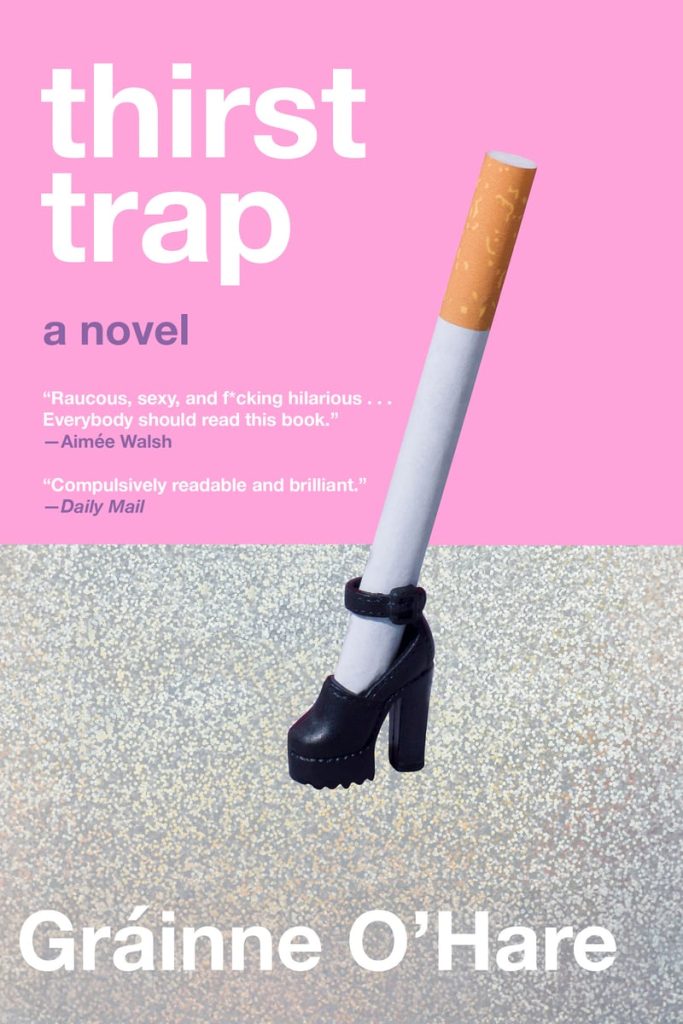
by Gráinne O'Hare
Filled with heart and humor, Thirst Trap by Gráinne O’Hare is a lively celebration of friendship, embracing uncertainty, and indulging in “just one more round” before heading home. This sharply funny novel explores the challenges of being in your late 20s as you approach 30, questioning when you will tire of morning hangovers, dead-end entry-level jobs, and late nights at bars. This friend group is about to discover the answer.
Sometimes friends hold you together.
Sometimes they’re why you’re falling apart.
Harley, Róise, and Maggie have been friends for a long time. They met in primary school years ago, and they are still together, spending their nights on the sticky dance floors of Belfast’s grungiest pubs. Each woman is navigating her own challenges—entry-level jobs, messy romantic entanglements, and late nights—but they always find their way back to each other and to the ramshackle house they share. Amidst the familiar chaos, the three are still grieving their fourth housemate, whose room remains untouched, with the weight of their last big fight lingering heavily over them.
The girls’ house has witnessed the highs and lows of their roaring twenties—raucous parties, surprising (and sometimes regrettable) hook-ups, and hellish hangovers. However, as they approach thirty, their home begins to crumble around them, and the cracks in their friendship become harder to ignore. In the midst of the wreckage, they must decide whether their friendship will survive into a new decade or if growing up sometimes means letting go.
Gráinne O’Hare is a writer from Belfast based in Newcastle upon Tyne. She received a Northern Debut Award for Fiction from New Writing North and was awarded funding by the Arts Council for the development and completion of her first novel. She has also been shortlisted for the Francis MacManus Short Story Competition and the Bridport Prize, and came in the top three of the Benedict Kiely Short Story Competition.
She is a media sub-editor for Criticks reviews of the British Society for Eighteenth-Century Studies and holds a PhD in eighteenth-century women’s life-writing from Newcastle University.
Discover your next favorite book and dive into a world of curated, exciting reads by purchasing through my links. You’ll have access to a diverse selection of books that I’ve personally vetted to ensure quality and enjoyment. Additionally, by supporting these selections, you’ll help me continue to provide you with more personalized recommendations. I earn a small commission from your purchase, which allows me to buy and share even more books with you. Your support truly makes a difference!
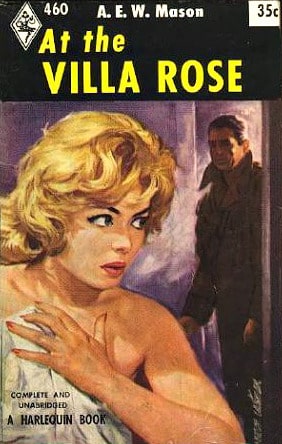
by Major Alfred Edward Woodley Mason
At the Villa Rose by Major Alfred Edward Woodley Mason, initially published in 1910, is a mystery novel in which Major Mason introduced his French detective, Inspector Hanaud, who was an early template for Agatha Christie’s famous Hercule Poirot. Missing jewels, high adventure some one hundred and fifty kilometers from Geneva, a casino, and blind love are all factors in a complex case for Hanaud, which ultimately involves a gang of frightened murderers. If you enjoy deductive mysteries like me, I highly recommend At the Villa Rose.
The Goodreads summary,
In Aix les Bains during the early 20th century, Celia Harland, a beautiful (of course) young English girl down on her luck, is befriended by a wealthy widow, Madame Dauvray, an addict of “spiritualism,” and stages seances for her benefactrix, while knowing full well that the supposed manifestations from the spirit world are entirely bogus. This set-up supplies the opportunity for a criminal gang master-minded by Madame Dauvray’s maid, with their eyes on the widow’s jewelry collection, to engineer an introduction for one of their numbers, Adele Tacé (“Rossignol”), whose taunts of disbelief goad the old lady into allowing a seance to be held which, unsuspected by either Celia or her patron, will be the cover for murder and robbery.
The crux of the plot is that as a medium, Celia will be made their innocent victim, on whom suspicion is to be planted.
The Jan Lilien Education Fund sponsors ongoing sustainability and environmental awareness programs. All donations are tax-deductible.
I receive a commission when you buy a book or product using a link on this page. Thank you for supporting Sharing Jan’s Love blog.
by Francesca Giannone
In the bestselling novel that has captivated readers in Italy, The Letter Carrier by Francesca Giannone depicts a small town in southern Italy that reflects the experiences of many others. It portrays the lives of women and men—husbands and wives, fathers and sons, mothers and daughters—as they strive to navigate the world while remaining true to their hearts. The Letter Carrier explores the universal theme of connection and examines the consequences that arise when those connections occur at the wrong time.
Salento, Italy, June 1934: A coach stops in the main square of Lizzanello, a tight-knit village where everyone knows each other. A couple gets off: The man, Carlo, a Southerner, is happy to be back home after a long time away; the woman, Anna—his wife—is a Northerner. Carlo’s brother is there to meet them, and he, along with everyone else, can’t help but notice that Anna is as beautiful as a Greek statue.
But Anna is not like the other wives. She doesn’t gossip or attend church. She reads books no one else has ever heard of, exploring ideas that some find threatening. She even wears pants, just like a man, and thinks a woman should have rights, just like a man.
There aren’t many options for a woman with Anna’s sensibilities, so when she learns that the post office is hiring, she leaps at the opportunity. A female letter carrier? It is unthinkable! But Anna passes the postal exam and soon becomes the invisible thread connecting the town as she delivers letters between clandestine lovers, families waiting to hear news of loved ones away at war, and even helps those who can’t read.
Letters connect people, conveying both information and emotion. But for some in Lizzanello, letters are too little and too late.
Francesca Giannone holds a degree in communication science and studied at the CSC, the oldest film school in Europe, located in Rome. She has published several short stories in literary magazines, both in print and online. Currently, Giannone resides in Milan, but her heart remains in her hometown of Lizzanello, a seaside town in the Salento region of Italy. She hopes to return there to live one day.
Elettra Pauletto translated The Letter Carrier. After earning her MFA from Columbia University, she has split her time between writing about her experiences in Africa—specifically in the Democratic Republic of the Congo, Rwanda, and Senegal—and translating fiction and nonfiction works from Italian and French into English. In both her writing and translations, she heavily relies on her background as a former political risk analyst who covered Sub-Saharan Africa, the Middle East, and Europe.
When you purchase a book through one of my links, I earn a small commission that helps support my passion for reading. This contribution allows me to buy even more books to share with you, creating an incredible cycle of discovering great reads together! Your support truly makes a difference!
Enjoy a limited-time offer of 20% off your next book purchase at Bookshop.org!
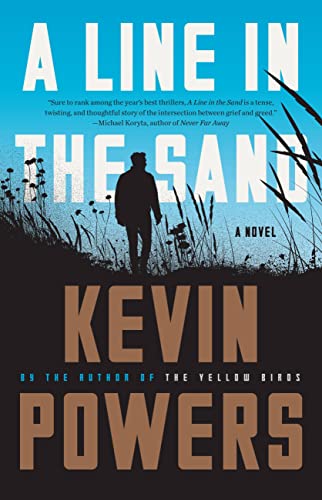
by Kevin Powers
Today I started reading A Line in the Sand: A Novel by Kevin Powers. Listed as one of the books to read this week by The New York Times, which described it as “a stunning novel. Kevin Powers provides what any discerning reader desires the most — complex and flawed characters, precise use of language, succinct description, and believable dialogue.”
One early morning on a Norfolk beach in Virginia, a dead body is discovered by a man taking his daily swim—Arman Bajalan, formerly an interpreter in Iraq. After narrowly surviving an assassination attempt that killed his wife and child, Arman has been given lonely sanctuary in the US as a maintenance worker at the Sea Breeze Motel. Now, convinced that the body is connected to his past, he knows he is still unsafe.
Seasoned detective Catherine Wheel and her newly minted partner have little to go on beyond a bus ticket in the dead man’s pocket. It leads them to Sally Ewell, a local journalist as grief-stricken as Arman is by the Iraq War, investigating a corporation on the cusp of landing a multi-billion-dollar government defense contract.
As victims mount around Arman, taking the team down wrong turns and towards startling evidence, they find themselves in a race committed to unraveling the truth and keeping Arman alive—even if it costs them everything.
The Jan Lilien Education Fund sponsors ongoing sustainability and environmental awareness programs. Gifts made this month; I will match dollar-for-dollar. All donations are tax-deductible.
I receive a commission when you buy a book or product using a link on this page. Thank you for supporting Sharing Jan’s Love blog.
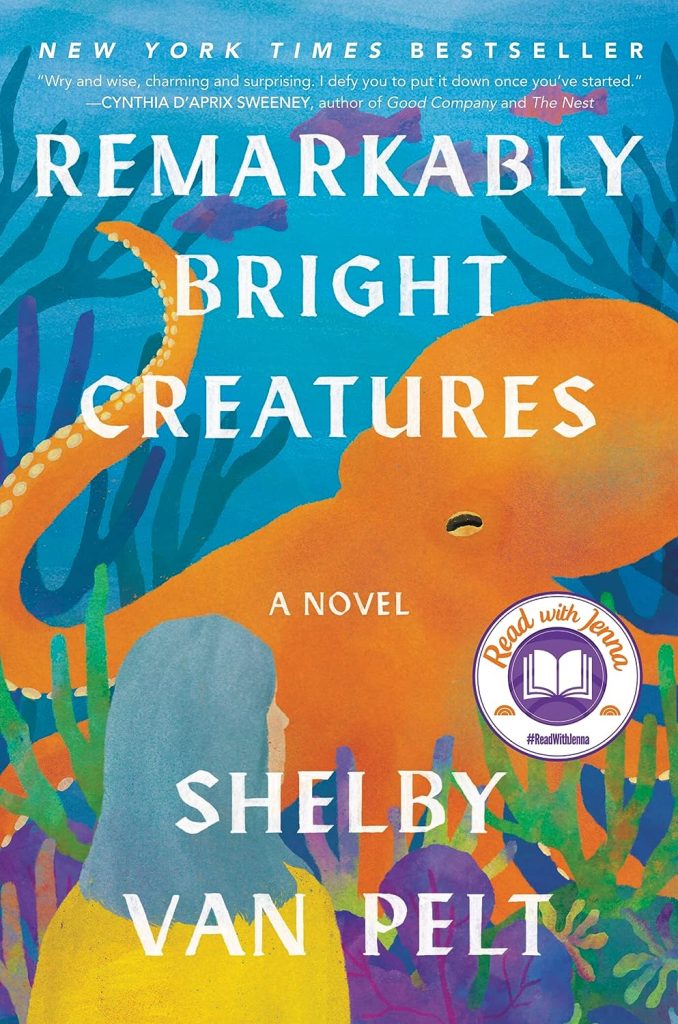
by Shelby Van Pelt
Today, I recommended reading “Remarkably Bright Creatures” by Shelby Van Pelt. It’s a charming, witty, and compulsively readable exploration of friendship, reckoning, and hope. The novel traces the unlikely connection of a widow with a giant Pacific octopus, making it perfect for fans of “A Man Called Ove.” Shelby Van Pelt’s debut novel is a gentle reminder that sometimes, looking at the past can help uncover a future that once felt impossible.
The story follows Tova Sullivan, who works the night shift at the Sowell Bay Aquarium after her husband dies. Tova has been coping with loss since her eighteen-year-old son, Erik, mysteriously vanished on a boat in Puget Sound over thirty years ago.
While at the aquarium, Tova becomes acquainted with Marcellus, a grumpy giant Pacific octopus who refuses to cooperate with his human captors. However, Marcellus forms a remarkable friendship with Tova and helps her uncover the truth about her son’s disappearance.
As a detective, Marcellus uses his invertebrate body to deduce what happened when Tova’s son disappeared. Together, they embark on a journey to unearth the truth before it’s too late.
The Jan Lilien Education Fund sponsors ongoing sustainability and environmental awareness programs. Gifts made this month; I will match dollar-for-dollar. All donations are tax-deductible.
I receive a commission when you buy a book or product using a link on this page. Thank you for supporting Sharing Jan’s Love blog.