
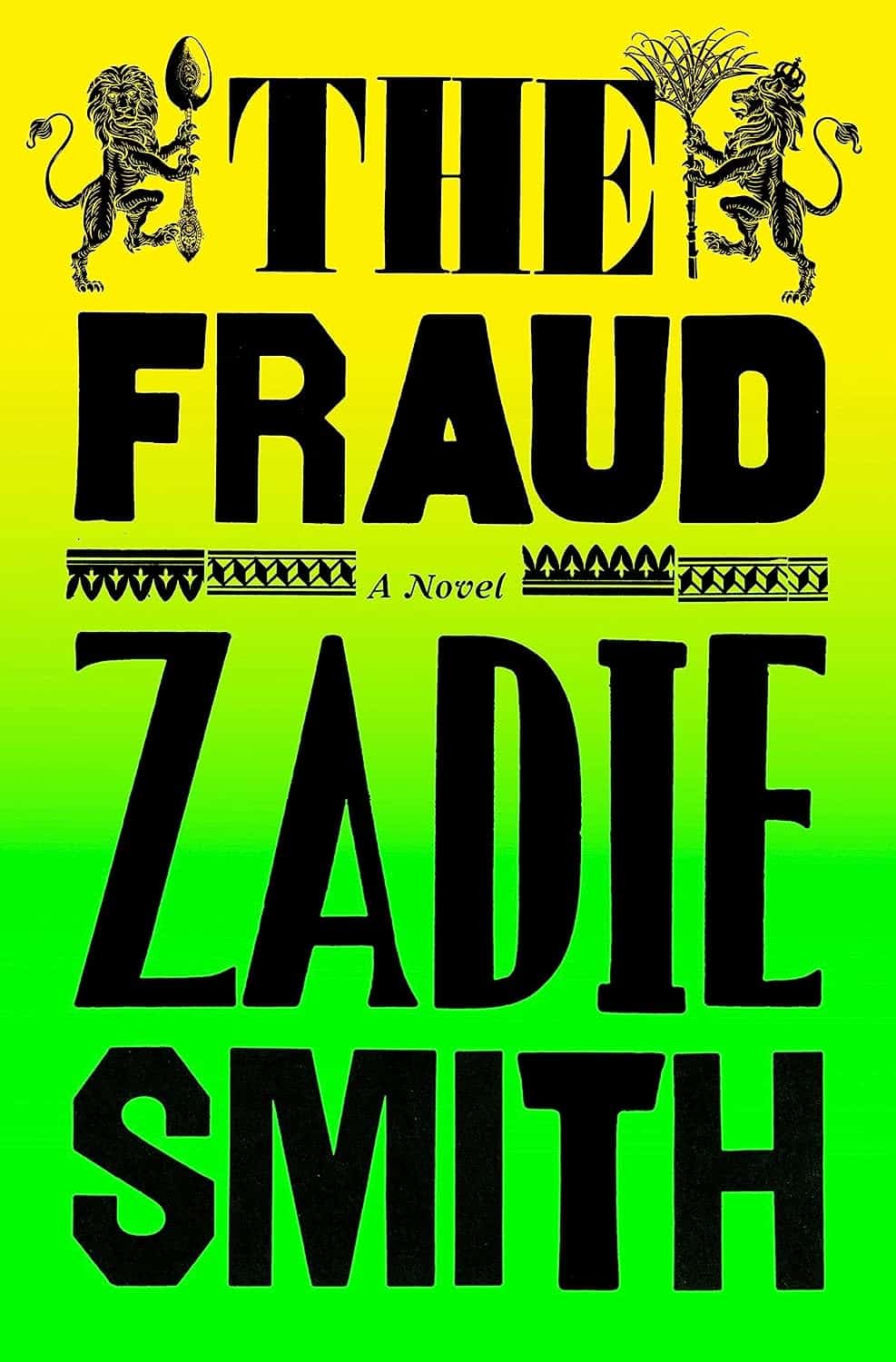
The Fraud: A Novel

Estimated reading time: 1 minute, 40 seconds

I started reading The Fraud: A Novel by Zadie Smith today. The book is a kaleidoscopic work of historical fiction that revolves around a legal trial that divided Victorian England. The story is set in 1873, where Mrs. Eliza Touchet, a Scottish housekeeper and cousin by marriage of a once-famous novelist, William Ainsworth, lives with him for thirty years. Mrs. Touchet is interested in literature, justice, abolitionism, class, and her cousin’s wives.

However, she is skeptical of her cousin’s talent, Mr. Charles Dickens’ character, and England’s facades, in which nothing is as it seems.

On the other hand, Andrew Bogle grew up enslaved on the Hope Plantation in Jamaica. He knows that every lump of sugar comes at a human cost, that the rich deceive the poor, and that people are more easily manipulated than they realize. When Bogle finds himself in London, a star witness in a celebrated case of imposture, he knows that his future depends on telling the right story.

The “Tichborne Trial” captivates Mrs. Touchet and all of England. The trial involves a lower-class butcher from Australia who claimed he was the rightful heir of a sizable estate and title. The question is whether Sir Roger Tichborne is genuinely who he says he is or whether he’s a fraud. In a world of hypocrisy and self-deception, deciding what’s real is complicated for Mrs. Touchet and Mr. Bogle.

The Fraud is a dazzling novel about truth and fiction, Jamaica and Britain, fraudulence and authenticity, and the mystery of “other people.” It’s based on historical events.


The Jan Lilien Education Fund sponsors ongoing sustainability and environmental awareness programs. Gifts made this month; I will match dollar-for-dollar. All donations are tax-deductible.

Subscribe

Contact Us

I receive a commission when you buy a book or product using a link on this page. Thank you for supporting Sharing Jan’s Love blog.


The Jan Lilien Education Fund!

Stony The Road

Read: October 2019

Get this book

Stony the Road

by Henry Louis Gates Jr

Stony the Road: Reconstruction, White Supremacy, and the Rise of Jim Crow by Henry Louis Gates Jr. is a must-read book, especially with white nationalism on the rise.

I read this book when Jan began her chemotherapy. Although the book’s subject – the retreat from reconstruction – was one I studied in college, at times, I found it hard to focus on the material and my wife’s health at the same time. I stayed on the stony road as it is a subject we need to understand if we are going to correct the past failures.

As The New York Times wrote,

Henry Louis Gates Jr.’s “Stony the Road: Reconstruction, White Supremacy, and the Rise of Jim Crow,” an indispensable guide to the making of our times, addresses 2017’s mystifications. The book sets the Obama era beside Reconstruction and the Trump era beside the white supremacist terrorism of Redemption, the period beginning in 1877 during which Reconstruction’s nascent, biracial democracy was largely dismantled. Gates juxtaposes the optimism of Reconstruction, the despair of Redemption, and the promise of the New Negro movement — the effort by black Americans, starting around the turn of the 20th century, to craft a counternarrative to white supremacy. In doing so, “Stony the Road” presents a bracing alternative to Trump-era white nationalism.

Growing up in the Jim Crow south, I was well aware of white nationalism. This book is an essential read if we are going to make America a multi-racial democracy.

Subscribe

Contact Us

×
What Kind of Paradise

Read: July 2025

Get this book

What Kind of Paradise: A Novel

by Janelle Brown

What Kind of Paradise is a captivating and suspenseful novel by bestselling author Janelle Brown. It follows a young woman on her quest to understand self-identity. The story boldly explores complex themes, including the relationships between parents and children, the balance between nature and technology, the tension between innocence and knowledge, the losses we experience in our past, and our aspirations for the future.

This unforgettable narrative delves into what shapes us as individuals. The first thing you have to understand is that my father was my entire world, says Jane, the narrator.

Growing up in an isolated cabin in Montana in the mid-1990s, Jane knows only the world that she and her father live in: the woodstove that heats their home, the vegetable garden where they try to eke out a subsistence, the books of nineteenth-century philosophy that her father gives her to read instead of going to school. Her father is elusive about their pasts, giving Jane little beyond the fact that they once lived in the Bay Area and that her mother died in a car accident, the crash propelling him to move Jane off the grid to raise her in a Walden-esque utopia.

As Jane becomes a teenager, she begins to push against the boundaries of her restricted world. She begs to accompany her father on his occasional trips away from the cabin. But when Jane realizes that her devotion to her father has made her an accomplice to a horrific crime, she flees Montana to the only place she knows to look for answers about her mysterious past and her mother’s death: San Francisco. It is a city amid a seismic change, where her quest to understand herself will force her to reckon with both the possibilities and the perils of the fledgling internet, and where she will come to question everything she values.


Janelle Brown is the New York Times bestselling author of I’ll Be You, Pretty Things, Watch Me Disappear, All We Ever Wanted Was Everything, and This Is Where We Live. An essayist and journalist, she has written for Vogue, The New York Times, Elle, Wired, Self, Los Angeles Times, Salon, and more. She lives in Los Angeles with her husband and their two children.


When you purchase a book through one of my links, I earn a small commission that helps support my passion for reading. This contribution allows me to buy even more books to share with you, creating an incredible cycle of discovering great reads together! Your support truly makes a difference!

Enjoy a limited-time offer of 20% off your next book purchase at Bookshop.org!


×
How Democracies Die

Read: January 2021

Get this book

How Democracies Die: What History Reveals About Our Future

by Steven Levitsky and Daniel Ziblatt

How Democracies Die: What History Reveals About Our Future by Steven Levitsky and Daniel Ziblatt was on my reading list for almost a year. In late December of last year, I started reading it and was in the final chapter on January 6, 2021. Like many of us, I never in my life expected to see a day like that in our country.

This type of event is one the authors talk about in their book.

According to the overview in GoodReads,

Donald Trump’s presidency has raised a question that many of us never thought we’d be asking: Is our democracy in danger? Harvard professors Steven Levitsky and Daniel Ziblatt have spent more than twenty years studying the breakdown of democracies in Europe and Latin America, and they believe the answer is yes. Democracy no longer ends with a bang–in a revolution or military coup–but with a whimper: the slow, steady weakening of critical institutions, such as the judiciary and the press, and the gradual erosion of long-standing political norms. The good news is that there are several exit ramps on the road to authoritarianism. The bad news is that, by electing Trump, we have already passed the first one.

Drawing on decades of research and a wide range of historical and global examples, from 1930s Europe to contemporary Hungary, Turkey, and Venezuela, to the American South during Jim Crow, Levitsky and Ziblatt show how democracies die–and how ours can be saved.

Our democracy is too valuable for us to have it die. We all need to work to preserve and strengthen it. How Democracies Die is a book that everyone needs to read!

Subscribe

Contact Us

×
Jack: A Novel

Read: March 2022

Get this book

Jack: A Novel

by Marilynne Robinson

Jack: A Novel by Marilynne Robinson is the second book in this series I have read. Previously I read,  Home, and now I have read the fourth. Without Jan by my side, I read more but not always in order. Fortunately, Jack appears in Home at a later point than is covered in this novel. That provided an understanding of the next phase of Jack and Della’s relationship.

I very much enjoyed reading this novel. Although Jan and I fell in love without all of the complexities of this couple, there were enough similarities that reminded me of how special our love was and remains. For example, our long conversations, many of which were while we walked, are reminiscent of the novel.

I highly recommend this novel. One of the reviews suggested that the next volume should be about Della. I will read that book before the ink drys.

Goodreads provides an overview.

In this book, Robinson tells the story of John Ames Boughton, the prodigal son of Gilead’s Presbyterian minister, and his romance with Della Miles, a high school teacher who is also the child of a preacher. They’re deeply felt, tormented, star-crossed interracial romance resonates with all the paradoxes of American life, then and now.

Marilynne Robinson’s mythical world of Gilead, Iowa—the setting of her novels Gilead, Home, and Lila, and now Jack—and its beloved characters have illuminated and interrogated the complexities of American history, the power of our emotions, and the wonders of a sacred world.

Robinson’s Gilead novels, which have won one Pulitzer Prize and two National Book Critics Circle Awards, are vital to contemporary American literature and a revelation of our national character and humanity.

Register to Attend Celebrate Jan Day

Subscribe

Contact Us

When you buy a book or product using a link on this page, I receive a commission. Thank you for supporting Sharing Jan’s Love blog.

×
The Singing Word

Read: September 2025

Get this book

The Singing Word

by Walt Hunter

The Singing Word: 168 Years of Atlantic Poetry, edited by Walt Hunter, celebrates the people, land, and spirit of America. This remarkable collection showcases a wide range of contemporary and historical poetry from the 168-year archive of The Atlantic magazine. Since its first issue in 1857, the poetry published in The Atlantic has drawn attention to the nation’s ongoing journey of self-discovery.

The magazine’s verse has featured odes to American leaders and landscapes, laments for the dead, and calls for change, appealing to the enduring ideals of Atlantic readers.

This one-of-a-kind collection selects poems of rousing optimism, clear-eyed realism, and moving lyricism—poems infused with the language of America’s songs, myths, and history, from the Civil War up through the present in three rich parts: National Anthems, Natural Lines, and Personal Mythologies.

Curated by The Atlantic’s Poetry Editor, this anthology features both world-famous poets—from Longfellow to Limón, including Robert Frost, W. S. Merwin, Sylvia Plath, and Adrienne Rich—as well as poets whose work has never before been published outside of the magazine.

Offering readers an essential understanding of American canon and the evolving nation, its poets have yearned to capture—the poetry of The Atlantic is the poetry of America.


Walt Hunter is a professor of twentieth- and twenty-first-century literature and chair of the English department at Case Western Reserve University. He is also the fiction and poetry editor for The Atlantic.


Discover your next favorite book and dive into a world of curated, exciting reads by purchasing through my links. You’ll have access to a diverse selection of books that I’ve personally vetted to ensure quality and enjoyment. Additionally, by supporting these selections, you’ll help me continue to provide you with more personalized recommendations. I earn a small commission from your purchase, which allows me to buy and share even more books with you. Your support truly makes a difference!


×
The Young Man

Read: April 2026

Get this book

The Young Man: A Memoir

by Annie Ernaux

Annie Ernaux, the winner of the 2022 Nobel Prize in Literature, is the author of “The Young Man,” which chronicles her passionate love affair with A., a man about 30 years her junior, while she was in her fifties. This relationship prompts her to reflect on her own youth while also making her feel ageless, as if she is living her life in reverse.

Amidst talk of having a child together, she feels time running its course, and menopause approaching. The Young Man recalls Ernaux as the “scandalous girl” she once was, but is composed with the mastery and the self-assurance she has achieved across decades of writing. The book was published in France in 2022


Annie Ernaux, the winner of the 2022 Nobel Prize in Literature, is the author of approximately twenty works of fiction and memoir. She received the Prix Renaudot for her book A Man’s Place and the Marguerite Yourcenar Prize for her body of work. Additionally, she has won the International Strega Prize and the French-American Translation Prize and was shortlisted for the Man Booker International Prize for her book The Years. In 2019, Ernaux was awarded the Prix Formentor. She is now recognized as France’s most important literary voice and is the first French woman to win the Nobel Prize in Literature.

Alison L. Strayer is a Canadian writer and translator whose work has been shortlisted for the Governor General’s Award for Literature and Translation, the Grand Prix du livre de Montréal, and the Prix littéraire France-Québec. She currently resides in Paris.


Discover your next favorite book and dive into a world of curated, exciting reads by purchasing through my links. You’ll have access to a diverse selection of books I’ve personally vetted for quality and enjoyment. Supporting these selections not only helps me continue to provide you with personalized recommendations but also ensures you have access to meaningful stories that enrich your life. Your support truly makes a difference in helping me share more books and insights with you!


×