
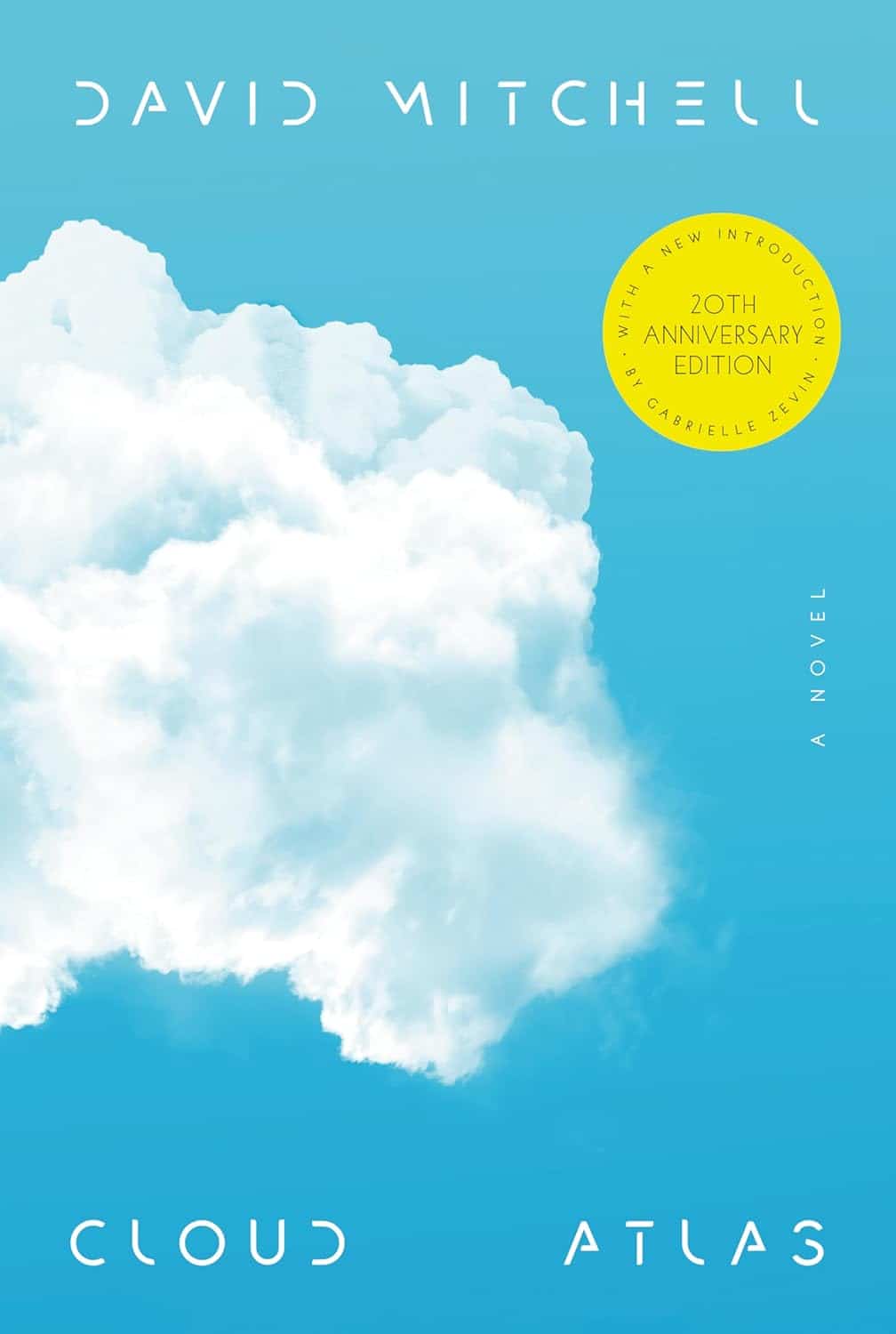
Cloud Atlas: A Novel

Estimated reading time: 1 minute, 8 seconds

Today, I started reading Cloud Atlas: A Novel by David Mitchell, one of The New York Times’ 100 Best Books of the 21st Century. Cloud Atlas begins in 1850 with Adam Ewing, an American notary, voyaging from the Chatham Isles to his home in California. Ewing is befriended by a physician, Dr. Goose, who begins treating him for a rare species of brain parasite.

The novel careens, with dazzling virtuosity, to Belgium in 1931, the West Coast in the 1970s, an inglorious present-day England, a Korean superstate of the near future where neo-capitalism has run amok, and, finally, a postapocalyptic Iron Age Hawaii in the last days of history. But the story doesn’t end even there. What sets Cloud Atlas apart is its unique narrative structure, which boomerangs back through centuries and space, returning by the same route, in reverse, to its starting point. This journey reveals how the disparate characters connect, how their fates intertwine, and how their souls drift across time like clouds across the sky.

As wild as a video game, as mysterious as a Zen koan, Cloud Atlas is an unforgettable tour de force that, like its incomparable author, has transcended its cult classic status to become a worldwide phenomenon. The novel’s diverse settings and cultures, from 1850 Chatham Isles to a postapocalyptic Iron Age Hawaii, appeal to readers across the globe, offering a rich and varied reading experience.

The Jan Lilien Education Fund!

Hostage: A Memoir

Read: October 2025

Get this book

Hostage: A Memoir

by Eli Sharabi

In a raw and unflinching memoir, Eli Sharabi, a survivor of 491 days in Hamas captivity, recounts his harrowing ordeal in “Hostage: A Memoir.” He was abducted from Kibbutz Be’eri on October 7, 2023. In this powerful narrative, he shares the profound loss of his wife and daughters along with his unwavering determination to survive. Comparisons can be drawn to Elie Wiesel‘s “Night” and Laura Hillenbrand‘s “Unbroken.” “Hostage” stands as a significant testimony to history, ensuring that his experience will neither be forgotten nor erased.

“I refuse to let myself drown in pain. I am surviving. I am a hostage in the heart of Gaza, a stranger in this unfamiliar land, living with a family that supports Hamas. And I am getting out of here. I have to. I’m getting out of here. I’m coming home.” — Eli Sharabi.

On October 7, 2023, Hamas terrorists stormed Kibbutz Be’eri, shattering the peaceful life Eli Sharabi had built with his British wife, Lianne, and their teenage daughters, Noiya and Yahel. Dragged barefoot out his front door while his family watched in horror, Sharabi was plunged deep into the suffocating darkness of Gaza’s tunnels. As war raged above him, he endured a grueling 491 days in captivity, all the while holding onto the hope that he would one day be reunited with his loved ones.

Eli Sharabi‘s story is one of hunger and heartache, of physical pain, longing, loneliness, and a helplessness that threatens to destroy the soul. But it is also a story of strength, of resilience, and of the human spirit’s refusal to surrender. It is about the camaraderie forged in captivity, the quiet power of faith, and one man’s unrelenting decision to choose life, time and time again.

In the first memoir by a released Israeli hostage, and the fastest-selling book in Israel’s history, Sharabi offers a searing firsthand account of survival under unimaginable conditions—starvation, isolation, physical beatings, and psychological abuse at the hands of his captors.


Franklin Foer‘s essay –The Existential Heroism of the Israeli Hostages – was written about Hostage. His closing paragraph eloquently summarizes how hope can persist even in our darkest days. 

“This weekend, on the cusp of the release of the last 20 living hostages in Gaza, Donald Trump’s son-in-law Jared Kushner stood in the plaza in front of the Tel Aviv Museum of Art, dubbed Hostages Square, to address a jubilant throng. He called the hostages’ release the end of a nightmare. In reality, the nightmare never ends; trauma that endures for generations is the surest outcome of this war. But we also know that the hostages are going home, living proof that hope can persist even in the darkest hole.”


Eli Sharabi is a former hostage who survived 491 days in Hamas captivity after being abducted from Kibbutz Be’eri on October 7, 2023. Since his release, Sharabi has become a global advocate for the remaining hostages. He has met with world leaders, including former US President Donald Trump, spoken at the United Nations, and shared his story with audiences around the world. His memoir, *Hostage*, which is the first published account by a released Israeli hostage, quickly became a number one bestseller in Hebrew and the fastest-selling book in Israeli history.

Born in Tel Aviv to Yemenite and Moroccan parents, Sharabi moved to Be’er Sheva as a teenager. He later married Lianne, a British woman, and they have two daughters, Noiya and Yahel, aged sixteen and thirteen. A longtime resident of Be’eri, Sharabi worked as the Kibbutz’s business manager and served as the Chief Financial Officer for Be’eri Printing and other private companies in Israel. He continues to work tirelessly as a leader in the campaign for the release of captives.


Discover your next favorite book and dive into a world of curated, exciting reads by purchasing through my links. You’ll have access to a diverse selection of books that I’ve personally vetted to ensure quality and enjoyment. Additionally, by supporting these selections, you’ll help me continue to provide you with more personalized recommendations. I earn a small commission from your purchase, which allows me to buy and share even more books with you. Your support truly makes a difference!


×
How to Read a Book: A Novel

Read: May 2024

Get this book

How to Read a Book: A Novel

by Monica Wood

I started reading Monica Wood‘s “How to Read a Book: A Novel” today. It’s a heartfelt and uplifting story about a chance encounter at a bookstore—the novel delves into themes of redemption, unlikely friendships, and the life-changing power of sharing stories. With Monica Wood’s characteristic heart, wit, grace, and understanding, the novel illuminates the decisions that shape a life and the kindnesses that make life meaningful.

The story revolves around three characters: Violet Powell, a twenty-two-year-old from rural Abbott Falls, Maine, who is being released from prison after serving twenty-two months for a drunk-driving crash that killed a local kindergarten teacher; Harriet Larson, a retired English teacher who runs the prison book club and is facing the prospect of an empty nest; and Frank Daigle, a retired machinist who is struggling to come to terms with the complexities of his marriage to the woman Violet killed.

Their lives unexpectedly intersect one morning in a bookstore in Portland, Maine. Violet buys the novel she read in the prison book club before her release, Harriet selects the following title for the remaining women, and Frank fulfills his duties as the store handyman. Their encounters set off a chain of events that will profoundly change them.

How to Read a Book is a candid and hopeful story about releasing guilt, embracing second chances, and the profound impact of books on our lives.

×
Autocracy, Inc.: The Dictators Who Want to Run the World

Read: January 2025

Get this book

Autocracy, Inc.

by Anne Applebaum

Today, I plunged into the captivating world of “Autocracy, Inc.: The Dictators Who Want to Run the World” by Anne Applebaum. I listened to an engaging discussion between her and the Executive Director of the YIVO Institute for Jewish Research, Jonathan Brent. Their insights left me eager for more, and I couldn’t resist making this book my next read. I’m thrilled to dive deeper into her thought-provoking perspective!

This compelling New York Times bestseller by the Pulitzer Prize-winning author paints a chilling picture of how autocratic regimes join forces to erode democracy globally. Applebaum sheds light on this pressing issue and offers insights on how we can unite to fight back.

We think we know what an autocratic state looks like: An all-powerful leader is at the top. He controls the police. The police threaten the people with violence. There are evil collaborators and maybe some brave dissidents.

But in the 21st century, that bears little resemblance to reality. Nowadays, autocracies are underpinned not by one dictator but by sophisticated networks composed of kleptocratic financial structures, surveillance technologies, and professional propagandists, all of which operate across multiple regimes, from China to Russia to Iran. Corrupt companies in one country do business with corrupt companies in another. The police in one country can arm and train the police in another, and propagandists share resources and themes, pounding home the same messages about the weakness of democracy and the evil of America.

International condemnation and economic sanctions cannot move the autocrats. Even popular opposition movements, from Venezuela to Hong Kong to Moscow, don’t stand a chance. The members of Autocracy, Inc. aren’t linked by a unifying ideology, like communism, but rather by a common desire for power, wealth, and impunity. In this urgent treatise, which evokes George Kennan’s essay calling for “containment” of the Soviet Union, Anne Applebaum calls for the democracies to reorient their policies to fight a new threat fundamentally.


In the video, Jonathan Brent asks Anne Applebaum to read the last paragraph of “Autocracy, Inc.: The Dictators Who Want to Run the World.”

There is no liberal world order anymore, and the aspiration to create one no longer seems real. But there are liberal societies, open and free countries that offer a better chance for people to live useful lives than closed dictatorships do. They are hardly perfect. Those that exist have deep flaws, profound divisions, and terrible historical scars. But that’s all the more reason to defend and protect them. So few of them have existed across human history; so many have existed for a short time and then failed. They can be destroyed from the outside and from the inside, too, by division and demagogues. Or they can be saved. But only if those of us who live in them are willing to make the effort to save them.

After finishing Autocracy, Inc.: The Dictators Who Want to Run the World,” this closing paragraph should be a call to action. Failure to respond to the challenge will doom our future to an unacceptable one. I recommend this book and encourage people to read it, discuss its contents, and take action to save our collective future.


When you purchase a book through one of my links, I earn a small commission that helps support my passion for reading. This contribution allows me to buy even more books to share with you, creating an incredible cycle of discovering great reads together! Your support truly makes a difference!


×
Universality

Read: August 2025

Get this book

Universality: A Novel

by Natasha Brown

Universality,” a thrilling novel by the acclaimed young author Natasha Brown, is a compelling and unsettling celebration of the extraordinary—and often troubling—power of language. It dares readers to face the raw, astonishing force of words and challenges them not to look away. Longlisted for the THE 2025 Booker Prize, this novel promises an extraordinary reading experience!

Late one night on a Yorkshire farm, amid an illegal rave, a young man is nearly bludgeoned to death with a solid gold bar.

An ambitious young journalist sets out to uncover the truth surrounding the attack, connecting the dots between an amoral banker landlord, an iconoclastic newspaper columnist, and a radical anarchist movement that has taken up residence on the farm. She solves the mystery, but her viral exposé raises more questions than it answers. Through a voyeuristic lens, and with a simmering power, Universality focuses on words: what we say, how we say it, and what we mean.


Natasha Brown was recognized as one of Granta’s Best of Young British Novelists. Her debut novel, Assembly, received nominations for the Folio Prize, the Goldsmiths Prize, and the Orwell Prize for Political Fiction.


When you purchase a book through one of my links, I earn a small commission that helps support my passion for reading. This contribution allows me to buy even more books to share with you, creating an incredible cycle of discovering great reads together! Your support truly makes a difference!

Enjoy a limited-time offer of 20% off your next book purchase at Bookshop.org!


×
Daughter: A Novel

Read: September 2023

Get this book

Daughter: A Novel

by Claudia Dey

I started reading “Daughter: A Novel” by Claudia Dey today. According to Mona Dean, to be loved by your father is to be loved by God. Mona is a playwright, actress, and daughter of a man who is famous for a great novel. However, her father’s needs and insecurities significantly impact the women in his family, including Mona, her sister, her half-sister, and their mothers.

Mona’s father’s infidelity shattered her childhood, causing her to be in opposition to her stepmother, who also suffered from his actions. Mona’s father begins a new affair, and he confides in her. She enjoys his attention painfully and parasitically. When he confesses to his wife, Mona is blamed for the disruption, punished for her father’s actions, and kicked out of the family.

Mona’s life is chaotic, and she struggles to regain stability. Only when she experiences a profound and defining loss does she begin to replace absent love with real love? Pushed to the brink, she must decide how she wants to live, what Mona needs to say, and the risks she’s willing to take to say it.

Claudia Dey provides penetrating insight and devilish humor to chronicle our most intimate lives in “Daughter.” It’s an obsessive and blazing examination of the forces that drive us to become, create, and break free.

×
Weather

Read: March 2022

Get this book

Weather: A Novel

by Jenny Offil

Weather: A Novel by Jenny Offil was a book that I was confused and uncertain if I wanted to finish for the first few pages. I am delighted that I did, and I highly recommend this book. Its brief diary-like dispatches about life in our time when we sense that we may all be doomed to a climate catastrophe made this a book I truly enjoyed reading. The subtext of the rise of right-wing strongmen in the USA and abroad adds to the crisis her dispatches describe.

Her Obligatory Note of Hope challenges all of us to engage in solutions instead of accepting doom.

How can we contribute to the common good? There are people all over the world trying to answer these questions. In big ways but also in small ways. In grand leaps but also in fits and starts.

I always thought it was ridiculous to try and fight for social change when I couldn’t even get my own house in order. How could a meat-eating, plane-flying, march-hating person like me ever find a place in the climate justice movement? But then I started to read about all the different ways ordinary people were refusing to give into fatalism and were exploring the possibilities of what they could do, what they might fight for in this half-ruined world of ours.

There were saints among these accidental activists, but also stone-cold hypocrites like me. Slowly, I began to see collective action as the antidote to my dithering and despair.

There’s a way in for everyone. Aren’t you tired of all this fear and dread?

Goodreads provides an overview of the book if you are not yet convinced to read it.

 Lizzie Benson is a very relatable woman who slid into her job as a librarian without a traditional degree. But this gives her a vantage point from which to practice her other calling: a fake shrink. She has tended to her God-haunted mother and her recovering addict brother for years. They have both stabilized for the moment, but Lizzie has little chance to spend her new free time with her husband and son before her old mentor, Sylvia Liller, proposes. She wants to hire Lizzie to answer the mail she receives: left-wingers worried about climate change and right-wingers concerned about the decline of western civilization. Sylvia has become famous for her prescient podcast, Hell and High Water, and wants to hire Lizzie to answer the mail she receives: from left-wingers worried about climate change and right wingers worried about the decline of western civilization.

As Lizzie dives into this polarized world, she begins to wonder what it means to keep tending your own garden once you’ve seen the flames beyond its walls. When her brother becomes a father and Sylvia a recluse, Lizzie is forced to address the limits of her own experience. But she still tries to save everyone, using everything she’s learned about empathy and despair, conscience and collusion, floundering the library stacks her years of wa.. And all the while the voices of the city keep floating in—funny, disturbing, and increasingly mad.

Register to Attend Celebrate Jan Day

Subscribe

Contact Us

When you buy a book or product using a link on this page, I receive a commission. Thank you for supporting Sharing Jan’s Love blog.

×