Jan Needs Me Now!

Estimated reading time: 14 minutes, 3 seconds
One Step at a Time

As I turned in McCarren Park and headed south to my home, I glanced across at Automotive High School. Almost a half-decade prior, I had met Jan when school was over, and we would walk in this park hand in hand. It was the year before our wedding, and she worked as a drug counselor. My feet begged me to cross the street and stand by the entrance, hoping she would exit from the doorway into my arms. But Sam’s admonition kept me on the route home. 

Turning to North 12th from Bedford, my Apple Watch began to ring. A few months ago, it rang all the time, but I needed a job to remember the sound of the ringtone. Who would be calling me?

Slowing my pace, I lifted my left hand to determine who was calling. There was no caller id, and I thought for a moment to avoid answering.

It could be someone with a new phone number. If it is a junk call, I can hang up.

“Hello,” I answered in what many had conveyed to me was my watch’s robotic voice.

“Richard, it’s Jan. I am so glad you answered.” 

My feet screeched to a halt as I heard her voice echoing with tears

“It is wonderful to hear from you. How are you?”

“I am not OK. I needed to talk to someone whom I could trust….”

“I am all ears.” I interrupted her.

“Thanks. I did not know anyone else I could call. You told me I could when we spoke at your retirement dinner.”

I nodded my head as if she was standing next to me. 

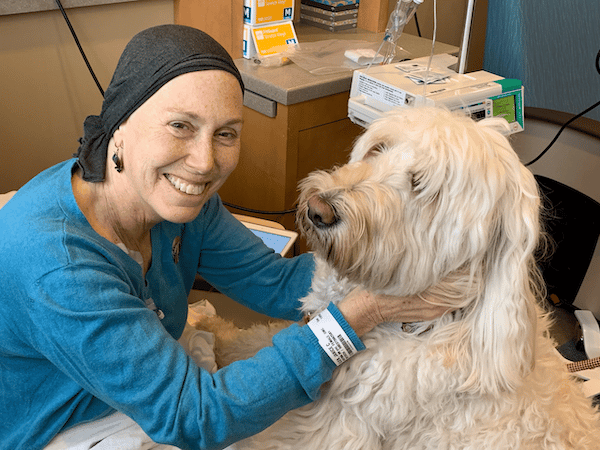
“I have been diagnosed with blood cancer.”

My body shook, and I could hear her voice quivering as it choked up with tears.

I started to speak, but she continued talking before I could formulate the words for a response.

“I am meeting with the oncologist this afternoon. Today they will tell me what type of cancer I have and the treatment plan. I am aware I should not ask this of you after everything I did to hurt you, but could you go with me to the appointment?” Jan paused for a moment.

My calendar was free for the balance of the day, but before I could speak, Jan’s garbled voice said, “I am sorry, I should not have called.”

“What time, where is the appointment,” my mind raced through the questions of who, what, and where. 

Jan started to give me the details.

“I can and will go with you, but can you text the information? I am walking now and do not want to trust my memory.”

“Yes.”

I wanted to continue talking to her, but I told her I needed to get home so I could shower and change before meeting her. 

“I appreciate this. I am afraid and did not know whom else I could call.”

Pages: 1 2 3 4 5 6

2 comments add your comment

Share your thoughts and ideas

This site uses Akismet to reduce spam. Learn how your comment data is processed.

Previous Post:

Next Post:

The Jan Lilien Education Fund!

All the Sinners Bleed- A Novel

Read: June 2023

Get this book

All the Sinners Bleed: A Novel

by S. A. Cosby

Today, I delved into the gripping pages of “All the Sinners Bleed” by S. A. Cosby. This enthralling novel centers around Titus Crown, the first African American sheriff in Charon County, Virginia. Despite the county’s reputation for traditional customs such as moonshine, cornbread, and honeysuckle, Titus, with his FBI expertise, knows that the peace won’t last forever.

On the first anniversary of Titus’s election, a schoolteacher is murdered by an ex-student, and Titus’s deputies take down the perpetrator. As Titus delves deeper into the case, he uncovers a web of horrendous crimes and finds a serial killer lurking in plain sight, haunting Charon’s dirt roads and woodland clearings.

Titus is determined to solve the case, despite its connection to a nearby church, and he harbors a personal secret that haunts him. However, he faces opposition from a far-right group that wants to hold a parade to honor the town’s Confederate past while he tries to solve the issue.

Despite the challenges, Titus remains resolute in his love for Charon and his commitment to finding justice. The collision of religion and hatred cannot deter him from his duty.


S. A. Cosby is a New York Times bestselling writer from southeastern Virginia. He is the author of All the Sinners Bleed, which was on more than forty Best of the Year lists, including Barack Obama’s, as well as Edgar Award finalist Razorblade Tears and Los Angeles Times Book Prize winner Blacktop Wasteland. He has also won the Anthony Award, ITW Thriller Award, Barry Award, Macavity Award, BCALA Award, and Audie Award. He has been longlisted for the ALA Andrew Carnegie Medal for Excellence.


When you purchase a book through one of my links, I earn a small commission that helps support my passion for reading. This contribution allows me to buy even more books to share with you, creating an incredible cycle of discovering great reads together! Your support truly makes a difference!

Enjoy a limited-time offer of 20% off your next book purchase at Bookshop.org!


×
Four Spirits

Read: July 2021

Get this book

Four Spirits

by Sena Jeter Naslund

Four Spirits by Sena Jeter Naslund is a book that I could not put down. It is a page-turner. The title is from the four girls killed at Sunday School in Birmingham. When that happened in 1963, I was only a few years older and the impact brought home to me that we lived in a broken world that required repair. Like Stella Silver in the novel, my life changed as a result of the bombing. 

As my reading list may indicate, I have always preferred non-fiction with a preference for history. Picking this novel up combined my prior reading habits with my desire to read books that my wife, Jan, recommended.

Weaving together the lives of blacks and whites, racists and civil rights advocates, and the events of peaceful protest and violent repression, Sena Jeter Naslund creates a tapestry of American social transformation at once intimate and epic.

In Birmingham, Alabama, twenty-year-old Stella Silver, an idealistic white college student, is sent reeling off her measured path by the events of 1963. Combining political activism with single parenting and night-school teaching, African American Christine Taylor discovers she must heal her own bruised heart to actualize meaningful social change. Inspired by the courage and commitment of the civil rights movement, the child Edmund Powers embodies hope for future change. In this novel of maturation and growth, Naslund makes vital the intersection of spiritual, political, and moral forces that have redefined America.

Stella’s idealism reminded me of how I became the person I am. Change is not easy but, it takes all of us to risk our lives to repair the world so, it works for all of us.

The book’s critical focus on the “intersection of spiritual, political, and moral forces that have redefined America” makes this a must-read. The redefinition has made America a better country but, we may be retreating from that ideal.

Subscribe

Contact Us

×
How the Word is Passed

Read: December 2021

Get this book

How the Word Is Passed: A Reckoning with the History of Slavery Across America

by Clint Smith

How the Word Is Passed: A Reckoning with the History of Slavery Across America by Clint Smith. This book was a gift from my son Jon. The New York Times selected How the Word is Passed as one of the best books published this year. Beginning in his hometown of New Orleans, Clint Smith leads the reader on an unforgettable tour of monuments and landmarks—those that are honest about the past and those that are not—that offer an intergenerational story of how slavery has been central in shaping our nation’s collective history, and ourselves.

How the Word is Passed is one of the best books I have read in 2021. I had read an excerpt in The Atlantic on the Whitney Plantation, one of the only former plantations devoted to preserving the experience of the enslaved people whose lives and work sustained it. Like most of us, I had placed the book on my to-read list, where it remained lost in the cobwebs. Fortunately, my son Jon purchased the book for me.

Secondly, the book rekindled my long-lost dream of being an American Studies professor. As soon as Jan and I met, I dropped plans to leave Brooklyn and start graduate school in the fall of 1974. I made that decision primarily because of how much I loved Jan. But it was also partly that I did not have a clear vision of what my life would be like as a professor. The book provided clear examples of people like Yvonne Holden at The Whitney Plantation redefining history to be more accurate and inclusive. I probably could not have done as well as she did, but I can now see that it might have resulted in a career for me that could have been impactful.

Goodreads provides this overview for those who still need to be convinced to read this book.

It is the story of the Monticello Plantation in Virginia, the estate where Thomas Jefferson wrote letters espousing the urgent need for liberty while enslaving over 400 people on the premises. It is the story of the Whitney Plantation, one of the only former plantations devoted to preserving the experience of the enslaved people whose lives and work sustained it. It is the story of Angola Prison in Louisiana, a former plantation named for the country from which most of its enslaved people arrived and which has since become one of the most gruesome maximum-security prisons in the world. And it is the story of Blandford Cemetery, the final resting place of tens of thousands of Confederate soldiers.

In a deeply researched and transporting exploration of the legacy of slavery and its imprint on centuries of American history, How the Word Is Passed illustrates how some of our country’s most essential stories are hidden in plain view-whether in places we might drive by on our way to work, holidays such as Juneteenth, or entire neighborhoods—like downtown Manhattan—on which the brutal history of the trade in enslaved men, women and children has been deeply imprinted.

Informed by scholarship and brought alive by the story of people living today, Clint Smith’s debut work of nonfiction is a landmark work of reflection and insight that offers a new understanding of the hopeful role that memory and history can play in understanding our country.

How the Word is Passed is one of the best books I have read this year and many prior ones. I encourage you to read it and share your comments.

Subscribe

Contact Us

When you buy a book or product using a link on this page, I receive a commission. Thank you for supporting Sharing Jan’s Love blog.

×
Autobiography of Cotton

Read: February 2026

Get this book

Autobiography of Cotton

by Cristina Rivera Garza

In 1934, a young José Revueltas traveled to Tamaulipas to support the cotton workers’ strike in Estación Camarón, which would later serve as the foundation for his landmark novel, Human Mourning. In her groundbreaking novel Autobiography of Cotton, Cristina Rivera Garza recounts her grandparents’ journey from mining towns to those same cotton fields. Her narrative intersects with Revueltas’s life and offers a vivid and evocative account of the history of cotton cultivation along the Mexico-U.S. border.

Through archival research and personal narrative, Rivera Garza explores how cotton transformed the borderlands by recounting the story of the cotton workers’ strike. She reveals how cycles of deprivation and environmental destruction continue to affect generations. Rivera Garza skillfully creates a new kind of border novel that illustrates how a fragile landscape drastically changed her grandparents’ lives and the territories they helped to develop. In this intimate fictionalization, Autobiography of Cotton offers a rich social history that encompasses agricultural colonization, labor activism, environmental degradation, and cross-border migration.

I recommend “Autobiography of Cotton,” but readers should be patient as the book shifts back and forth in time. Everything becomes clear as you continue reading.


Cristina Rivera Garza is the Pulitzer Prize–winning author of Liliana’s Invincible Summer. A MacArthur Fellow, she is the Hugh Roy and Lillie Cranz Cullen Distinguished Chair and founder of the University of Houston’s PhD in Creative Writing in Spanish.

Christina MacSweeney is the award-winning literary translator of works by Julián Herbert, Valeria Luiselli, and Elvira Navarro. She received the 2024 Sundial Literary Translation Award for her translation of Verónica Gerber Bicecci‘s The Company.


Discover your next favorite book and dive into a world of curated, exciting reads by purchasing through my links. You’ll have access to a diverse selection of books that I’ve personally vetted to ensure quality and enjoyment. Additionally, by supporting these selections, you’ll help me continue to provide you with more personalized recommendations. I earn a small commission from your purchase, which allows me to buy and share even more books with you. Your support truly makes a difference!


×
1944: FDR and the Year That Changed History

Read: October 2019

Get this book

1944: FDR and the Year That Changed History

by Jay Winik

1944: FDR and the Year That Changed History by Jay Winik is a book that I had put off reading several times. When I finally did read it, I could not remember why I had not read it sooner. Had I gone to graduate school and become a professor, it might have been the type of book I might write, and I certainly would have had on my list of books for my classes. 

As The NY Times wrote, “Jay Winik brings to life in gripping detail the year 1944, which determined the outcome of World War II and put more pressure than any other on an ailing yet determined President Roosevelt.” Reading a book about events five years before my birth that transformed the world I live in becomes an easy page-turner.

It was not inevitable that World War II would end as it did or that it would even end well. Nineteen forty-four was a year that could have stymied the Allies and cemented Hitler’s waning power. Instead it saved those democracies – but with a fateful cost. Now, in a superbly told story, Jay Winik, the acclaimed author of April 1865 and The Great Upheaval, captures the epic images and extraordinary history as never before.

1944 witnessed a series of titanic events: FDR at the pinnacle of his wartime leadership as well as his reelection, the planning of Operation Overlord with Churchill and Stalin, the unprecedented D-Day invasion, the liberation of Paris, and the horrific Battle of the Bulge, and the tumultuous conferences that finally shaped the coming peace. But on the way, millions of more lives were still at stake as President Roosevelt was exposed to mounting evidence of the most grotesque crime in history, the Final Solution. Just as the Allies were landing in Normandy, the Nazis were accelerating the killing of millions of European Jews.

Winik shows how escalating pressures fell on an all but dying Roosevelt, whose rapidly deteriorating health was a closely guarded secret. Here then, as with D-Day, was a momentous decision for the president. Was winning the war the best way to rescue the Jews? Was a rescue even possible? Or would it get in the way of defeating Hitler? In a year when even the most audacious undertakings were within the world’s reach, including the liberation of Europe, one challenge – saving Europe’s Jews – seemed to remain beyond Roosevelt’s grasp.

I recommend this book.

Subscribe

Contact Us

×
Do You Remember Being Born?: A Novel

Read: September 2023

Get this book

Do You Remember Being Born?

by Sean Michaels

I started reading “Do You Remember Being Born?” by Sean Michaels, a writer who won the Scotiabank Giller Prize. The novel is about an aging poet named Marian Ffarmer, a legend in the world of poetry. However, despite her success, she struggles with financial issues and her son’s inability to buy a house. Marian has sacrificed her personal relationships and happiness to pursue her career but questions whether it is worth it.

One day, she receives an invitation from a Tech Company to travel to California and work with their poetry AI, Charlotte. The company wants her to co-author a poem with their bot in a historic partnership, which clashes with Marian’s beliefs about the individual pursuit of art. However, she decides to take this opportunity, even though it makes her feel like a sell-out and a skeptic. The encounter in California changes her life, work, and understanding of kinship.

The book explores the nature of language, art, labor, capital, family, and community. It’s a response to some of the most disquieting questions of our time. The author, Sean Michaels, is a winner of the Scotiabank Giller Prize, and his book is a love letter to and interrogation of the creative legacy. It’s a joyful recognition that belonging to one’s art must mean belonging to the world to survive meaningfully.


The Jan Lilien Education Fund sponsors ongoing sustainability and environmental awareness programs. Gifts made this month; I will match dollar-for-dollar. All donations are tax-deductible.

Subscribe

Contact Us

I receive a commission when you buy a book or product using a link on this page. Thank you for supporting Sharing Jan’s Love blog.


×

Discover more from Sharing Jan’s Love

Subscribe now to keep reading and get access to the full archive.

Continue reading