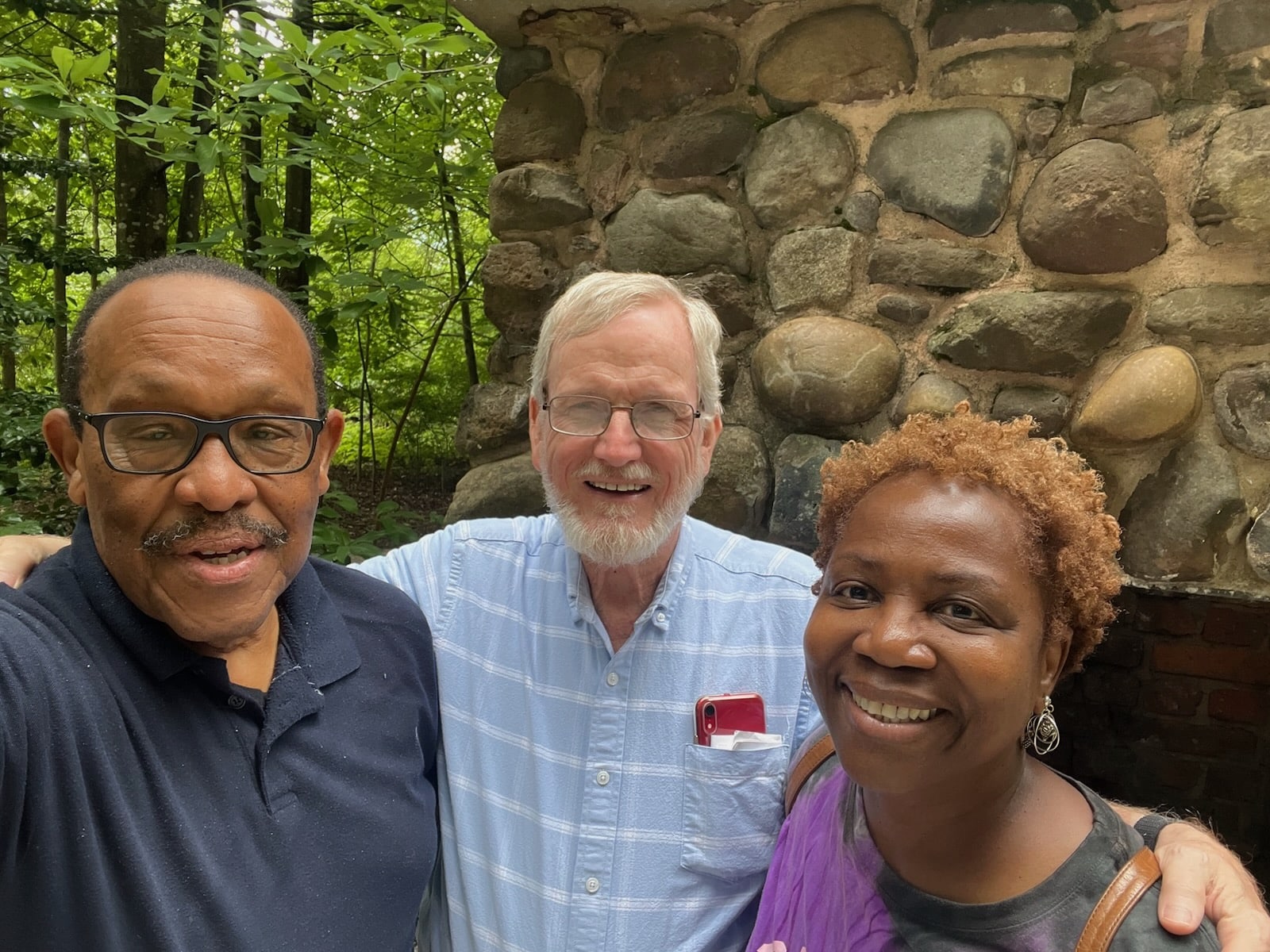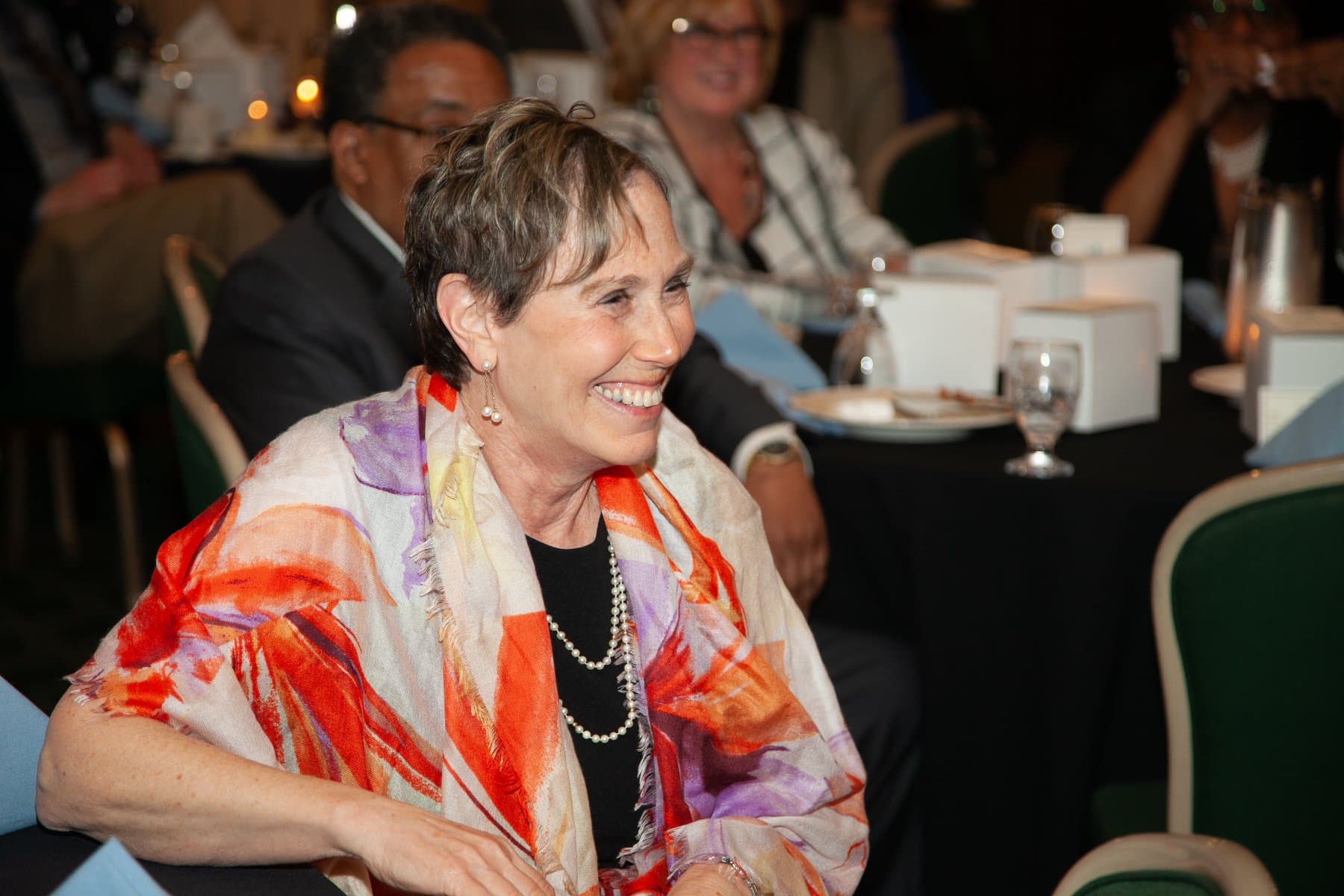

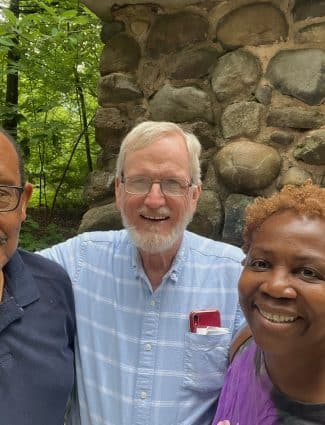
Ron and Deborah

Sharing Jan’s Love Allows Me to Live Fully!

Jans Love is as Free as the Birds in Hanson Park

Estimated reading time: 1 minute, 57 seconds
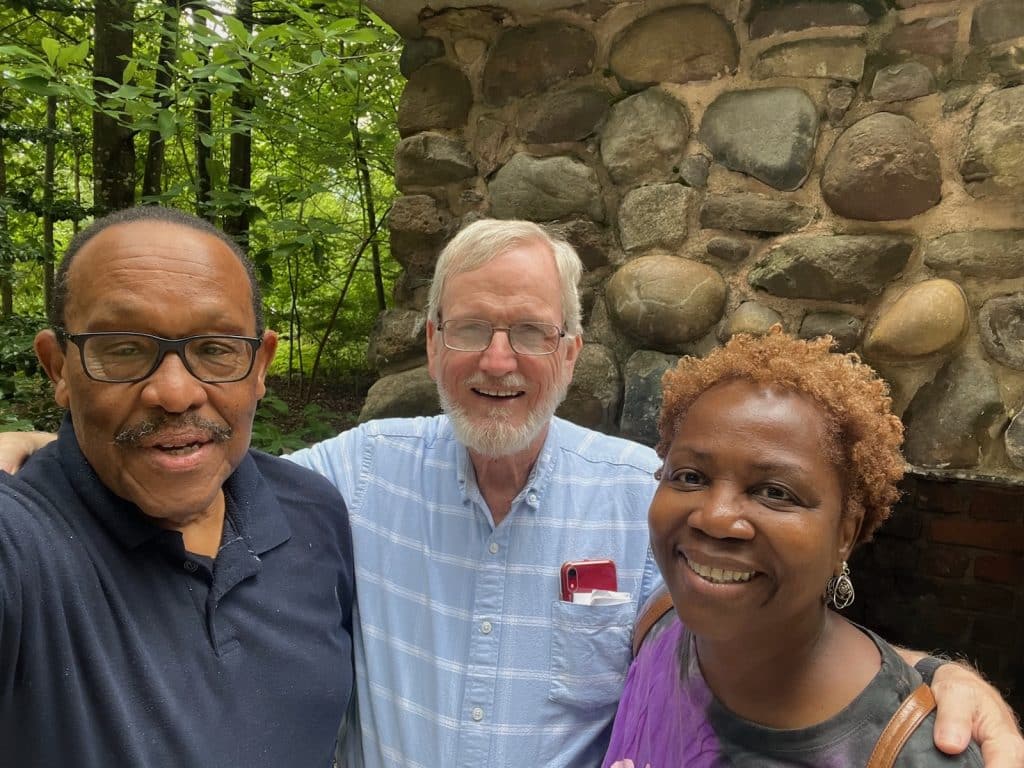
Ron and Deborah

Ron, Me, and Deborah

On Monday, I visited Jan’s Memorial Garden in Hanson Park with my friends Ron and Deborah. We caught up on how I’ve been doing in the two-plus years since her death. Whenever I’m in the park, I feel closer to Jan than on the thousands of days or nights we spent together. I always enjoy showing my friends the Wind Sculpture, benches, and other park activities.

Sharing ideas on the benefits of gardening and how it can help build community, I felt that the blood, sweat, and tears I spent on building Jan’s Memorial Garden were worthwhile. Over lunch at IL Gabbiano Italian Bistro, I remembered Ron had called me the day Jan died. After expressing his condolences, he said I was a resilient individual and that this trait would assist me in moving forward without Jan. When he spoke, I was uncertain how or if resilience could help me manage the loss of the love of my life.

In hindsight, embracing adaptability as a core value has helped me cope with the challenges of being a widow. Instead of clinging to the love I shared with my late spouse, Jan, I freely shared her love with everyone I encountered. If I had kept Jan’s love to myself, it would have sealed her spirit into a time capsule, ending her life and legacy. But by sharing her love, Jan’s spirit inspires and motivates us to improve the world. Her love is now as free as the birds in Hanson Park. It’s incredible how sharing love causes it to return to me, more vibrant than ever.

Jan’s unwavering love has been a source of strength and direction for me through life’s challenges. Thanks to her support, I can now live with an open heart, embracing the beauty of love in all its forms.


The Jan Lilien Education Fund sponsors ongoing sustainability and environmental awareness programs. Gifts made this month; I will match dollar-for-dollar. All donations are tax-deductible.

Subscribe

Contact Us

I receive a commission when you buy a book or product using a link on this page. Thank you for supporting Sharing Jan’s Love blog.


Is Resilience My Hidden Power?

Adaptability has been explored in depth in the context of prevention strategies, with "The Art of Being Adaptable" in Prevention offering valuable insights into the subject matter. This work posits that adaptability is crucial in any successful prevention strategy and provides potential solutions for cultivating and maintaining this trait. Focusing on the importance of flexibility, resilience, and open-mindedness, this work offers practical advice on adapting to changing circumstances. Ultimately, by embracing adaptability as a core value, individuals and organizations can better prepare themselves for challenges.

Jan's love has been my guiding light, even in the darkest times. Her unwavering devotion has given me the strength to persevere through life's obstacles.

Show thread (1)

The Awesome Power of Love

Jans Love is as Free as the Birds in Hanson Park

Estimated reading time: 1 minute, 57 seconds
The Awesome Power of Love

Sharing Jan's love through the garden and the people whose lives she touched has been incredibly fulfilling and has helped me manage my grief.

I've also been inspired by Viktor E. Frankl's observation that "love is the ultimate goal in life." Jan's love will continue to live on through the garden and in my heart, inspiring me daily.

Share your thoughts and ideas

This site uses Akismet to reduce spam. Learn how your comment data is processed.

The Jan Lilien Education Fund!

Ron and Deborah
×
The Invisible Hour: A Novel

Read: August 2023

Get this book

The Invisible Hour: A Novel

by Alice Hoffman

Today I started reading The Invisible Hour by Alice Hoffman. It’s a story about love, heartbreak, self-discovery, and the magic of books. The Invisible Hour is the story of one woman’s dream. For a little while, it came true. Nathaniel Hawthorne wrote: “A single dream is more powerful than a thousand realities.

Mia Jacob finds hope in the power of words on a brilliant June day. She reads The Scarlet Letter, a novel written almost two hundred years earlier, which mirrors her life. Mia and her mother, Ivy, live inside an oppressive cult in western Massachusetts called the Community, where contact with the outside world is forbidden, and books are considered evil. Nathaniel Hawthorne’s words perfectly capture the pain and loss that Mia carries inside her.

As Mia journeys through heartbreak and time, she breaks free from the rules of her Community. Along the way, she discovers the power of reading to transport and connect people, the fluidity of time, and the strength of love to overcome any obstacle.

As a young girl, Mia fell in love with a book. Now as a woman, she falls for a writer as she travels back in time. But what if Nathaniel Hawthorne never wrote “The Scarlet Letter”? What if Mia never found the book on the day she planned to end her life?


The Jan Lilien Education Fund sponsors ongoing sustainability and environmental awareness programs. Gifts made this month; I will match dollar-for-dollar. All donations are tax-deductible.

Subscribe

Contact Us

I receive a commission when you buy a book or product using a link on this page. Thank you for supporting Sharing Jan’s Love blog.


×
Hello Beautiful

Read: March 2023

Get this book

Hello Beautiful

by Ann Napolitano

Hello Beautiful by Ann Napolitano is a gorgeous, profoundly moving portrait of what’s possible when we choose to love someone, not despite who they are but because of it. Although several sources recommended Hello Beautiful, I chose the novel based on the title as it is how I always greeted Jan. I highly recommend this book as it is one of the best I have ever read.

Hello Beautiful is an exquisite homage to Louisa May Alcott’s timeless classic, Little Women. Knowing it was not him, William Waters’s experience growing up as an only child was an engaging character in the early portion of the novel. However, my hero was Sylvie, the dreamer who pursued true love and found it in a place one would less expect to find it. The consequences of her love reverberate over decades in their families

The following passage is one example of a well-written book.

We’re separated from the world by our own edges,” Charlie Padavano says to Sylvie in “Hello Beautiful.” He continues, “We’re all interconnected, and when you see that, you see how beautiful life is.

The interconnections of the characters make this novel one of the best I have read. If only more of us could learn the lessons that Charlie Padavano shared with Sylvie.

As a man on a lifetime grief journey, this exchange echoes my experience.

When an old person dies,” Kent said, “even if that person is wonderful, he or she is still somewhat ready, and so are the people who loved them. They’re like old trees, whose roots have loosened in the ground. They fall gently. But when someone like your aunt Sylvie dies—before her time—her roots get pulled out and the ground is ripped up. Everyone nearby is in danger of being knocked over.”

Grief is love.” Now Alice thought: Forgiveness is too.

The Goodreads summary provides an overview,

William Waters grew up in a house silenced by tragedy, where his parents could hardly bear to look at him, much less love him. So it’s a relief when his skill on the basketball court earns him a scholarship to college, far away from his childhood home. He soon meets Julia Padavano, a spirited and ambitious young woman who surprises William with her appreciation of his quiet steadiness. With Julia comes her family; she is inseparable from her three younger sisters: Sylvie, the dreamer, is happiest with her nose in a book and imagines a future different from the expected path of wife and mother; Cecelia, the family’s artist; and Emeline, who patiently takes care of all of them. Happily, the Padavanos fold Julia’s new boyfriend into their loving, chaotic household.

But then darkness from William’s past surfaces, jeopardizing not only Julia’s carefully orchestrated plans for their future, but the sisters’ unshakeable loyalty to one another. The result is a catastrophic family rift that changes their lives for generations. Will the loyalty that once rooted them be strong enough to draw them back together when it matters most?


The Jan Lilien Education Fund sponsors ongoing sustainability and environmental awareness programs. Gifts made this month; I will match dollar-for-dollar. All donations are tax-deductible.

Subscribe

Contact Us

I receive a commission when you buy a book or product using a link on this page. Thank you for supporting Sharing Jan’s Love blog.


×
Invisible Child

Read: December 2021

Get this book

Invisible Child: Poverty, Survival & Hope in an American City

by Andrea Elliott

Invisible Child: Poverty, Survival & Hope in an American City by Andrea Elliott was a gift from my son Jon. The New York Times selected “Invisible Child” as one of the best books published this year. It is indeed one of the top books on my all-time list.

GoodReads summary provides a good overview,

The riveting, unforgettable story of a girl whose indomitable spirit is tested by homelessness, poverty, and racism in an unequal America—from Pulitzer Prize-winning journalist Andrea Elliott of The New York Times

Invisible Child follows eight dramatic years in the life of Dasani Coates, a child with imagination as soaring as the skyscrapers near her Brooklyn homeless shelter. Born at the turn of a new century, Dasani is named for the bottled water that comes to symbolize Brooklyn’s gentrification and the shared aspirations of a divided city. As Dasani grows up, moving with her tight-knit family from shelter to shelter, this story goes back to trace the passage of Dasani’s ancestors from slavery to the Great Migration north. When Dasani comes of age, New York City’s homeless crisis explodes as the chasm deepens between rich and poor.

In the shadows of this new Gilded Age, Dasani must lead her seven siblings through a thicket of problems: hunger, parental drug addiction, violence, housing instability, segregated schools, and the constant monitoring of the child-protection system. When, at age thirteen, Dasani enrolls at a boarding school in Pennsylvania, her loyalties are tested like never before. As she learns to “code switch” between the culture she left behind and the norms of her new town, Dasani starts to feel like a stranger in both places. Ultimately, she faces an impossible question: What if leaving poverty means abandoning the family you love?

By turns heartbreaking and revelatory, provocative and inspiring, Invisible Child tells an astonishing story about the power of resilience, the importance of family, and the cost of inequality. Based on nearly a decade of reporting, this book vividly illuminates some of the most critical issues in contemporary America through the life of one remarkable girl.

Jan and I were involved and knew that child poverty and homelessness needed repair. In addition, Jan lived on Washington Park across from Ft. Greene Park in 1974-75. We knew the neighborhood where much of the book’s story takes place. 

Before meeting Jan in 1973, I was both a community/tenant organizer and a youth worker. In the latter role, I made weekly hostel trips for eight to ten young boys from East Williamsburg during 1973. The trips were the first the boys had ever been outside of their neighborhood.

Many of them had imaginations like Dasani. They also had her instinct to fight. One of my first tasks was to check for any weapons.

Decades later, when I would see any of them, now adults, they would ask when we were going on another trip. I wish I had met Jan when I made those trips. She would have helped me improve them and document the impact. If I could re-write history, I would have her join me as the second adult on the hostel trips.

After that summer, it was clear my primary skills were as a community/tenant organizer. Over the next few years, my work focused on creating affordable and supportive housing.

Jan and I did meaningful work that made a difference, yet the need for a permanent solution to the crisis remains. The book highlights the crucial role of resilience, the importance of family, and the cost of inequality. As a nation, we cannot undermine those values by breaking up families, impeding resilience, and maintaining racial and economic inequality. 

The current debate in Washington over the Build Back Better legislation needs to focus not on how much we spend but on its impact on children and families

David Brooks, a conservative commentator, has supported these expenditures for what they can do to address this country’s cultural and economic crisis. 

These packages say to the struggling parents and the warehouse workers: I see you. Your work has dignity. You are paving your way. You are at the center of our national vision.

This is how you fortify a compelling moral identity, which is what all of us need if we’re going to be able to look in the mirror with self-respect. This is the cultural transformation that good policy can sometimes achieve. Statecraft is soulcraft.

If you can only read one book this year, this is the one to read. Child poverty, homelessness, and inequality impact all of us. Ending child poverty and homelessness will make us a healthier and more inclusive nation. It is time for a compelling moral call to action!

Subscribe

Contact Us

When you buy a book or product using a link on this page, I receive a commission. Thank you for supporting Sharing Jan’s Love blog.

×
Good and Evil and Other Stories

Read: September 2025

Get this book

Good and Evil and Other Stories

by Samanta Schweblin

Good and Evil and Other Stories” by Samanta Schweblin, translated by Megan McDowell, explores characters who find themselves at a point of no return, captivated by the impending tragedy surrounding them. Vulnerable and deeply human, they become ensnared in moments when the uncanny intrudes upon their lives. Some characters transform, others find themselves isolated, and many oscillate between feelings of guilt and tenderness. All are driven by uncertainty.

Schweblin’s prose employs tension and truth to create a literary universe where the monsters of everyday life come so close that we can almost feel their breath. Her writing evokes both awe and discomfort, placing readers in a state of alarm while transporting them to a world that is both recognizable and strange.


Samanta Schweblin won the 2022 National Book Award for Translated Literature for her story collection Seven Empty Houses. Her debut novel, Fever Dream, was shortlisted for the International Booker Prize, while her book, Little Eyes, and her story collection, Mouthful of Birds, have both been longlisted for the same prize. Her books have been translated into over forty languages, and her stories have appeared in prestigious English publications, including The New Yorker, The Paris Review, Granta, and Harper’s Magazine. Originally from Buenos Aires, Schweblin currently lives in Berlin.

Megan McDowell is the recipient of a 2020 Award in Literature from the American Academy of Arts and Letters and has been short- or longlisted four times for the International Booker Prize. She resides in Santiago, Chile.


Discover your next favorite book and dive into a world of curated, exciting reads by purchasing through my links. You’ll have access to a diverse selection of books that I’ve personally vetted to ensure quality and enjoyment. Additionally, by supporting these selections, you’ll help me continue to provide you with more personalized recommendations. I earn a small commission from your purchase, which allows me to buy and share even more books with you. Your support truly makes a difference!


×
Nothing but the Truth

Read: December 2024

Get this book

Nothing But The Truth

by Robyn Gigl

Today, I started reading “Nothing But the Truth,” the fourth book in Robyn Gigl‘s Erin McCabe Legal Thriller series. The New York Times has selected it as one of the Best Crime Novels 2024. I have also read “The Hunter” and “Gods of Wood,” which are on the same list. Nothing but the Truth is a gripping and timely thriller exploring murder, prejudice, and police corruption.

One of the reasons I decided to read this novel is that it—and the entire series—takes place mainly in Union County, particularly in Cranford, my hometown! Erin McCabe and her law partner get salads from the Gourmet Deli, and she dines with her husband at the Cranford Hotel. In this installment, Erin McCabe, a transgender attorney from the Garden State, discovers that uncovering the Truth can be deadly.

New Jersey State Trooper Jon Mazer has been charged with killing Black investigative reporter Russell Marshall in a racially charged, headline-making murder. The evidence against criminal defense attorney Erin McCabe’s new client is overwhelming. The gun used is Mazer’s off-duty weapon. Fingerprints and carpet fibers link Mazer to the crime. And Mazer was patrolling Marshall’s neighborhood shortly before the victim took three bullets to the chest. Mazer’s argument? He’s a gay officer being set up to take the fall in an even bigger story.

Mazer swears he was a secret source for Marshall’s exposé about the Lords of Discipline. The covert gang operating within the New Jersey State Police is notorious for enforcing its code of harassing women, framing minorities, and out-powering any troopers who don’t play their rogue and racist games. With everyone from the governor to the county prosecutor on the wrong side of justice, Erin and her partner, Duane Swisher, are prepared to do anything to ensure Mazer doesn’t become another victim.

As Erin deals with an intensely personal issue at home and faces an uphill battle to prove her client’s innocence, she and Duane find themselves mired in a conspiracy of corruption more profound than they imagined—and far more dangerous than they feared.


When you purchase a book through one of my links, I earn a small commission that helps support my passion for reading. This contribution allows me to buy even more books to share with you, creating an incredible cycle of discovering great reads together! Your support truly makes a difference!


×
Bluff: Poems

Read: December 2024

Get this book

Bluff: Poems

by Danez Smith

Today, I began reading Bluff: Poems by Danez Smith, which was selected as one of The New York Times 100 Notable Books of 2024. This collection emerged after two years of artistic silence, during which the world slowed due to the COVID-19 pandemic, and Minneapolis became the epicenter of protests following the murder of George Floyd. In Bluff, Danez Smith powerfully reflects on their role and responsibilities as a poet and their connection to their hometown of the Twin Cities.

This book addresses the awakening from violence, guilt, shame, and critical pessimism to a sense of wonder, envisioning how we might strive for a new existence in a world that seems to be descending into desolate futures.

Smith infuses these poems with a startling urgency; their questions demand a new language, deep self-scrutiny, and virtuosic textual shapes. A series of ars poetica gives way to “anti-poetica” and “ars America,” implicating poetry in collusion with unchecked capitalism. A photographic collage builds across a sequence, illustrating the consequences of America’s acceptance of mass shootings. Additionally, a brilliant long poem—part map, part annotation, part visual argument—offers the history of Saint Paul’s vibrant Rondo neighborhood before and after officials decided to route an interstate directly through it.

Bluff is a manifesto of artistic resilience, even when time feels fleeting and the places we hold dear—both given and created—are in turmoil. In this powerful collection, Smith turns to honesty, hope, rage, and imagination to envision possible futures.


When you purchase a book through one of my links, I earn a small commission that helps support my passion for reading. This contribution allows me to buy even more books to share with you, creating an incredible cycle of discovering great reads together! Your support truly makes a difference!


×