
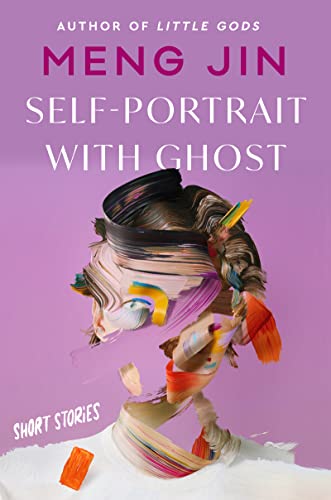
Self-Portrait with Ghost: Short Stories

Estimated reading time: 1 minute, 38 seconds

Self-Portrait with Ghost: Short Stories by Meng Jin was written during the turbulent years of the Trump administration and the first year of the pandemic, these stories explore intimacy and isolation, coming of age, and coming to terms with the repercussions of past mistakes, fraying relationships, and surprising moments of connection. I highly recommend Self-Portrait with Ghost: Short Stories!

Each story speaks so clearly to the loneliness epidemic that confronts our world. I would read one short story and promise to stop and wait until another day to read the next one. Instead

One phrase that will always remain with me is: “The hallucinatory quality of grief.” As a widow, the phrase struck a chord that will forever resonate in my soul.

This is the seventy-third book I have read this year.

The Goodreads summary provides an overview,

Meng Jin’s critically acclaimed debut novel, Little Gods, was praised as “spectacular and emotionally polyphonic (Omar El-Akkad, BookPage), “powerful” (Washington Post), and “meticulously observed, daringly imagined” (Claire Messud). Jin turns her considerable talents into short fiction in ten thematically linked stories.

Moving between San Francisco and China, and from unsparing realism to genre-bending delight, Self-Portrait with Ghost considers what it means to live in an age of heightened self-consciousness, seemingly unlimited access to knowledge, and little actual power.

Page-turning, thought-provoking, and wholly unique, Self-Portrait with Ghost further establishes Meng Jin as a writer who “reminds us that possible explanations in our universe are as varied as the beings who populate it” (Paris Review).


The Jan Lilien Education Fund sponsors ongoing sustainability and environmental awareness programs. Gifts made this month; I will match dollar-for-dollar. All donations are tax-deductible.

Subscribe

Contact Us

I receive a commission when you buy a book or product using a link on this page. Thank you for supporting Sharing Jan’s Love blog.


The Jan Lilien Education Fund!

The Rest Is Memory: A Novel

Read: January 2025

Get this book

The Rest Is Memory: A Novel

by Lily Tuck

Today, I dove into “The Rest Is Memory: A Novel” by Lily Tuck, and it’s already leaving a powerful impression. This poignant tale follows a young Catholic girl’s harrowing journey to Auschwitz, woven in a captivating Rashomon-style narrative showcasing Tuck’s brilliance as a storyteller. Esquire has rightly placed it on their list of Best Books for Fall 2024, and I can see why.

In Tuck‘s skilled hands, “The Rest Is Memory” transforms into an unforgettable piece of historical reclamation, breathing life into an innocent soul who has long been remembered only through a haunting triptych of photographs. It’s a journey that promises to linger in my thoughts long after I’ve turned the last page.

In this mesmerizing novel by Lily Tuck, we first glimpse fourteen-year-old Czeslawa riding on the back of a boy’s motorcycle. Tuck imagines Czeslawa’s upbringing in a small Polish village before her world imploded in late 1942. Stripped of her modest belongings, she arrives at Auschwitz shorn and bearing the tattoo number 26947. Shortly after, she is photographed. Three months later, she is dead.

How did this happen to an ordinary Polish citizen? This is the question Tuck grapples with in this haunting narrative, which frames Czeslawa’s story within the tragic context of the six million Poles who perished during the German occupation. A decade before writing The Rest Is Memory“, Tuck read an obituary of the photographer Wilhelm Brasse, who took over 40,000 pictures of Auschwitz prisoners—including three of Czeslawa Kwoka, a Catholic girl from rural southeastern Poland. Tuck cut out these photos and kept them, determined to learn more about Czeslawa. However, she could only gather the barest facts: the village she came from, the transport she was on, that she was accompanied by her mother and neighbors, her tattoo number, and the date of her death. Tuck crafts a remarkable kaleidoscope of imagination from this scant evidence, something only our greatest novelists can achieve.

Susanna Moore described the novel as “Beautifully written, all the while instilling a sense of horror.” Tuck’s language swirls around the reader, yet no word is out of place. The subtly rotating images tumble forth, accelerating as we learn about Czeslawa’s tragic time in Auschwitz, as well as the lives of real individuals, including the brutal Commandant Rudolf Höss, his unconscionable wife Hedwig, psychiatrist and child rescuer Janusz Korczak, and the sharp Polish short story writer Tadeusz Borowski. Although we know Czeslawa’s fate, we must keep turning the pages, thoroughly captivated by Tuck’s nearly otherworldly prose.


When you purchase a book through one of my links, I earn a small commission that helps support my passion for reading. This contribution allows me to buy even more books to share with you, creating an incredible cycle of discovering great reads together! Your support truly makes a difference!


×
The Immortal Irishman

Read: October 2019

Get this book

The Immortal Irishman

by Timothy Egan


The Immortal Irishman: The Irish Revolutionary Who Became an American Hero by Timothy Egan is a book I started reading as The Worst Hard Timesincluded the first fifty pages.

I often only read a few pages and then return the book to the e-library. The Immortal Irishman was not the case, and I could not stop reading and borrowed the book immediately.

I had never heard of Thomas Francis Meagher or his life in Ireland or America. The story was fascinating, unique, and essential.

The Irish-American story, with all its twists and triumphs, is told through the improbable life of one man. A dashing young orator during the Great Famine of the 1840s, in which a million of his Irish countrymen died, Thomas Francis Meagher led a failed uprising against British rule, for which he was banished to a Tasmanian prison colony. He escaped and six months later was heralded in the streets of New York – the revolutionary hero, back from the dead, at the dawn of the great Irish immigration to America.

Meagher’s rebirth in America included his leading the newly formed Irish Brigade from New York in many of the fiercest battles of the Civil War – Bull Run, Antietam, Fredericksburg. Twice shot from his horse while leading charges, left for dead in the Virginia mud, Meagher’s dream was that Irish-American troops, seasoned by war, would return to Ireland and liberate their homeland from British rule.

The hero’s last chapter, as territorial governor of Montana, was a romantic quest for a true home in the far frontier. His death has long been a mystery to which Egan brings haunting, colorful new evidence.

I recommend this book.

Subscribe

Contact Us

×
The Shadow King: A Novel

Read: April 2022

Get this book

The Shadow King: A Novel

by Maaza Mengiste

The Shadow King: A Novel by Maaza Mengiste is a book happened to offer two often overlooked threads of history. The first is Mussolini’s 1935 invasion of Ethiopia. The second one I am most interested in is the women soldiers who were left out of the historical record. I highly recommend The Shadow King. It is a gorgeously crafted and unputdownable exploration of female power and what it means to be a woman at war.

Hirut and Aster come alive in Maaza Mengiste talented writing. Their struggles to be seen as equal in a society at war is engaging. Hirut’s plan to create a shadow kingpin the absence of Emperor Haile Selassie is one that turns defeat into victory.

Goodreads provides a good overview of the book.

With the threat of Mussolini’s army looming, recently orphaned Hirut struggles to adapt to her new life as a maid in Kidane and his wife Aster’s household. Kidane, an officer in Emperor Haile Selassie’s army, rushes to mobilize his most muscular men before the Italians invaded. His initial kindness to Hirut shifts into flinty cruelty when she resists his advances. Hirut finds herself tumbling into a new world of thefts and violations, betrayals, and overwhelming rage. Meanwhile, Mussolini’s technologically advanced army prepared for an easy victory. Hundreds of thousands of Italians―Jewish photographer Ettore among them―march on Ethiopia seeking adventure.

As the war begins in earnest, Hirut, Aster, and the other women long to do more than care for the wounded and bury the dead. When Emperor Haile Selassie goes into exile and Ethiopia quickly loses hope, Hirut offers a plan to maintain morale. She helps disguise a gentle peasant as the emperor and soon becomes his guard, inspiring other women to take arms against the Italians. But how could she have predicted her war as a prisoner of one of Italy’s most vicious officers, who would force her to pose before Ettore’s camera?

What follows is a gorgeously crafted and unputdownable exploration of female power, with Hirut as the fierce, original, and brilliant voice at its heart. In incandescent, lyrical prose, Maaza Mengiste breathes life into complicated characters on both sides of the battle line, shaping a heartrending, unforgettable exploration of what it means to be a woman at war.

Subscribe

Contact Us

When you buy a book or product using a link on this page, I receive a commission. Thank you for supporting Sharing Jan’s Love blog.
×
When We Cease to Understand the World

Read: September 2024

Get this book

When We Cease to Understand the World

by Benjamín Labatut

Today, I began reading When We Cease to Understand the World by Benjamín Labatut, translated by Adrian Nathan West. This book, listed on The New York Times 100 Best Books of the 21st Century, promises to be thought-provoking as it delves into the intricate connections between scientific and mathematical discovery, madness, and destruction.

In a world where scientific advancements often involve ethical dilemmas and societal implications, this book offers a unique perspective on the lives of scientists who have shaped our understanding of the world. Fritz Haber, Alexander Grothendieck, Werner Heisenberg, and Erwin Schrödinger are some of the luminaries whose troubled lives Benjamín Labatut deeply explores in his fictional examination. Labatut shows how these scientists and thinkers grappled with profound questions of existence, experiencing strokes of unparalleled genius, alienating friends and lovers, and descending into isolation and insanity. Their discoveries, some of which significantly improved human life, while others led to chaos and unimaginable suffering, continue to shape our world.

With a breakneck pace and a wealth of disturbing detail, Labatut uses fiction’s imaginative resources to tell the stories of the scientists and mathematicians who expanded our notions of the possible.

×
The Passing Storm

Read: May 2022

Get this book

The Passing Storm

by Christine Nolfi

The Passing Storm by Christine Nolfi is a gripping, openhearted novel about family, reconciliation, and bringing closure to the secrets of the past. From the first chapter, it was a pageturner and a book that engaged me when I needed to focus on life’s challenges. I was looking for something different from my most recent books.

I very much enjoyed this novel. It is focused on losses, including one parent and a daughter. I had not anticipated that but found that Ms. Nolfi handled that in an empathic way that did not trigger my grief but helped me understand my grief. The primary characters Rae, Quinn, Connor, and Griffin are brought to life by the writer. It left me wanting to know what happens to them now that they have survived the early stages of grief.

The Goodreads summary provides a good overview.

Early into the turbulent decade of her thirties, Rae Langdon struggles to work through grief she never anticipated. With her father, Connor, she tends to their Ohio farm, a forty-acre spread that has enjoyed better days. As memories sweep through her, some too precious to bear, Rae gives shelter from a brutal winter to a teenager named Quinn Galecki.

His parents have thrown out Quinn, a couple too troubled to help steer the misunderstood boy through his losses. Now Quinn has found a temporary home with the Langdons—and an unexpected kinship because Rae, Quinn, and Connor share a past and understand one another’s pain. But its depths—and all its revelations and secrets—have yet to come to light. To finally move forward, Rae must confront them and fight for Quinn, whose parents have other plans for their son.

There might be hope for a new season with forgiveness, love, and the spring thaw—a second chance Rae believed in her heart was gone forever.


Subscribe

Contact Us

When you buy a book or product using a link on this page, I receive a commission. Thank you for supporting Sharing Jan’s Love blog.
×
Dogs and Monsters: Stories

Read: October 2024

Get this book

Dogs and Monsters: Stories

by Mark Haddon

Today, I started reading Dogs and Monsters: Stories by Mark Haddon. The collection features eight captivating and imaginative stories that blend Greek myths with contemporary dystopian narratives. The stories explore themes of mortality, moral choices, and various forms of love, including romantic, familial, and self-love. Haddon’s clear-eyed vision is infused with deep empathy.

In addition, Haddon’s fluid prose showcases his remarkable powers of observation, both of the physical world and the inner workings of the human psyche. Greek myths have fascinated people for millennia with their timeless appeal and enduring lessons about fate, hubris, and life’s uncertainties. In Dogs and Monsters: Stories, Mark Haddon delves into the heart of these ancient fables and presents them in a fresh light. For instance, in one story, the dawn goddess Eos requests that Zeus grant her lover Tithonus eternal life but forgets to ask for eternal youth. In “The Quiet Limit of the World,” Haddon imagines Tithonus’s life as he ages over thousands of years, transforming this cautionary tale about tempting the gods into a spellbinding meditation on observing death from the outside. This tale ultimately explores how carnal love evolves into something more profound and poignant over time.

In “The Mother‘s Story,” Haddon reinterprets the myth of the Minotaur, born of the monstrous lust of King Minos’s wife, Pasiphaë. He turns it into a heartbreaking parable of a mother’s love for a damaged child and the more tangible monstrosities of patriarchy. In “D.O.G.Z.,” the story of Actaeon, who was transformed into a stag after glimpsing the naked goddess Diana and was subsequently torn apart by his hunting dogs, becomes a visceral metaphor for the continuum of human and animal behavior.

Other stories in Dogs and Monsters: Stories play with contemporary mythic tropes—such as genetic engineering, attempts to escape the future, and the cruelty of adolescent ostracism. These stories showcase how modern humans are subject to the same capriciousness that concerned the Greeks but in a fresh and intriguing light. Haddon‘s tales cover a wide range of themes, from the mythic to the domestic, from ancient Greece to the present day, and explore love alongside stories of cruelty. They take readers from battlefields to bed and breakfasts and from dogs in space to doors between worlds, all bound together by profound sympathy and an insight into how human beings think, feel, and act when pushed to their limits.

×