
By Sharing Jan's Love, I Live Fully and Interdepently!

The End of Suffering From Grief

Falling Through the Trapdoor of Faith

Estimated reading time: 3 minutes, 3 seconds

Marginalian‘s Sunday and Wednesday email messages have been a great source of guidance for navigating life’s challenges. Today’s “The Wild Iris: Nobel Laureate Louise Glück on the Door at the End of Your Suffering” email was particularly inspiring. It reminded me to embrace life to the fullest, even after experiencing loss. Thanks to this newfound perspective, my friends have noticed a positive change in me. Although I fell through a trapdoor almost two years ago, I allowed myself to feel my emotions and listen to my soul. Now, I choose to celebrate life by striving to be the best version of myself.

As Maria Popova wrote in the Marginalian, “A handful of times a lifetime, if you are lucky, an experience opens a trapdoor in your psyche with its almost unbearable beauty and strangeness, its discomposing unlikeness to anything you have known before. Down, down you go into the depths of the unconscious, dark and fertile with the terror and longing that make for suffering, the surrender that makes for the end of suffering, not in resignation but in faith. It is then that the still, small voice of the soul begins to sing; it is then that the trapdoor becomes a portal into a life more significant, truer, and more possible — a kind of rebirth.
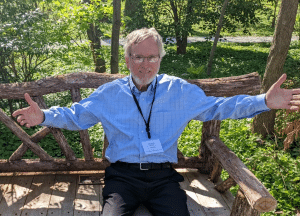
Richard W. BrownI have endured a profound sense of loss and sorrow, which has been a constant struggle for me to come to terms with. It wasn’t until I decided to dedicate a memorial garden to my late wife on her birthday, which was on April 24, 2022, that I finally allowed myself to accept the overwhelming feeling of grief that I had been trying to avoid. Every time I felt myself being pulled into the depths of despair, I would swim away from facing the truth, as I was unable and unwilling to accept the deeper level of pain that it would bring. However, having taken the risk to confront my suffering, I have found a way to move forward and live my life after the loss.

Through the act of surrendering, I took a significant risk and put my life on the line in search of a path forward after experiencing loss. Although some may say I am now a different person, I feel I have become a better version of myself. From where I stand today, I have learned that by embracing my pain and suffering, I can gain valuable insights from grief that can help me love, live, and be more fully human. As I take each step into the unknown future, I feel a deep connection to my soul, which reminds me that there is still hope. I understand now that I need to accept life on faith rather than unquestioningly believing that I can control everything that happens to me and manage everything on my own.

Nobel laureate Louise Glück (April 22, 1943–October 13, 2023), as Maria Popova wrote, “captures the essence of such experiences, the way they sober us to being mortal and to being alive, with an image of piercing originality in the title poem of her 1992 collection The Wild Iris (public library).”

My experiences with grief have taught me that it can be an influential teacher. Despite having many skilled instructors throughout my life, it was only when I fully embraced the pain of loss that I learned how to truly live, love, and become the best version of myself. Each step into the unknown future, I reconnect with my soul and hear it singing. I am not a new person, but I have become a better person because of my experiences with grief.

Learning From Grief

Though grief was a challenging experience, I found the courage to move forward and learn more about myself and the world around me. As a result, I gained a greater appreciation for my resilience and growth potential as I navigated the world alone.

Show thread (2)

My Apolytus Moment

Falling Through the Trapdoor of Faith

Estimated reading time: 3 minutes, 3 seconds

My Apolytus Moment

Despite the deep and abiding pain of missing my beloved wife daily, I have come to understand that it is essential that I continue living and finding joy in the present moment.

THE WILD IRIS by Louise Glück

Falling Through the Trapdoor of Faith

Estimated reading time: 3 minutes, 3 seconds

At the end of my suffering
there was a door.

Hear me out: that which you call death
I remember.

Overhead, noises, branches of the pine shifting.
Then nothing. The weak sun
flickered over the dry surface.

It is terrible to survive
as consciousness
buried in the dark earth.

Then it was over: that which you fear, being
a soul and unable
to speak, ending abruptly, the stiff earth
bending a little. And what I took to be
birds darting in low shrubs.

You who do not remember
passage from the other world
I tell you I could speak again: whatever
returns from oblivion returns
to find a voice:

from the center of my life came
a great fountain, deep blue
shadows on azure sea water.

Share your thoughts and ideas

This site uses Akismet to reduce spam. Learn how your comment data is processed.

The Jan Lilien Education Fund!

By Sharing Jan's Love, I Live Fully and Interdepently!
×
Whale Fall: A Novel

Read: July 2024

Get this book

Whale Fall: A Novel

by Elizabeth O'Connor

I have started reading “Whale Fall: A Novel” by Elizabeth O’Connor. With its unique blend of loss, isolation, folklore, and the journey of self-discovery, this debut novel offers a compelling narrative set in 1938 on a remote Welsh island. The story is catalyzed by the arrival of a dead whale, a powerful symbol that sets the stage for the characters’ journeys.

The story revolves around Manod, a young woman who has spent her entire life on the island. Despite their island home’s harsh yet stunning surroundings, Manod yearns to explore life beyond it, a desire that will resonate with many readers.

As two English ethnographers arrive to study the island’s culture, Manod sees it as a potential escape from her community. However, her growing involvement with them triggers a profound internal conflict. She grapples with the dilemma of pursuing her desires or remaining loyal to her community. This struggle resonates with the universal human experience, making it a compelling read for many.

Whale Fall‘ vividly portrays the tensions that surface when one person’s aspirations threaten the unity of a community. O’Connor’s narrative skillfully depicts the community and Manod on the brink, forced to confront a world that seems to infringe upon them. This evokes a sense of admiration for O’Connor’s storytelling prowess, making it a must-read for literary fiction enthusiasts.

×
Piranesi

Read: May 2022

Get this book

Piranesi: A Novel by Susanna Clarke

by Susanna Clarke

Piranesi by Susanna Clarke is about a man known as Piranesi who lives in a big house and explores the labyrinth of rooms and hopes of understanding the meaning. Is it any surprise that I would pick this book as my thirtieth of the year? As a widow, I journal and journey in a life I did not expect to live, and I still believe I will find meaning and purpose

In addition, a labyrinth is one of the options we have discussed for the next phase of the work in Hanson Park.

Piranesi is a page-turner, but that does not fully describe the beauty of the world that Susanna Clarke created. I highly recommend this book as it is one of my best this year. 

The Goodreads summary provides an overview of Piranesi by Susanna Clarke.

Piranesi’s house is no ordinary building: its rooms are infinite, its corridors endless, its walls are lined with thousands upon thousands of statues, each one different from all the others. Within the labyrinth of halls an ocean is imprisoned; waves thunder up staircases, rooms are flooded in an instant. But Piranesi is not afraid; he understands the tides as he understands the pattern of the labyrinth itself. He lives to explore the house.

There is one other person in the house—a man called The Other, who visits Piranesi twice a week and asks for help with research into A Great and Secret Knowledge. But as Piranesi explores, evidence emerges of another person, and a terrible truth begins to unravel, revealing a world beyond the one Piranesi has always known.

For readers of Neil Gaiman’s The Ocean at the End of the Lane and fans of Madeline Miller’s Circe, Piranesi introduces an astonishing new world, an infinite labyrinth, full of startling images and surreal beauty, haunted by the tides and the clouds.


Subscribe

Contact Us

When you buy a book or product using a link on this page, I receive a commission. Thank you for supporting Sharing Jan’s Love blog.

×
20 Under 40

Read: January 2019

Get this book

20 Under 40 Fiction

by Various Writers Under 40

Short Stories that Will Define the Future of American Letters

The New Yorker’s collection of short stories – 20 Under 40 – is a collection of twenty writers “whose work will help define the future of American letters.”

Some of these I had read in The New Yorker and others I had missed. Either way, they were a pleasure to read.

As The New Yorker wrote,

The range of voices is extraordinary. There is the lyrical realism of Nell Freudenberger, Philipp Meyer, C. E. Morgan, and Salvatore Scibona; the satirical comedy of Joshua Ferris and Gary Shteyngart; and the genre-bending tales of Jonathan Safran Foer, Nicole Krauss, and Téa Obreht. David Bezmozgis and Dinaw Mengestu offer clear-eyed portraits of immigration and identity; Sarah Shun-lien Bynum, ZZ Packer, and Wells Tower offer voice-driven, idiosyncratic narratives. Then there are the haunting sociopolitical stories of Chimamanda Ngozi Adichie, Daniel Alarcón, and Yiyun Li, and the metaphysical fantasies of Chris Adrian, Rivka Galchen, and Karen Russell.

Each of these writers reminds us why we read. And each is aiming for greatness: fighting to get and to hold our attention in a culture that is flooded with words, sounds, and pictures; fighting to surprise, to entertain, to teach, and to move not only us but generations of readers to come. A landmark collection, 20 Under 40 stands as a testament to the vitality of fiction today.

I recommend this collection of short stories.

Subscribe

Contact Us

×
Sun City

Read: February 2025

Get this book

Sun City by Tove Jansson

by Tove Jansson

Today, I began reading “Sun City” by Tove Jansson, translated by Thomas Teal. I found this book mentioned in Maya Chung‘s review in The Atlantic’s Book Briefings, and as an older man, it seemed like the perfect choice for me. In “The Summer Book” and “The True Deceiver,” as well as in her many short stories, Tove Jansson consistently explores the everyday lives of older adults.

She portrays them not as a separate group but as fully fleshed individuals who experience the same jealousies, desires, and joys as any other demographic. It’s no wonder that in her travels through America in the 1970s, she became fascinated with what was then a particularly American institution, the retirement home, where older people lived in their tightly knit worlds.

In Sun City, Jansson depicts these worlds in a group portrait of residents and employees at the Berkeley Arms in St. Petersburg, Florida. As the narrative moves from character to character, the characters move through an America riven by cultural divides, facing the death of its dream. The Berkeley Arms’s newest resident finds a place among the rocking chairs and endless chatter on the veranda while other residents long for past glories, mourning their losses and killing time. Meanwhile, one of their attendants, Bounty Joe, is eagerly awaiting a letter, or even just a postcard, alerting him to the imminent return of Jesus Christ. Nobody’s normal anymore,” the bartender says, “not the old geezers and not the newborn kids.”


When you purchase a book through one of my links, I earn a small commission that helps support my passion for reading. This contribution allows me to buy even more books to share with you, creating an incredible cycle of discovering great reads together! Your support truly makes a difference!


×
Corey Fah Does Social Mobility

Read: February 2024

Get this book

Corey Fah Does Social Mobility

by Isabel Waidner

Today, I began reading “Corey Fah Does Social Mobility: A Novel” by Isabel Waidner. The book is about Corey Fah, a writer whose novel has just won the Fictionalization of Social Evils prize. Despite this achievement, the trophy and funds with the award still need to be in reach. The novel celebrates radical queer survival and challenges false notions of success.

Corey, their partner Drew, and their pet spider, Bambi Pavok, embark on a quest to find an elusive trophy with neon-beige color and UFO-like qualities. This journey takes them back to their childhood in the forest and includes a stint on a reality TV show. While facing the horrors of wormholes and time loops, Corey discovers the difference between a prize and a gift in a complex way.

Following the Goldsmiths Prize–winning Sterling Karat Gold, Isabel Waidner’s bold and buoyant new novel is about coming into one’s own, the labor of love, the tendency of history to repeat itself, and what ensues when a large amount of cultural capital is suddenly deposited in a place it has never been before.

×
Black River

Read: November 2024

Get this book

Black River: A Novel

by Nilanjana S. Roy

Today, I dove into the captivating pages of “Black River” by Nilanjana S. Roy, a standout selection from The New York Times’ 100 Notable Books of 2024. This compelling debut novel unfolds against contemporary India, a country grappling with rising religious intolerance. Roy’s storytelling is nothing short of mesmerizing, intricately weaving a narrative that vividly reflects the nation’s complexities and contradictions.

Teetapur, an unassuming village just a few hours outside bustling Delhi, is known for nothing—until the discovery of an 8-year-old girl named Munia, found dead and hanging from the branch of a Jamun tree. In this predominantly Hindu village, suspicion quickly falls on Mansoor, an itinerant Muslim man. The tension ignites like wildfire, intensified by the underlying religious discord.

The responsibility for uncovering the elusive truth—and preventing the lynching of the prime suspect—falls on the weary shoulders of Sub-Inspector Ombir Singh. With only one other officer under his command and a single working revolver between them, can he bring justice to a grieving father and an angry village? Or will Teetapur demand vengeance instead?

Black River” offers readers a gripping mystery and a sweeping analysis of the nation’s state, serving as a searing critique of modern India.


When you purchase a book through one of my links, I earn a small commission that helps support my passion for reading. This contribution allows me to buy even more books to share with you, creating an incredible cycle of discovering great reads together! Your support truly makes a difference!


×