

Tree of Hope

Tree of Hope, Heart of Love

Finding Light in the Darkness

Estimated reading time: 2 minutes, 35 seconds

On Monday, I attended the Public Affairs Lecture Series (PALS) for the first time. PALS is a fantastic program that keeps the mind active and engaged, which I find incredibly valuable, especially as I strive to sharpen my cognitive abilities. The Morris Museum hosts the PALS lecture series, which features impressive “canstruction” exhibits constructed entirely from cans. While all the exhibits were remarkable, one particularly captured my attention – “Tree of Hope, Heart of Love” by Solutions Architecture. This creation showcased incredible design and construction skills and offered a deeper insight into the designers’ and builders’ dreams and aspirations.
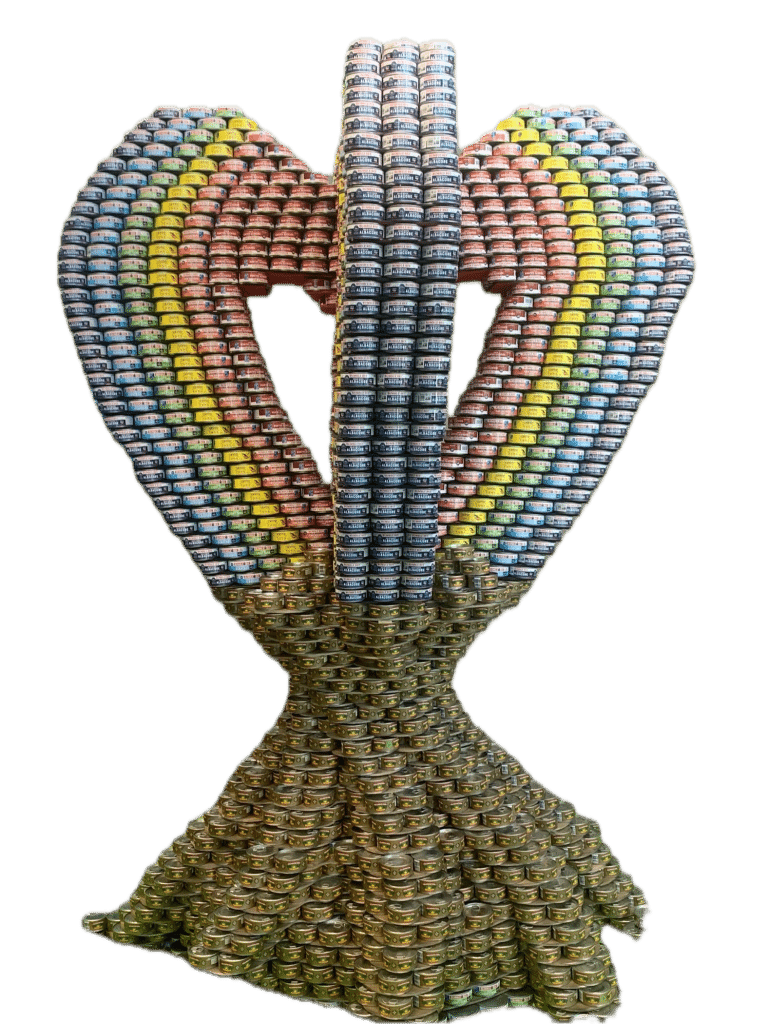
Tree of Hope, Heart of Love

The tree’s roots remind us of our shared foundation, a universal symbol of life, stability, and enduring connection to the earth. The heart, an emblem of compassion and kindness, signifies the core message of love – unconditional and all-encompassing.

This creation is a testament to our commitment to fostering a world where peace, unity, and love prevail. We are excited to share this symbol of hope and unity with everyone, and we hope it inspires all who see it to embrace these values in their own.

Throughout my life, I have consistently maintained an unwavering sense of optimism, even amidst the most challenging circumstances. I am steadfast in my belief that joining forces can shape a world characterized by peace, unity, and love. My life’s purpose is rooted in endeavors to rectify a fractured society. While some may perceive me as romantic, I am a pragmatist who recognizes love’s formidable and enchanting force and perceives love as the key to deliverance and a pathway to inner renewal.

After reading today’s issue of The Marginalian on the memory of James Baldwin, who passed away on December 1, 1987, editor Maria Popova shared a poignant quote from “Nothing Personal,” a collaboration between Baldwin and his high school classmate and lifelong friend, photographer Richard Avedon. This quote has been a source of comfort for me, especially during my darkest nights. The quote resonates with me every time I hear it.

One discovers the light in darkness, that is what darkness is for; but everything in our lives depends on how we bear the light. While in darkness, it is necessary to know that there is a light somewhere, to know that in oneself, waiting to be found, there is a light.

I can see the light even in the darkest hours of the night. It flickers on and off until we pull ourselves up and walk into the whole light of the day. We can see and embrace the “Tree of Hope, Heart of Love” with shadows still long from the morning light. I’m an ordinary man seeking to live life fully after loss. Grief has taught me the most critical lessons of my life. I have learned to serve and bless the living. One of the other important lessons I have learned is that I can love again. Will I be loved again in the days and nights I have left? Although I would prefer that, it may not matter, as knowing I can love gives me the strength to live fully after loss.

Love is a Magical Force!

Whenever I fall in love, I do so with all my heart and soul, leaving no room for half-steps. My love is unconditional and knows no boundaries. My wife knew and accepted me for who I am. Together, Jan and I created a legacy for ages to come.

Share your thoughts and ideas

This site uses Akismet to reduce spam. Learn how your comment data is processed.

The Jan Lilien Education Fund!

Tree of Hope
×
Neighbors and Other Stories

Read: February 2024

Get this book

Neighbors and Other Stories

by Diane Oliver

Today, I began reading Diane Oliver‘s Neighbors and Other Stories. It’s a powerful and eerie debut collection of stories that portrays the struggles of different characters as they face the everyday dangers of racism during the Jim Crow era. The book features an introduction by Tayari Jones.

Diane Oliver is an important yet often overlooked figure in African American literature of the 20th century. She was a gifted writer, ahead of her time, whose talent was cut short by her untimely death at 22 in 1966. Nevertheless, she left behind a remarkable collection of crisply written and often chilling tales that delve into race and racism in America during the 1950s and 60s. Oliver’s insightful stories remain relevant today; this is the only existing collection of her works. She has rightfully earned her place in the literary canon as a masterful storyteller.

The passage below describes several short stories with different themes. The first story, “The Closet on the Top Floor,” tells the story of Winifred, the first Black student in a newly integrated college. In this story, Winifred begins to disappear, creating a nightmarish scenario. The second story is titled “Mint Juleps not Served Here.” It’s about a couple who live deep in a forest with their son. They will go to bloody lengths to protect him from any danger. The third story, “Spiders Cry without Tears,” features a couple named Meg and Walt. They must confront prejudices and strains of interracial and extramarital love. Finally, the last story is the titular one, and it’s a high-tension narrative that follows a nervous older sister the night before her younger brother is set to desegregate his school.

These are powerful and personal depictions of African American families everyday struggles and moments of distress, illustrating how they utilize their abilities to overcome challenges. “Neighbors” is an enthralling compilation and a valuable historical and social document, displaying the remarkable literary skills of a previously overlooked author.

×
Shiner: A Novel

Read: March 2022

Get this book

Shiner: A Novel

by Amy Jo Burns

Shiner: A Novel by Amy Jo Burns was my twenty-second of the year, and I achieved my Goodreads 2022 Reading Challenge. An hour from the closest West Virginia mining town, fifteen-year-old Wren Bird lives in a secluded mountain cabin with her parents. They have no car, mailbox, or visitors- except for her mother’s lifelong best friend.

Wren’s narration of her discoveries of the secrets of the past over one summer drives the novel and makes it a page-turner. Her mother, Ruby, and her best friend, Ivy, are two strong women who dreamed of escaping the West Virginia mountains. The male characters play secondary roles in the novel, as they should. Shiner is a feminist book about how women can and must take back their stories and lives from men whose power is an illusion.

I highly recommend this novel and look forward to reading other books by Amy Jo Burns. It was the perfect book to finish my reading challenge. As I continue to read this year, I hope to find another of her books on my shelf.

Goodreads provides an overview.

Every Sunday, Wren’s father delivers winding sermons in an abandoned gas station. He takes up serpents and praises the Lord for his blighted white eye, proof of his divinity and key to his hold over the community, Wren, and her mother.

But over the course of one summer, a miracle performed by Wren’s father quickly turns to tragedy. As the order of her world begins to shatter, Wren must uncover the truth of her father’s mysterious legend and her mother’s harrowing history and complex bond with her best friend. And with that newfound knowledge, Wren can imagine a different future for herself than she has been told to expect.

Rich with epic love and epic loss, and diving deep into a world that is often forgotten but still part of America, Shiner reveals the hidden story behind two generations’ worth of Appalachian heartbreak and resolve. Amy Jo Burns brings us a smoldering, taut debut novel about modern female myth-making in a land of men-and one young girl who must ultimately open her eyes.

Register to Attend Celebrate Jan Day

Subscribe

Contact Us

When you buy a book or product using a link on this page, I receive a commission. Thank you for supporting Sharing Jan’s Love blog.

×
The Bully Pulpit

Read: October 2019

Get this book

The Bully Pulpit

by Doris Kearns Goodwin

The Bully Pulpit by Doris Kearns Goodwin is a history of the first decade of the Progressive era told by focusing on the intense friendship of Theodore Roosevelt and William Howard Taft.

Although I had read many books about Theodore Roosevelt, I had limited knowledge about Taft until I read this book. Reading about their friendship and its eventual collapse helped me to understand both of these presidents and the times in which they lived in a way I had not understood previously.

The Bully Pulpit is also the story of the muckraking press, which arouses the spirit of reform that helps Roosevelt push the government to shed its laissez-faire attitude toward robber barons, corrupt politicians, and corporate exploiters of our natural resources. The muckrakers are portrayed through the greatest group of journalists ever assembled at one magazine—Ida Tarbell, Ray Stannard Baker, Lincoln Steffens, and William Allen White—teamed under the mercurial genius of publisher S. S. McClure.

Goodwin’s narrative is founded upon a wealth of primary materials. The correspondence of more than four hundred letters between Roosevelt and Taft begins in their early thirties and ends only months before Roosevelt’s death. Edith Roosevelt and Nellie Taft kept diaries. The muckrakers wrote hundreds of letters to one another, kept journals, and wrote their memoirs. The letters of Captain Archie Butt, who served as a personal aide to both Roosevelt and Taft, provide an intimate view of both men.

I recommend this book without reservations.

Subscribe

Contact Us

×
Apples Never Fall

Read: January 2022

Get this book

Apples Never Fall

by Liane Moriarty

Apples Never Fall by Liane Moriarty is a novel that looks at marriage, siblings, and how the people we love the most can hurt us the deepest. The Delaney family love one another dearly—it’s just that sometimes they want to murder each other.

If your mother was missing, would you tell the police? Even if the most obvious suspect was your father? The four grown Delaney siblings face this dilemma.

This book is a page-turner. With all of the characters having issues unrelated to their mission mother, they have a life with many mysteries and rivalries. I sometimes wanted to know more about their lives instead of the missing mum.

Although I will not reveal the conclusion, it is clear how a missing parent could appear to be the crime of the century.

According to Goodreads,

The Delaneys are fixtures in their community. The parents, Stan and Joy, are the envy of all of their friends. They’re killers on the tennis court, and off it, their chemistry is palpable. But after fifty years of marriage, they’ve finally sold their famed tennis academy and are ready to start what should be the golden years of their lives. So why are Stan and Joy so miserable?

The four Delaney children―Amy, Logan, Troy, and Brooke―were tennis stars in their own right, yet as their father will tell you, none of them had what it took to go all the way. But that’s okay, now that they’re all successful grown-ups. In addition, there is the beautiful possibility of grandchildren on the horizon.

One night a stranger named Savannah knocks on Stan and Joy’s door, bleeding after a fight with her boyfriend. The Delaneys are more than happy to give her the small kindness she sorely needs. If only that were all, she wanted.

Later, when Joy goes missing and Savannah is nowhere to be found, the police question the one person who remains: Stan. But for someone who claims to be innocent, he, like many spouses, seems to have a lot to hide. Two of the Delaney children think their father is innocent. Two are not so sure―but as the two sides square off against each other in perhaps their most important match ever, all of the Delaneys will start to reexamine their shared family history in a very new light.

I recommend this book.

Subscribe

Contact Us

When you buy a book or product using a link on this page, I receive a commission. Thank you for supporting Sharing Jan’s Love blog.

×
All Fours: A Novel

Read: May 2024

Get this book

All Fours: A Novel

by Miranda July

Today, I started reading All Fours: A Novel by Miranda July. A semi-famous artist announces her plan to drive cross-country from LA to NY. Thirty minutes after leaving her husband and child at home, she spontaneously exits the freeway, checks into a nondescript motel, and immerses herself in an entirely different journey.

Miranda July’s second novel, a testament to her unique approach to fiction, confirms the brilliance of her storytelling. With July’s wry voice, perfect comic timing, unabashed curiosity about human intimacy, and palpable delight in pushing boundaries, All Fours tells the story of one woman’s quest for a new kind of freedom. Part absurd entertainment, part tender reinvention of the sexual, romantic, and domestic life of a forty-five-year-old female artist, All Fours transcends expectation while excavating our beliefs about life as a woman. Once again, July hijacks the familiar and turns it into something new and thrillingly, profoundly alive.


When you purchase a book through one of my links, I earn a small commission that helps support my passion for reading. This contribution allows me to buy even more books to share with you, creating an incredible cycle of discovering great reads together! Your support truly makes a difference!


×
The Testaments: The Sequel to The Handmaid's Tale

Read: September 2021

Get this book

The Testaments

by Margaret Atwood

The Testaments: The Sequel to The Handmaid’s Tale by Margaret Atwood is a sequel worth reading.

The novel alternates between the perspectives of three women presented as portions of a manuscript written by one (the Ardua Hall Holograph) and testimonies by the other two. Being an amateur historian, I found this a fascinating way for Ms. Atwood to write this book.

Aunt Lydia is the author of the Ardua Hall Holograph, which is a surprise based on her role in The Handmaid’s Tale. It is a surprise that she is a mole who despises Gilead and works for the resistance.

The other characters are young women who, along with Aunt Lydia, are forced to come to terms with who she is and how far she will go for what she believes.

Agnes Jemima was born in Gilead and is being educated not to be literate but to be a wife. She finds out her parents are not who she thought they were when Agnes discovers she is the daughter of a Handmaid.

Daisy was raised in Toronto, lives with her adoptive parents, and is an educated woman. As noted in most reviews, Daisy is also the daughter of a Handmaid. She is Baby Nicole from the original book, and Gilead wants her to return.

Read the book! It is a moving and engaging sequel! The testimonies in the book combine these three women’s stories to undermine Gilead.

Subscribe

Contact Us

×