
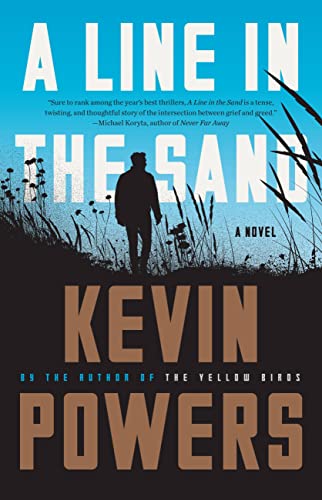
A Line in the Sand: A Novel

Estimated reading time: 1 minute, 30 seconds

Today I started reading A Line in the Sand: A Novel by Kevin Powers. Listed as one of the books to read this week by The New York Times, which described it as “a stunning novel. Kevin Powers provides what any discerning reader desires the most — complex and flawed characters, precise use of language, succinct description, and believable dialogue.”

One early morning on a Norfolk beach in Virginia, a dead body is discovered by a man taking his daily swim—Arman Bajalan, formerly an interpreter in Iraq. After narrowly surviving an assassination attempt that killed his wife and child, Arman has been given lonely sanctuary in the US as a maintenance worker at the Sea Breeze Motel. Now, convinced that the body is connected to his past, he knows he is still unsafe.

Seasoned detective Catherine Wheel and her newly minted partner have little to go on beyond a bus ticket in the dead man’s pocket. It leads them to Sally Ewell, a local journalist as grief-stricken as Arman is by the Iraq War, investigating a corporation on the cusp of landing a multi-billion-dollar government defense contract.

As victims mount around Arman, taking the team down wrong turns and towards startling evidence, they find themselves in a race committed to unraveling the truth and keeping Arman alive—even if it costs them everything.


The Jan Lilien Education Fund sponsors ongoing sustainability and environmental awareness programs. Gifts made this month; I will match dollar-for-dollar. All donations are tax-deductible.

Subscribe

Contact Us

I receive a commission when you buy a book or product using a link on this page. Thank you for supporting Sharing Jan’s Love blog.


The Jan Lilien Education Fund!

Lincoln in the Bardo: A Novel

Read: August 2024

Get this book

Lincoln in the Bardo: A Novel

by George Saunders

My journey with “Lincoln in the Bardo: A Novel” by George Saunders began with recognition as one of The New York Times’ 100 Best Books of the Century. As I turned its pages, I was immersed in its profound exploration of living and loving in the face of inevitable endings. The book, which struck a personal chord with me after a loss, is a testament to Saunders’ storytelling prowess and a must-read for those interested in Abraham Lincoln.

February 1862. The Civil War is less than one year old. The fighting has begun in earnest, and the nation has already realized it is in for a long, bloody struggle. Meanwhile, President Lincoln’s beloved eleven-year-old son, Willie, lies upstairs in the White House, gravely ill. In a matter of days, despite predictions of a recovery, Willie dies and is laid to rest in a Georgetown cemetery. “My poor boy, he was too good for this earth,” the president says at the time. “God has called him home.” Newspapers report that a grief-stricken Lincoln returns, alone, to the crypt several times to hold his boy’s body.

From a seed of historical truth, George Saunders weaves an unforgettable tale of familial love and loss that transcends its realistic, historical framework. The story takes a daring leap into a realm that is hilarious and terrifyingly supernatural. Willie Lincoln’s journey in a strange purgatory, where ghosts mingle, gripe, commiserate, quarrel, and enact bizarre acts of penance, is a testament to Saunders’ imaginative prowess. The monumental struggle over young Willie’s soul in this transitional state, known as the bardo in the Tibetan tradition, is a narrative that will leave you spellbound.

Lincoln in the Bardo is an astonishing feat of imagination and a bold step forward from one of his generation’s most important and influential writers. Formally daring, generous in spirit, and deeply concerned with matters of the heart, it is a testament to fiction’s ability to speak honestly and powerfully about the things that matter to us. Saunders has invented a thrilling new form that deploys a kaleidoscopic, theatrical panorama of voices to ask a timeless, profound question: How do we live and love when we know everything we love must end?


George Saunders is the author of thirteen books, including the novel Lincoln in the Bardo, which won the Booker Prize, and five collections of stories, including Tenth of December, which was a finalist for the National Book Award, and the recent collection Liberation Day (selected by former President Obama as one of his ten favorite books of 2022).

Three of Saunders’s books—Pastoralia, Tenth of December, and Lincoln in the Bardo—were chosen for The New York Times’s list of the 100 Best Books of the 21st Century. Saunders hosts the popular Story Club on Substack, which grew out of his book, A Swim in a Pond in the Rain. In 2013, he was named one of Time’s 100 Most Influential People. He teaches in the creative writing program at Syracuse University.


Discover your next favorite book and dive into a world of curated, exciting reads by purchasing through my links. You’ll have access to a diverse selection of books that I’ve personally vetted to ensure quality and enjoyment. Additionally, by supporting these selections, you’ll help me continue to provide you with more personalized recommendations. I earn a small commission from your purchase, which allows me to buy and share even more books with you. Your support truly makes a difference!


×
Invisible Child

Read: December 2021

Get this book

Invisible Child: Poverty, Survival & Hope in an American City

by Andrea Elliott

Invisible Child: Poverty, Survival & Hope in an American City by Andrea Elliott was a gift from my son Jon. The New York Times selected “Invisible Child” as one of the best books published this year. It is indeed one of the top books on my all-time list.

GoodReads summary provides a good overview,

The riveting, unforgettable story of a girl whose indomitable spirit is tested by homelessness, poverty, and racism in an unequal America—from Pulitzer Prize-winning journalist Andrea Elliott of The New York Times

Invisible Child follows eight dramatic years in the life of Dasani Coates, a child with imagination as soaring as the skyscrapers near her Brooklyn homeless shelter. Born at the turn of a new century, Dasani is named for the bottled water that comes to symbolize Brooklyn’s gentrification and the shared aspirations of a divided city. As Dasani grows up, moving with her tight-knit family from shelter to shelter, this story goes back to trace the passage of Dasani’s ancestors from slavery to the Great Migration north. When Dasani comes of age, New York City’s homeless crisis explodes as the chasm deepens between rich and poor.

In the shadows of this new Gilded Age, Dasani must lead her seven siblings through a thicket of problems: hunger, parental drug addiction, violence, housing instability, segregated schools, and the constant monitoring of the child-protection system. When, at age thirteen, Dasani enrolls at a boarding school in Pennsylvania, her loyalties are tested like never before. As she learns to “code switch” between the culture she left behind and the norms of her new town, Dasani starts to feel like a stranger in both places. Ultimately, she faces an impossible question: What if leaving poverty means abandoning the family you love?

By turns heartbreaking and revelatory, provocative and inspiring, Invisible Child tells an astonishing story about the power of resilience, the importance of family, and the cost of inequality. Based on nearly a decade of reporting, this book vividly illuminates some of the most critical issues in contemporary America through the life of one remarkable girl.

Jan and I were involved and knew that child poverty and homelessness needed repair. In addition, Jan lived on Washington Park across from Ft. Greene Park in 1974-75. We knew the neighborhood where much of the book’s story takes place. 

Before meeting Jan in 1973, I was both a community/tenant organizer and a youth worker. In the latter role, I made weekly hostel trips for eight to ten young boys from East Williamsburg during 1973. The trips were the first the boys had ever been outside of their neighborhood.

Many of them had imaginations like Dasani. They also had her instinct to fight. One of my first tasks was to check for any weapons.

Decades later, when I would see any of them, now adults, they would ask when we were going on another trip. I wish I had met Jan when I made those trips. She would have helped me improve them and document the impact. If I could re-write history, I would have her join me as the second adult on the hostel trips.

After that summer, it was clear my primary skills were as a community/tenant organizer. Over the next few years, my work focused on creating affordable and supportive housing.

Jan and I did meaningful work that made a difference, yet the need for a permanent solution to the crisis remains. The book highlights the crucial role of resilience, the importance of family, and the cost of inequality. As a nation, we cannot undermine those values by breaking up families, impeding resilience, and maintaining racial and economic inequality. 

The current debate in Washington over the Build Back Better legislation needs to focus not on how much we spend but on its impact on children and families

David Brooks, a conservative commentator, has supported these expenditures for what they can do to address this country’s cultural and economic crisis. 

These packages say to the struggling parents and the warehouse workers: I see you. Your work has dignity. You are paving your way. You are at the center of our national vision.

This is how you fortify a compelling moral identity, which is what all of us need if we’re going to be able to look in the mirror with self-respect. This is the cultural transformation that good policy can sometimes achieve. Statecraft is soulcraft.

If you can only read one book this year, this is the one to read. Child poverty, homelessness, and inequality impact all of us. Ending child poverty and homelessness will make us a healthier and more inclusive nation. It is time for a compelling moral call to action!

Subscribe

Contact Us

When you buy a book or product using a link on this page, I receive a commission. Thank you for supporting Sharing Jan’s Love blog.

×
Shred Sisters

Read: January 2025

Get this book

Shred Sisters: A Novel

by Betsy Lerner

Today, I dove into Betsy Lerner‘s debut novel, “Shred Sisters.” Lerner is also known for her acclaimed work, “The Bridge Ladies.” This gripping story beautifully unravels the intricate tapestry of family bonds, mental illness, and the tumultuous relationship between two sisters. It’s compelling enough to have earned a spot on the longlist for the Center for Fiction First Novel Prize.

The tagline resonates deeply: “No one will love or hurt you more than a sister.” When one family member is unstable, the entire family feels the impact. Enter the Shreds. Olivia, the sister in the spotlight, finds her once-stunning confidence becoming erratic and unpredictable, causing chaos in her wake. Her younger sister, Amy, is cautious and studious, believing in facts, proof, and empirical evidence. Yet none of that can explain what’s happening to Ollie, whose physical beauty and charisma hide the mental illness that will ultimately disrupt Amy’s carefully constructed life.

As Amy ages, she strives to find her place—first in academics, then in New York publishing, and through a series of troubled relationships. With every step she takes, she encounters Ollie, who unpredictably slips in and out of the Shred family’s life. Despite the challenges threatening their sibling bond, Amy and Ollie cannot escape or deny the unbreakable sisterly connection that ties them together.

Shred Sisters” is an intimate and bittersweet story that explores the complexities of sisterhood, mental health, loss, and love over two decades. In the end, Amy learns a valuable lesson on her journey to self-acceptance: no one will love or hurt you more than a sister. I can’t wait to see where this emotional journey takes me!


When you purchase a book through one of my links, I earn a small commission that helps support my passion for reading. This contribution allows me to buy even more books to share with you, creating an incredible cycle of discovering great reads together! Your support truly makes a difference!


×
Vanishing World

Read: April 2025

Get this book

Vanishing World

by Sayaka Murata

Today, I began reading Sayaka Murata‘s Vanishing World, translated by Ginny Tapley Takemori. This novel, from the author of the bestselling literary sensations Convenience Store Woman and Earthlings, presents a surprising and highly imaginative story set in an alternate version of Japan where sexual relations between married couples have disappeared, and all children are conceived through artificial insemination.

Sayaka Murata has established herself as a remarkable observer of society’s peculiarities, delving into our contemporary world with bizarre and unsettling insights. Her portrayals of a contentedly unmarried retail worker in Convenience Store Woman and a young woman who believes she is an alien in Earthlings have resonated with millions of readers globally. In Vanishing World, Murata takes her vision to a bold new level, envisioning an alternative Japan where attitudes toward sex and procreation diverge significantly from our own.

As a girl, Amane is horrified to learn that her parents “copulated” to conceive her rather than using artificial insemination, which became the norm in the mid-twentieth century. She seeks to escape what she perceives as her mother’s indoctrination into this peculiar “system.” Despite her efforts, Amane’s attractions to both anime characters and real people carry an undeniable sexual weight.

As an adult in a suitably sexless marriage—where sex between married couples is regarded as taboo, akin to incest—Amane and her husband, Saku, decide to relocate to a mysterious new town called Experiment City, or Paradise-Eden. In this community, all children are raised collectively, and every person is considered a mother to all children. Men are beginning to experience pregnancy through artificial wombs that exist outside their bodies, resembling balloons, and children are nameless, referred to simply as “Kodomo-chan.” Will this new world finally cleanse Amane of her strangeness?


Sayaka Murata is the author of several books, including Convenience Store Woman, which won the Akutagawa Prize, Earthlings, and Life Ceremony. Freeman has recognized her as a “Future of New Writing” author, and Vogue Japan has honored her as a Woman of the Year.

Ginny Tapley Takemori has translated works from more than a dozen Japanese writers, including Ryu Murakami. She resides at the foot of a mountain in Eastern Japan.


When you purchase a book through one of my links, I earn a small commission that helps support my passion for reading. This contribution allows me to buy even more books to share with you, creating an incredible cycle of discovering great reads together! Your support truly makes a difference!

Enjoy a limited-time offer of 20% off your next book purchase at Bookshop.org!


×
Neruda on the Park: A Novel

Read: May 2023

Get this book

Neruda on the Park: A Novel

by Cleyvis Natera

Neruda on the Park is a novel by Cleyvis Natera that beautifully depicts the complexities of family, friendship, and ambition. The story highlights the community’s efforts to protect their neighborhood amidst the gentrification and the tension between a mother and her daughter.

The Guerreros have lived in Nothar Park, a Dominican neighborhood in New York City, for twenty years. When a neighboring tenement faces demolition, Eusebia, an elder of the community, takes matters into her own hands and devises a series of increasingly dangerous schemes to halt the construction of luxury condos. Meanwhile, Eusebia’s daughter, Luz, a rising associate at a Manhattan law firm, becomes distracted by a passionate romance with the handsome white developer working on the project her mother opposes.

As Luz’s father, Vladimir, designs their retirement home in the Dominican Republic, mother and daughter clash, escalating tensions in Nothar Park and leading to a near-fatal climax. Overall, Neruda on the Park is a captivating story that weaves a rich, vivid tapestry of community and sacrifice to protect what matters most.


The Jan Lilien Education Fund sponsors ongoing sustainability and environmental awareness programs. Gifts made this month; I will match dollar-for-dollar. All donations are tax-deductible.

Subscribe

Contact Us

I receive a commission when you buy a book or product using a link on this page. Thank you for supporting Sharing Jan’s Love blog.


×
Clear: A Novel

Read: April 2024

Get this book

Clear: A Novel

by Carys Davies

Today, I started reading “Clear: A Novel” by Carys Davies. It’s a stunning and exquisite novel written by an award-winning author. The story follows John, a Scottish minister who is sent to a remote island off the coast of Scotland to evict the last remaining inhabitant, Ivar. However, Ivar is unwilling to leave, and John’s wife, Mary, has severe misgivings about the task.

Shortly after arriving on the island, John falls off a cliff and is badly injured. Ivar finds him and takes him home, where he tends to his wounds. John and Ivar understand each other despite the language barrier and the fragile connection that forms.

The story takes place in the 1840s, during the Scottish Clearances, a period of forced evictions that saw many rural communities lose their homes. The novel explores the differences and connections between people, the impact of history on our beliefs, and the resilience of the human spirit.

“Clear” is a moving, unpredictable, sensitive, and spellbinding novel. It is a profound and pleasurable read that will stay with you long after you finish the last page.

×