

Not All Walks Are Equal

Not All Walks Are Equal

Proxy Voting for the Future

Estimated reading time: 2 minutes, 15 seconds

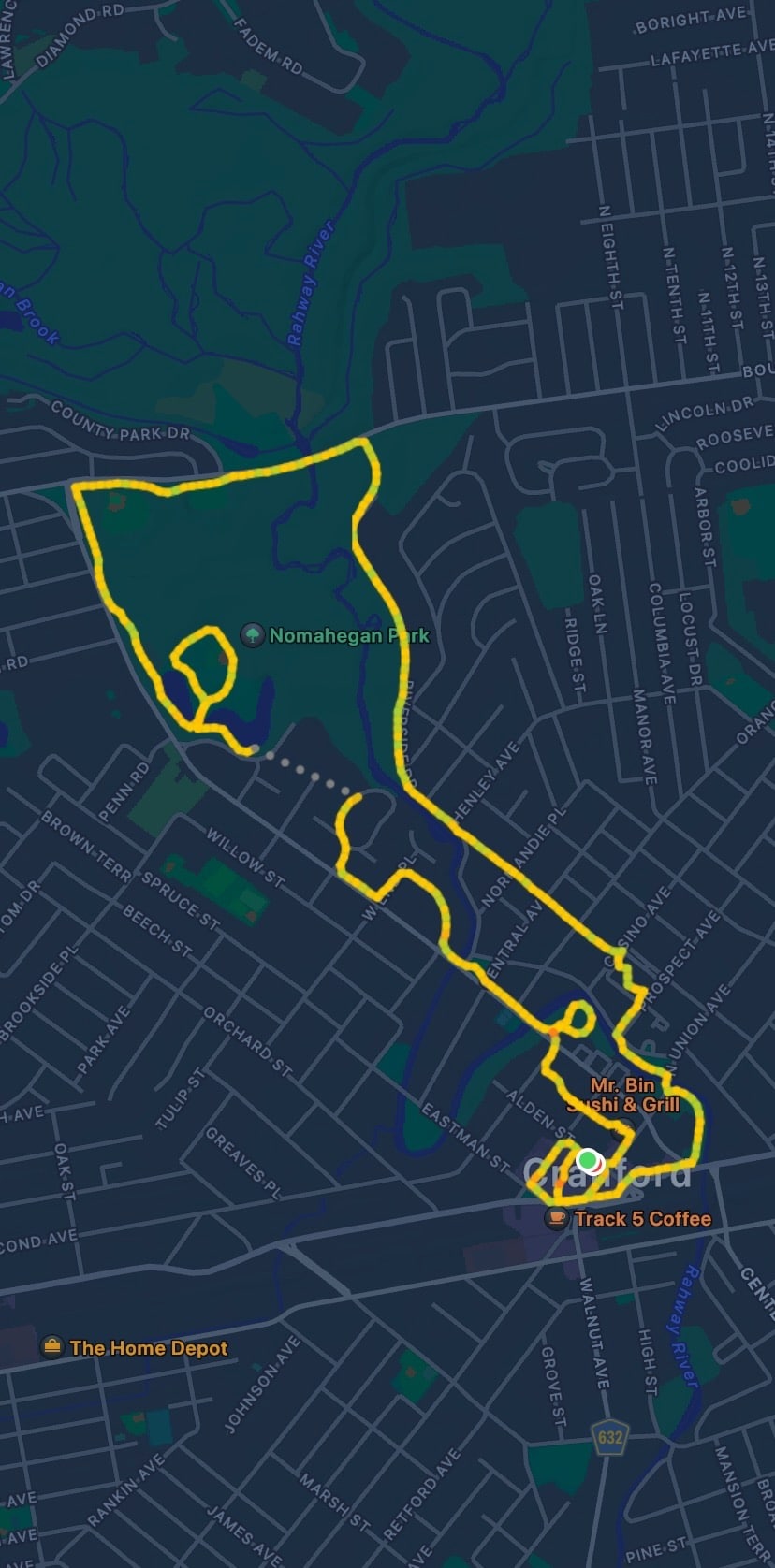
During the first mile after leaving home, I walked at a steady pace of just under nineteen minutes per mile. I varied my speed to ensure comfort. However, as I hit my stride on the second mile, my pace began to slow, and I started to feel bloated and gassy, which made the walk more challenging. When I reached the four-mile mark while exiting Nomahegan Park, my Apple Watch notified me that its battery was running low, less than 10%. I was surprised; the percentage had been 87% when I started, and I’ve walked twice as far without encountering a low-charge issue. The realization that I had to end my walk around five miles discouraged me. However, everything changed as I turned from North Union to North Avenue by Wells Fargo.

As I strolled around the corner, I saw a young woman gracefully walking with her tiny furry companion. The morning air was crisp, and my main focus was concluding my walk before my electronic device ran out of power. However, I made it a point to acknowledge her and say, “Good morning, have a lovely day.” Despite feeling fatigued, I strongly believe in the importance of politeness. The young woman expressed gratitude as I continued my journey, heading west on North Avenue.

As I strolled down the narrow alley next to Bread De La Vie, I missed the sweet aroma of freshly baked goods as they were closed on Monday. Eagerly, I made my way towards the stairs that led up to the parking lot, three-tenths of a mile shy of five miles. Just as I turned the corner onto my street, near the charming Augusta Mae Boutique, I almost bumped into the woman I had seen by the bank. Glancing at my Apple Watch, I was pleased to receive the notification that I had achieved my target of walking five miles.
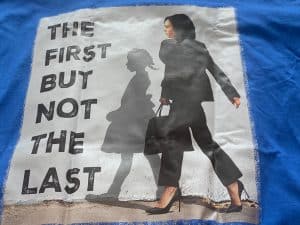
First But not the LastI ignored the notification on my Apple Watch and apologized for almost colliding with her. As I passed her, she complimented me on my t-shirt, which I had ordered when Kamala Harris was the nominee for vice president. The message on the shirt is “The first, but not the last,” which seemed inspiring to both of us. We briefly discussed the upcoming election, and she shared that she was voting for Kamala because she believed Harris was the leader we needed. She expressed a desire for a better future for her two daughters, and we joked about the idea of proxy votes for parents, which neither of us favored. Despite being initially disappointed to cut my morning walk short, the encounter significantly lifted my spirits as I entered my apartment. Who knew my walking t-shirt would be so well received?
Twelve Hundred Days

I promise not to accept aging gracefully but to face it with an unwavering determination to make the most of the opportunities in my life. I will listen attentively, embrace wholeheartedly, and courageously step into the future!

4 comments add your comment

Share your thoughts and ideas

This site uses Akismet to reduce spam. Learn how your comment data is processed.

The Jan Lilien Education Fund!

Not All Walks Are Equal
×
A Line in the Sand- A Novel

Read: June 2023

Get this book

A Line in the Sand: A Novel

by Kevin Powers

Today I started reading A Line in the Sand: A Novel by Kevin Powers. Listed as one of the books to read this week by The New York Times, which described it as “a stunning novel. Kevin Powers provides what any discerning reader desires the most — complex and flawed characters, precise use of language, succinct description, and believable dialogue.”

One early morning on a Norfolk beach in Virginia, a dead body is discovered by a man taking his daily swim—Arman Bajalan, formerly an interpreter in Iraq. After narrowly surviving an assassination attempt that killed his wife and child, Arman has been given lonely sanctuary in the US as a maintenance worker at the Sea Breeze Motel. Now, convinced that the body is connected to his past, he knows he is still unsafe.

Seasoned detective Catherine Wheel and her newly minted partner have little to go on beyond a bus ticket in the dead man’s pocket. It leads them to Sally Ewell, a local journalist as grief-stricken as Arman is by the Iraq War, investigating a corporation on the cusp of landing a multi-billion-dollar government defense contract.

As victims mount around Arman, taking the team down wrong turns and towards startling evidence, they find themselves in a race committed to unraveling the truth and keeping Arman alive—even if it costs them everything.


The Jan Lilien Education Fund sponsors ongoing sustainability and environmental awareness programs. Gifts made this month; I will match dollar-for-dollar. All donations are tax-deductible.

Subscribe

Contact Us

I receive a commission when you buy a book or product using a link on this page. Thank you for supporting Sharing Jan’s Love blog.


×
Breathe

Read: September 2021

Get this book

Breathe

by Joyce Carol Oates

Celebrate JanReading Breathe by Joyce Carol Oates was a book I knew I needed to read once Jan was diagnosed. Although the book might trigger negative memories, I finally read Breathe. It was what I needed to read at this point in my journey.

Ms. Oates wrote the book in 2019 after her husband, Charlie Gross, died. The novel is a story of love, loss, and loneliness, topics that I write about on this blog. I needed to read the book both for my mental health and for the readers of Sharing Jan’s Love.

The protagonist, Michaela, loses her husband while they are on a sabbatical in New Mexico. Her husband, Gerard, writes a book and teaches a class on memories. Jan and I never considered relocating before her illness, but this book convinced me that it would have aggravated my grief journey.

One of the parallels I observed while reading the novel is the similarity between Gerard’s reluctance to let family, friends, and co-workers know of his illness. Jan shared that reluctance in the early days, but I convinced her that the only chance of beating cancer was with the help of family and friends.

This dialogue could easily be one that Jan and I had.

Of course you want to summon his family—his (adult) children—but quickly, he says no.

Still waiting.

But – When?

Just not yet.

He is not an alarmist. (You are the alarmist.)

The novel is written in two parts – The Vigil and the Post-Mortem.

The opening paragraphs set the tone.

A Hand is gripping yours. Warm, dry hand gripping your slippery, humid hand.

Whoever it is urging you – Breathe!

Leaning over you begging you – Breathe!

As one mourning the death of the love of his life, I found several phrases in the book helpful in understanding what I have gone through and will continue to confront.

Among them is grief-vise, which I have written about in this stream.

In the grip of the grief vise, all that you will do, all that you even imagine doing, will require many times more effort.. Hardly daring to breathe for the grief-vise will tighten around your chest, squeezing the very air out of your lungs.

In the early stages of grief, the vise was strangling me. Breathing was impossible, and weeping was constant at times.

Michaela struggles with her grief. Seeing her husband every time she sees a man alone, even if they are older or younger than he was. I know I have felt Jan’s presence and still expect her to walk into our apartment.

Her struggles with a grief counselor and overly helpful friends are an experience I have not had but are familiar to those suffering from losing a loved one.

The last chapters are ones in which time becomes confusing and chaotic. At times, I was uncertain about which were real or imagined. The end, like all good novels, was ambiguous.

These are some of the other phrases I have found useful and will include in posts.

  • If there is no one to love, do we merit existence?
  • Never come to the end of kissing.
  • The first principle of life is; Breathe.
  • Shy in the language of intimacy.
  • As if a life lived with strangers could compensate for the emptiness in your heart.
  • No purpose in your life. No compass.

What you love most, that you will lose. The price of your love is your loss.

I recommend this book to all readers, even those struggling with grief.

Subscribe

Contact Us

When you buy a book or product using a link on this page, I receive a commission. Thank you for supporting Sharing Jan’s Love blog.

×
The Bully Pulpit

Read: October 2019

Get this book

The Bully Pulpit

by Doris Kearns Goodwin

The Bully Pulpit by Doris Kearns Goodwin is a history of the first decade of the Progressive era told by focusing on the intense friendship of Theodore Roosevelt and William Howard Taft.

Although I had read many books about Theodore Roosevelt, I had limited knowledge about Taft until I read this book. Reading about their friendship and its eventual collapse helped me to understand both of these presidents and the times in which they lived in a way I had not understood previously.

The Bully Pulpit is also the story of the muckraking press, which arouses the spirit of reform that helps Roosevelt push the government to shed its laissez-faire attitude toward robber barons, corrupt politicians, and corporate exploiters of our natural resources. The muckrakers are portrayed through the greatest group of journalists ever assembled at one magazine—Ida Tarbell, Ray Stannard Baker, Lincoln Steffens, and William Allen White—teamed under the mercurial genius of publisher S. S. McClure.

Goodwin’s narrative is founded upon a wealth of primary materials. The correspondence of more than four hundred letters between Roosevelt and Taft begins in their early thirties and ends only months before Roosevelt’s death. Edith Roosevelt and Nellie Taft kept diaries. The muckrakers wrote hundreds of letters to one another, kept journals, and wrote their memoirs. The letters of Captain Archie Butt, who served as a personal aide to both Roosevelt and Taft, provide an intimate view of both men.

I recommend this book without reservations.

Subscribe

Contact Us

×
Light to the Hills

Read: January 2023

Get this book

Light to the Hills: A Novel

by Bonnie Blaylock

Light to the Hills: A Novel by Bonnie Blaylock is about Amanda Rye, a young widowed mother and traveling packhorse librarian who comes through a mountain community struck by the nation’s economic collapse in the 1930s. I recommend this page-turner as it highlights the importance of family and community. From this foundation, truth lights a path toward survival, mountain justice, forgiveness, and hope.

The novel was recommended by Olivia Hawker, bestselling author of The Fire and the Ore, who said, “Light to the Hills is a touching meditation on motherhood and the importance of community, especially during difficult times.”

Last year I read a modern tale about Appalachia, Demon Copperhead. Both are good novels but very different.

Light to the Hills was a feel-good read despite the problems faced by Ms. Rye and the MacInteer family. It was precisely the book I needed to read this week.

The Goodreads summary provides an overview,

The folks in the Kentucky Appalachians are scraping by. Coal mining and hardscrabble know-how are a way of life for these isolated people. But when Amanda Rye, a young widowed mother and traveling packhorse librarian, comes through a mountain community walloped by the nation’s economic collapse, she brings with her hope, courage, and apple pie. Along the way, Amanda takes a shine to the MacInteer family, especially to the gentle Rai, her quick-study daughter, Sass, and Finn, the eldest son who’s easy to warm to. They remind Amanda of her childhood and her parents with whom she longs to be reconciled.

Her connection with the MacInteers deepens, and Amanda shares with them a dangerous secret from her past. When that secret catches up with Amanda in the present, she, Rai, Sass, and Finn find their lives intersecting—and threatened—in the most unexpected ways. Now, they must come together as the truth lights a path toward survival, mountain justice, forgiveness, and hope.


The Jan Lilien Education Fund sponsors ongoing sustainability and environmental awareness programs. Gifts made this month; I will match dollar-for-dollar. All donations are tax-deductible.

Subscribe

Contact Us

I receive a commission when you buy a book or product using a link on this page. Thank you for supporting Sharing Jan’s Love blog.


×
The Sum of Our Dreams

Read: September 2019

Get this book

The Sum of Our Dreams: A Concise History of America

by Louis P. Masur

The Sum of Our Dreams: A Concise History of America by Louis P. Masur is a book I got through my membership at One Day University. Professor Masur is one of the best teaches that One Day University has. He is the Board of Governors Distinguished Professor of American Studies and History at Rutgers University.

Most concise histories leave out more than they include. I found the Sum of our Dreams to be an excellent book to read, and professor Masur conveyed the American experience concisely and clearly. The more recent history is complex as events like the Global War on Terror are still being analyzed and re-understood.

Evoking Barack Obama’s belief that America remains the “sum of its dreams,” Masur locates the origin of those dreams of freedom, equality, and opportunity and traces their progress chronologically, illuminating the nation’s struggle over time to articulate and fulfill their promise.

Masur lets the story of American tell itself. Inspired by James Baldwin’s observation that “American history is longer, larger, more beautiful and more terrible than anything anyone has ever said about it,” he expands our notion of that history while identifying its threads.

I recommend this book as well as any of Professor Masur’s lectures at One Day University.

Subscribe

Contact Us

×
Move Like Water: My Story of the Sea

Read: October 2023

Get this book

Move Like Water: My Story of the Sea

by Hannah Stowe

I recently started reading a book called “Move Like Water: My Story of the Sea” by Hannah Stowe. It’s a captivating book that immerses you in a world of water, whales, storms, and starlight, allowing you to experience what it’s like to sail for weeks and live life to a new rhythm.

Hannah Stowe, a marine biologist and sailor in her mid-twenties, grew up on the Pembrokeshire coast of Wales, where she fell asleep to the sound of the lighthouse beam. Drawing upon her experiences sailing tens of thousands of miles in various seas, including the North Sea, North Atlantic, Mediterranean, Celtic Sea, and the Caribbean, she explores the human connection to the wild waters. Stowe ponders why she and others are drawn to life at sea and what we can learn from the water around us.

Stowe intertwines her narrative and illustrations with stories of six keystone marine creatures: the fire crow, sperm whale, wandering albatross, humpback whale, shearwater, and barnacle. Through these stories, she invites readers to fall in love with the sea and its inhabitants and to discover the majesty, wonder, and fragility of the underwater world.

If you enjoy the works of Rachel Carson and Annie Dillard, then “Move Like Water: My Story of the Sea” is a must-read. It’s an inspiring and heartfelt tribute to the sea, a testimony to pursuing and achieving a dream, and an unforgettable introduction to a talented new nature writer.


The Jan Lilien Education Fund sponsors ongoing sustainability and environmental awareness programs. Gifts made this month; I will match dollar-for-dollar. All donations are tax-deductible.

Subscribe

Contact Us

I receive a commission when you buy a book or product using a link on this page. Thank you for supporting Sharing Jan’s Love blog.


×