New Book: Still Life

Estimated reading time: 0 minutes, 0 seconds
Still Life: A GMA Book Club Pick: A Novel

Still Life: A Novel

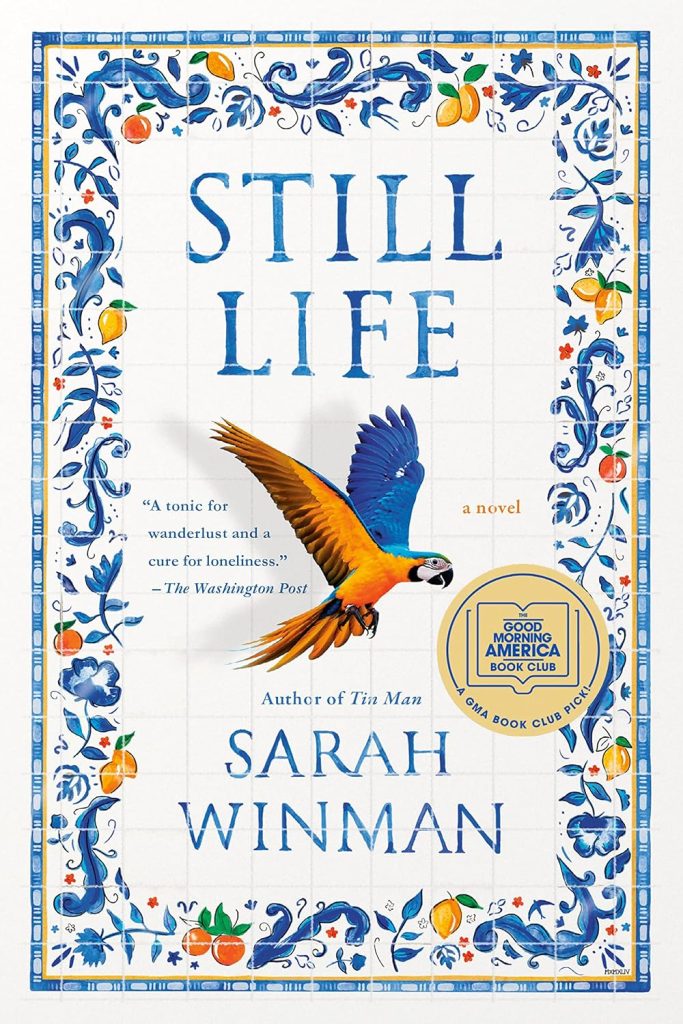
I began reading "Still Life," a GMA Book Club pick by Sarah Winman. This captivating and bighearted novel weaves a rich tapestry of stories about people connected by love, war, art, flood, and the ghost of E.M. Forster. Kristen V. Brown, in The Atlantic Magazine's Culture Survey, describes "Still Life" as the best novel she has recently read and considers it the best nonfiction work.

Read book review Get this book All books

Share your thoughts and ideas

This site uses Akismet to reduce spam. Learn how your comment data is processed.

The Jan Lilien Education Fund!

Still Life: A GMA Book Club Pick: A Novel

Read: January 2025

Get this book

Still Life: A Novel

by Sarah Winman

I began reading “Still Life,” a GMA Book Club pick by Sarah Winman. This captivating and bighearted novel weaves a rich tapestry of stories about people connected by love, war, art, flood, and the ghost of E.M. Forster. Kristen V. Brown, in The Atlantic Magazine’s Culture Survey, describes “Still Life” as the best novel she has recently read and considers it the best nonfiction work.

In Tuscany in 1944, as Allied troops advance and bombs fall around deserted villages, a young English soldier, Ulysses Temper, finds himself in the wine cellar of an abandoned villa. There, he encounters Evelyn Skinner, a middle-aged art historian who has come to Italy to salvage paintings from the ruins and recall long-forgotten memories of her youth. In each other, Ulysses and Evelyn find a kindred spirit amidst the rubble of war-torn Italy and set off on a course of events that will shape Ulysses’s life for the next four decades.

As Ulysses returns home to London, reimmersing himself in his crew at The Stoat and Parot—a motley mix of pub crawlers and eccentrics—he carries his time in Italy. And when an unexpected inheritance brings him back to where it all began, Ulysses knows better than to tempt fate and returns to the Tuscan hills.

With beautiful prose, extraordinary tenderness, and bursts of humor and light, Still Life is a sweeping portrait of unforgettable individuals who come together to make a family and a deeply drawn celebration of beauty and love in all its forms.


When you purchase a book through one of my links, I earn a small commission that helps support my passion for reading. This contribution allows me to buy even more books to share with you, creating an incredible cycle of discovering great reads together! Your support truly makes a difference!


×
The Hidden Life of Trees

Read: August 2021

Get this book

The Hidden Life of Trees

by Peter Wohlleben

The Hidden Life of Trees: What They Feel, How They Communicate ― Discoveries from A Secret World is a book I have wanted but had not had the time to read. In July of this year, when I was still in the early stages of my recovery journey, I talked to a friend of my wife’s (whom I now count as my friend) about our plans to plant a tree in Hanson Park.

As I talked about our plans, my friend suggested I read this book as it would help me understand the importance of trees. I will forever be grateful for her recommendation, as it made me read this book sooner than later.

To read that trees have a social network with more prominent, healthier trees concerned about the smaller, weaker ones. How is it that humans, a supposedly advanced species, have a social network that divides and weakens our community?

Are trees social beings? In The Hidden Life of Trees forester and author Peter Wohlleben convincingly makes the case that, yes, the forest is a social network. He draws on groundbreaking scientific discoveries to describe how trees are like human families: tree parents live together with their children, communicate with them, support them as they grow, share nutrients with those who are sick or struggling, and even warn each other of impending dangers. Wohlleben also shares his deep love of woods and forests, explaining the amazing processes of life, death, and regeneration he has observed in his woodland.

Having read this book, I am more sensitive to trees and have enjoyed my walks more than ever. In addition, when we plant Jan’s tree in Hanson Park, I will now have even more reasons to talk about the importance of trees to Jan, myself, and the community.

Subscribe

Contact Us

×
The White Hot

Read: November 2025

Get this book

The White Hot: A Novel

by Quiara Alegría Hudes

The White Hot” by Quiara Alegría Hudes is a letter from a mother to her daughter, reflecting on a moment of abandonment that stretches from ten days to ten years. It offers an explanation rather than an apology. Hudes tells April’s story—spiritual and sensual, fierce and humorous—using delicate lyricism and tough love. Through this narrative, Hudes transforms April’s struggle for self-discovery into an unforgettable short epic.

April is a young mother raising her daughter in a multigenerational home filled with unspoken secrets and loud arguments. Her only refuge is the locked bathroom, where she plugs her ears into an ambient soundscape and repeats a mantra: “dead inside.” This continues until one day, as she feels herself spiraling toward the volcanic rage she calls “the white hot,” an inner voice tells her to simply walk away.

She goes to a bus station and asks for a one-way ticket to the furthest destination. This ticket takes her from her Philadelphia home to the threshold of a wilderness, marking the start of a nameless quest—an accidental journey that awakens her, nearly kills her, and leads her to an impossible choice.

As April discovers the key to freeing herself and her family from a cycle of generational trauma through her painful and absurd journey,


Quiara Alegría Hudes is a Pulitzer Prize-winning playwright known for her plays “Water by the Spoonful” and “In the Heights,” the latter of which won the Tony Award for Best Musical. She also adapted this musical for the screen.

Her memoir, “My Broken Language,” was longlisted for the Andrew Carnegie Medal. Hudes has written essays published in prominent outlets, including The New York Times, The Washington Post, The Cut, The Nation, and American Theater Magazine. Additionally, she co-founded the prison writing program Emancipated Stories with her cousin Sean.


Discover your next favorite book and dive into a world of curated, exciting reads by purchasing through my links. You’ll have access to a diverse selection of books that I’ve personally vetted to ensure quality and enjoyment. Additionally, by supporting these selections, you’ll help me continue to provide you with more personalized recommendations. I earn a small commission from your purchase, which allows me to buy and share even more books with you. Your support truly makes a difference!


×
We Do Not Part

Read: March 2025

Get this book

We Do Not Part: A Novel

by Han Kang

Today, I explored “We Do Not Part,” the latest novel by Han Kang, the 2024 Nobel Prize in Literature laureate. Translated by the talented e. yaewon and Paige Aniyah Morris, this book offers a remarkable journey. The New York Times has called it Kang’s most revealing work since her acclaimed novel, “The Vegetarian.” What captivates me the most is how it intricately weaves the story of two women’s friendship while shedding light on a hidden chapter of Korean history.

One winter morning, Kyungha receives an urgent message from her friend Inseon, asking her to visit a hospital in Seoul. Inseon has injured herself in an accident and begs Kyungha to return to Jeju Island, where she lives, to save her beloved pet—a white bird named Ama. A snowstorm hits the island when Kyungha arrives. At all costs, she must reach Inseon’s house, but the icy wind and blizzards slow her down as night falls. She wonders if she will arrive in time to save the animal—or even survive the terrible cold that envelops her with every step. Lost in a world of snow, she does not yet suspect the vertiginous plunge into darkness that awaits her at her friend’s house.

Blurring the boundaries between dream and reality, “We Do Not Part” powerfully illuminates a forgotten chapter of Korean history buried for decades, bringing to light the lost voices of the past to prevent them from fading into oblivion. It is both a tribute to enduring friendship and a plea for remembrance. The novel tells a story of profound love in the face of unspeakable violence and celebrates life, however fragile.


Han Kang was born in 1970 in South Korea. She is the author of The Vegetarian, which I have read, and winner of the International Booker Prize,  Human ActsThe White BookGreek Lessons, and We Do Not Part. In 2024, she received the Nobel Prize in Literature.

e. yaewon is based in Korea and translates from and into Korean, including titles by Hwang Jungeun, Deborah Levy, and Samuel Beckett.

Paige Aniyah Morris divides her time between the United States and Korea. Recent translations include works by Pak Kyongni, Ji-min Lee, and Chang Kang-myoung.


When you purchase a book through one of my links, I earn a small commission that helps support my passion for reading. This contribution allows me to buy even more books to share with you, creating an incredible cycle of discovering great reads together! Your support truly makes a difference!


×
Demon Copperhead: A Novel

Read: December 2022

Get this book

Demon Copperhead: A Novel

by Barbara Kingsolver

Demon Copperhead: A Novel by Barbara Kingsolver is a must-read page-turner! Set in the mountains of southern Appalachia, this is the story of a boy born to a teenage single mother in a single-wide trailer, with no assets beyond his dead father’s good looks and copper-colored hair, a caustic wit, and a fierce talent for survival. Demon Copperhead speaks for a new generation of lost boys and all those born into beautiful, cursed places they can’t imagine leaving behind.

With more knowledge about the devastation of an economy that works for a few and the opioid crisis, I felt as if I was reading about people I knew. Although the book focuses on the impact on boys, it also details the devastation that girls experience.

If Jan had read Demon Copperhead, she would have encouraged me to read it. It reminds us of the work we must do to repair the world.

As a widow, it was a reminder of the long road that we must all take even after we have hit bottom.

WNYC’s All of it hosted an interview with Barbara Kingsolver in which she speaks about Demon Copperhead and her writing.

Demon Copperhead is one of the NYTimes’ top five fiction books of 2022. I have read three of them, The Candy House, The Furrows, and Checkout 19.

The Goodreads summary provides an overview.

In a plot that never pauses for breath, relayed in his unsparing voice, he braves the modern perils of foster care, child labor, derelict schools, athletic success, addiction, disastrous loves, and crushing losses. Through all of it, he reckons with his invisibility in a popular culture where even the superheroes have abandoned rural people in favor of cities.

Many generations ago, Charles Dickens wrote David Copperfield from his experience as a survivor of institutional poverty and its damage to children in his society. Those problems have yet to be solved in ours. Dickens is not a prerequisite for readers of this novel, but he provided its inspiration. In transposing a Victorian epic novel to the contemporary American South, Barbara Kingsolver enlists Dickens’ anger and compassion and, above all, his faith in the transformative powers of a good story. Demon Copperhead speaks for a new generation of lost boys and all those born into beautiful, cursed places they can’t imagine leaving behind.


The Jan Lilien Education Fund sponsors ongoing sustainability and environmental awareness programs. Gifts made this month; I will match dollar-for-dollar. All donations are tax-deductible.

Subscribe

Contact Us

I receive a commission when you buy a book or product using a link on this page. Thank you for supporting Sharing Jan’s Love blog.


×
Death Takes Me

Read: December 2025

Get this book

Death Takes Me: A Novel

by Cristina Rivera Garza

Originally written in Spanish by Cristina Rivera Garza, Death Takes Me is a thrilling masterpiece of literary fiction that turns the traditional crime narrative of gendered violence on its head. As sharp as the cuts on the bodies of the victims, the story unfolds with the dreamlike logic of a surreal experience, transitioning from the police station to a professor’s classroom and through the intricate worlds of Latin American poetry and art. It invites readers to explore the unstable terrains of desire and sexuality.

A city is always a cemetery.

In the narrative, a professor named Cristina Rivera Garza stumbles upon the corpse of a mutilated man in a dark alley and promptly reports it to the police. When shown a crime scene photo, she discovers a stark warning written in tiny print with coral nail polish on the brick wall beside the body: “Beware of me, my love / beware of the silent woman in the desert.”

The professor becomes the primary informant in the case, which is led by a detective who is newly obsessed with poetry and haunted by a list of past failures. But what has the professor truly witnessed? As more bodies of castrated men alongside lines of verse, the detective attempts to decipher the meaning of the poems in hopes of stopping the spreading violence throughout the city.


Cristina Rivera Garza is an acclaimed author known for works such as The Taiga Syndrome and The Iliac Crest. Her memoir, Liliana’s Invincible Summer, won the Pulitzer Prize and was a finalist for the National Book Award. She has received the MacArthur Fellowship and the Sor Juana Inés de la Cruz Prize. Currently, Rivera Garza holds the Hugh Roy and Lillie Cranz Cullen Distinguished Chair and serves as director of the PhD program in Creative Writing in Spanish at the University of Houston.

Sarah Booker is a teacher and a literary translator. Her translations include novels by Mónica Ojeda, Cristina Rivera Garza, and Gabriela Ponce. She is also an associate editor at Southwest Review.

Robin Myers is a poet and translator. Her translations encompass Andrés Neuman’s Bariloche, Claudia Peña Claros’s The Trees, Isabel Zapata’s In Vitro, Eliana Hernández-Pachón’s The Brush, and Cristina Rivera Garza’s The Restless Dead: Necrowriting and Disappropriation.


Discover your next favorite book and dive into a world of curated, exciting reads by purchasing through my links. You’ll have access to a diverse selection of books I’ve personally vetted for quality and enjoyment. Additionally, by supporting these selections, you’ll help me continue to provide you with more personalized recommendations. I earn a small commission from your purchase, which allows me to buy and share even more books with you. Your support truly makes a difference!


×
The Rest Is Memory: A Novel

Read: January 2025

Get this book

The Rest Is Memory: A Novel

by Lily Tuck

Today, I dove into “The Rest Is Memory: A Novel” by Lily Tuck, and it’s already leaving a powerful impression. This poignant tale follows a young Catholic girl’s harrowing journey to Auschwitz, woven in a captivating Rashomon-style narrative showcasing Tuck’s brilliance as a storyteller. Esquire has rightly placed it on their list of Best Books for Fall 2024, and I can see why.

In Tuck‘s skilled hands, “The Rest Is Memory” transforms into an unforgettable piece of historical reclamation, breathing life into an innocent soul who has long been remembered only through a haunting triptych of photographs. It’s a journey that promises to linger in my thoughts long after I’ve turned the last page.

In this mesmerizing novel by Lily Tuck, we first glimpse fourteen-year-old Czeslawa riding on the back of a boy’s motorcycle. Tuck imagines Czeslawa’s upbringing in a small Polish village before her world imploded in late 1942. Stripped of her modest belongings, she arrives at Auschwitz shorn and bearing the tattoo number 26947. Shortly after, she is photographed. Three months later, she is dead.

How did this happen to an ordinary Polish citizen? This is the question Tuck grapples with in this haunting narrative, which frames Czeslawa’s story within the tragic context of the six million Poles who perished during the German occupation. A decade before writing The Rest Is Memory“, Tuck read an obituary of the photographer Wilhelm Brasse, who took over 40,000 pictures of Auschwitz prisoners—including three of Czeslawa Kwoka, a Catholic girl from rural southeastern Poland. Tuck cut out these photos and kept them, determined to learn more about Czeslawa. However, she could only gather the barest facts: the village she came from, the transport she was on, that she was accompanied by her mother and neighbors, her tattoo number, and the date of her death. Tuck crafts a remarkable kaleidoscope of imagination from this scant evidence, something only our greatest novelists can achieve.

Susanna Moore described the novel as “Beautifully written, all the while instilling a sense of horror.” Tuck’s language swirls around the reader, yet no word is out of place. The subtly rotating images tumble forth, accelerating as we learn about Czeslawa’s tragic time in Auschwitz, as well as the lives of real individuals, including the brutal Commandant Rudolf Höss, his unconscionable wife Hedwig, psychiatrist and child rescuer Janusz Korczak, and the sharp Polish short story writer Tadeusz Borowski. Although we know Czeslawa’s fate, we must keep turning the pages, thoroughly captivated by Tuck’s nearly otherworldly prose.


When you purchase a book through one of my links, I earn a small commission that helps support my passion for reading. This contribution allows me to buy even more books to share with you, creating an incredible cycle of discovering great reads together! Your support truly makes a difference!


×