
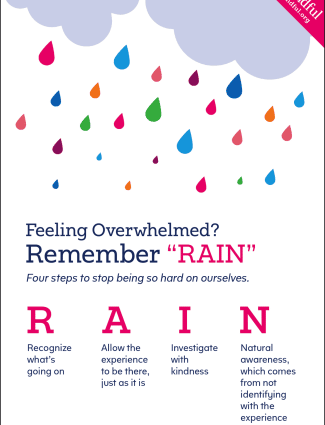
RAIN

Mindfulness with RAIN

Estimated reading time: 0 minutes, 42 seconds

Celebrate JanI do mindfulness meditations daily using Michele McDonald’s acronym RAIN‘s four steps:

  1. Recognize what is going on
  2. Allow the experience to be there, just as it is
  3. Investigate with kindness
  4. Natural awareness comes from not identifying with the experience.

I have learned to recognize and accept that Jan is only with me in spirit.

Acceptance was not easy, but it was necessary to experience my life entirely.

When I investigate with kindness, I am reminded how transformative Jan’s love was and continues to be.

Natural loving awareness helped me understand that our love will never end.

Subscribe

Contact Us

When you buy a book or product using a link on this page, I receive a commission. Thank you for supporting Sharing Jan’s Love blog.

Share your thoughts and ideas

This site uses Akismet to reduce spam. Learn how your comment data is processed.

The Jan Lilien Education Fund!

RAIN
×
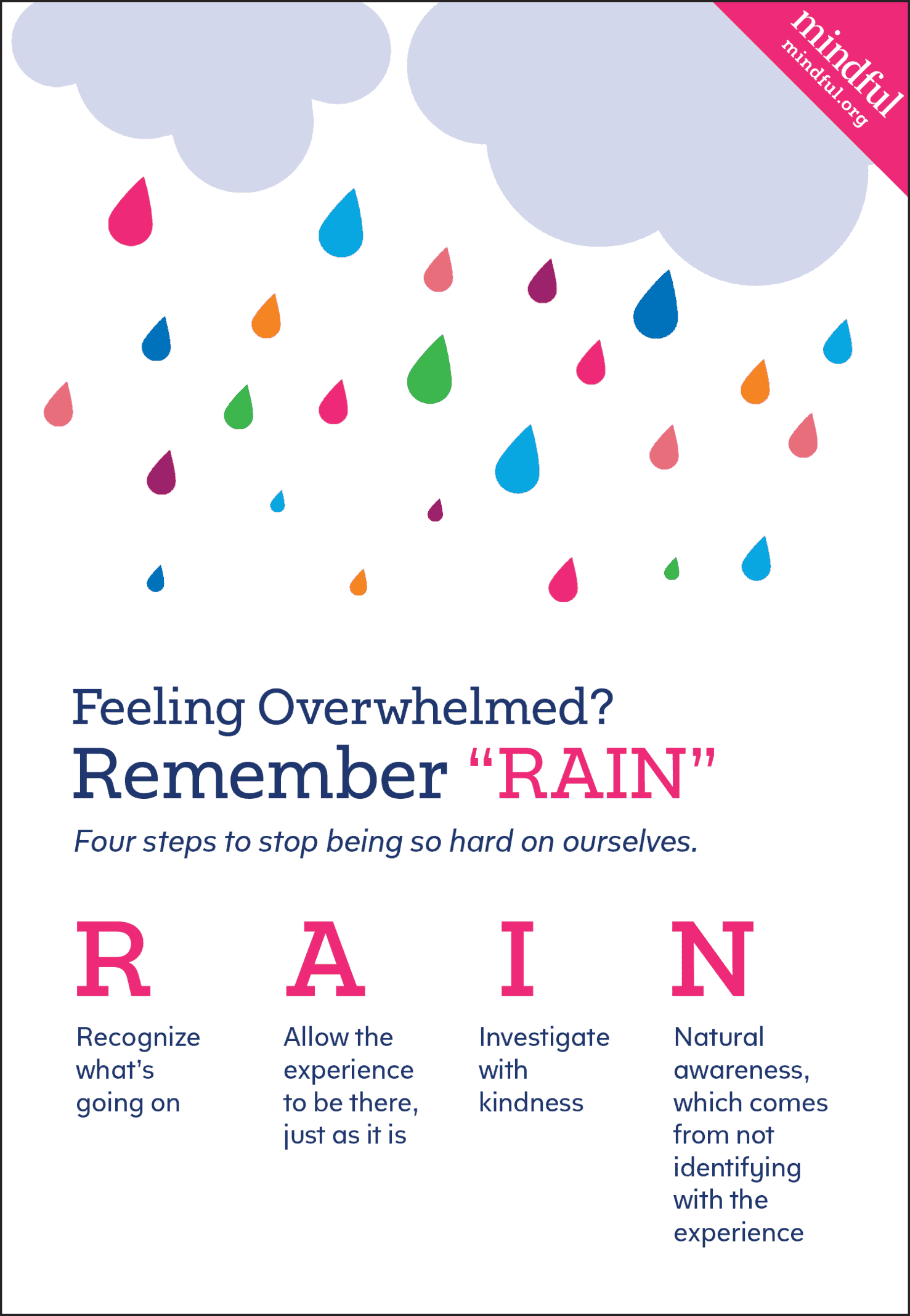
We Were Eight Years in Power

Read: September 2020

Get this book

We Were Eight Years in Power

by Ta-Nehisi Coates

We Were Eight Years in Power by Ta-Nehisi Coates is a collection featuring the landmark essay The Case for Reparations he wrote for The Atlantic. Even though I am a subscriber to The Atlantic and have read many of the pieces, this is a must-read book as it reflects on race, Barack Obama’s presidency, and its jarring aftermath, including the election of Donald Trump.

We were eight years in power as the lament of Reconstruction-era black politicians as the American experiment in multiracial democracy ended with the return of white supremacist rule in the South. In this sweeping collection of new and selected essays, Ta-Nehisi Coates explores the tragic echoes of that history in our own time: the unprecedented election of a black president followed by a vicious backlash that fueled the election of the man Coates argues is America’s first white president.

But the story of these present-day eight years is not just about presidential politics. This book also examines the new voices, ideas, and movements for justice that emerged over this period and the effects of the persistent, haunting shadow of our nation’s old and unreconciled history. Coates powerfully examines the events of the Obama era from his intimate and revealing perspective:” the point of view of a young writer who begins the journey in an unemployment office in Harlem and ends it in the Oval Office, interviewing a president.

We Were Eight Years in Power features Coatesa’s iconic essays first published in The Atlantic, including Fear of a Black President, The Case for Reparations, and The Black Family in the Age of Mass Incarceration, along with eight fresh essays that revisit each year of the Obama administration through Coate’s own experiences, observations, and intellectual development, capped by a bracingly original assessment of the election that fully illuminated the tragedy of the Obama era. We Were Eight Years in Power is a vital account of modern America, from one of the definitive voices of this historic moment.

I recommend this book to all readers.

Subscribe

Contact Us

×
The Heat Will Kill You First

Read: July 2023

Get this book

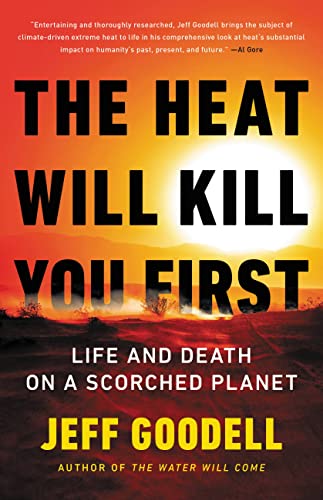
The Heat Will Kill You First

by Jeff Goodell

I recently started reading “The Heat Will Kill You First” by Jeff Goodell, which delves into the extreme ways our planet is already changing. The book explores how spring is arriving earlier and fall is arriving later and how this will impact our food supply and disease outbreaks. As I have stated in my Action Alert: EPA’s Carbon Rule, the time to act is now.

The book also predicts the consequences of summer days in cities like Chicago and Boston, reaching temperatures as high as 110°F. Goodell explains that heat waves are used only to affect the most vulnerable people, but as they become more intense and familiar, they will affect everyone.

It is becoming increasingly clear that the world is facing a new reality. In California, wildfires are now seasonal, while the Northeast is experiencing less and less snow each winter. Meanwhile, the Arctic and Antarctic ice sheets are melting alarmingly. Heat is the primary threat that is driving all other impacts of the climate crisis. As temperatures rise, it exposes weaknesses in our governments, politics, economy, and values.

The basic science is straightforward: If we stop burning fossil fuels tomorrow, the global temperature will also stop rising. However, if we wait for 50 years to stop burning them, the temperature will continue to rise, making parts of our planet uninhabitable. The responsibility to act is in our hands. The hotter it gets, the more our underlying issues will surface and expand.

Jeff Goodell has been an award-winning journalist in the field of environmental reporting for several decades. His latest book explains how extreme heat will cause significant changes in the world. The book is an excellent blend of scientific insights and on-the-ground storytelling, and Goodell explores some of the most significant questions surrounding the topic. He reveals that extreme heat is a force we have yet to comprehend fully.


The Jan Lilien Education Fund sponsors ongoing sustainability and environmental awareness programs. Gifts made this month; I will match dollar-for-dollar. All donations are tax-deductible.

Subscribe

Contact Us

I receive a commission when you buy a book or product using a link on this page. Thank you for supporting Sharing Jan’s Love blog.


×
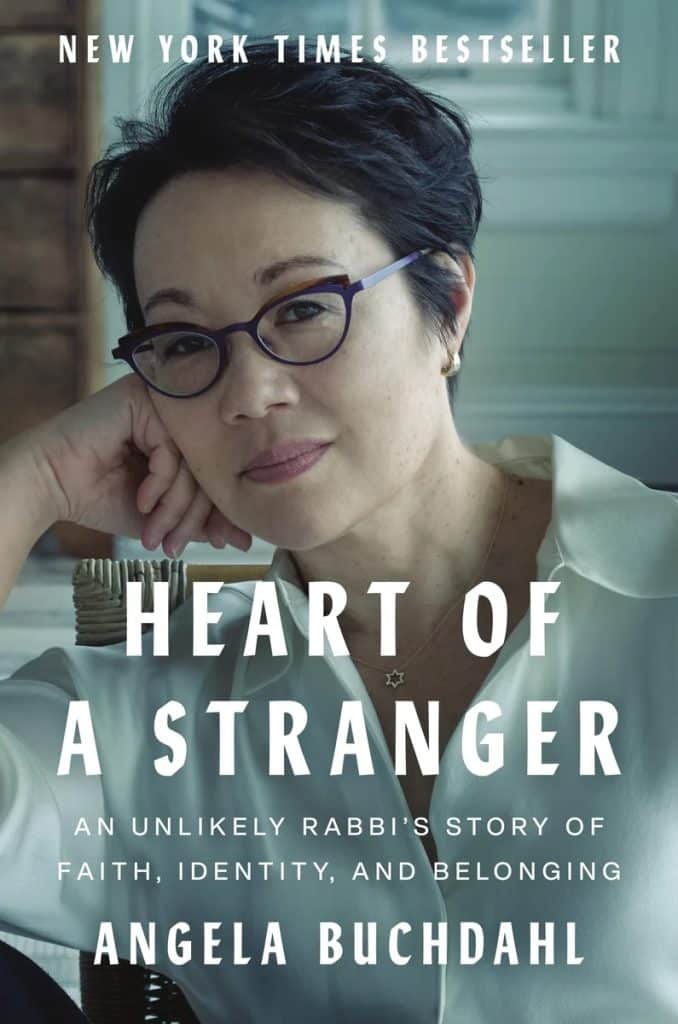
Heart of a Stranger

Read: February 2026

Get this book

Heart of a Stranger

by Rabbi Angela Warnick Buchdahl

In “Heart of a Stranger,” Angela Buchdahl shares her journey from feeling like an outsider to becoming an officiant. She describes her transformation from estrangement to belonging, ultimately emerging with a deep conviction that we are all connected to a larger whole and purpose. Her book serves as both a memoir and a spiritual guide for everyday living, addressing a need that many of us experience today. As the first Asian American ordained as a rabbi, she offers a compelling account of her evolution into one of the world’s most respected religious leaders.

Angela Buchdahl was born in Seoul, the daughter of a Korean Buddhist mother and Jewish American father. Profoundly spiritual from a young age, by sixteen, she felt the first stirrings to become a rabbi. Despite the naysayers and periods of self-doubt—Would a mixed-race woman ever be seen as authentically Jewish or chosen to lead a congregation?—she stayed the course, which took her first to Yale, then to rabbinical school, and finally to the pulpit of one of the largest, most influential congregations in the world.

Today, Angela Buchdahl inspires Jews and non-Jews alike with her invigorating, joyful approach to worship and her belief in the power of faith, gratitude, and responsibility for one another, regardless of religion. She does not shy away from difficult topics, from racism within the Jewish community and the sexism she confronted when she aspired to the top job, to rising antisemitism today. Buchdahl teaches how these challenges, which can make one feel like a stranger, can ultimately be the source of our greatest empathy and strength.

While reading this book, I experienced a revival and deepening of my faith. “Heart of a Stranger,” “Man’s Search for Meaning,” “Judaism is About Love,” “Hostage,” and “The Amen Effect” are all cherished titles that I will reference and reread for years to come.


Angela Buchdahl is the first Asian American rabbi. She serves as the Senior Rabbi of Central Synagogue in New York City, the first woman to lead this flagship congregation in its 185-year history. Under her leadership, Central has grown into one of the largest synagogues in the world, with live-stream viewers in more than 100 countries. She has led prayers in the White House for two U.S. presidents and has been featured on national news outlets, including Today, NPR, and The Wall Street Journal, to discuss the day’s moral issues.

Rabbi Buchdahl and her husband live in New York City and have three children.


Discover your next favorite book and dive into a world of curated, exciting reads by purchasing through my links. You’ll have access to a diverse selection of books that I’ve personally vetted to ensure quality and enjoyment. Additionally, by supporting these selections, you’ll help me continue to provide you with more personalized recommendations. I earn a small commission from your purchase, which allows me to buy and share even more books with you. Your support truly makes a difference!


×
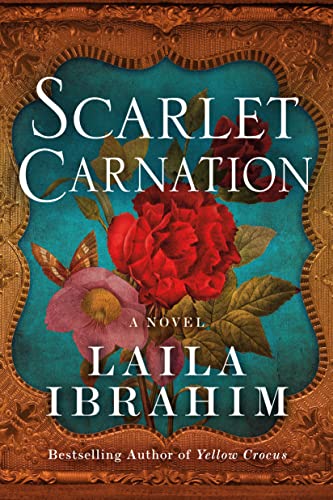
Scarlet Carnation: A Novel

Read: March 2022

Get this book

Scarlet Carnation: A Novel

by Laila Ibrahim

Scarlet Carnation: A Novel by Laila Ibrahim is a book I enjoyed reading. Having read this book, I am now a fan of Laila Ibrahim and look forward to reading more of her novels. In addition, I am a fan of historical fiction, and this is one of the best I have read about the second decade of the twentieth century.

May and Naomi are related, but their lives are very relatable to the reader. The promises of equality and transformation of women’s roles resonate even now. Bringing together the myriad issues they confront – racism, shaming for decisions they made, peace, and the interlocking of their families from a plantation, make this a book that I highly recommend.

The only observation was my shock at reading that they were petitioning President Coolidge at the start of WW I. It is a minor issue as the story flows strongly from the first to the last page.

The Goodreads overview highlights the narrative of the book.

In an early twentieth-century America roiling with racial injustice, class divides, and WWI, two women fight for their dreams in a galvanizing novel by the bestselling author of Golden Poppies. 1915. May and Naomi are extended families, their grandmothers’ lives inseparably entwined on a Virginia plantation in the volatile time leading up to the Civil War. For both women, the twentieth century promises social transformation and equal opportunity.

May, a young white woman, is on the brink of achieving the independent life she’s dreamed of since childhood. Naomi, a nurse, mother, and leader of the NAACP, has fulfilled her own dearest desire: buying a home for her family. But they both are about to learn that dreams can be destroyed in an instant. May’s future is upended, and she is forced to rely once again on her mother. Meanwhile, the white-majority neighborhood into which Naomi has moved is organizing against her while her sons are away fighting for their country.

In the tumult of a changing nation, these two women—whose grandmothers survived the Civil War—support each other’s quest for liberation and dignity. Both find the strength to confront injustice and the faith to thrive on their chosen paths.

Register to Attend Celebrate Jan Day

Subscribe

Contact Us

When you buy a book or product using a link on this page, I receive a commission. Thank you for supporting Sharing Jan’s Love blog.
×
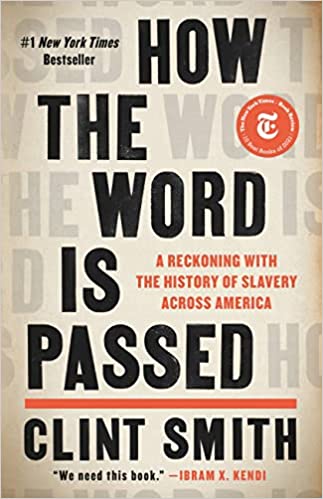
How the Word is Passed

Read: December 2021

Get this book

How the Word Is Passed: A Reckoning with the History of Slavery Across America

by Clint Smith

How the Word Is Passed: A Reckoning with the History of Slavery Across America by Clint Smith. This book was a gift from my son Jon. The New York Times selected How the Word is Passed as one of the best books published this year. Beginning in his hometown of New Orleans, Clint Smith leads the reader on an unforgettable tour of monuments and landmarks—those that are honest about the past and those that are not—that offer an intergenerational story of how slavery has been central in shaping our nation’s collective history, and ourselves.

How the Word is Passed is one of the best books I have read in 2021. I had read an excerpt in The Atlantic on the Whitney Plantation, one of the only former plantations devoted to preserving the experience of the enslaved people whose lives and work sustained it. Like most of us, I had placed the book on my to-read list, where it remained lost in the cobwebs. Fortunately, my son Jon purchased the book for me.

Secondly, the book rekindled my long-lost dream of being an American Studies professor. As soon as Jan and I met, I dropped plans to leave Brooklyn and start graduate school in the fall of 1974. I made that decision primarily because of how much I loved Jan. But it was also partly that I did not have a clear vision of what my life would be like as a professor. The book provided clear examples of people like Yvonne Holden at The Whitney Plantation redefining history to be more accurate and inclusive. I probably could not have done as well as she did, but I can now see that it might have resulted in a career for me that could have been impactful.

Goodreads provides this overview for those who still need to be convinced to read this book.

It is the story of the Monticello Plantation in Virginia, the estate where Thomas Jefferson wrote letters espousing the urgent need for liberty while enslaving over 400 people on the premises. It is the story of the Whitney Plantation, one of the only former plantations devoted to preserving the experience of the enslaved people whose lives and work sustained it. It is the story of Angola Prison in Louisiana, a former plantation named for the country from which most of its enslaved people arrived and which has since become one of the most gruesome maximum-security prisons in the world. And it is the story of Blandford Cemetery, the final resting place of tens of thousands of Confederate soldiers.

In a deeply researched and transporting exploration of the legacy of slavery and its imprint on centuries of American history, How the Word Is Passed illustrates how some of our country’s most essential stories are hidden in plain view-whether in places we might drive by on our way to work, holidays such as Juneteenth, or entire neighborhoods—like downtown Manhattan—on which the brutal history of the trade in enslaved men, women and children has been deeply imprinted.

Informed by scholarship and brought alive by the story of people living today, Clint Smith’s debut work of nonfiction is a landmark work of reflection and insight that offers a new understanding of the hopeful role that memory and history can play in understanding our country.

How the Word is Passed is one of the best books I have read this year and many prior ones. I encourage you to read it and share your comments.

Subscribe

Contact Us

When you buy a book or product using a link on this page, I receive a commission. Thank you for supporting Sharing Jan’s Love blog.
×
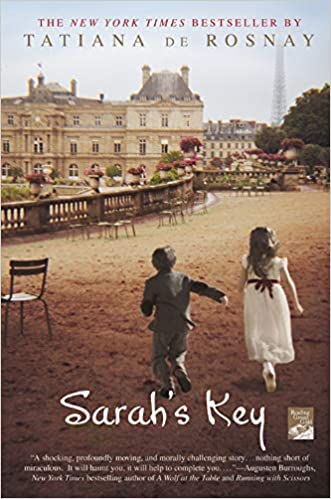
Sarah's Key

Read: January 2022

Get this book

Sarah’s Key

by Tatiana de Rosnay

Sarah’s Key by Tatiana de Rosnay is the untold story of the roundup of the Jews in Paris in July 1942. The novel focuses on how the French were complicit in rounding up thousands of Jews in 1942. It is also a reminder that we can never allow another genocide. I finished this book the day before Holocaust Remembrance Day, January 27, the date on which the Auschwitz-Birkenau concentration and death camp complex was liberated in 1945.

Ten-year-old Sarah is brutally arrested with her family in the Vel’ d’Hiv’ roundup, the most notorious act of French collaboration with the Nazis. But before the police come to take them, Sarah locks her younger brother, Michel, in their favorite hiding place, a cupboard in the family’s apartment. She keeps the key, thinking she will be back within a few hours.

Paris, May 2002: On Vel’ d’Hiv’s sixtieth anniversary, Julia Jarmond, an American journalist, is asked by her Paris-based American magazine to write an article about this black day in France’s past. Julia has lived in Paris for nearly twenty-five years and married a Frenchman, and she is shocked both by her ignorance about the event and the silence that still surrounds it.

The twin narratives of Sarah and Julia hold the first two-thirds of the book together and make it a page-turner. Sarah’s memory reminds us during the final third of the book and ensures that the complete story of the Vel’ d’Hiv’ roundup and its lasting impact are told.

As Goodreads describes the novel,

In the course of her investigation, she stumbles onto a trail of long-hidden family secrets that connects her to Sarah. Julia finds herself compelled to retrace the girl’s ordeal, from the terrible days spent shut in at the Vel’ d’Hiv’ to the camps and beyond. As she probes into Sarah’s past, she begins to question her own place in France and to reevaluate her marriage and her life.

Writing about the fate of her country with a pitiless clarity, Tatiana de Rosnay offers us a brilliantly subtle, compelling portrait of France under occupation and reveals the taboos and denial surrounding this painful episode in French history.

I highly recommend the book.

Subscribe

Contact Us

When you buy a book or product using a link on this page, I receive a commission. Thank you for supporting Sharing Jan’s Love blog.
×