
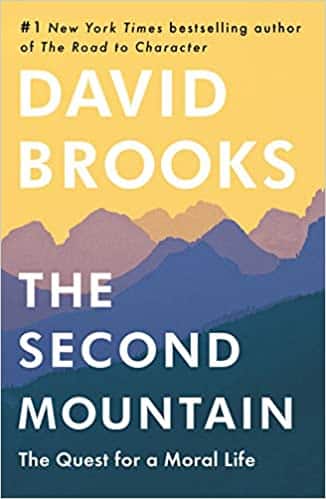
The Second Mountain: The Quest for a Moral Life

Estimated reading time: 1 minute, 44 seconds

The Second Mountain: The Quest for a Moral Life by David Brooks is a book I often recommend. Mr. Brooks writes about the first mountain that most people climb. The book challenges the reader to “live for a cause greater than themselves.”

It is about “to be a success, make your mark, experience personal happiness.” Even when they reach the top of the mountain, most people find they are unhappy. The climb to the summit has become unsatisfying.

On the second mountain, life moves from self-centered to other-centered.” Life becomes interdependent, not independent; it becomes a life of commitment, not about us.

Mr. Brooks “explores the four commitments that define a life of meaning and purpose: to a spouse and family, to a vocation, to a philosophy or faith, and to a community.

We live in a society, Brooks argues, that celebrates freedom, that tells us to be true to ourselves, at the expense of surrendering to a cause, rooting ourselves in a neighborhood, binding ourselves to others by social solidarity and love. We have taken individualism to the extreme—and in the process we have torn the social fabric in a thousand different ways.

When I read The Second Mountain, it became clear that Jan and I never even attempted to climb the first mountain. We were constantly climbing the second mountain.

We had chosen to do work that repaired the world; we both had a faith community and lived in a community.

All we were missing as far as commitments when we met was each other. Our love for each other provided the missing link and allowed us to climb to the top of the second mountain.


The Jan Lilien Education Fund sponsors ongoing sustainability and environmental awareness programs. Gifts made this month; I will match dollar-for-dollar. All donations are tax-deductible.

Subscribe

Contact Us

I receive a commission when you buy a book or product using a link on this page. Thank you for supporting Sharing Jan’s Love blog.

The Jan Lilien Education Fund!

Memorial Days: A Memoi

Read: March 2025

Get this book

Memorial Days: A Memoir

by Geraldine Brooks

Today, I started reading “Memorial Days: A Memoir” by Geraldine Brooks, the bestselling Pulitzer Prize-winning author of Horse”. In this poignant and beautifully written memoir, she explores sudden loss and the journey toward healing. Why do I choose to read novels and memoirs about loss and grief? Perhaps it’s because, as Martín Prechtel wrote in his book The Smell of Rain on Dust”, “Grief is praise because it is the natural way love honors what it misses.”

Many cultural and religious traditions expect grieving people to withdraw from the world. In modern life, we frequently encounter bureaucratic obstacles and lengthy to-do lists. This is precisely what happened to Geraldine Brooks when her partner of more than thirty years, Tony Horwitz—just sixty years old and, to her knowledge, vigorous and healthy—collapsed and died on a sidewalk in Washington, D.C.

After spending their early years together in conflict zones as foreign correspondents, Geraldine and Tony settled down to raise two sons on Martha’s Vineyard. They lived a fulfilling life filled with meaningful work, good humor, and tenderness. Geraldine and Tony spent their days writing and evenings cooking family dinners or enjoying sunsets with friends at the beach. Their peaceful existence abruptly ended on Memorial Day 2019 when Geraldine received the dreaded phone call we all fear. The demands of life became immediate and overwhelming, leaving little room for grief. The sudden loss created a profound void in their lives.

Three years later, she booked a flight to a remote island off the coast of Australia to give herself the time to mourn finally. She often spent days alone in a shack on the pristine, rugged coast without seeing another person. It was a space for her to reflect on the various ways cultures grieve and consider which rituals might help her rebuild her life in the wake of Tony’s death.

Memorial Days,” a spare and profoundly moving memoir, portrays a larger-than-life man and the timeless love between two souls. It exquisitely captures the joy, agony, and mystery of life.


Geraldine Brooks is the author of six novels, including “Horse,” “People of the Book,” “Year of Wonders,” and the Pulitzer Prize-winning “March.” She has also written acclaimed nonfiction works, including “Nine Parts of Desire” and “Foreign Correspondence.” Her books have been translated into more than thirty languages and have sold millions of copies worldwide. Born and raised in Australia, Brooks now divides her time between Sydney and Martha’s Vineyard.


My journey through grief has significantly helped me grow as a person by focusing on conscientious resilience. I make it a point to read and walk daily, engage in worship, and actively participate as a volunteer and a good neighbor in my community. Fourteen hundred days ago, I wasn’t sure if I could continue living or how to move forward. However, by concentrating on strengthening my resilience, I now lead a life filled with meaning and purpose. I choose to look back not on what I lost but on what I have gained.

As my friend Danny said nearly a year ago, “You are an incredible person! You are a new person! A better person! Although Jan is not here physically, she has done so much for you!

My Rabbi, Rav Uri, echoed similar sentiments during his remarks when I received the Rev. Dr. Martin Luther King, Jr. Distinguished Service Award. If their beliefs are true, much of my progress directly results from my conscientious resilience!


When you purchase a book through one of my links, I earn a small commission that helps support my passion for reading. This contribution allows me to buy even more books to share with you, creating an incredible cycle of discovering great reads together! Your support truly makes a difference!


×
Wintering: The Power of Rest and Retreat in Difficult Times

Read: October 2021

Get this book

Wintering: The Power of Rest and Retreat in Difficult Times

by Katherine May

Wintering: The Power of Rest and Retreat in Difficult Times by Katherine May is “an intimate, revelatory book exploring the ways we can care for and repair ourselves when life knocks us down.”

Two quotes that resonated with me were:

That’s what grief is – a yearning for that one last moment of contact that would settle everything.

We are in the habit of imagining our lives to be linear, a long march from birth to death in which we mass our powers, only to surrender them again, all the while slowly losing our youthful beauty. This is a brutal untruth. Life meanders through the woods. We have seasons when we flourish and seasons when the leaves fall upon us, revealing our bare bones. Given time they grow again.

May writes in a clear voice that conveys the importance of accepting the cycles of life instead of fighting them.

Sometimes you slip through the cracks: unforeseen circumstances like an abrupt illness, the death of a loved one, a breakup, or a job loss can derail a life. These periods of dislocation can be lonely and unexpected. For May, her husband fell ill, her son stopped attending school, and her own medical issues led her to leave a demanding job. Wintering explores how she not only endured this painful time but embraced the singular opportunities it offered.

A moving personal narrative shot through with lessons from literature, mythology, and the natural world, May’s story offers instruction on the transformative power of rest and retreat. Illumination emerges from many sources: solstice celebrations and dormice hibernation, C.S. Lewis and Sylvia Plath swimming in icy waters, and sailing arctic seas.

Ultimately Wintering invites us to change how we relate to our own fallow times. May models an active acceptance of sadness and finds nourishment in deep retreat, joy in the serene beauty of winter, and encouragement in understanding life as cyclical, not linear. A secular mystic, May forms a guiding philosophy for transforming the hardships that arise before the ushering in of a new season.

I recommend this book without reservation.


The Jan Lilien Education Fund sponsors ongoing sustainability and environmental awareness programs. Gifts made this month; I will match dollar-for-dollar. All donations are tax-deductible.

Subscribe

Contact Us

I receive a commission when you buy a book or product using a link on this page. Thank you for supporting Sharing Jan’s Love blog.


×
Interpreter of Maladies

Read: June 2022

Get this book

Interpreter of Maladies

by Jhumpa Lahiri

Interpreter of Maladies by Jhumpa Lahiri is an incredible book. Each short story is a page-turner that I will re-read many times. As Ms. Lahiri writes, “The question of identity is always a difficult one, but especially so for those who are culturally displaced, as immigrants are, or those who grow up in two worlds simultaneously, as is the case for their children.”

Since 2000, Interpreter of Maladies has been on my reading list. For what is a writer, if not an interpreter of maladies? Perhaps, I waited until now so that I would have grief to help guide me thru this collection of short stories. I highly recommend Interpreter of Maladies.

The Goodreads summary provides a concise overview.

Navigating between the Indian traditions they’ve inherited and the baffling new world, the characters in Jhumpa Lahiri’s elegant, touching stories seek love beyond the barriers of culture and generations. In “A Temporary Matter,” published in The New Yorker, a young Indian-American couple faces the heartbreak of a stillborn birth. At the same time, their Boston neighborhood copes with a nightly blackout. In the title story, an interpreter guides an American family through the India of their ancestors and hears an astonishing confession. Lahiri writes with deft cultural insight reminiscent of Anita Desai and a nuanced depth that recalls Mavis Gallant.


Subscribe

Contact Us

I receive a commission when you buy a book or product using a link on this page. Thank you for supporting Sharing Jan’s Love blog.
×
How the Word is Passed

Read: December 2021

Get this book

How the Word Is Passed: A Reckoning with the History of Slavery Across America

by Clint Smith

How the Word Is Passed: A Reckoning with the History of Slavery Across America by Clint Smith. This book was a gift from my son Jon. The New York Times selected How the Word is Passed as one of the best books published this year. Beginning in his hometown of New Orleans, Clint Smith leads the reader on an unforgettable tour of monuments and landmarks—those that are honest about the past and those that are not—that offer an intergenerational story of how slavery has been central in shaping our nation’s collective history, and ourselves.

How the Word is Passed is one of the best books I have read in 2021. I had read an excerpt in The Atlantic on the Whitney Plantation, one of the only former plantations devoted to preserving the experience of the enslaved people whose lives and work sustained it. Like most of us, I had placed the book on my to-read list, where it remained lost in the cobwebs. Fortunately, my son Jon purchased the book for me.

Secondly, the book rekindled my long-lost dream of being an American Studies professor. As soon as Jan and I met, I dropped plans to leave Brooklyn and start graduate school in the fall of 1974. I made that decision primarily because of how much I loved Jan. But it was also partly that I did not have a clear vision of what my life would be like as a professor. The book provided clear examples of people like Yvonne Holden at The Whitney Plantation redefining history to be more accurate and inclusive. I probably could not have done as well as she did, but I can now see that it might have resulted in a career for me that could have been impactful.

Goodreads provides this overview for those who still need to be convinced to read this book.

It is the story of the Monticello Plantation in Virginia, the estate where Thomas Jefferson wrote letters espousing the urgent need for liberty while enslaving over 400 people on the premises. It is the story of the Whitney Plantation, one of the only former plantations devoted to preserving the experience of the enslaved people whose lives and work sustained it. It is the story of Angola Prison in Louisiana, a former plantation named for the country from which most of its enslaved people arrived and which has since become one of the most gruesome maximum-security prisons in the world. And it is the story of Blandford Cemetery, the final resting place of tens of thousands of Confederate soldiers.

In a deeply researched and transporting exploration of the legacy of slavery and its imprint on centuries of American history, How the Word Is Passed illustrates how some of our country’s most essential stories are hidden in plain view-whether in places we might drive by on our way to work, holidays such as Juneteenth, or entire neighborhoods—like downtown Manhattan—on which the brutal history of the trade in enslaved men, women and children has been deeply imprinted.

Informed by scholarship and brought alive by the story of people living today, Clint Smith’s debut work of nonfiction is a landmark work of reflection and insight that offers a new understanding of the hopeful role that memory and history can play in understanding our country.

How the Word is Passed is one of the best books I have read this year and many prior ones. I encourage you to read it and share your comments.

Subscribe

Contact Us

When you buy a book or product using a link on this page, I receive a commission. Thank you for supporting Sharing Jan’s Love blog.
×
Godwin: A Novel

Read: February 2025

Get this book

Godwin: A Novel

by Joseph O'Neill

Today, I dove into “Godwin” by Joseph O’Neill, the brilliant mind behind “Netherland,” which snagged the title of Best Book of the Year from the New York Times Book Review. This captivating tale follows the adventure of two brothers embarking on a globe-trotting quest to find an extraordinary African soccer prodigy—someone who might transform their lives forever. The thrill of their journey and the promise of discovery have me hooked!

Mark Wolfe, a brilliant self-thwarting technical writer, lives in Pittsburgh with his wife, Sushila, and their toddler daughter. Born and raised in the United Kingdom, his half-brother Geoff is a desperate young soccer agent. He pulls Mark across the ocean into a scheme to track down an elusive prospect known as “Godwin“—an African teenager Geoff believes could be the next Lionel Messi.

Narrated in turn by Mark and his work colleague Lakesha Williams, Godwin is a tale of family and migration as well as an international adventure story that implicates the brothers in the beauty and ugliness of soccer, the perils and promises of global business, and the dark history of transatlantic money-making.

As only he can do, Joseph O’Neill investigates the legacy of colonialism in the context of family love, global capitalism, and the dreaming individual.


Mr. O’Neill was born in Ireland and grew up in Mozambique, Iran, Turkey, and Holland. His previous novels include the PEN/Faulkner Award-winning Netherland and the Booker Prize long-listed The Dog. O’Neill’s short fiction appears regularly in The New Yorker and his political essays in The New York Review of Books. He lives in New York City.


When you purchase a book through one of my links, I earn a small commission that helps support my passion for reading. This contribution allows me to buy even more books to share with you, creating an incredible cycle of discovering great reads together! Your support truly makes a difference!


×
Last House: A Novel

Read: May 2024

Get this book

Last House: A Novel

by Jessica Shattuck

I started reading “Last House: A Novel” by Jessica Shattuck today. She is an esteemed New York Times bestselling author known for her work “The Women in the Castle.” This sweeping narrative, perfect for “The Dutch House” and “Great Circle” fans, explores a nation’s rise to power and a family’s complex ties to the resources that shaped their wealth. It also delves into the events that led to their greatest tragedy, a secret that threatens to tear them apart.

In 1953, a World War II veteran turned company lawyer, Nick Taylor, saw oil as the key to the future. He commutes to the city for work and returns to the peaceful suburbs to be with his wife, Bet, a former codebreaker now a housewife, and their two children, Katherine and Harry. Nick, who comes from humble origins, can provide for his family, including their secluded country escape called Last House, thanks to his work for American Oil. Last House, deep in the Vermont mountains, offers the Taylors a retreat from the stresses of modern life. Bet no longer worries about the Russian H-bombs that haunt her dreams, and the children can roam freely in the woods. Last House is a place that seems capable of surviving the end of the world.

1968, a turning point in American history, where the nation teeters on the brink of transformation. The streets pulsate with protestors challenging everything from the Vietnam War to racism and even the country’s reliance on Big Oil. As Katherine enters adulthood, she finds herself caught in the era’s tide, struggling to reconcile her ideals with the privileged upbringing her parents, part of the Greatest Generation, toiled to provide. But when the Movement takes a secure, more radical turn, each member of the Taylor family must face the repercussions of their choices for the causes they believed in. This rich historical backdrop infuses the Taylor family’s narrative with depth and intrigue, leaving us hungry for more about this transformative era.

Last House” spans multiple generations and nearly eighty years, telling the story of one American family during a time of grand ideals and significant downfalls. It explores themes of family dynamics, the impact of wealth, and the societal changes that shaped America. Set against the backdrop of our nation’s history, this emotional tour de force delves deeply into questions of inheritance and what we owe each other. It captures the gravity of time, the double edge of progress, and the hubris of empire to stunning effect.

×