
Meandering Morning Meditation

Meandering Morning Meditation

Estimated reading time: 0 minutes, 32 seconds
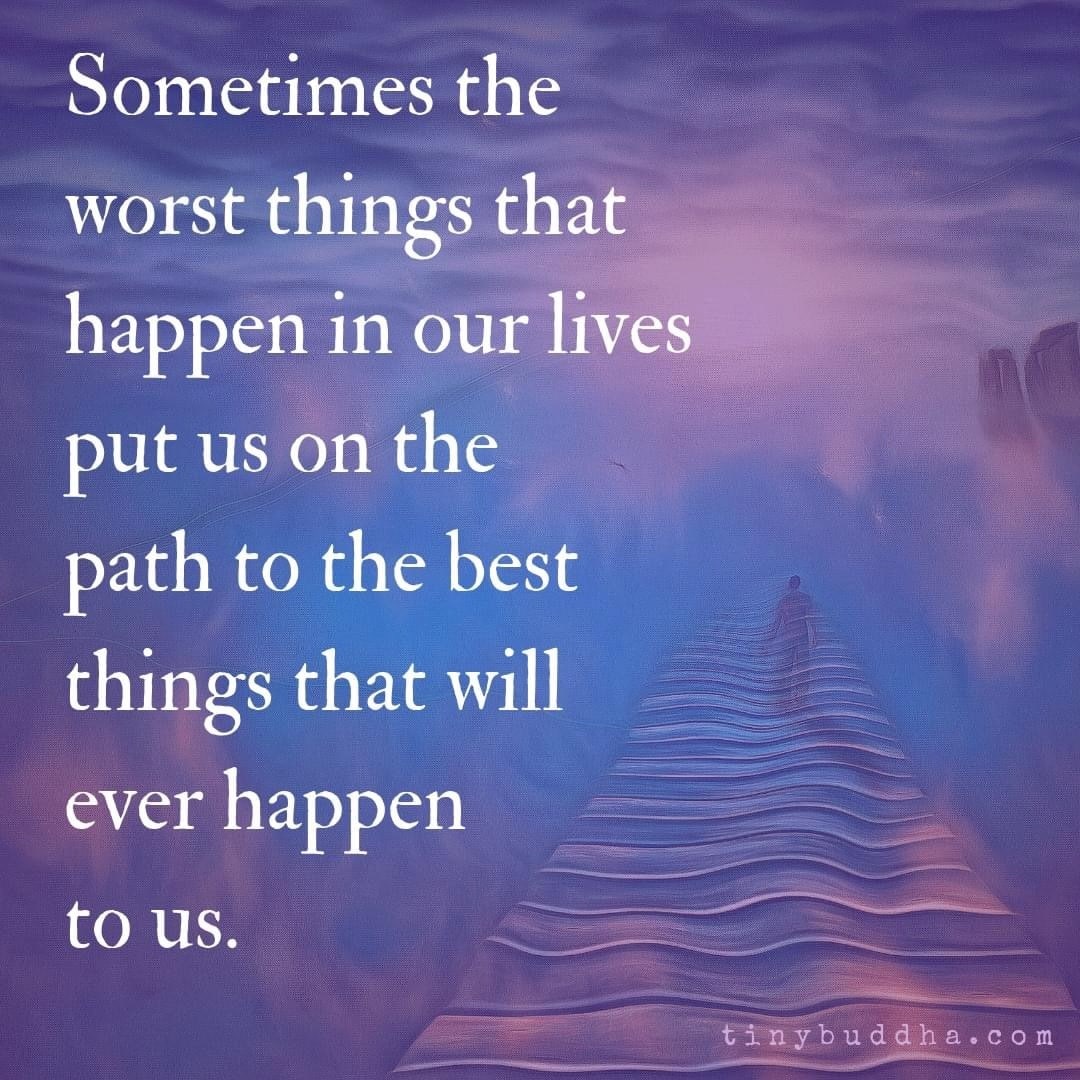
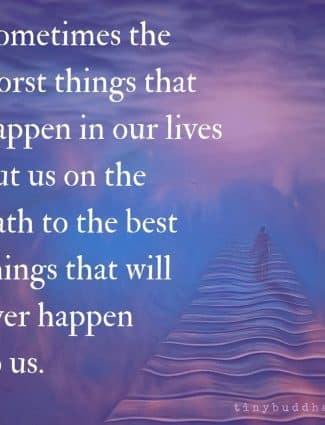
During my morning walks, I allow my mind to wander, and I can think clearly about the issues that burden my soul. Meditating with a clear head in the cooler early hours has proven to be the key to my healing and growth after losing Jan. Sometimes, I can understand life lessons that we should have learned in kindergarten. Today, I thought about how much I have learned from grief, specifically that the worst things in our lives lead to the best things that will ever happen to us. When I returned home, someone sent me the image featured on tinybudda.com, reinforcing my daily meditative meanderings.

Show thread (1)

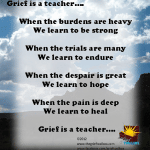
Grief is a Great Teacher

Estimated reading time: 0 minutes, 32 seconds

Grief is a Great Teacher

As I pray every week at Temple Sha'arey Shalom, when we remember those we lost in this passage, one of our readings is: "Grief is a great teacher when it sends us back to serve and bless the living. We learn how to counsel and comfort those who, like ourselves, are bowed with sorrow. We learn when to keep silent in their presence and when a word will assure them of our love and concern."

3 comments add your comment

Share your thoughts and ideas

This site uses Akismet to reduce spam. Learn how your comment data is processed.

The Jan Lilien Education Fund!

Meandering Morning Meditation
×
When We Cease to Understand the World

Read: September 2024

Get this book

When We Cease to Understand the World

by Benjamín Labatut

Today, I began reading When We Cease to Understand the World by Benjamín Labatut, translated by Adrian Nathan West. This book, listed on The New York Times 100 Best Books of the 21st Century, promises to be thought-provoking as it delves into the intricate connections between scientific and mathematical discovery, madness, and destruction.

In a world where scientific advancements often involve ethical dilemmas and societal implications, this book offers a unique perspective on the lives of scientists who have shaped our understanding of the world. Fritz Haber, Alexander Grothendieck, Werner Heisenberg, and Erwin Schrödinger are some of the luminaries whose troubled lives Benjamín Labatut deeply explores in his fictional examination. Labatut shows how these scientists and thinkers grappled with profound questions of existence, experiencing strokes of unparalleled genius, alienating friends and lovers, and descending into isolation and insanity. Their discoveries, some of which significantly improved human life, while others led to chaos and unimaginable suffering, continue to shape our world.

With a breakneck pace and a wealth of disturbing detail, Labatut uses fiction’s imaginative resources to tell the stories of the scientists and mathematicians who expanded our notions of the possible.

×
The Secrets we Left Behind

Read: March 2022

Get this book

The Secrets We Left Behind

The Secrets We Left Behind by Soraya M. Lane is a historical fiction that raises the question, where were the women after Dunkirk and the fall of France? When World War II appeared to have been lost with a Nazi victory. Ms. Lane watched the movie Dunkirk and then researched that time and the women’s possible roles during that difficult moment in history.

She connected the evacuation at Dunkirk to the Massacre at Le Paradis, fifty miles away, to connect a British nurse and two French women whose strength helps them survive Nazi-occupied France. Three British male soldiers, two of whom survived the massacre and one who escaped Dunkirk, have secondary roles in the novel. 

The Secrets We Left Behind is the story of the three strong women and their efforts to survive the occupation while hiding the three soldiers. This focus on the role of women has been long overdue in history. Ms. Lane, who studied to be a lawyer, has found a career as a writer. The Secrets We Left Behind is the first book I have read, but it will not be the last one by Ms. Lane that I read.

I strongly recommend this book!

The Goodreads synopsis provides an overview of the novel.

How far will they go for family, friendship, and love? Occupied France, 1940. When the staff at a field hospital draw straws to find out who will join the evacuation from Dunkirk, Nurse Cate is left behind. But when the Nazis arrive to claim prisoners of war, she takes her chance and flees into the night, taking one patient with her.

Fifty miles away, the surrendering soldiers of the Royal Norfolk Regiment are shot dead by the advancing Germans. Beneath the pile of bodies, two men survive, crawling to the safety of a nearby farmhouse, where sisters Elise and Adelaide risk their lives to take them in. When Cate, too, arrives at their door with her injured soldier, the pressure mounts.

The sisters are risking everything to keep their visitors safe. But with the Nazis coming ever closer and relationships in the farmhouse intensifying, they must all question the sacrifices they are willing to make for the lives of others. How far will they go for family, friendship, and love?

Register to Attend Celebrate Jan Day

Subscribe

Contact Us

When you buy a book or product using a link on this page, I receive a commission. Thank you for supporting Sharing Jan’s Love blog.

×
How to Love Your Daughter

Read: August 2023

Get this book

How to Love Your Daughter

by Hila Blum

I started reading a novel called “How to Love Your Daughter,” written by Hila Blum and translated by Daniella Zamir today. The book explores a complicated relationship between a mother and her grown daughter. It raises the question of how much harm we can do to our loved ones when love blinds us.

The story takes place thousands of miles away from home, where a woman finds herself peeking through well-lit windows at her two granddaughters. She has never met them before, as they are the daughters of her estranged daughter, whom she hasn’t seen in years.

The book’s central theme revolves around the woman’s attempt to understand how a once-loving relationship between her and her daughter ended up in such a distant and unfathomable state. The story shifts past and present as the woman unravels her memories and long-buried emotions. She tries to make sense of the seemingly insignificant moments of parental care that, combined, may have undermined what she valued most.

The author, Blum, skillfully delves into the complexities of family life, where a parent can easily cross the line between protectiveness and possession without even realizing it. The story leaves us wondering whether it’s possible ever to find our way back from such a point.


The Jan Lilien Education Fund sponsors ongoing sustainability and environmental awareness programs. Gifts made this month; I will match dollar-for-dollar. All donations are tax-deductible.

Subscribe

Contact Us

I receive a commission when you buy a book or product using a link on this page. Thank you for supporting Sharing Jan’s Love blog.


×
The Vegetarian: A Novel

Read: October 2024

Get this book

The Vegetarian: A Novel

by Han Kang

Today, I started reading The Vegetarian: A Novel by Han Kang, Winner of the 2024 Nobel Prize in Literature. The novel also won The International Booker Prize and is one of The New York Times’s 100 Best Books of the 21st Century. Celebrated by critics worldwide, The Vegetarian is a darkly allegorical, Kafka-esque tale of power, obsession, and one woman’s struggle to break free from the violence both without and within her.

Before the nightmares began, Yeong-hye and her husband lived an ordinary, controlled life. But the dreams—invasive images of blood and brutality—torture her, driving Yeong-hye to purge her mind and renounce eating meat altogether. It’s a small act of independence, but it interrupts her marriage and sets into motion an increasingly grotesque chain of events at home.

As her husband, her brother-in-law, and her sister each fight to reassert their control, Yeong-hye obsessively defends the choice that’s become sacred to her. Soon, their attempts turn desperate, subjecting first her mind and then her body to ever more intrusive and perverse violations, sending Yeong-hye spiraling into a dangerous, bizarre estrangement, not only from those closest to her but also from herself.


Han Kang was born in 1970 in South Korea. She is the author of The Vegetarian, which I have read, and winner of the International Booker Prize,  Human ActsThe White BookGreek Lessons, and We Do Not Part. In 2024, she received the Nobel Prize in Literature.


When you purchase a book through one of my links, I earn a small commission that helps support my passion for reading. This contribution allows me to buy even more books to share with you, creating an incredible cycle of discovering great reads together! Your support truly makes a difference!


×
Good and Evil and Other Stories

Read: September 2025

Get this book

Good and Evil and Other Stories

by Samanta Schweblin

Good and Evil and Other Stories” by Samanta Schweblin, translated by Megan McDowell, explores characters who find themselves at a point of no return, captivated by the impending tragedy surrounding them. Vulnerable and deeply human, they become ensnared in moments when the uncanny intrudes upon their lives. Some characters transform, others find themselves isolated, and many oscillate between feelings of guilt and tenderness. All are driven by uncertainty.

Schweblin’s prose employs tension and truth to create a literary universe where the monsters of everyday life come so close that we can almost feel their breath. Her writing evokes both awe and discomfort, placing readers in a state of alarm while transporting them to a world that is both recognizable and strange.


Samanta Schweblin won the 2022 National Book Award for Translated Literature for her story collection Seven Empty Houses. Her debut novel, Fever Dream, was shortlisted for the International Booker Prize, while her book, Little Eyes, and her story collection, Mouthful of Birds, have both been longlisted for the same prize. Her books have been translated into over forty languages, and her stories have appeared in prestigious English publications, including The New Yorker, The Paris Review, Granta, and Harper’s Magazine. Originally from Buenos Aires, Schweblin currently lives in Berlin.

Megan McDowell is the recipient of a 2020 Award in Literature from the American Academy of Arts and Letters and has been short- or longlisted four times for the International Booker Prize. She resides in Santiago, Chile.


Discover your next favorite book and dive into a world of curated, exciting reads by purchasing through my links. You’ll have access to a diverse selection of books that I’ve personally vetted to ensure quality and enjoyment. Additionally, by supporting these selections, you’ll help me continue to provide you with more personalized recommendations. I earn a small commission from your purchase, which allows me to buy and share even more books with you. Your support truly makes a difference!


×
Do You Remember Being Born?: A Novel

Read: September 2023

Get this book

Do You Remember Being Born?

by Sean Michaels

I started reading “Do You Remember Being Born?” by Sean Michaels, a writer who won the Scotiabank Giller Prize. The novel is about an aging poet named Marian Ffarmer, a legend in the world of poetry. However, despite her success, she struggles with financial issues and her son’s inability to buy a house. Marian has sacrificed her personal relationships and happiness to pursue her career but questions whether it is worth it.

One day, she receives an invitation from a Tech Company to travel to California and work with their poetry AI, Charlotte. The company wants her to co-author a poem with their bot in a historic partnership, which clashes with Marian’s beliefs about the individual pursuit of art. However, she decides to take this opportunity, even though it makes her feel like a sell-out and a skeptic. The encounter in California changes her life, work, and understanding of kinship.

The book explores the nature of language, art, labor, capital, family, and community. It’s a response to some of the most disquieting questions of our time. The author, Sean Michaels, is a winner of the Scotiabank Giller Prize, and his book is a love letter to and interrogation of the creative legacy. It’s a joyful recognition that belonging to one’s art must mean belonging to the world to survive meaningfully.


The Jan Lilien Education Fund sponsors ongoing sustainability and environmental awareness programs. Gifts made this month; I will match dollar-for-dollar. All donations are tax-deductible.

Subscribe

Contact Us

I receive a commission when you buy a book or product using a link on this page. Thank you for supporting Sharing Jan’s Love blog.


×