Temporary Upsurges in Grief

Estimated reading time: 0 minutes, 34 seconds

Celebrate JanToday, my grief feels like the smooth sailing I have experienced since late August remains steady. Still, with the rapid approach of the family holiday season, my Sunfish now might be entering the most troubled waters since the beginning of the grief journey.

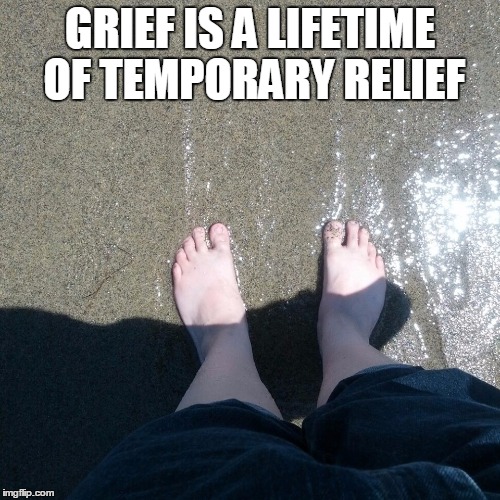
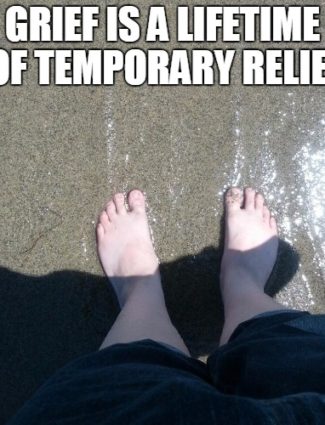
Dr. Bill Webster calls these days “Temporary Upsurges in Grief or TUGs.” The waves of grief ebb and flow, and during the holiday seasons, waves of grief return but only temporarily.

I am using Anne Marie Lockmeyer’s Surviving the Holidays and Other Special Days materials to help prepare me.

Will it be enough?

Subscribe

Contact Us

Share your thoughts and ideas

This site uses Akismet to reduce spam. Learn how your comment data is processed.

The Jan Lilien Education Fund!

×
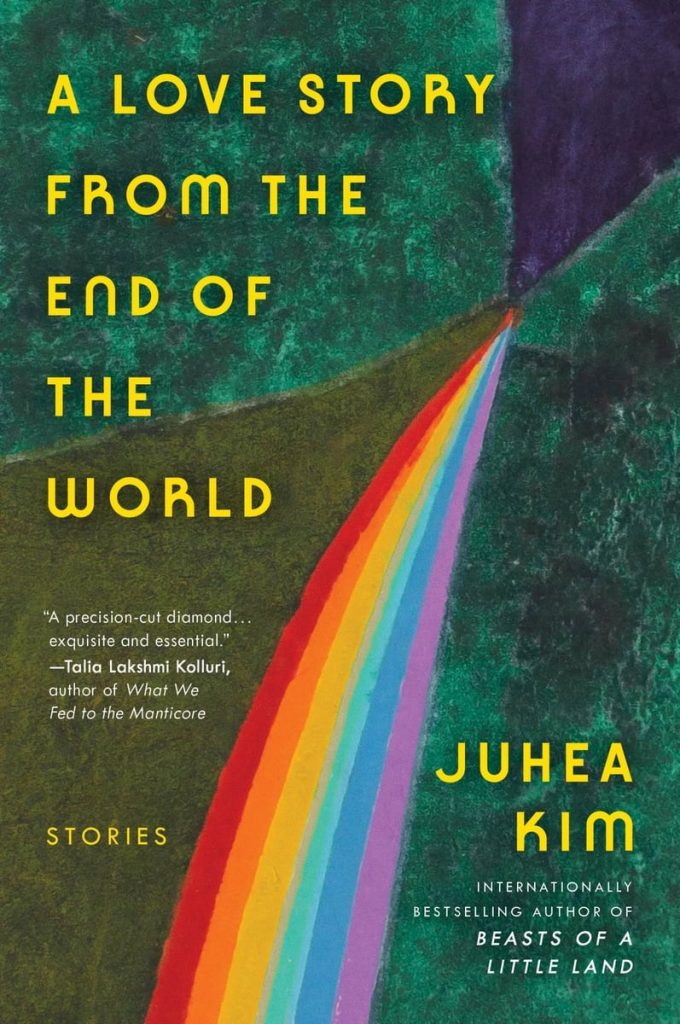
A Love Story from the End of the World

Read: January 2026

Get this book

A Love Story from the End of the World

by Juhea Kim

Juhea Kim, the acclaimed author of Beasts of a Little Land and City of Night Birds, presents an exquisite collection of stories that explores the delicate balance between humans and the natural world. With the clear-eyed reverence of Richard Powers and the sparkling sincerity of George Saunders, her first story collection, A Love Story from the End of the World, offers a breathtaking view of our fractured world—and our broken hearts. Through its passionate narrative, the collection serves as a poignant reminder that, as humans, we are nothing without nature.

Spanning multiple locales and time periods, and rendered in fine detail and vivid color, this transportive collection illustrates what it means to live as human inhabitants of our singular, miraculous planet.

Lyrical, at times hilarious, and always heartfelt, each of these ten stories reflects individual choices in the face of “man-made” apocalypses. In a near-future Seoul, where air pollution has become so severe that a translucent biodome has covered the city, a civil engineer responsible for its upkeep considers an arranged marriage. A painter, disenchanted with New York City, travels to the South of France and becomes romantically involved with an entrepreneur who claims to have invented a new color. Meanwhile, on an island where the Indian and Pacific Oceans converge, and where foreign countries have dumped their waste, causing a landfill mountain to form, a local boy facing daily hardships gains internet fame for his K-pop-inspired dances.


Juhea Kim is the author of the novel Beasts of a Little Land, which was a finalist for the Dayton Literary Peace Prize and the winner of the Yasnaya Polyana Literary Award, Russia’s most significant annual award in literature. It has been translated into many languages and is for television. She is also the author of City of Night Birds, which was a Reese’s Book Club pick.

A graduate of Princeton University, her writing has been published in Granta, the Times Literary Supplement, the Independent, Zyzzyva, Guernica<, and other outlets. She is an advocate for wildlife conservation, animal rights, and education and aid in Africa. Born in Korea and raised in Portland, Oregon, Kim now lives in London.


Discover your next favorite book and dive into a world of curated, exciting reads by purchasing through my links. You’ll have access to a diverse selection of books that I’ve personally vetted to ensure quality and enjoyment. Additionally, by supporting these selections, you’ll help me continue to provide you with more personalized recommendations. I earn a small commission from your purchase, which allows me to buy and share even more books with you. Your support truly makes a difference!


×
Three Strong Women

Read: August 2022

Three Strong Women

by Marie NDiaye

Three Strong Women by Marie NDiaye is a novel that focuses on three women who say no. Winner of the coveted Prix Goncourt, the first by a black woman, Marie NDiaye, creates a luminous narrative triptych as harrowing as beautiful. With lyrical intensity, Marie NDiaye masterfully evokes the relentless denial of dignity, to say nothing of happiness, in these lives caught between Africa and Europe. I highly recommend this novel.

John Fletcher translated the Kindle version.

The Goodreads summary provides an overview,

This is the story of three women who say no: Norah, a French-born lawyer who finds herself in Senegal, summoned by her estranged, tyrannical father to save another victim of his paternity; Fanta, who leaves a modest but contented life as a teacher in Dakar to follow her white boyfriend back to France, where his delusional depression and sense of failure poison everything; and Khady, an impoverished widow put out by her husband’s family with nothing but the name of a distant cousin (the Fanta above) who lives in France, a place Khady can scarcely conceive of but toward which she must now take desperate flight.

With lyrical intensity, Marie NDiaye masterfully evokes the relentless denial of dignity, to say nothing of happiness, in these lives caught between Africa and Europe. We see with stunning emotional exactitude how ordinary women discover unimagined reserves of strength, even as their humanity is chipped away. Three Strong Women admits to an immigrant experience rarely, if ever, examined in fiction, but even more into the depths of the suffering heart.


The Jan Lilien Education Fund sponsors ongoing sustainability and environmental awareness programs. Gifts made this month are matched dollar-for-dollar. All donations are tax-deductible.

Subscribe

Contact Us

I receive a commission when you buy a book or product using a link on this page. Thank you for supporting Sharing Jan’s Love blog.

×
How the Word is Passed

Read: December 2021

Get this book

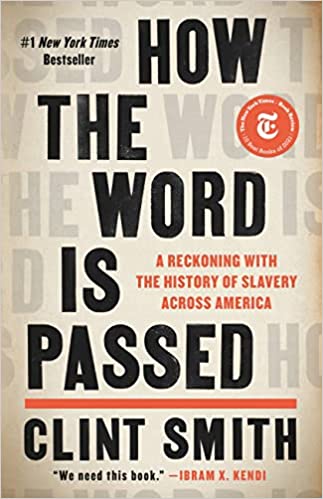
How the Word Is Passed: A Reckoning with the History of Slavery Across America

by Clint Smith

How the Word Is Passed: A Reckoning with the History of Slavery Across America by Clint Smith. This book was a gift from my son Jon. The New York Times selected How the Word is Passed as one of the best books published this year. Beginning in his hometown of New Orleans, Clint Smith leads the reader on an unforgettable tour of monuments and landmarks—those that are honest about the past and those that are not—that offer an intergenerational story of how slavery has been central in shaping our nation’s collective history, and ourselves.

How the Word is Passed is one of the best books I have read in 2021. I had read an excerpt in The Atlantic on the Whitney Plantation, one of the only former plantations devoted to preserving the experience of the enslaved people whose lives and work sustained it. Like most of us, I had placed the book on my to-read list, where it remained lost in the cobwebs. Fortunately, my son Jon purchased the book for me.

Secondly, the book rekindled my long-lost dream of being an American Studies professor. As soon as Jan and I met, I dropped plans to leave Brooklyn and start graduate school in the fall of 1974. I made that decision primarily because of how much I loved Jan. But it was also partly that I did not have a clear vision of what my life would be like as a professor. The book provided clear examples of people like Yvonne Holden at The Whitney Plantation redefining history to be more accurate and inclusive. I probably could not have done as well as she did, but I can now see that it might have resulted in a career for me that could have been impactful.

Goodreads provides this overview for those who still need to be convinced to read this book.

It is the story of the Monticello Plantation in Virginia, the estate where Thomas Jefferson wrote letters espousing the urgent need for liberty while enslaving over 400 people on the premises. It is the story of the Whitney Plantation, one of the only former plantations devoted to preserving the experience of the enslaved people whose lives and work sustained it. It is the story of Angola Prison in Louisiana, a former plantation named for the country from which most of its enslaved people arrived and which has since become one of the most gruesome maximum-security prisons in the world. And it is the story of Blandford Cemetery, the final resting place of tens of thousands of Confederate soldiers.

In a deeply researched and transporting exploration of the legacy of slavery and its imprint on centuries of American history, How the Word Is Passed illustrates how some of our country’s most essential stories are hidden in plain view-whether in places we might drive by on our way to work, holidays such as Juneteenth, or entire neighborhoods—like downtown Manhattan—on which the brutal history of the trade in enslaved men, women and children has been deeply imprinted.

Informed by scholarship and brought alive by the story of people living today, Clint Smith’s debut work of nonfiction is a landmark work of reflection and insight that offers a new understanding of the hopeful role that memory and history can play in understanding our country.

How the Word is Passed is one of the best books I have read this year and many prior ones. I encourage you to read it and share your comments.

Subscribe

Contact Us

When you buy a book or product using a link on this page, I receive a commission. Thank you for supporting Sharing Jan’s Love blog.

×
Breathe

Read: September 2021

Get this book

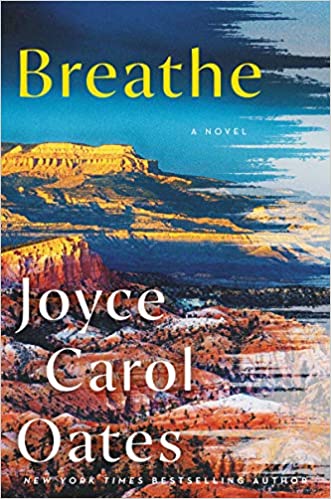
Breathe

by Joyce Carol Oates

Celebrate JanReading Breathe by Joyce Carol Oates was a book I knew I needed to read once Jan was diagnosed. Although the book might trigger negative memories, I finally read Breathe. It was what I needed to read at this point in my journey.

Ms. Oates wrote the book in 2019 after her husband, Charlie Gross, died. The novel is a story of love, loss, and loneliness, topics that I write about on this blog. I needed to read the book both for my mental health and for the readers of Sharing Jan’s Love.

The protagonist, Michaela, loses her husband while they are on a sabbatical in New Mexico. Her husband, Gerard, writes a book and teaches a class on memories. Jan and I never considered relocating before her illness, but this book convinced me that it would have aggravated my grief journey.

One of the parallels I observed while reading the novel is the similarity between Gerard’s reluctance to let family, friends, and co-workers know of his illness. Jan shared that reluctance in the early days, but I convinced her that the only chance of beating cancer was with the help of family and friends.

This dialogue could easily be one that Jan and I had.

Of course you want to summon his family—his (adult) children—but quickly, he says no.

Still waiting.

But – When?

Just not yet.

He is not an alarmist. (You are the alarmist.)

The novel is written in two parts – The Vigil and the Post-Mortem.

The opening paragraphs set the tone.

A Hand is gripping yours. Warm, dry hand gripping your slippery, humid hand.

Whoever it is urging you – Breathe!

Leaning over you begging you – Breathe!

As one mourning the death of the love of his life, I found several phrases in the book helpful in understanding what I have gone through and will continue to confront.

Among them is grief-vise, which I have written about in this stream.

In the grip of the grief vise, all that you will do, all that you even imagine doing, will require many times more effort.. Hardly daring to breathe for the grief-vise will tighten around your chest, squeezing the very air out of your lungs.

In the early stages of grief, the vise was strangling me. Breathing was impossible, and weeping was constant at times.

Michaela struggles with her grief. Seeing her husband every time she sees a man alone, even if they are older or younger than he was. I know I have felt Jan’s presence and still expect her to walk into our apartment.

Her struggles with a grief counselor and overly helpful friends are an experience I have not had but are familiar to those suffering from losing a loved one.

The last chapters are ones in which time becomes confusing and chaotic. At times, I was uncertain about which were real or imagined. The end, like all good novels, was ambiguous.

These are some of the other phrases I have found useful and will include in posts.

  • If there is no one to love, do we merit existence?
  • Never come to the end of kissing.
  • The first principle of life is; Breathe.
  • Shy in the language of intimacy.
  • As if a life lived with strangers could compensate for the emptiness in your heart.
  • No purpose in your life. No compass.

What you love most, that you will lose. The price of your love is your loss.

I recommend this book to all readers, even those struggling with grief.

Subscribe

Contact Us

When you buy a book or product using a link on this page, I receive a commission. Thank you for supporting Sharing Jan’s Love blog.

×
Small Things Like These

Read: July 2024

Get this book

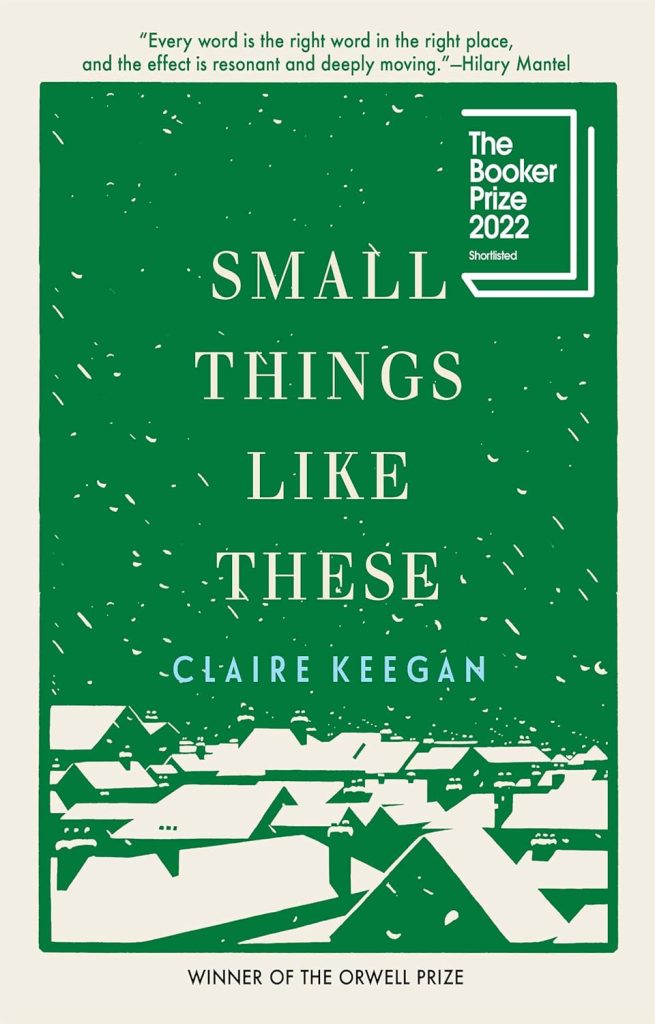
Small Things Like These

by Claire Keegan

Today, I read “Small Things Like These” by Claire Keegan, one of the New York Times’s 100 Best Books of the 21st Century, and the seventeenth book I have read from that list. “Small Things Like These” is award-winning author Claire Keegan‘s landmark new novel, a tale of one man’s courage and a remarkable portrait of love and family.

The story is set in 1985 in a small Irish town. During the weeks leading up to Christmas, Bill Furlong, a coal merchant and family man, faces his busiest season. Early one morning, while delivering an order to the local convent, Bill makes a discovery that forces him to confront his past and the complicit silences of a town controlled by the church.

I found this short but well-written novel very impactful. The following quote explains the powerful impact of the need for meaning and purpose in our lives as Furlong walks in the snow after taking action after bringing home a young girl from a Magdalen laundry. How often can we ignore the small things like these and still look ourselves in the mirror?

“As they carried on along and met more people Furlong did and did not know, he found himself asking was there any point in being alive without helping one another? Was it possible to carry on along through all the years, the decades, through an entire life, without once being brave enough to go against what was there and yet call yourself a Christian, and face yourself in the mirror?”

As an international bestseller, ‘Small Things Like These‘ is a profoundly moving story of hope and quiet heroism. It’s a narrative that will make you admire the characters and stir your empathy, all crafted by one of our most critically acclaimed and iconic writers. The characters in the story are so relatable that you will feel understood and deeply invested in their journey.

×
The Wilderness

Read: October 2025

Get this book

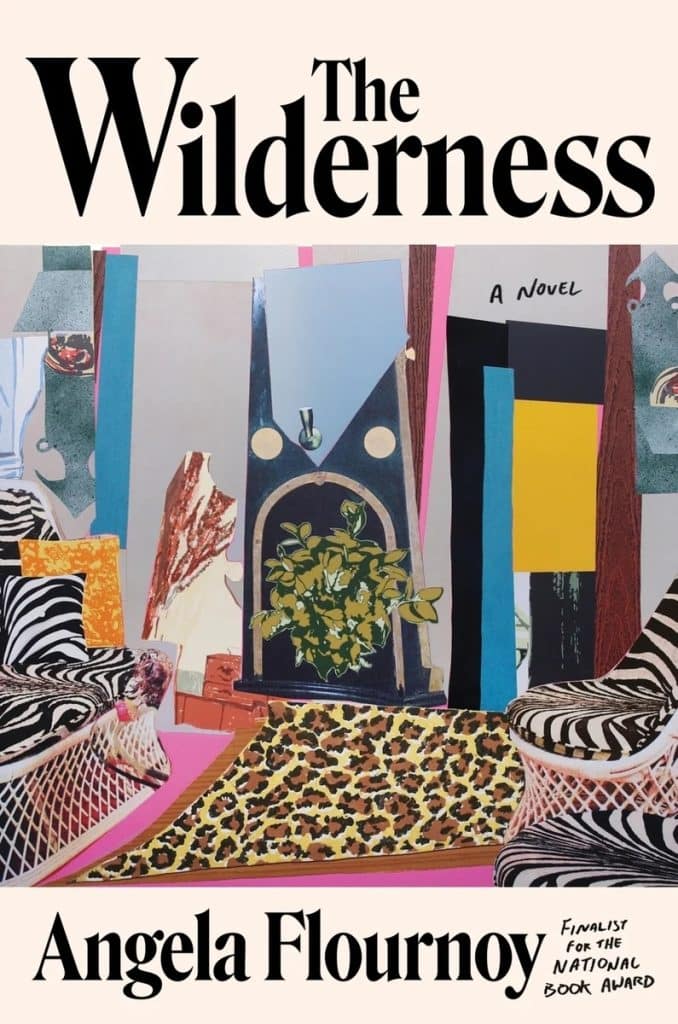
The Wilderness: A Novel

by Angela Flournoy

The Wilderness” by Angela Flournoy is a remarkable and multifaceted follow-up to her critically acclaimed debut, “The Turner House.” A true talent, Flournoy skillfully captures how five women form deep, lasting connections over a lifetime, often reflecting the complex and uncertain nature of friendship, with sharp wit and vibrant language. The book is a finalist for the 2025 Kirkus Prize for Fiction and longlisted for the 2025 National Book Award for Fiction.

This era-defining novel centers on the lives of five Black women as they navigate their twenty-year friendship, moving through the dizzying and sometimes precarious transition from young adulthood to midlife. It is a highly anticipated second book from National Book Award finalist Angela Flournoy.

Desiree, Danielle, January, Monique, and Nakia are all in their early twenties, beginning their careers, marriages, and motherhood, while also settling into their big-city lives in New York and Los Angeles. Together, they are finding their path through the wilderness—an overwhelming, mysterious period of life filled with both freedom and consequences.

Desiree and Danielle, sisters whose shared history has only deepened their estrangement, cope with painful family wounds in different ways. January finds herself in a relationship with a “good” man but feels ambivalent about him, especially following her unexpected pregnancy. Monique, a librarian and aspiring blogger, unexpectedly gains online fame after calling out her university for its plans to whitewash its complicated history. Meanwhile, Nakia is striving to establish her restaurant without relying on her upper-middle-class family, who question whether she should pursue a more conventional career.

As these friends transition from the late 2000s into the late 2020s, evolving from young adults into grown women, they must discover what they mean to each other amid political upheaval, economic and environmental instability, and the increasing volatility of modern American life.


Angela Flournoy is the author of “The Turner House“, which was a finalist for the National Book Award, the Center for Fiction First Novel Prize, and selected as a Barnes & Noble Discover Great New Writers choice. It was also an Indie Next pick and recognized as a New York Times Notable Book of the Year.

Her fiction has appeared in The Paris Review, and she has written for The New York Times, The New Yorker, the Los Angeles Times, and other publications.

A graduate of the Iowa Writers’ Workshop, Flournoy has taught at the University of Iowa, Princeton University, and UCLA. She currently lives in New York.


Discover your next favorite book and dive into a world of curated, exciting reads by purchasing through my links. You’ll have access to a diverse selection of books that I’ve personally vetted to ensure quality and enjoyment. Additionally, by supporting these selections, you’ll help me continue to provide you with more personalized recommendations. I earn a small commission from your purchase, which allows me to buy and share even more books with you. Your support truly makes a difference!


×