New Book: Black Sun

Estimated reading time: 0 minutes, 0 seconds
Black Sun

Black Sun

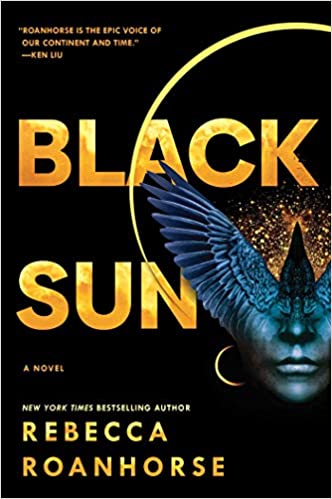
Black Sun by Rebecca Roanhorse.  Black Sun is the first book in the Between Earth and Sky trilogy, inspired by the civilizations of the Pre-Columbian Americas and woven into a tale of celestial prophecies, political intrigue, and forbidden magic.

Read book review Get this book All books

Share your thoughts and ideas

This site uses Akismet to reduce spam. Learn how your comment data is processed.

The Jan Lilien Education Fund!

Black Sun

Read: November 2021

Get this book

Black Sun – Between the Earth and Sky

by Rebecca Roanhorse

Black Sun by Rebecca Roanhorse.  Black Sun is the first book in the Between Earth and Sky trilogy, inspired by the civilizations of the Pre-Columbian Americas and woven into a tale of celestial prophecies, political intrigue, and forbidden magic.

I have always enjoyed fantasy novels like Black Sun, and this is the first one set in the Pre-Columbian Americas.

A god will return
When the earth and sky converge
Under the black sun

In the holy city of Tova, the winter solstice is usually a time for celebration and renewal, but this year, it coincides with a solar eclipse, a rare celestial event proscribed by the Sun Priest as an unbalancing of the world.

Meanwhile, a ship launches from a distant city bound for Tova and set to arrive on the solstice. The captain of the ship, Xiala, is a disgraced Teek whose song can calm the waters around her as quickly as it can warp a man’s mind. Her ship carries one passenger. Described as harmless, the passenger, Serapio, is a young man, blind, scarred, and cloaked in destiny. As Xiala well knows, when a man is described as harmless, he usually ends up being a villain.

Will Serapio be harmless or a villain? The answer, my friend, will be known when you read this book or perhaps the second one in the trilogy.

Before meeting and falling forever in love with Jan, I had dreamed of the life of an American Studies professor. Thousands of students are relieved to know I did not pursue that life. If I had opened that door, an area of focus would have been on Pre-Columbian Americas.

I recommend this book and will read the next two in the Between Earth and Sky trilogy.

Subscribe

Contact Us

When you buy a book or product using a link on this page, I receive a commission. Thank you for supporting Sharing Jan’s Love blog.

×
The White Hot

Read: November 2025

Get this book

The White Hot: A Novel

by Quiara Alegría Hudes

The White Hot” by Quiara Alegría Hudes is a letter from a mother to her daughter, reflecting on a moment of abandonment that stretches from ten days to ten years. It offers an explanation rather than an apology. Hudes tells April’s story—spiritual and sensual, fierce and humorous—using delicate lyricism and tough love. Through this narrative, Hudes transforms April’s struggle for self-discovery into an unforgettable short epic.

April is a young mother raising her daughter in a multigenerational home filled with unspoken secrets and loud arguments. Her only refuge is the locked bathroom, where she plugs her ears into an ambient soundscape and repeats a mantra: “dead inside.” This continues until one day, as she feels herself spiraling toward the volcanic rage she calls “the white hot,” an inner voice tells her to simply walk away.

She goes to a bus station and asks for a one-way ticket to the furthest destination. This ticket takes her from her Philadelphia home to the threshold of a wilderness, marking the start of a nameless quest—an accidental journey that awakens her, nearly kills her, and leads her to an impossible choice.

As April discovers the key to freeing herself and her family from a cycle of generational trauma through her painful and absurd journey,


Quiara Alegría Hudes is a Pulitzer Prize-winning playwright known for her plays “Water by the Spoonful” and “In the Heights,” the latter of which won the Tony Award for Best Musical. She also adapted this musical for the screen.

Her memoir, “My Broken Language,” was longlisted for the Andrew Carnegie Medal. Hudes has written essays published in prominent outlets, including The New York Times, The Washington Post, The Cut, The Nation, and American Theater Magazine. Additionally, she co-founded the prison writing program Emancipated Stories with her cousin Sean.


Discover your next favorite book and dive into a world of curated, exciting reads by purchasing through my links. You’ll have access to a diverse selection of books that I’ve personally vetted to ensure quality and enjoyment. Additionally, by supporting these selections, you’ll help me continue to provide you with more personalized recommendations. I earn a small commission from your purchase, which allows me to buy and share even more books with you. Your support truly makes a difference!


×
Tenth of December: Stories

Read: July 2024

Get this book

Tenth of December: Stories

by George Saunders

One of the most important and blazingly original writers of his generation, George Saunders, is an undisputed master of the short story. The Tenth of December is his most honest, accessible, and moving collection yet. It is one of the New York Times’ 100 Best Books of the Century. The book is structured as a collection of short stories, each offering a unique and compelling narrative.

In the taut opener, “Victory Lap,” a boy witnesses the attempted abduction of the girl next door and is faced with a harrowing choice: Does he ignore what he sees or override years of smothering advice from his parents and act?

In “Home,” a combat-damaged soldier moves back in with his mother and struggles to reconcile the world he left behind with the one he has returned to.

In the title story, a stunning meditation on imagination, memory, and loss, a middle-aged cancer patient walks into the woods to commit suicide, only to encounter a troubled young boy who, throughout a fateful morning, gives the dying man a final chance to recall who he is.

An unfortunate, deluded owner of an antique store; two mothers struggling to do the right thing; a teenage girl whose idealism is challenged by a brutal brush with reality; a man tormented by a series of pharmaceutical experiments that force him to lust, to love, to kill—the unforgettable characters that populate the pages of Tenth of December are vividly and lovingly infused with Saunders’s signature blend of exuberant prose, deep humanity, and stylistic innovation.

Writing brilliantly and profoundly about class, sex, love, loss, work, despair, and war, Saunders cuts to the core of the contemporary experience. These stories take on the big questions and explore the fault lines of our morality, delving into what makes us suitable and what makes us human. They are not just stories but profound explorations that will stimulate your intellect and make you ponder.

Unsettling, insightful, and hilarious, the stories in Tenth of December—through their manic energy, their focus on what is redeemable in human beings, and their generosity of spirit—not only entertain and delight but also fulfill Chekhov’s dictum that art should “prepare us for tenderness.” The humor in these stories will keep you entertained and laughing, even as they delve into profound themes.


George Saunders is the author of thirteen books, including the novel Lincoln in the Bardo, which won the Booker Prize, and five collections of stories, including Tenth of December, which was a finalist for the National Book Award, and the recent collection Liberation Day (selected by former President Obama as one of his ten favorite books of 2022).

Three of Saunders’s books—Pastoralia, Tenth of December, and Lincoln in the Bardo—were chosen for The New York Times’s list of the 100 Best Books of the 21st Century. Saunders hosts the popular Story Club on Substack, which grew out of his book, A Swim in a Pond in the Rain. In 2013, he was named one of Time’s 100 Most Influential People. He teaches in the creative writing program at Syracuse University.


When you purchase a book through one of my links, I earn a small commission that helps support my passion for reading. This contribution allows me to buy even more books to share with you, creating an incredible cycle of discovering great reads together! Your support truly makes a difference!


×
Dogs and Monsters: Stories

Read: October 2024

Get this book

Dogs and Monsters: Stories

by Mark Haddon

Today, I started reading Dogs and Monsters: Stories by Mark Haddon. The collection features eight captivating and imaginative stories that blend Greek myths with contemporary dystopian narratives. The stories explore themes of mortality, moral choices, and various forms of love, including romantic, familial, and self-love. Haddon’s clear-eyed vision is infused with deep empathy.

In addition, Haddon’s fluid prose showcases his remarkable powers of observation, both of the physical world and the inner workings of the human psyche. Greek myths have fascinated people for millennia with their timeless appeal and enduring lessons about fate, hubris, and life’s uncertainties. In Dogs and Monsters: Stories, Mark Haddon delves into the heart of these ancient fables and presents them in a fresh light. For instance, in one story, the dawn goddess Eos requests that Zeus grant her lover Tithonus eternal life but forgets to ask for eternal youth. In “The Quiet Limit of the World,” Haddon imagines Tithonus’s life as he ages over thousands of years, transforming this cautionary tale about tempting the gods into a spellbinding meditation on observing death from the outside. This tale ultimately explores how carnal love evolves into something more profound and poignant over time.

In “The Mother‘s Story,” Haddon reinterprets the myth of the Minotaur, born of the monstrous lust of King Minos’s wife, Pasiphaë. He turns it into a heartbreaking parable of a mother’s love for a damaged child and the more tangible monstrosities of patriarchy. In “D.O.G.Z.,” the story of Actaeon, who was transformed into a stag after glimpsing the naked goddess Diana and was subsequently torn apart by his hunting dogs, becomes a visceral metaphor for the continuum of human and animal behavior.

Other stories in Dogs and Monsters: Stories play with contemporary mythic tropes—such as genetic engineering, attempts to escape the future, and the cruelty of adolescent ostracism. These stories showcase how modern humans are subject to the same capriciousness that concerned the Greeks but in a fresh and intriguing light. Haddon‘s tales cover a wide range of themes, from the mythic to the domestic, from ancient Greece to the present day, and explore love alongside stories of cruelty. They take readers from battlefields to bed and breakfasts and from dogs in space to doors between worlds, all bound together by profound sympathy and an insight into how human beings think, feel, and act when pushed to their limits.

×
Borscht Belt Boy: Recollections of a Hotel Brat

Read: January 2024

Get this book

Borscht Belt Boy

by Mark Kramer

I started reading Borscht Belt Boy: Recollections of a Hotel Brat by Mark Kramer today. The book is the story of a young man who grew up in the heyday of the Borscht Belt. The author sent me a copy when I shared my 2023 reading accomplishments. I found joy in reading his memoir as the author, and I are almost the same age.

The author, the son of a Catskills Mountain resort hotel owner, describes his experiences growing up when hotels, bungalow colonies, and sleep-away camps were booming. Learn about the characters that populated this world, from the kids who worked in the dining rooms, the handymen recruited from the Bowery, to the chefs and maitre d’s.

Enjoy the author’s humorous description of the different kinds of people who summered in the mountains. Read fascinating tales of entertainers, including Buddy Hackett and Lenny Bruce’s experiences at the family hotel. There is a brief history of Catskills’ institutions, how the influx of Jews changed the landscape, and how the resort trade influenced race, religion, and class.

This lighthearted memoir will return fond memories to those who visited the Borscht Belt in their youth and enlighten those not lucky enough to have shared this particular time and place in history.


The Jan Lilien Education Fund sponsors ongoing sustainability and environmental awareness programs. Regarding gifts made this month, I will match dollar for dollar. All donations are tax-deductible.

Subscribe

Contact Us

I receive a commission when you buy a book or product using a link on this page. Thank you for supporting Sharing Jan’s Love blog.


×
The Book of Love: A Novel

Read: March 2024

Get this book

The Book of Love: A Novel

by Kelly Link

I started reading “The Book of Love: A Novel” by Kelly Link today. The book showcases her exceptional writing skills, where she channels different forms of love, including friendships, romance, and family ties, with her trademark compassion, wit, and literary prowess. Readers can expect to experience joy, a little terror, and an affirmation that love endures despite challenges.

The story revolves around Laura, Daniel, and Mo, who mysteriously vanished from their hometown in Lovesend, Massachusetts, and were presumed dead. However, almost a year later, they find themselves in a high school classroom with their unremarkable music teacher. The teacher seems to know why they disappeared and what brought them back. They agree to undertake magical tasks to reclaim their lives, allowing them to return to their families and friends, but they can’t reveal where they’ve been. The tasks would lead to winners and losers.

Their resurrection attracts the attention of other supernatural beings with their agendas, which puts the community in danger and chaos. As Laura, Daniel, and Mo try to piece their lives together, and Laura’s sister Susannah tries to make sense of what she remembers, they must solve the mystery of their deaths to prevent a looming disaster.

The story takes place in Lovesend, where readers will experience love and loss, laughter and dread, magic, karaoke, and some delicious pizza.

×
How Democracies Die

Read: January 2021

Get this book

How Democracies Die: What History Reveals About Our Future

by Steven Levitsky and Daniel Ziblatt

How Democracies Die: What History Reveals About Our Future by Steven Levitsky and Daniel Ziblatt was on my reading list for almost a year. In late December of last year, I started reading it and was in the final chapter on January 6, 2021. Like many of us, I never in my life expected to see a day like that in our country.

This type of event is one the authors talk about in their book.

According to the overview in GoodReads,

Donald Trump’s presidency has raised a question that many of us never thought we’d be asking: Is our democracy in danger? Harvard professors Steven Levitsky and Daniel Ziblatt have spent more than twenty years studying the breakdown of democracies in Europe and Latin America, and they believe the answer is yes. Democracy no longer ends with a bang–in a revolution or military coup–but with a whimper: the slow, steady weakening of critical institutions, such as the judiciary and the press, and the gradual erosion of long-standing political norms. The good news is that there are several exit ramps on the road to authoritarianism. The bad news is that, by electing Trump, we have already passed the first one.

Drawing on decades of research and a wide range of historical and global examples, from 1930s Europe to contemporary Hungary, Turkey, and Venezuela, to the American South during Jim Crow, Levitsky and Ziblatt show how democracies die–and how ours can be saved.

Our democracy is too valuable for us to have it die. We all need to work to preserve and strengthen it. How Democracies Die is a book that everyone needs to read!

Subscribe

Contact Us

×