
Victory City: A Novel

Estimated reading time: 3 minutes, 16 seconds

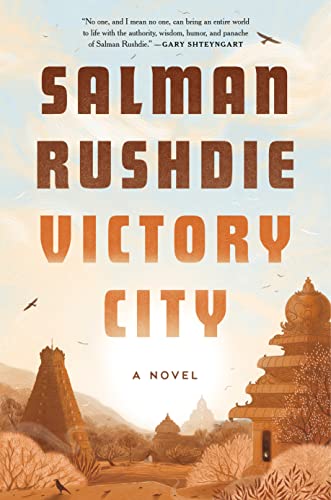
Victory City: A Novel by Salman Rushdie is an epic tale of a woman who breathes a fantastical empire into existence, only to be consumed by it over the centuries from the transcendent imagination of Booker Prize-winning, internationally bestselling author Salman Rushdie. It is well written and was a page-turner from page one to the end. I highly recommend this novel and encourage everyone to read it.

Brilliantly styled as a translation of an ancient epic, this is a saga of love, adventure, and myth that is a testament to storytelling’s power. After witnessing her mother’s death, the grief-stricken Pampa Kampana becomes a vessel for the goddess Parvati, who begins to speak out of the girl’s mouth. I was hooked when Pampa Kampana provided the seeds that created Victory City out of thin air.

David Remnick’s interview with Salman Rushdie in The New Yorker provided background I would have missed.

“The first kings of Vijayanagara announced, quite seriously, that they were descended from the moon,” Rushdie said. “So when these kings, Harihara and Bukka, announce that they’re members of the lunar dynasty, they’re associating themselves with those great heroes. It’s like saying, ‘I’ve descended from the same family as Achilles.’ Or Agamemnon. And so I thought, Well, if you could say that, I can say anything.”

Above all, the book is buoyed by the character of Pampa Kampana, who, Rushdie says, “just showed up in my head” and gave him his story, his sense of direction. Rushdie’s pleasure in writing the novel was in “world building” and, at the same time, writing about a character building that world: “It’s me doing it, but it’s also her doing it.” The pleasure is infectious. “Victory City” is an immensely enjoyable novel. It is also an affirmation. At the end, with the great city in ruins, what is left is not the storyteller but her words:

I, Pampa Kampana, am the author of this book.
I have lived to see an empire rise and fall.
How are they remembered now, these kings, these queens?
They exist now only in words . . .
I myself am nothing now. All that remains is this city of words.
Words are the only victors.

The Goodreads summary provides a brief overview,

In the wake of an insignificant battle between two long-forgotten kingdoms in fourteenth-century southern India, a nine-year-old girl has a divine encounter that will change the course of history. After witnessing her mother’s death, the grief-stricken Pampa Kampana becomes a vessel for the goddess Parvati, who begins to speak out of the girl’s mouth. Granting her powers beyond Pampa Kampana’s comprehension, the goddess tells her that she will be instrumental in the rise of a great city called Bisnaga–literally victory city–the wonder of the world.

Over the next two hundred and fifty years, Pampa Kampana’s life becomes deeply interwoven with Bisnaga’s, from its literal sowing out of a bag of magic seeds to its tragic ruination in the most human of ways: the hubris of those in power. Whispering Bisnaga and its citizens into existence, Pampa Kampana attempts to make good on Parvati’s task: giving women equal agency in a patriarchal world. But all stories have a way of getting away from their creator, and Bisnaga is no exception. As years pass, rulers come and go, battles are won and lost, and allegiances shift, the very fabric of Bisnaga becomes an ever more complex tapestry–with Pampa Kampana at its center.


The Jan Lilien Education Fund sponsors ongoing sustainability and environmental awareness programs. Gifts made this month; I will match dollar-for-dollar. All donations are tax-deductible.

Subscribe

Contact Us

I receive a commission when you buy a book or product using a link on this page. Thank you for supporting Sharing Jan’s Love blog.


The Jan Lilien Education Fund!

The City We Became

Read: October 2021

Get this book

The City We Became: A Novel

by N. K. Jemisin

The City We Became: A Novel by N. K. Jemisin is my first science fiction and urban fantasy novel in quite some time. It is a story of culture, identity, magic, and myths in contemporary New York City. Jan and I had lived in New York City, and the book brought back fond memories.

Every great city has a soul. Some are ancient as myths, and others are as new and destructive as children.

But every City also has a dark side. A roiling, ancient evil stirs beneath the earth, threatening to destroy the City and her five protectors unless they can come together and stop it once and for all.

As Jemisin writes:

A city is never alone, not really — and this city seems less solitary than most. More like a family: many parts, frequently squabbling … but in the end, against enemies, they come together to protect one another. They must, or die.

The challenge is when evil forces threaten the City; the entire community needs to unite, and the City’s avatars for each of the five boroughs.

Initially, this is supposed to be one for each borough and one for the entire City. In the end, one of the avatars for the five boroughs chooses not to unite with the others. Without all six, they stand no chance to defeat the forces of evil.

How do they solve this? By adding the sixth borough – Jersey City.

I recommend this book without reservation.

When you buy a book or product using a link on this page, I receive a commission. Thank you for supporting Sharing Jan’s Love blog.

Subscribe

Contact Us

×
The Testaments: The Sequel to The Handmaid's Tale

Read: September 2021

Get this book

The Testaments

by Margaret Atwood

The Testaments: The Sequel to The Handmaid’s Tale by Margaret Atwood is a sequel worth reading.

The novel alternates between the perspectives of three women presented as portions of a manuscript written by one (the Ardua Hall Holograph) and testimonies by the other two. Being an amateur historian, I found this a fascinating way for Ms. Atwood to write this book.

Aunt Lydia is the author of the Ardua Hall Holograph, which is a surprise based on her role in The Handmaid’s Tale. It is a surprise that she is a mole who despises Gilead and works for the resistance.

The other characters are young women who, along with Aunt Lydia, are forced to come to terms with who she is and how far she will go for what she believes.

Agnes Jemima was born in Gilead and is being educated not to be literate but to be a wife. She finds out her parents are not who she thought they were when Agnes discovers she is the daughter of a Handmaid.

Daisy was raised in Toronto, lives with her adoptive parents, and is an educated woman. As noted in most reviews, Daisy is also the daughter of a Handmaid. She is Baby Nicole from the original book, and Gilead wants her to return.

Read the book! It is a moving and engaging sequel! The testimonies in the book combine these three women’s stories to undermine Gilead.

Subscribe

Contact Us

×
The Worst Hard Time

Read: September 2019

Get this book

The Worst Hard Time

by Timothy Egan

The Worst Hard Time: The Untold Story of Those Who Survived the Great American Dust Bowl by Timothy Egan was initially a book I selected from the e-library because nothing else I wanted to read was available. Once I started reading the book, I could not put it down.

Now that we have had the warmest summer since 1936 during the dust bowl, the book has even more meaning.

According to The New York Times,

The dust storms that terrorized the High Plains in the darkest years of the Depression were like nothing ever seen before or since. Timothy Egan’s critically acclaimed account rescues this iconic chapter of American history from the shadows in a tour de force of historical reportage. Following a dozen families and their communities through the rise and fall of the region, Egan tells of their desperate attempts to carry on through blinding black dust blizzards, crop failure, and the death of loved ones. Brilliantly capturing the terrifying drama of catastrophe, Egan does equal justice to the human characters who become his heroes, “the stoic, long-suffering men and women whose lives he opens up with urgency and respect.”

With the likelihood of more ecological catastrophes in the immediate future, this is a book I highly recommend.

Subscribe

Contact Us

×
The Annual Banquet of the Gravediggers' Guild

Read: January 2024

Get this book

The Annual Banquet of the Gravediggers’ Guild

by Mathias Énard

Today, I started reading “The Annual Banquet of the Gravediggers’ Guild” by Mathias Énard. The book has been translated into English by Frank Wynne. This novel is full of Mathias Énard‘s characteristic humor and extensive knowledge. It is a lively book where the boundaries between past and present are constantly blurred, set against a backdrop of excess reminiscent of Rabelais’ writing.

David Mazon, an anthropology student, moves from Paris to La Pierre-Saint-Christophe, a village in the marshlands of western France, to research his thesis on contemporary agrarian life. He is determined to understand the essence of the local culture and spends his time scurrying around on his moped to interview the residents.

David must be made aware of the extraordinary events in an ordinary location. This place, where wars and revolutions once occurred, is now a dancefloor for Death. When something dies, its soul is recycled by the Wheel of Life and thrown back into the world as a microbe, human, or wild animal – sometimes in the past and sometimes in the future. Once a year, Death and the living agree to a temporary truce, during which gravediggers indulge in a three-day feast filled with food, drink, and conversation.

Mathias Énard’s novel, The Annual Banquet of the Gravediggers’ Guild, is a riotous and exciting comic masterpiece that won the prestigious Prix Goncourt award. The novel is set in the French countryside and is filled with Énard’s characteristic wit and encyclopedic brilliance. Against a backdrop of excess, the story blurs the lines between past and present, creating a Rabelaisian world of chaos and humor.


The Jan Lilien Education Fund sponsors ongoing sustainability and environmental awareness programs. Gifts made this month; I will match dollar-for-dollar. All donations are tax-deductible.

Subscribe

Contact Us

I receive a commission when you buy a book or product using a link on this page. Thank you for supporting Sharing Jan’s Love blog.


×
The Human Stain: A Novel

Read: September 2024

Get this book

The Human Stain: A Novel

by Philip Roth

Today, I started reading The Human Stain: A Novel by Philip Roth. This book is considered a masterpiece and has earned its place among The New York Times’ 100 Best Books of the 21st Century. The story takes place in 1998, a significant year marked by a presidential impeachment that affected the entire nation. In a peaceful New England town, the respected classics professor Coleman Silk is forced into retirement due to false accusations of racism by his colleagues.

This accusation triggers a series of events that bring to light shocking revelations about Coleman, revelations that carry a profound societal significance. Coleman Silk harbors a secret, a secret that is not about his affair with Faunia Farley, a woman half his age with a troubled past, or the alleged racism that led to his downfall at the college where he was once a respected dean. It’s not even about misogyny, despite Professor Delphine Roux’s attempts to portray him as such. Coleman’s true secret, a secret he has guarded for fifty years from everyone in his life, including his wife, children, colleagues, and friends, is a defining aspect of his character and his relationships.

The Human Stain is a compelling portrayal of 1990s America, a time of clashing moralities and ideological divisions. Through public denunciations and rituals of purification, it delves into how the nation’s destiny and the ‘human stain’ that marks human nature shape the lives of postwar Americans. This potent and captivating novel is a fitting continuation of Philip Roth‘s earlier works, each set in a distinct historical period.

×
The Candy House

Read: December 2022

Get this book

The Candy House: A Novel

by Jennifer Egan

The Candy House: A Novel by Jennifer Egan focuses on a new technology that allows you access to every memory you’ve ever had and to share your memories in exchange for access to the memories of others—it has seduced multitudes. According to the NYTimes, “this is minimalist maximalism. As a widow, I live in a world of memories, but I would not want them shared as they are in The Candy House. “It’s as if Egan compressed a big 19th-century novel onto a flash drive.”

Of course, I am not able to access my unconscious memories. Albeit in an amateur way, I write down some of my memories as they remind me of the power of the love that Jan and I shared. For example, the essay when I met Jan rekindles the memory and attempts to tell the story the way it happened, not how some would like it to be remembered.

The Candy House is one of the NYTimes’ top five fiction books of 2022. I have read two of them, The Furrows and Checkout 19. Initially, I was overwhelmed by the multitude of characters and was confused. By the novel’s middle, their interconnectedness helped me understand its real meaning. In the end, Egan delivers a fierce and exhilarating testament to the tenacity and transcendence of human longing for authentic connection, love, family, privacy, and redemption. As a widow, authenticity Is what I need to heal.

The Candy House is the seventieth (70) book I have read this year. 

The Goodreads summary provides an overview.

It’s 2010. Staggeringly successful and brilliant tech entrepreneur Bix Bouton is desperate for a new idea. He’s forty, with four kids, and restless when he stumbles into a conversation with mostly Columbia professors, one of whom is experimenting with downloading or “externalizing” memory. Within a decade, Bix’s new technology, Own Your Unconscious—that allows you access to every memory you’ve ever had and to share every memory in exchange for access to the memories of others—has seduced multitudes. But not everyone.

In spellbinding linked narratives, Egan spins out the consequences of Own Your Unconscious through the lives of multiple characters whose paths intersect over several decades. Egan introduces these characters in an astonishing array of styles—from omniscient to first person plural to a duet of voices, an epistolary chapter, and a chapter of tweets. In the world of Egan’s spectacular imagination, there are “counters” who track and exploit desires and “eluders” who understand the price of taking a bite of the Candy House.

Intellectually dazzling and extraordinarily moving, The Candy House is a bold, brilliant imagining of a world that is moments away. With a focus on social media, gaming, and alternate worlds, you can almost experience moving among dimensions in a role-playing game.​ Egan delivers a fierce and exhilarating testament to the tenacity and transcendence of human longing for real connection, love, family, privacy, and redemption.


The Jan Lilien Education Fund sponsors ongoing sustainability and environmental awareness programs. Gifts made this month; I will match dollar-for-dollar. All donations are tax-deductible.

Subscribe

Contact Us

I receive a commission when you buy a book or product using a link on this page. Thank you for supporting Sharing Jan’s Love blog.


×