
I See a Ghost!

Estimated reading time: 14 minutes, 44 seconds

VISTA House

“Do you need help with your suitcase,” asked Barbara, one of my fellow VISTAs. “I’ve got it,” I responded. t was the last day of February 1972, and the six new volunteers and I moved into the VISTA House, which included former volunteers and others working in the community. “With Mark, Doug, Peter, Linda, Barbara, and I were probably moving into the most affordable rental in NYC. Ten dollars a month covered utilities and a once-a-month dinner party. The only extra cost was for phone calls. 

As Barbara and I worked our way up the stairs, we met Linda, another VISTA on the second floor. 

“I want to thank both of you for helping me get the room on this floor at the back,” I conveyed my heartfelt appreciation to them.

We were happy to help. Mark thinks he has the right to whatever he wants.” Linda responded. 

“He is so macho. Richard, I wish more guys were like you,” added Barbara.

The week before we moved in, we visited the VISTA House. Both of them had been with me when I claimed the room. Mark, according to them, had walked in after I left and claimed he wanted that room. 

I am an average guy, and I appreciate your support.”

“No, you are special. You do not hit on us. You respect us as equals,” said Barbara.

“Mark wanted that room and the two of us in rooms close to him,” said Linda.

“Not happening…”

If he wasn’t hitting on us all the time and acting like he was God’s gift to women, he might get lucky.

“Not with me!”

“Or me!”

“Richard, your girlfriend is fortunate to have a man like you.”

“Yes, she is fortunate to have you! I do hope we can meet her.

All I could do was mumble thanks, and yes, I hope you can meet her. I had not told them she had broken up with me.

I thanked them again as I moved my limited possessions into my bedroom. 

The bedrooms were more oversized than I had expected. But then I remembered that this had been the nurse’s residence for the closed St. Catherine Hospital. Nurses needed space to live and relax when not on duty. 

The City of NY was planning to build a high school on the site, but a lack of funding had stalled those plans. Until the City opened the school, we could live here. 

When I finished unpacking, I looked around and remembered McClure House, my last college residence. It was also an old house where I had many friends,

It will work, I said to myself. It would be perfect if only the woman I still loved were here. As painful as it was, I had to remind myself that she had dumped me. 


Next Page

Pages: 1 2 3 4 5

5 comments add your comment

Share your thoughts and ideas

This site uses Akismet to reduce spam. Learn how your comment data is processed.

Previous Post:

Next Post:

The Jan Lilien Education Fund!

How Democracies Die

Read: January 2021

Get this book

How Democracies Die: What History Reveals About Our Future

by Steven Levitsky and Daniel Ziblatt

How Democracies Die: What History Reveals About Our Future by Steven Levitsky and Daniel Ziblatt was on my reading list for almost a year. In late December of last year, I started reading it and was in the final chapter on January 6, 2021. Like many of us, I never in my life expected to see a day like that in our country.

This type of event is one the authors talk about in their book.

According to the overview in GoodReads,

Donald Trump’s presidency has raised a question that many of us never thought we’d be asking: Is our democracy in danger? Harvard professors Steven Levitsky and Daniel Ziblatt have spent more than twenty years studying the breakdown of democracies in Europe and Latin America, and they believe the answer is yes. Democracy no longer ends with a bang–in a revolution or military coup–but with a whimper: the slow, steady weakening of critical institutions, such as the judiciary and the press, and the gradual erosion of long-standing political norms. The good news is that there are several exit ramps on the road to authoritarianism. The bad news is that, by electing Trump, we have already passed the first one.

Drawing on decades of research and a wide range of historical and global examples, from 1930s Europe to contemporary Hungary, Turkey, and Venezuela, to the American South during Jim Crow, Levitsky and Ziblatt show how democracies die–and how ours can be saved.

Our democracy is too valuable for us to have it die. We all need to work to preserve and strengthen it. How Democracies Die is a book that everyone needs to read!

Subscribe

Contact Us

×
The Secrets we Left Behind

Read: March 2022

Get this book

The Secrets We Left Behind

The Secrets We Left Behind by Soraya M. Lane is a historical fiction that raises the question, where were the women after Dunkirk and the fall of France? When World War II appeared to have been lost with a Nazi victory. Ms. Lane watched the movie Dunkirk and then researched that time and the women’s possible roles during that difficult moment in history.

She connected the evacuation at Dunkirk to the Massacre at Le Paradis, fifty miles away, to connect a British nurse and two French women whose strength helps them survive Nazi-occupied France. Three British male soldiers, two of whom survived the massacre and one who escaped Dunkirk, have secondary roles in the novel. 

The Secrets We Left Behind is the story of the three strong women and their efforts to survive the occupation while hiding the three soldiers. This focus on the role of women has been long overdue in history. Ms. Lane, who studied to be a lawyer, has found a career as a writer. The Secrets We Left Behind is the first book I have read, but it will not be the last one by Ms. Lane that I read.

I strongly recommend this book!

The Goodreads synopsis provides an overview of the novel.

How far will they go for family, friendship, and love? Occupied France, 1940. When the staff at a field hospital draw straws to find out who will join the evacuation from Dunkirk, Nurse Cate is left behind. But when the Nazis arrive to claim prisoners of war, she takes her chance and flees into the night, taking one patient with her.

Fifty miles away, the surrendering soldiers of the Royal Norfolk Regiment are shot dead by the advancing Germans. Beneath the pile of bodies, two men survive, crawling to the safety of a nearby farmhouse, where sisters Elise and Adelaide risk their lives to take them in. When Cate, too, arrives at their door with her injured soldier, the pressure mounts.

The sisters are risking everything to keep their visitors safe. But with the Nazis coming ever closer and relationships in the farmhouse intensifying, they must all question the sacrifices they are willing to make for the lives of others. How far will they go for family, friendship, and love?

Register to Attend Celebrate Jan Day

Subscribe

Contact Us

When you buy a book or product using a link on this page, I receive a commission. Thank you for supporting Sharing Jan’s Love blog.

×
The Hidden Habits of Genius

Read: September 2019

Get this book

The Hidden Habits of Genius

by Craig Wright

The Hidden Habits of Genius: Beyond Talent, IQ, and Grit―Unlocking the Secrets of Greatness by Craig Wright, Ph.D., I got through my membership in One Day University.

Dr. Wright raises many important questions as he analyses fourteen (14) critical traits of genius. Professor Craig Wright, creator of Yale University’s famous “Genius Course,” explores what we can learn from brilliant minds that have changed the world.

What we often presume about a genius does not match reality. Among other interesting observations, Dr. Wright reminds the reader that Picasso could not pass a fourth-grade math test, and Steve Jobs’s high school GPA was 2.65. He questions why to teach children to behave and play by the rules when transformative geniuses do not.

Examining the lives of transformative individuals ranging from Charles Darwin and Marie Curie to Leonardo Da Vinci and Andy Warhol to Toni Morrison and Elon Musk, Wright identifies more than a dozen drivers of genius, characteristics and patterns of behavior common to great minds throughout history. He argues that genius is about more than intellect and work ethic and that the famed “eureka” moment is a Hollywood fiction. Brilliant insights that change the world are never sudden, but rather, they are the result of unique modes of thinking and lengthy gestation.

I found the book to be a fascinating read and raised more questions for future thought and reading. Professor Wright argues that the habits of mind that produce great thinking and discovery can be actively learned and cultivated. In the book, he explains how. He notes that reading the book will not make you a genius but can “make you more strategic, creative, and successful, and, ultimately, happier.

Subscribe

Contact Us

×
We Do Not Part

Read: March 2025

Get this book

We Do Not Part: A Novel

by Han Kang

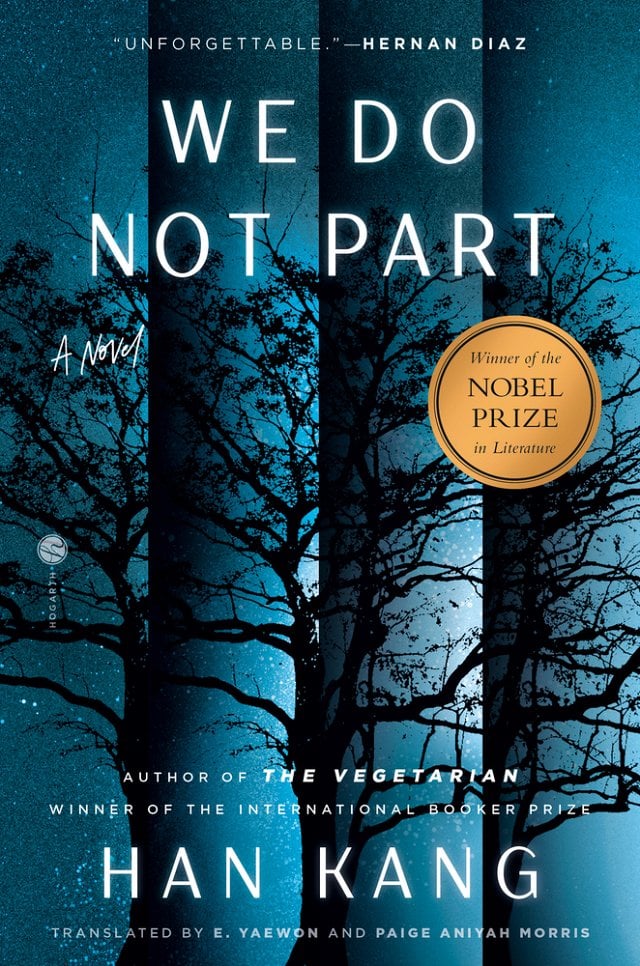
Today, I explored “We Do Not Part,” the latest novel by Han Kang, the 2024 Nobel Prize in Literature laureate. Translated by the talented e. yaewon and Paige Aniyah Morris, this book offers a remarkable journey. The New York Times has called it Kang’s most revealing work since her acclaimed novel, “The Vegetarian.” What captivates me the most is how it intricately weaves the story of two women’s friendship while shedding light on a hidden chapter of Korean history.

One winter morning, Kyungha receives an urgent message from her friend Inseon, asking her to visit a hospital in Seoul. Inseon has injured herself in an accident and begs Kyungha to return to Jeju Island, where she lives, to save her beloved pet—a white bird named Ama. A snowstorm hits the island when Kyungha arrives. At all costs, she must reach Inseon’s house, but the icy wind and blizzards slow her down as night falls. She wonders if she will arrive in time to save the animal—or even survive the terrible cold that envelops her with every step. Lost in a world of snow, she does not yet suspect the vertiginous plunge into darkness that awaits her at her friend’s house.

Blurring the boundaries between dream and reality, “We Do Not Part” powerfully illuminates a forgotten chapter of Korean history buried for decades, bringing to light the lost voices of the past to prevent them from fading into oblivion. It is both a tribute to enduring friendship and a plea for remembrance. The novel tells a story of profound love in the face of unspeakable violence and celebrates life, however fragile.


Han Kang was born in 1970 in South Korea. She is the author of The Vegetarian, which I have read, and winner of the International Booker Prize,  Human ActsThe White BookGreek Lessons, and We Do Not Part. In 2024, she received the Nobel Prize in Literature.

e. yaewon is based in Korea and translates from and into Korean, including titles by Hwang Jungeun, Deborah Levy, and Samuel Beckett.

Paige Aniyah Morris divides her time between the United States and Korea. Recent translations include works by Pak Kyongni, Ji-min Lee, and Chang Kang-myoung.


When you purchase a book through one of my links, I earn a small commission that helps support my passion for reading. This contribution allows me to buy even more books to share with you, creating an incredible cycle of discovering great reads together! Your support truly makes a difference!


×
The Covenant of Water

Read: December 2023

Get this book

The Covenant of Water

by Abraham Verghese

Today, I began reading The Covenant of Water, the long-awaited new novel by Abraham Verghese, the author of the significant word-of-mouth bestseller Cutting for Stone, which has sold over 1.5 million copies in the United States alone and remained on the New York Times bestseller list for over two years. The Covenant of Water was a holiday gift from Mike, Elyssa, Nick, and Wes.

From 1900 to 1977, The Covenant of Water is set in Kerala, on South India’s Malabar Coast. It follows three generations of a family that suffers a peculiar affliction: in every generation, at least one person dies by drowning—and in Kerala, water is everywhere. At the turn of the century, a twelve-year-old girl from Kerala’s long-existing Christian community, grieving the death of her father, is sent by boat to her wedding, where she will meet her forty-year-old husband for the first time. From this unforgettable new beginning, the young girl—and future matriarch, known as Big Ammachi—will witness unthinkable changes throughout her extraordinary life, full of joy and triumph as well as hardship and loss, her faith and love the only constants.

A shimmering evocation of a bygone India and of the passage of time itself, The Covenant of Water is a hymn to progress in medicine and human understanding and a humbling testament to the difficulties undergone by past generations for the sake of those alive today. It is one of the most masterful literary novels published in recent years.


The Jan Lilien Education Fund sponsors ongoing sustainability and environmental awareness programs. Regarding gifts made this month, I will match dollar for dollar. All donations are tax-deductible.

Subscribe

Contact Us

I receive a commission when you buy a book or product using a link on this page. Thank you for supporting Sharing Jan’s Love blog.


×
When She Woke

Read: August 2022

Get this book

When She Woke

by Hillary Jordan

When She Woke, a fable about a stigmatized woman struggling to navigate an America of a not-too-distant future by Hillary Jordan, Bellwether Prize WinnerHannah Payne, the protagonist, embarks on a path of self-discovery that forces her to question the values she once held and the righteousness of a country that politicizes faith. The premise of When She Woke seems to be happening as I read the novel. It is also the one hundred books I have read since the beginning of 2019 and the forty-fifth this year.

Hannah Payne, like Hester Prynne, is attacked for her actions by extreme religious beliefs. Instead of wearing a scarlet letter, Hannah’s chroming (i.e., having her skin altered) makes her skin red from head to toe. The chroming might have been a good theme for a science fiction novel. Still, Ms. Jordan has written a captivating book in which Hannah confronts who she is and, after questioning the values she once had, discovers that Hannah is more vital than she believed she could be.

I highly recommend this novel.

As Ms. Jordan describes the book,

Hannah Payne’s life has been devoted to church and family. But after she’s convicted of murder, she awakens to a nightmare: she finds herself lying on a table in a solitary confinement cell, her skin turned bright red. Cameras are broadcasting her every move to millions at home, for whom observing newly made “Chromes”—criminals whose skin color has been genetically altered to reflect their crime—is a sinister form of entertainment. Hannah is a Red, a murderess. The victim, says the state of Texas, was her unborn child, and she’s determined to protect the identity of the father, a public figure with whom she shared a fierce and forbidden love.

A powerful reimagining of The Scarlet Letter, When She Woke is a timely fable about a stigmatized woman struggling to navigate a dystopian America. In this not-too-distant future, the line between church and state has been eradicated and convicted felons are no longer imprisoned, but “chromed” and released back into the population to survive as best they can.

As she seeks a path to safety in an alien and hostile world, Hannah unknowingly embarks on a journey of self-discovery that forces her to question the values she once held true and the righteousness of a country that politicizes faith and love.


The Jan Lilien Education Fund sponsors ongoing sustainability and environmental awareness programs. All donations are tax-deductible.

Subscribe

Contact Us

I receive a commission when you buy a book or product using a link on this page. Thank you for supporting Sharing Jan’s Love blog.

×

Discover more from Sharing Jan’s Love

Subscribe now to keep reading and get access to the full archive.

Continue reading