
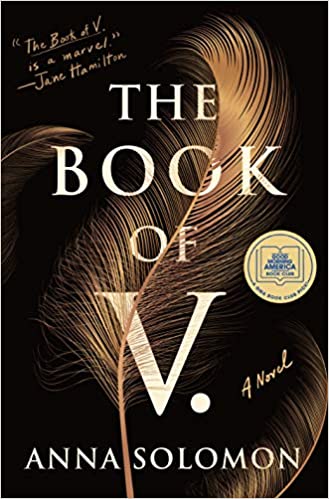
The Book of V

Estimated reading time: 1 minute, 39 seconds

The Book of V by Anna Solomon is a book that I may not have read at another time in my life, and I did find it to be a book that I could not stop reading.

Goodreads summarizes its plot.

Anna Solomon’s kaleidoscopic novel intertwines the lives of a Brooklyn mother in 2016, a senator’s wife in 1970s Washington, D.C., and the Bible’s Queen Esther, whose stories of sex, power and desire overlap and ultimately converge—showing how women’s roles have and have not changed over thousands of years.

Being Jewish, I knew the story of Queen Esther, although this version added new layers of the story that I did not know. The book’s illumination that women’s roles have not changed over thousands of years was something I knew but did not fully understand.

The three characters are very vivid and weave a story that is worth reading.

Lily is a mother and a daughter. And a second wife. And a writer, maybe? Or she was going to be, before she had children. Now, in her rented Brooklyn apartment, she’s grappling with her sexual and intellectual desires while also trying to manage her roles as a mother and a wife.

Vivian Barr seems to be the perfect political wife, dedicated to helping her charismatic and ambitious husband find success in Watergate-era Washington D.C. But one night he demands a humiliating favor, and her refusal to obey changes the course of her life—along with the lives of others.

Esther is a fiercely independent young woman in ancient Persia, where she and her uncle’s tribe live a tenuous existence outside the palace walls. When an innocent mistake results in devastating consequences for her people, she is offered up as a sacrifice to please the king, in the hopes that she will save them all.

I recommend this book.

Subscribe

Contact Us

The Jan Lilien Education Fund!

Worry: A Novel

Read: May 2024

Get this book

Worry: A Novel

by Alexandra Tanner

Today, I began reading Alexandra Tanner‘s debut novel, Worry: A Novel. The New Yorker praised it as “dryly witty,” The New York Times Book Review called it “fabulously revealing.” The story follows two siblings-turned-roommates who try to navigate an absurd world on the verge of calamity. It explores existentialism and sisterhood in a Seinfeldian style.

In March 2019, Jules Gold, a 28-year-old woman, felt anxious, frustrated with her art, and addicted to the internet. She lives alone in the apartment she used to share with her ex-fiancé. Her younger sister Poppy unexpectedly comes to stay with her indefinitely. Poppy, who attempted suicide a year and a half ago, is looking for work and purpose in Brooklyn. Meanwhile, Jules spends her days scrolling through the feeds of Mormon mommy bloggers and waiting for something to happen in her life.

Poppy’s hives, which she has had since childhood, flare up again. Jules has health problems with her uterus. Poppy adopts a poorly behaved-rescue dog named Amy Klobuchar. Poppy’s mother, who recently became a devout Messianic Jew, starts believing in the same deep-state conspiracy theories as Jules’ online mommies. Jules half-heartedly tries to find the source of her ennui and cruelly blames Poppy for not being a good enough friend, writer, or sister. As the year progresses and a new decade approaches, a disastrous trip back to Florida forces Jules and Poppy to question their futures and whether they want to spend them together or apart.

Worry is a darkly funny and deadpan portrayal of two sisters struggling through anxiety and uncertainty in America. A bold new voice in contemporary fiction writes it.

×
Do You Remember Being Born?: A Novel

Read: September 2023

Get this book

Do You Remember Being Born?

by Sean Michaels

I started reading “Do You Remember Being Born?” by Sean Michaels, a writer who won the Scotiabank Giller Prize. The novel is about an aging poet named Marian Ffarmer, a legend in the world of poetry. However, despite her success, she struggles with financial issues and her son’s inability to buy a house. Marian has sacrificed her personal relationships and happiness to pursue her career but questions whether it is worth it.

One day, she receives an invitation from a Tech Company to travel to California and work with their poetry AI, Charlotte. The company wants her to co-author a poem with their bot in a historic partnership, which clashes with Marian’s beliefs about the individual pursuit of art. However, she decides to take this opportunity, even though it makes her feel like a sell-out and a skeptic. The encounter in California changes her life, work, and understanding of kinship.

The book explores the nature of language, art, labor, capital, family, and community. It’s a response to some of the most disquieting questions of our time. The author, Sean Michaels, is a winner of the Scotiabank Giller Prize, and his book is a love letter to and interrogation of the creative legacy. It’s a joyful recognition that belonging to one’s art must mean belonging to the world to survive meaningfully.


The Jan Lilien Education Fund sponsors ongoing sustainability and environmental awareness programs. Gifts made this month; I will match dollar-for-dollar. All donations are tax-deductible.

Subscribe

Contact Us

I receive a commission when you buy a book or product using a link on this page. Thank you for supporting Sharing Jan’s Love blog.


×
Prayer to the Invisible

Read: February 2026

Get this book

Prayer to the Invisible

by Diane Frank

Diane Frank, a poet and author of “Prayer to the Invisible,” was a childhood friend of my wife, Jan, in Springfield, NJ. Both were gifted and talented young women who excelled as students and were also musicians, dreamers, and diarists. I met Diane at a poetry reading in NYC, where Jan insisted that we meet her brilliant friend. Diane often referred to Jan as her “Angel.”

In her luminous 9th collection, Prayer to the Invisible, poet Diane Frank fully unmasks her wild and loving imagination. With a river-deep range in subject matter and voice, Frank guides us through terrains both difficult and joyous – her Jewish mother’s love of Christmas carols, a grace-filled visitation from a victim of ethnic violence, a ballerina-in-disguise on public transit, and many transcendent visions from dreams. According to Prartho Sereno, Poet Laureate Emerita of Marin County, California. Author of Starfall in the Temple, “Diane Frank is the wise and wonder-struck, barefoot-dancing companion we all long for in these precarious times.”

Each poem was thought-provoking and a blessing for these uncertain times. The title poem, “Prayer to the Invisible,” was written in memory of Dr. Jerry Rabinowitz, who died during the attack at the Tree of Life Synagogue in Pittsburgh on October 27, 2018. He was a fellow alumnus of Jonathan Dayton Regional High School, as were Diane and my wife. The poem is a moving tribute to Dr. Rabinowitz as its words brought tears to my eyes.

The poem is a moving tribute that brought tears to my eyes for Dr. Rabinowitz, and one stanza echoed how I felt when my wife died.

I carry your spirit on my shoulders
as I walk into the synagogue
where we played music for you,
as I follow an eclipse north
as I walk into a dream.
I write your name in the sky after midnight
in the Leonid meteor showers,
in the penumbra of an eclipse
of the wolf moon.


Diane Frank is a poet and musician, author of nine books of poems, three novels, and a photo memoir of her 400-mile trek in the Nepal Himalayas. Listening to the Enigma Variations: New and Selected Poems won the 2022 Next Generation Indie Book Award for Poetry. She is the editor of three bestselling anthologies: River of Earth and Sky: Poems for the Twenty-First Century; Fog and Light: San Francisco through the Eyes of the Poets Who Live Here; and Pandemic Puzzle Poems. Her first novel, Blackberries in the Dream House, was nominated for the Pulitzer Prize.


Discover your next favorite book and dive into a world of curated, exciting reads by purchasing through my links. You’ll have access to a diverse selection of books I’ve personally vetted for quality and enjoyment. Additionally, by supporting these selections, you’ll help me continue to provide you with more personalized recommendations. I earn a small commission from your purchase, which allows me to buy and share even more books with you. Your support truly makes a difference!


×
Time of the Child

Read: December 2024

Get this book

Time of the Child

by Niall Williams

Today, I dove into “Time of the Child” by Niall Williams, and I can already tell it will be a journey worth taking. This beautifully crafted novel, penned by the same author who brought us “This Is Happiness,” unfolds during a magical Christmas in the quaint Irish town of Faha. At its heart is a touching story about a father and daughter that beautifully explores the idea that miracles can touch our lives, no matter our beliefs.

As I turned the pages, I thought about how this enchanting tale would evoke love’s profound and transformative power when I light my Hanukkah candles. It promises to be a genuinely uplifting read!

Doctor Jack Troy was born and raised in Faha, but his responsibilities toward the sick and his care for the dying have always set him apart from the town. His eldest daughter, Ronnie, has grown up in her father’s shadow and remains there, having missed one chance at love and declined another marriage proposal from an unsuitable man.

During the Advent season of 1962, as the town prepared for Christmas, Ronnie and Doctor Troy’s lives were turned upside down when a baby arrived on their doorstep. As winter passes, the lives of the father and daughter, their understanding of family, and their roles in the community are changed forever.

Set throughout one December in the same village as Williams’ beloved “This Is Happiness,” “Time of the Child” offers a tender return to Faha for readers familiar with its charms and serves as a heartwarming welcome for new readers exploring it for the first time.


When you purchase a book through one of my links, I earn a small commission that helps support my passion for reading. This contribution allows me to buy even more books to share with you, creating an incredible cycle of discovering great reads together! Your support truly makes a difference!


×
Dogs and Monsters: Stories

Read: October 2024

Get this book

Dogs and Monsters: Stories

by Mark Haddon

Today, I started reading Dogs and Monsters: Stories by Mark Haddon. The collection features eight captivating and imaginative stories that blend Greek myths with contemporary dystopian narratives. The stories explore themes of mortality, moral choices, and various forms of love, including romantic, familial, and self-love. Haddon’s clear-eyed vision is infused with deep empathy.

In addition, Haddon’s fluid prose showcases his remarkable powers of observation, both of the physical world and the inner workings of the human psyche. Greek myths have fascinated people for millennia with their timeless appeal and enduring lessons about fate, hubris, and life’s uncertainties. In Dogs and Monsters: Stories, Mark Haddon delves into the heart of these ancient fables and presents them in a fresh light. For instance, in one story, the dawn goddess Eos requests that Zeus grant her lover Tithonus eternal life but forgets to ask for eternal youth. In “The Quiet Limit of the World,” Haddon imagines Tithonus’s life as he ages over thousands of years, transforming this cautionary tale about tempting the gods into a spellbinding meditation on observing death from the outside. This tale ultimately explores how carnal love evolves into something more profound and poignant over time.

In “The Mother‘s Story,” Haddon reinterprets the myth of the Minotaur, born of the monstrous lust of King Minos’s wife, Pasiphaë. He turns it into a heartbreaking parable of a mother’s love for a damaged child and the more tangible monstrosities of patriarchy. In “D.O.G.Z.,” the story of Actaeon, who was transformed into a stag after glimpsing the naked goddess Diana and was subsequently torn apart by his hunting dogs, becomes a visceral metaphor for the continuum of human and animal behavior.

Other stories in Dogs and Monsters: Stories play with contemporary mythic tropes—such as genetic engineering, attempts to escape the future, and the cruelty of adolescent ostracism. These stories showcase how modern humans are subject to the same capriciousness that concerned the Greeks but in a fresh and intriguing light. Haddon‘s tales cover a wide range of themes, from the mythic to the domestic, from ancient Greece to the present day, and explore love alongside stories of cruelty. They take readers from battlefields to bed and breakfasts and from dogs in space to doors between worlds, all bound together by profound sympathy and an insight into how human beings think, feel, and act when pushed to their limits.

×
Victory City: A Novel

Read: February 2023

Get this book

Victory City: A Novel

by Salman Rushdie

Victory City: A Novel by Salman Rushdie is an epic tale of a woman who breathes a fantastical empire into existence, only to be consumed by it over the centuries from the transcendent imagination of Booker Prize-winning, internationally bestselling author Salman Rushdie. It is well written and was a page-turner from page one to the end. I highly recommend this novel and encourage everyone to read it.

Brilliantly styled as a translation of an ancient epic, this is a saga of love, adventure, and myth that is a testament to storytelling’s power. After witnessing her mother’s death, the grief-stricken Pampa Kampana becomes a vessel for the goddess Parvati, who begins to speak out of the girl’s mouth. I was hooked when Pampa Kampana provided the seeds that created Victory City out of thin air.

David Remnick’s interview with Salman Rushdie in The New Yorker provided background I would have missed.

“The first kings of Vijayanagara announced, quite seriously, that they were descended from the moon,” Rushdie said. “So when these kings, Harihara and Bukka, announce that they’re members of the lunar dynasty, they’re associating themselves with those great heroes. It’s like saying, ‘I’ve descended from the same family as Achilles.’ Or Agamemnon. And so I thought, Well, if you could say that, I can say anything.”

Above all, the book is buoyed by the character of Pampa Kampana, who, Rushdie says, “just showed up in my head” and gave him his story, his sense of direction. Rushdie’s pleasure in writing the novel was in “world building” and, at the same time, writing about a character building that world: “It’s me doing it, but it’s also her doing it.” The pleasure is infectious. “Victory City” is an immensely enjoyable novel. It is also an affirmation. At the end, with the great city in ruins, what is left is not the storyteller but her words:

I, Pampa Kampana, am the author of this book.
I have lived to see an empire rise and fall.
How are they remembered now, these kings, these queens?
They exist now only in words . . .
I myself am nothing now. All that remains is this city of words.
Words are the only victors.

The Goodreads summary provides a brief overview,

In the wake of an insignificant battle between two long-forgotten kingdoms in fourteenth-century southern India, a nine-year-old girl has a divine encounter that will change the course of history. After witnessing her mother’s death, the grief-stricken Pampa Kampana becomes a vessel for the goddess Parvati, who begins to speak out of the girl’s mouth. Granting her powers beyond Pampa Kampana’s comprehension, the goddess tells her that she will be instrumental in the rise of a great city called Bisnaga–literally victory city–the wonder of the world.

Over the next two hundred and fifty years, Pampa Kampana’s life becomes deeply interwoven with Bisnaga’s, from its literal sowing out of a bag of magic seeds to its tragic ruination in the most human of ways: the hubris of those in power. Whispering Bisnaga and its citizens into existence, Pampa Kampana attempts to make good on Parvati’s task: giving women equal agency in a patriarchal world. But all stories have a way of getting away from their creator, and Bisnaga is no exception. As years pass, rulers come and go, battles are won and lost, and allegiances shift, the very fabric of Bisnaga becomes an ever more complex tapestry–with Pampa Kampana at its center.


The Jan Lilien Education Fund sponsors ongoing sustainability and environmental awareness programs. Gifts made this month; I will match dollar-for-dollar. All donations are tax-deductible.

Subscribe

Contact Us

I receive a commission when you buy a book or product using a link on this page. Thank you for supporting Sharing Jan’s Love blog.


×