
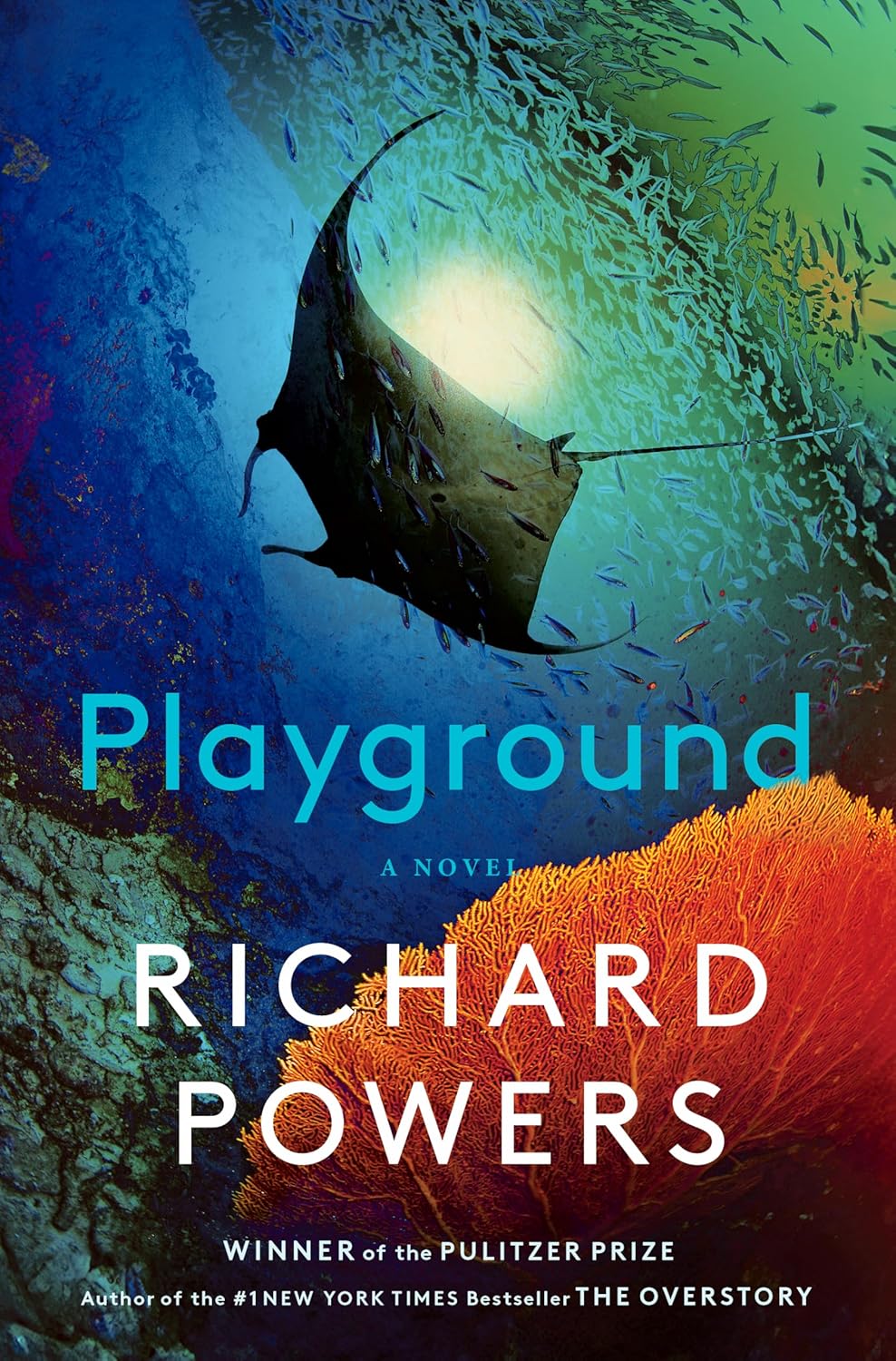
Playground: A Novel

Estimated reading time: 1 minute, 38 seconds

I started reading “Playground: A Novel” by Richard Powers today. This remarkable new novel comes from the Pulitzer Prize-winning and New York Times best-selling author of “The Overstory” and “Bewilderment.” Even more astonishing is that this marks my three hundredth book since I embarked on this reading journey on January 1, 2019! I’m also enjoying “Judaism Is About Love,” which means “Playground: A Novel” will be my 98th or 99th book in 2024.

In this sweeping, panoramic novel, four lives intertwine, showcasing Richard Powers at the height of his skills. Twelve-year-old Evie Beaulieu finds herself at the bottom of a swimming pool in Montreal, strapped to one of the world’s first aqua lungs. Ina Aroita grows up on naval bases across the Pacific, finding solace in art as her only home. At an elite high school in Chicago, two opposites bond over a three-thousand-year-old board game: Rafi Young gets lost in literature, while Todd Keane’s work leads to a startling breakthrough in artificial intelligence.

Their paths converge on the history-laden island of Makatea in French Polynesia, once known for its phosphorus deposits that helped sustain the world. This tiny atoll has been chosen for a groundbreaking venture: a plan to create floating, autonomous cities to venture out onto the open sea. However, the island’s residents must vote to approve the project or turn the seasteaders away.

Set against the world’s most enormous ocean backdrop, this awe-inspiring book delves into the last wild place we have yet to colonize, exploring a still-unfolding oceanic narrative. It beautifully weaves rich characters, profound themes of technology and the environment, and a deep examination of our shared humanity—and exploration that only Richard Powers can deliver.


When you purchase a book through one of my links, I earn a small commission that helps support my passion for reading. This contribution allows me to buy even more books to share with you, creating an incredible cycle of discovering great reads together! Your support truly makes a difference!


The Jan Lilien Education Fund!

Autobiography of Cotton

Read: February 2026

Get this book

Autobiography of Cotton

by Cristina Rivera Garza

In 1934, a young José Revueltas traveled to Tamaulipas to support the cotton workers’ strike in Estación Camarón, which would later serve as the foundation for his landmark novel, Human Mourning. In her groundbreaking novel Autobiography of Cotton, Cristina Rivera Garza recounts her grandparents’ journey from mining towns to those same cotton fields. Her narrative intersects with Revueltas’s life and offers a vivid and evocative account of the history of cotton cultivation along the Mexico-U.S. border.

Through archival research and personal narrative, Rivera Garza explores how cotton transformed the borderlands by recounting the story of the cotton workers’ strike. She reveals how cycles of deprivation and environmental destruction continue to affect generations. Rivera Garza skillfully creates a new kind of border novel that illustrates how a fragile landscape drastically changed her grandparents’ lives and the territories they helped to develop. In this intimate fictionalization, Autobiography of Cotton offers a rich social history that encompasses agricultural colonization, labor activism, environmental degradation, and cross-border migration.

I recommend “Autobiography of Cotton,” but readers should be patient as the book shifts back and forth in time. Everything becomes clear as you continue reading.


Cristina Rivera Garza is the Pulitzer Prize–winning author of Liliana’s Invincible Summer. A MacArthur Fellow, she is the Hugh Roy and Lillie Cranz Cullen Distinguished Chair and founder of the University of Houston’s PhD in Creative Writing in Spanish.

Christina MacSweeney is the award-winning literary translator of works by Julián Herbert, Valeria Luiselli, and Elvira Navarro. She received the 2024 Sundial Literary Translation Award for her translation of Verónica Gerber Bicecci‘s The Company.


Discover your next favorite book and dive into a world of curated, exciting reads by purchasing through my links. You’ll have access to a diverse selection of books that I’ve personally vetted to ensure quality and enjoyment. Additionally, by supporting these selections, you’ll help me continue to provide you with more personalized recommendations. I earn a small commission from your purchase, which allows me to buy and share even more books with you. Your support truly makes a difference!


×
How Democracies Die

Read: January 2021

Get this book

How Democracies Die: What History Reveals About Our Future

by Steven Levitsky and Daniel Ziblatt

How Democracies Die: What History Reveals About Our Future by Steven Levitsky and Daniel Ziblatt was on my reading list for almost a year. In late December of last year, I started reading it and was in the final chapter on January 6, 2021. Like many of us, I never in my life expected to see a day like that in our country.

This type of event is one the authors talk about in their book.

According to the overview in GoodReads,

Donald Trump’s presidency has raised a question that many of us never thought we’d be asking: Is our democracy in danger? Harvard professors Steven Levitsky and Daniel Ziblatt have spent more than twenty years studying the breakdown of democracies in Europe and Latin America, and they believe the answer is yes. Democracy no longer ends with a bang–in a revolution or military coup–but with a whimper: the slow, steady weakening of critical institutions, such as the judiciary and the press, and the gradual erosion of long-standing political norms. The good news is that there are several exit ramps on the road to authoritarianism. The bad news is that, by electing Trump, we have already passed the first one.

Drawing on decades of research and a wide range of historical and global examples, from 1930s Europe to contemporary Hungary, Turkey, and Venezuela, to the American South during Jim Crow, Levitsky and Ziblatt show how democracies die–and how ours can be saved.

Our democracy is too valuable for us to have it die. We all need to work to preserve and strengthen it. How Democracies Die is a book that everyone needs to read!

Subscribe

Contact Us

×
The Day Tripper: A Novel

Read: April 2024

Get this book

The Day Tripper: A Novel

by James Goodhand

Today, I began reading “The Day Tripper: A Novel” by James Goodhand. The story centers around Alex Dean, who can travel through time but, unfortunately, always ends up in the wrong place at the wrong time. This book is a perfect read for a rainy April day. The story moves quickly in just the first few pages, with time flying by faster than it does for Alex.

It’s 1995, and Alex Dean has it all: a spot at Cambridge University next year, the love of a fantastic woman named Holly, and all the time ahead of him. That is, until a brutal encounter with a ghost from his past sees him beaten, battered, and almost drowning in the Thames.

The next day, he wakes to find himself in a messy, derelict room he’s never seen before, in grimy clothes Alex doesn’t recognize, with no idea how he got there. A glimpse in the mirror tells him he’s much older and has been living a hard life, his features ravaged by time and poor decisions. He snatches a newspaper and finds it’s 2010—fifteen years since the fight.

After finally drifting off to sleep, Alex wakes the following morning to find it’s now 2019, another nine years later. But the next day, it’s 1999. Never knowing which day is coming, he begins to piece together what happens in his life after that fateful night by the river.

But what exactly is going on? Why does his life look nothing like he thought it would? What about Cambridge and Holly? In this page-turning adventure, Alex must navigate the years to learn that small actions have an untold impact. And that might be all he needs to save the people he loves and, equally importantly, himself.

×
Lucy by the Sea: A Novel

Read: November 2022

Get this book

Lucy by the Sea: A Novel

by Elizabeth Strout

Lucy by the Sea: A Novel by Elizabeth Strout is a poignant, pitch-perfect novel about a divorced couple stuck together during lockdown–and the love, loss, despair, and hope that animate us even as the world seems to be falling apart. Having lost Jan during Covid, I was apprehensive about reading this book. However, it was not only a page-turner but also a novel that gave me a new perspective on loss which helped me manage my grief.

With her trademark spare, crystalline prose, Elizabeth Strout turns her exquisitely tuned eye to the inner workings of the human heart, following the indomitable heroine of My Name Is Lucy Barton through the early days of the pandemic.

I highlighted several passages that specifically spoke to me.

We all live with people—and places—and things—that we have given great weight to. But we are weightless, in the end.

Who knows why people are different? We are born with a certain nature, I think. And then the world takes its swings at us.

It has been said that the second year of widowhood is worse than the first—the idea being, I think, that the shock has worn off and now one has to live with the loss, and I had been finding that to be true, even before I came to Maine with William. But now there were times I felt that I was just learning of David’s death again for the first time. And I would be privately staggered by grief. And to be in this place where David had never been (!)—I was really dislocated is what I mean.

And I also understood: Grief is a private thing. God, is it a private thing.

We are all in lockdown, all the time. We just don’t know it, that’s all. But we do the best we can. Most of us are just trying to get through.

The Goodreads summary provides an overview,

As a panicked world goes into lockdown, Lucy Barton is uprooted from her life in Manhattan and bundled away to a small town in Maine by her ex-husband and on-again, off-again friend, William. For the next several months, it’s just Lucy, William, and their complex past together in a little house nestled against the moody, swirling sea.

Rich with empathy and emotion, Lucy by the Sea vividly captures the fear and struggles that come with isolation, as well as the hope, peace, and possibilities that those long, quiet days can inspire. At the heart of this story are the deep human connections that unite us even when we’re apart–the pain of a beloved daughter’s suffering, the emptiness that comes from the death of a loved one, the promise of a new friendship, and the comfort of an old, enduring love.


The Jan Lilien Education Fund sponsors ongoing sustainability and environmental awareness programs. Gifts made this month; I will match dollar-for-dollar. All donations are tax-deductible.

Subscribe

Contact Us

I receive a commission when you buy a book or product using a link on this page. Thank you for supporting Sharing Jan’s Love blog.

×
Intermezzo: A Novel

Read: February 2025

Get this book

Intermezzo: A Novel

by Sally Rooney

Today, I dove into Sally Rooney‘s latest novel, “Intermezzo: A Novel,” which instantly captivated me. It’s a profoundly moving exploration of grief, love, and the intricacies of family life, with love at its heart. Reflecting on my journey through grief, I remember how Ms. Rooney‘s earlier work, “Beautiful World, Where Are You,” resonated with me during my second year of processing loss.

It beautifully highlighted love’s enduring nature and reminded me that, even in the depths of sorrow, love’s essence never truly fades. Intermezzo focuses on the fact that, aside from being brothers, Peter and Ivan Koubek seem to have little in common.

Peter is a Dublin lawyer in his thirties—successful, competent, and unassailable. But in the wake of their father’s death, he’s medicating himself to sleep and struggling to manage his relationships with two very different women—his enduring first love, Sylvia, and Naomi, a college student for whom life is one long joke.

Ivan is a twenty-two-year-old competitive chess player. He has always seen himself as socially awkward, a loner, the antithesis of his glib elder brother. Now, in the early weeks of his bereavement, Ivan meets Margaret, an older woman emerging from her turbulent past, and their lives become rapidly and intensely intertwined.

In this poignant interlude, we delve into the lives of two brothers grappling with their profound grief, accompanied by those who care for them. It’s a raw journey woven with threads of longing, heartbreak, and the flickering light of hope. Together, they navigate the uncharted territory of loss, uncovering how much the human spirit can withstand before it shatters.


When you purchase a book through one of my links, I earn a small commission that helps support my passion for reading. This contribution allows me to buy even more books to share with you, creating an incredible cycle of discovering great reads together! Your support truly makes a difference!

×
The Little Prince

Read: May 2021

Get this book

The Little Prince

by Antoine de Saint-Exupéry

The Little Prince by Antoine de Saint-Exupéry is often referred to as a children’s book. I read it as a child and later read it to my children. After Jan died, I picked it up again and read it more than once.

I have found quotes from the book very helpful during my grief journey. These are three that I often use in my writing and my conversations with friends and family.

The most beautiful things in the world cannot be seen or touched, they are felt with the heart.”

It is such a mysterious place, the land of tears.

You see, one loves the sunset when one is so sad.”

The first quote about beautiful things only felt in the heart summarizes how I knew Jan was the one for me within seconds of meeting her.

For those who have not read the book, this overview might help convince you to read it today!

The Little Prince describes his journey from planet to planet, each tiny world populated by a single adult. It’s a wonderfully inventive sequence that evokes the great fairy tales and monuments of postmodern whimsy. The author pokes similar fun at a business person, a geographer, and a lamplighter, all of whom signify some futile aspect of adult existence.

The Little Prince will be by my bedside as long as I live!

Subscribe

Contact Us

×