
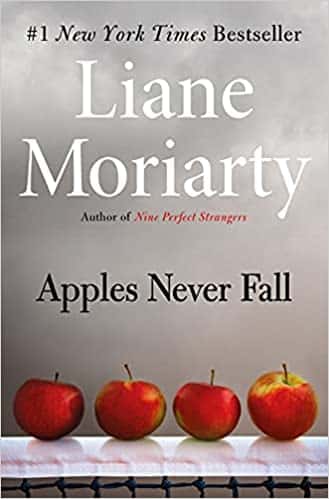
Apples Never Fall

Estimated reading time: 2 minutes, 13 seconds

Apples Never Fall by Liane Moriarty is a novel that looks at marriage, siblings, and how the people we love the most can hurt us the deepest. The Delaney family love one another dearly—it’s just that sometimes they want to murder each other.

If your mother was missing, would you tell the police? Even if the most obvious suspect was your father? The four grown Delaney siblings face this dilemma.

This book is a page-turner. With all of the characters having issues unrelated to their mission mother, they have a life with many mysteries and rivalries. I sometimes wanted to know more about their lives instead of the missing mum.

Although I will not reveal the conclusion, it is clear how a missing parent could appear to be the crime of the century.

According to Goodreads,

The Delaneys are fixtures in their community. The parents, Stan and Joy, are the envy of all of their friends. They’re killers on the tennis court, and off it, their chemistry is palpable. But after fifty years of marriage, they’ve finally sold their famed tennis academy and are ready to start what should be the golden years of their lives. So why are Stan and Joy so miserable?

The four Delaney children―Amy, Logan, Troy, and Brooke―were tennis stars in their own right, yet as their father will tell you, none of them had what it took to go all the way. But that’s okay, now that they’re all successful grown-ups. In addition, there is the beautiful possibility of grandchildren on the horizon.

One night a stranger named Savannah knocks on Stan and Joy’s door, bleeding after a fight with her boyfriend. The Delaneys are more than happy to give her the small kindness she sorely needs. If only that were all, she wanted.

Later, when Joy goes missing and Savannah is nowhere to be found, the police question the one person who remains: Stan. But for someone who claims to be innocent, he, like many spouses, seems to have a lot to hide. Two of the Delaney children think their father is innocent. Two are not so sure―but as the two sides square off against each other in perhaps their most important match ever, all of the Delaneys will start to reexamine their shared family history in a very new light.

I recommend this book.

Subscribe

Contact Us

When you buy a book or product using a link on this page, I receive a commission. Thank you for supporting Sharing Jan’s Love blog.

The Jan Lilien Education Fund!

The White Hot

Read: November 2025

Get this book

The White Hot: A Novel

by Quiara Alegría Hudes

The White Hot” by Quiara Alegría Hudes is a letter from a mother to her daughter, reflecting on a moment of abandonment that stretches from ten days to ten years. It offers an explanation rather than an apology. Hudes tells April’s story—spiritual and sensual, fierce and humorous—using delicate lyricism and tough love. Through this narrative, Hudes transforms April’s struggle for self-discovery into an unforgettable short epic.

April is a young mother raising her daughter in a multigenerational home filled with unspoken secrets and loud arguments. Her only refuge is the locked bathroom, where she plugs her ears into an ambient soundscape and repeats a mantra: “dead inside.” This continues until one day, as she feels herself spiraling toward the volcanic rage she calls “the white hot,” an inner voice tells her to simply walk away.

She goes to a bus station and asks for a one-way ticket to the furthest destination. This ticket takes her from her Philadelphia home to the threshold of a wilderness, marking the start of a nameless quest—an accidental journey that awakens her, nearly kills her, and leads her to an impossible choice.

As April discovers the key to freeing herself and her family from a cycle of generational trauma through her painful and absurd journey,


Quiara Alegría Hudes is a Pulitzer Prize-winning playwright known for her plays “Water by the Spoonful” and “In the Heights,” the latter of which won the Tony Award for Best Musical. She also adapted this musical for the screen.

Her memoir, “My Broken Language,” was longlisted for the Andrew Carnegie Medal. Hudes has written essays published in prominent outlets, including The New York Times, The Washington Post, The Cut, The Nation, and American Theater Magazine. Additionally, she co-founded the prison writing program Emancipated Stories with her cousin Sean.


Discover your next favorite book and dive into a world of curated, exciting reads by purchasing through my links. You’ll have access to a diverse selection of books that I’ve personally vetted to ensure quality and enjoyment. Additionally, by supporting these selections, you’ll help me continue to provide you with more personalized recommendations. I earn a small commission from your purchase, which allows me to buy and share even more books with you. Your support truly makes a difference!


×
Losing Earth: A Recent History

Read: October 2019

Get this book

Losing Earth: A Recent History

by Nathaniel Rich

Losing Earth: A Recent History by Nathaniel Rich reminds us how close we were to halting the climate emergency, and our failure has resulted in our passing the tilting point. The book “reveals, in previously unreported detail, the birth of climate denialism and the genesis of the fossil-fuel industry’s coordinated effort to thwart climate policy through misinformation propaganda and political influence.”

By 1979, we knew nearly everything we understand today about climate change – including how to stop it. Over the next decade, a handful of scientists, politicians, and strategists, led by two unlikely heroes, risked their careers in a desperate, escalating campaign to convince the world to act before it was too late. Losing Earth is their story and ours.

The New York Times Magazine devoted an entire issue to Nathaniel Rich’s groundbreaking chronicle of that decade, which became an instant journalistic phenomenon – the subject of news coverage, editorials, and conversations all over the world. In its emphasis on the lives of the people who grappled with the significant existential threat of our age, it made vivid the moral dimensions of our shared plight.

Losing Earth tells the human story of climate change in even richer, more intimate terms. It reveals, in previously unreported detail, the birth of climate denialism and the genesis of the fossil-fuel industry’s coordinated effort to thwart climate policy through misinformation propaganda and political influence. The audiobook carries the story into the present day, wrestling with the long shadow of our past failures and asking crucial questions about how we make sense of our past, our future, and ourselves.

Like John Hersey’s Hiroshima and Jonathan Schell’s The Fate of the Earth, Losing Earth is the rarest of achievements: a riveting work of dramatic history that articulates a moral framework for understanding how we got here and how we must go forward.

Losing Earth is a must-read book!

Subscribe

Contact Us

×
A Parish Chronicle

Read: February 2026

Get this book

A Parish Chronicle

by Halldór Laxness

In “A Parish Chronicle,” celebrated novelist Halldór Laxness weaves an essayistic tale about the unlikely miracles that keep a church—destined to disappear time and again—rooted on the same hillside. Laxness explores the minutiae of history, from the location of the ancient burial mound of national hero Egill Skallagrímsson to the end of the 19th century, where weak-sighted Ólafur and boisterous farmhand Gunna each play unexpected roles in the parish’s enduring survival.

1882. In the still of morning, Ólafur sharpens his scythe on the bone-dry pavestones that separate his farmhouse from the rest of Mosfell Valley, where life revolves around sheep. The sound of his hammer rings out like a high-pitched bell over the tussocky fields. Across the valley, perched on a hill that receives more sunshine than others, stands Mosfell Church. Nearby, the parish priest’s maid Gunna pours her “slosh,” a weak cup of coffee. Further afield in Reykjavík (“down south” as the locals say), the general assembly decides to revisit an old plan to cut costs by consolidating small parishes and calls for the demolition of Mosfell. Yet today a church stands on that same hillside—its sharp steeple silhouetted against the clouds, its crown bell hanging to the left of the altar.

This intimate tribute to life in Laxness‘s home valley also offers a thoughtful commentary on how the peculiarities of certain individuals can shape history. “A Parish Chronicle” is rich with life and detail.


Halldór Laxness (1902-1998) is the undisputed master of modern Icelandic fiction. He was awarded the Nobel Prize in Literature in 1955, “for his vivid epic power which has renewed the great narrative art of Iceland.” His body of work includes novels, essays, poems, plays, stories, and memoirs: more than sixty books in all. His works available in English include Independent People, The Fish Can Sing, World Light, Under the Glacier, Iceland’s Bell, and Paradise Reclaimed.

Philip Roughton has translated the work of Halldór Laxness, Jón Kalman Stefánsson, Kristín Marja Baldursdóttir, and many others. He has twice been awarded the American-Scandinavian Foundation Translation Prize for his renderings of Halldór Laxness‘s work, in 2001 for Iceland’s Bell and in 2015 for Wayward Heroes. He also received the 2016 Oxford-Weidenfeld Prize for his translation of Jón Kalman Stefánsson’s The Heart of Man. He lives in Iceland. Translator Residence: Akureyri, Iceland

Salvatore Scibona is the recipient of a Mildred and Harold Strauss Living Award from the American Academy of Arts and Letters. His first novel, The End, was a finalist for the National Book Award and winner of the Young Lions Fiction Award. His second novel, The Volunteer, was called a “masterpiece” by the New York Times and won the Ohioana Book Award. His books have been translated into ten languages. His work has won a Guggenheim Fellowship, a Pushcart Prize, an O. Henry Award, and a Whiting Award, and the New Yorker named him one of its “20 Under 40” fiction writers. He is the Sue Ann and John Weinberg Director of the Cullman Center for Scholars and Writers at the New York Public Library.


Discover your next favorite book and dive into a world of curated, exciting reads by purchasing through my links. You’ll have access to a diverse selection of books I’ve personally vetted for quality and enjoyment. Additionally, by supporting these selections, you’ll help me continue to provide you with more personalized recommendations. I earn a small commission from your purchase, which allows me to buy and share even more books with you. Your support truly makes a difference!


×
The Field of Blood: Violence in Congress and the Road to Civil War

Read: March 2019

Get this book

The Field of Blood

by Joanne B. Freeman

The Field of Blood: Violence in Congress and the Road to Civil War by Joanne B. Freeman, Professor of History and American Studies at Yale University, is a must-read in our hyper-partisan times. The partisanship and divisiveness of the period before the Civil War have many parallels to our time, and the difference is the violence of the Civil War era. Professor Freeman recovers the long-lost story of physical violence on the floor of the U.S. Congress.

She can do this by first source materials from Benjamin Brown French. He was never elected to office but was an acquaintance of twelve consecutive presidents, from Andrew Jackson to Ulysses S. Grant. In addition, he maintained a diary for forty years that highlighted the violence and his and the nation’s political transformation.

During much of this period, he was the Clerk in the House.  His diary documents the violence that did not get covered by the press. Legislative sessions included mortal threats, canings, flipped desks, and all-out slugfests. When debate broke down, members of Congress drew pistols and waved Bowie knives. One representative even killed another in a duel. Many were beaten and bullied in an attempt to intimidate them into compliance, particularly on the issue of slavery.

The Field of Blood is one of four books I purchased after my first One Day University class.

Subscribe

Contact Us

×
Intermezzo: A Novel

Read: February 2025

Get this book

Intermezzo: A Novel

by Sally Rooney

Today, I dove into Sally Rooney‘s latest novel, “Intermezzo: A Novel,” which instantly captivated me. It’s a profoundly moving exploration of grief, love, and the intricacies of family life, with love at its heart. Reflecting on my journey through grief, I remember how Ms. Rooney‘s earlier work, “Beautiful World, Where Are You,” resonated with me during my second year of processing loss.

It beautifully highlighted love’s enduring nature and reminded me that, even in the depths of sorrow, love’s essence never truly fades. Intermezzo focuses on the fact that, aside from being brothers, Peter and Ivan Koubek seem to have little in common.

Peter is a Dublin lawyer in his thirties—successful, competent, and unassailable. But in the wake of their father’s death, he’s medicating himself to sleep and struggling to manage his relationships with two very different women—his enduring first love, Sylvia, and Naomi, a college student for whom life is one long joke.

Ivan is a twenty-two-year-old competitive chess player. He has always seen himself as socially awkward, a loner, the antithesis of his glib elder brother. Now, in the early weeks of his bereavement, Ivan meets Margaret, an older woman emerging from her turbulent past, and their lives become rapidly and intensely intertwined.

In this poignant interlude, we delve into the lives of two brothers grappling with their profound grief, accompanied by those who care for them. It’s a raw journey woven with threads of longing, heartbreak, and the flickering light of hope. Together, they navigate the uncharted territory of loss, uncovering how much the human spirit can withstand before it shatters.


When you purchase a book through one of my links, I earn a small commission that helps support my passion for reading. This contribution allows me to buy even more books to share with you, creating an incredible cycle of discovering great reads together! Your support truly makes a difference!


×
On the Rooftop: A Novel

Read: November 2022

Get this book

On the Rooftop: A Novel

by Margaret Wilkerson Sexton

On the Rooftop: A Novel by Margaret Wilkerson Sexton, is a stunning novel about a mother whose dream of musical stardom for her three daughters collides with the daughters’ ambitions for their own lives—set against the backdrop of gentrifying 1950s San Francisco. The first few pages moved glacially and then the story unfolded fully and became a page-turner that I highly recommend.

After hearing Ms. Sexton’s interview on Get Lit with All Of It, a monthly on-air, social media, in-person, and live-stream book club hosted by Alison Stewart of WNYC’s All Of It, I picked up the book. The novel had been on my to-read list.

The novel was loosely based on Fiddler on the Roof and it worked exceedingly well. Vivian is the overbearing mother and the daughters who have their own dreams and goals. With urban renewal, AKA Urban Renewal, as the backdrop, the novel was one that I could not put down.

The small section of the song that Esther writes so she can sing for her people, was a song I wish I could hear in its entirety. That Chole choose to sing it for final audition made it even more powerful.

You put words to the music inside my heart You showed me the world could be its own art I’d never felt myself so whole before I’d never known how much I could reach for.

The Goodreads summary provides an overview,

At home they are just sisters, but on stage, they are The Salvations. Ruth, Esther, and Chloe have been singing and dancing in harmony since they could speak. Thanks to the rigorous direction of their mother, Vivian, they’ve become a bona fide girl group whose shows are the talk of the Jazz-era Fillmore.

Now Vivian has scored a once-in-a-lifetime offer from a talent manager, who promises to catapult The Salvations into the national spotlight. Vivian knows this is the big break she’s been praying for. But sometime between the hours of rehearsal on their rooftop and the weekly gigs at the Champagne Supper Club, the girls have become women, women with dreams that their mother cannot imagine.

The neighborhood is changing, too: all around the Fillmore, white men in suits are approaching Black property owners with offers. One sister finds herself called to fight back, one falls into the comfort of an old relationship, and another yearns to make her voice heard. And Vivian, who has always maintained control, will have to confront the parts of her life that threaten to splinter: the community, The Salvations, and even her family.


The Jan Lilien Education Fund sponsors ongoing sustainability and environmental awareness programs. Gifts made this month; I will match dollar-for-dollar. All donations are tax-deductible.

Subscribe

Contact Us

I receive a commission when you buy a book or product using a link on this page. Thank you for supporting Sharing Jan’s Love blog.


×