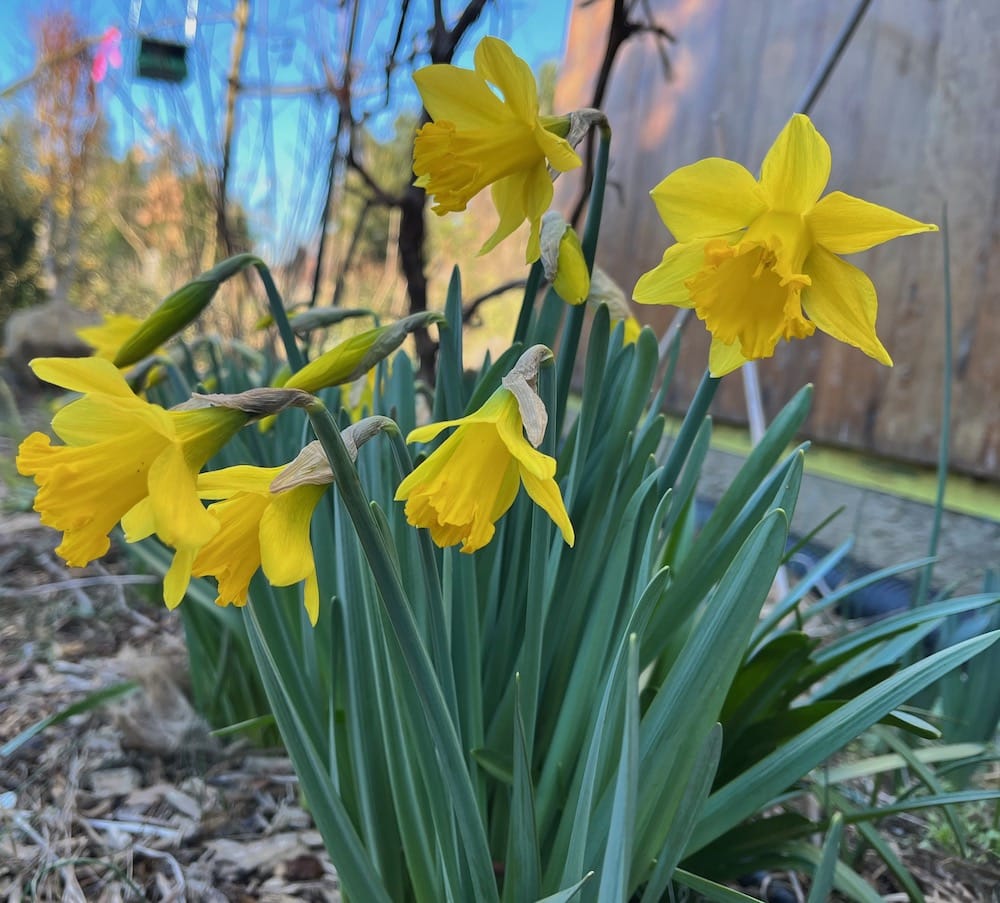

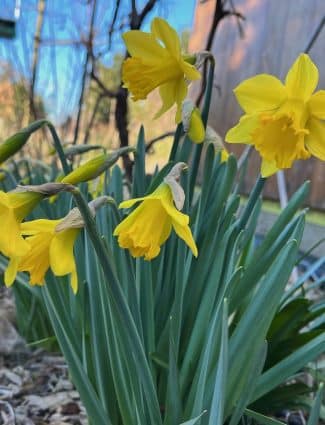
Daffodils

Spring’s First Weeping Willow Tree

Estimated reading time: 0 minutes, 41 seconds

Celebrate JanJan and I always found joy in the first sign of Spring.

Those signs could come anytime in an age of weird weather.

In Springfield and Teaneck, we had flower beds where the first daffodils would burst thru almost frozen ground to find the sun’s warmth.

I often found them first but always let Jan be the first to see Spring.

This morning, I saw the first yellowish hint in a weeping willow in Cranford despite freezing temperatures.

Jan’s still with me, so I will let her find this year’s first daffodils and willows.

Subscribe

Contact Us

I receive a commission when you buy a book or product using a link on this page. Thank you for supporting Sharing Jan’s Love blog.

Share your thoughts and ideas

This site uses Akismet to reduce spam. Learn how your comment data is processed.

The Jan Lilien Education Fund!

Daffodils
×
The Worst Hard Time

Read: September 2019

Get this book

The Worst Hard Time

by Timothy Egan

The Worst Hard Time: The Untold Story of Those Who Survived the Great American Dust Bowl by Timothy Egan was initially a book I selected from the e-library because nothing else I wanted to read was available. Once I started reading the book, I could not put it down.

Now that we have had the warmest summer since 1936 during the dust bowl, the book has even more meaning.

According to The New York Times,

The dust storms that terrorized the High Plains in the darkest years of the Depression were like nothing ever seen before or since. Timothy Egan’s critically acclaimed account rescues this iconic chapter of American history from the shadows in a tour de force of historical reportage. Following a dozen families and their communities through the rise and fall of the region, Egan tells of their desperate attempts to carry on through blinding black dust blizzards, crop failure, and the death of loved ones. Brilliantly capturing the terrifying drama of catastrophe, Egan does equal justice to the human characters who become his heroes, “the stoic, long-suffering men and women whose lives he opens up with urgency and respect.”

With the likelihood of more ecological catastrophes in the immediate future, this is a book I highly recommend.

Subscribe

Contact Us

×
The Vegetarian: A Novel

Read: October 2024

Get this book

The Vegetarian: A Novel

by Han Kang

Today, I started reading The Vegetarian: A Novel by Han Kang, Winner of the 2024 Nobel Prize in Literature. The novel also won The International Booker Prize and is one of The New York Times’s 100 Best Books of the 21st Century. Celebrated by critics worldwide, The Vegetarian is a darkly allegorical, Kafka-esque tale of power, obsession, and one woman’s struggle to break free from the violence both without and within her.

Before the nightmares began, Yeong-hye and her husband lived an ordinary, controlled life. But the dreams—invasive images of blood and brutality—torture her, driving Yeong-hye to purge her mind and renounce eating meat altogether. It’s a small act of independence, but it interrupts her marriage and sets into motion an increasingly grotesque chain of events at home.

As her husband, her brother-in-law, and her sister each fight to reassert their control, Yeong-hye obsessively defends the choice that’s become sacred to her. Soon, their attempts turn desperate, subjecting first her mind and then her body to ever more intrusive and perverse violations, sending Yeong-hye spiraling into a dangerous, bizarre estrangement, not only from those closest to her but also from herself.


Han Kang was born in 1970 in South Korea. She is the author of The Vegetarian, which I have read, and winner of the International Booker Prize,  Human ActsThe White BookGreek Lessons, and We Do Not Part. In 2024, she received the Nobel Prize in Literature.


When you purchase a book through one of my links, I earn a small commission that helps support my passion for reading. This contribution allows me to buy even more books to share with you, creating an incredible cycle of discovering great reads together! Your support truly makes a difference!


×
1944: FDR and the Year That Changed History

Read: October 2019

Get this book

1944: FDR and the Year That Changed History

by Jay Winik

1944: FDR and the Year That Changed History by Jay Winik is a book that I had put off reading several times. When I finally did read it, I could not remember why I had not read it sooner. Had I gone to graduate school and become a professor, it might have been the type of book I might write, and I certainly would have had on my list of books for my classes. 

As The NY Times wrote, “Jay Winik brings to life in gripping detail the year 1944, which determined the outcome of World War II and put more pressure than any other on an ailing yet determined President Roosevelt.” Reading a book about events five years before my birth that transformed the world I live in becomes an easy page-turner.

It was not inevitable that World War II would end as it did or that it would even end well. Nineteen forty-four was a year that could have stymied the Allies and cemented Hitler’s waning power. Instead it saved those democracies – but with a fateful cost. Now, in a superbly told story, Jay Winik, the acclaimed author of April 1865 and The Great Upheaval, captures the epic images and extraordinary history as never before.

1944 witnessed a series of titanic events: FDR at the pinnacle of his wartime leadership as well as his reelection, the planning of Operation Overlord with Churchill and Stalin, the unprecedented D-Day invasion, the liberation of Paris, and the horrific Battle of the Bulge, and the tumultuous conferences that finally shaped the coming peace. But on the way, millions of more lives were still at stake as President Roosevelt was exposed to mounting evidence of the most grotesque crime in history, the Final Solution. Just as the Allies were landing in Normandy, the Nazis were accelerating the killing of millions of European Jews.

Winik shows how escalating pressures fell on an all but dying Roosevelt, whose rapidly deteriorating health was a closely guarded secret. Here then, as with D-Day, was a momentous decision for the president. Was winning the war the best way to rescue the Jews? Was a rescue even possible? Or would it get in the way of defeating Hitler? In a year when even the most audacious undertakings were within the world’s reach, including the liberation of Europe, one challenge – saving Europe’s Jews – seemed to remain beyond Roosevelt’s grasp.

I recommend this book.

Subscribe

Contact Us

×
Grief Is the Thing with Feathers

Read: May 2026

Get this book

Grief Is the Thing with Feathers

Max Porter‘s extraordinary debut, “Grief Is the Thing with Feathers,” is a unique blend of novella, polyphonic fable, and essay about grief. Combining compassion with a bold writing style, it delivers a powerful impact. Filled with sharp humor and deep insights, this haunting and original work introduces an important new talent. The book will be released as a major motion picture titled “The Thing with Feathers,” starring Benedict Cumberbatch.

Here he is, husband and father, scruffy romantic, a shambolic scholar–a man adrift in the wake of his wife’s sudden, accidental death. And there are his two sons, who, like him, struggle in their London apartment to face the unbearable sadness that has engulfed them. The father imagines a future of well-meaning visitors and emptiness, while the boys wander, savage and unsupervised.

In this moment of violent despair, they are visited by Crow–antagonist, trickster, goad, protector, therapist, and babysitter. This self-described “sentimental bird,” at once wild and tender, who “finds humans dull except in grief,” threatens to stay with the wounded family until they no longer need him. As weeks turn to months and the pain of loss lessens with the balm of memories, Crow’s efforts are rewarded, and the little unit of three begins to recover: Dad resumes his book about the poet Ted Hughes; the boys get on with it, grow up.


Max Porter is a publishing professional who lives in South London with his wife and children. “Grief Is the Thing with Feathers” is his debut book.


Discover your next favorite book and dive into a world of curated, exciting reads by purchasing through my links. You’ll have access to a diverse selection of books I’ve personally vetted for quality and enjoyment. Supporting these selections not only helps me continue to provide you with personalized recommendations but also ensures you have access to meaningful stories that enrich your life. Your support truly makes a difference in helping me share more books and insights with you!


×
How to Read a Book: A Novel

Read: May 2024

Get this book

How to Read a Book: A Novel

by Monica Wood

I started reading Monica Wood‘s “How to Read a Book: A Novel” today. It’s a heartfelt and uplifting story about a chance encounter at a bookstore—the novel delves into themes of redemption, unlikely friendships, and the life-changing power of sharing stories. With Monica Wood’s characteristic heart, wit, grace, and understanding, the novel illuminates the decisions that shape a life and the kindnesses that make life meaningful.

The story revolves around three characters: Violet Powell, a twenty-two-year-old from rural Abbott Falls, Maine, who is being released from prison after serving twenty-two months for a drunk-driving crash that killed a local kindergarten teacher; Harriet Larson, a retired English teacher who runs the prison book club and is facing the prospect of an empty nest; and Frank Daigle, a retired machinist who is struggling to come to terms with the complexities of his marriage to the woman Violet killed.

Their lives unexpectedly intersect one morning in a bookstore in Portland, Maine. Violet buys the novel she read in the prison book club before her release, Harriet selects the following title for the remaining women, and Frank fulfills his duties as the store handyman. Their encounters set off a chain of events that will profoundly change them.

How to Read a Book is a candid and hopeful story about releasing guilt, embracing second chances, and the profound impact of books on our lives.

×
The Pursuit of Happiness

Read: January 2025

Get this book

The Pursuit of Happiness

by Jeffrey Rosen

Today, I started reading Jeffrey Rosen‘s book, “The Pursuit of Happiness: How Classical Writers on Virtue Inspired the Lives of the Founders.” This New York Times bestseller examines what “the pursuit of happiness” meant to our nation’s Founders, how that iconic phrase influenced their lives, and how it provided the foundation for our democracy—a quest for being good rather than merely feeling good.

The Declaration of Independence identifies “the pursuit of happiness” as one of our unalienable rights, alongside life and liberty. Jeffrey Rosen, president of the National Constitution Center, profiles six of the most influential Founding Fathers—Benjamin Franklin, George Washington, John Adams, Thomas Jefferson, James Madison, and Alexander Hamilton—to explore what pursuing happiness meant to them. This work provides “the best and most readable introduction to the ideas of the Founders that we have” (Gordon Wood, author of “Power and Liberty“).

By examining the classical Greek and Roman moral philosophers who inspired the Founders, Rosen illustrates how they understood the pursuit of happiness as a quest for being good rather than simply feeling good. It is about striving for lifelong virtue instead of seeking short-term pleasures. Among these virtues were the habits of industry, temperance, moderation, and sincerity, which the Founders regarded as essential components of personal growth, character development, and self-mastery. They believed that self-governance in politics required self-governance on an individual level. For all six Founders, the pursuit of virtue was fundamentally incompatible with the enslavement of African Americans, although the Virginians failed to uphold their principles in this regard.

Ken Burns describes “The Pursuit of Happiness” as “immensely readable and thoughtful. It is more than just an analysis of the famous phrase in the Declaration. It is a revealing journey into the Founders’ minds, offering a deep and fresh understanding of the foundations of our democracy.


When you purchase a book through one of my links, I earn a small commission that helps support my passion for reading. This contribution allows me to buy even more books to share with you, creating an incredible cycle of discovering great reads together! Your support truly makes a difference!


×