New Book: Invisible Child: Poverty, Survival & Hope in an American City

Estimated reading time: 0 minutes, 0 seconds
Invisible Child

Invisible Child: Poverty, Survival & Hope in an American City

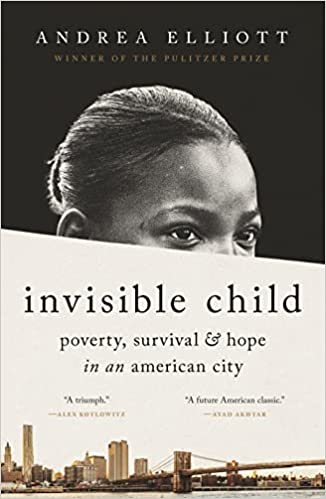
Invisible Child: Poverty, Survival & Hope in an American City by Andrea Elliott was a gift from my son Jon. The book highlights the crucial role of resilience, the importance of family, and the cost of inequality. Child poverty, homelessness, and inequality impact all of us. Ending child poverty and homelessness will make us a healthier and more inclusive nation. It is time for a compelling moral call to action!

Read book review Get this book All books

Share your thoughts and ideas

This site uses Akismet to reduce spam. Learn how your comment data is processed.

The Jan Lilien Education Fund!

Invisible Child

Read: December 2021

Get this book

Invisible Child: Poverty, Survival & Hope in an American City

by Andrea Elliott

Invisible Child: Poverty, Survival & Hope in an American City by Andrea Elliott was a gift from my son Jon. The New York Times selected “Invisible Child” as one of the best books published this year. It is indeed one of the top books on my all-time list.

GoodReads summary provides a good overview,

The riveting, unforgettable story of a girl whose indomitable spirit is tested by homelessness, poverty, and racism in an unequal America—from Pulitzer Prize-winning journalist Andrea Elliott of The New York Times

Invisible Child follows eight dramatic years in the life of Dasani Coates, a child with imagination as soaring as the skyscrapers near her Brooklyn homeless shelter. Born at the turn of a new century, Dasani is named for the bottled water that comes to symbolize Brooklyn’s gentrification and the shared aspirations of a divided city. As Dasani grows up, moving with her tight-knit family from shelter to shelter, this story goes back to trace the passage of Dasani’s ancestors from slavery to the Great Migration north. When Dasani comes of age, New York City’s homeless crisis explodes as the chasm deepens between rich and poor.

In the shadows of this new Gilded Age, Dasani must lead her seven siblings through a thicket of problems: hunger, parental drug addiction, violence, housing instability, segregated schools, and the constant monitoring of the child-protection system. When, at age thirteen, Dasani enrolls at a boarding school in Pennsylvania, her loyalties are tested like never before. As she learns to “code switch” between the culture she left behind and the norms of her new town, Dasani starts to feel like a stranger in both places. Ultimately, she faces an impossible question: What if leaving poverty means abandoning the family you love?

By turns heartbreaking and revelatory, provocative and inspiring, Invisible Child tells an astonishing story about the power of resilience, the importance of family, and the cost of inequality. Based on nearly a decade of reporting, this book vividly illuminates some of the most critical issues in contemporary America through the life of one remarkable girl.

Jan and I were involved and knew that child poverty and homelessness needed repair. In addition, Jan lived on Washington Park across from Ft. Greene Park in 1974-75. We knew the neighborhood where much of the book’s story takes place. 

Before meeting Jan in 1973, I was both a community/tenant organizer and a youth worker. In the latter role, I made weekly hostel trips for eight to ten young boys from East Williamsburg during 1973. The trips were the first the boys had ever been outside of their neighborhood.

Many of them had imaginations like Dasani. They also had her instinct to fight. One of my first tasks was to check for any weapons.

Decades later, when I would see any of them, now adults, they would ask when we were going on another trip. I wish I had met Jan when I made those trips. She would have helped me improve them and document the impact. If I could re-write history, I would have her join me as the second adult on the hostel trips.

After that summer, it was clear my primary skills were as a community/tenant organizer. Over the next few years, my work focused on creating affordable and supportive housing.

Jan and I did meaningful work that made a difference, yet the need for a permanent solution to the crisis remains. The book highlights the crucial role of resilience, the importance of family, and the cost of inequality. As a nation, we cannot undermine those values by breaking up families, impeding resilience, and maintaining racial and economic inequality. 

The current debate in Washington over the Build Back Better legislation needs to focus not on how much we spend but on its impact on children and families

David Brooks, a conservative commentator, has supported these expenditures for what they can do to address this country’s cultural and economic crisis. 

These packages say to the struggling parents and the warehouse workers: I see you. Your work has dignity. You are paving your way. You are at the center of our national vision.

This is how you fortify a compelling moral identity, which is what all of us need if we’re going to be able to look in the mirror with self-respect. This is the cultural transformation that good policy can sometimes achieve. Statecraft is soulcraft.

If you can only read one book this year, this is the one to read. Child poverty, homelessness, and inequality impact all of us. Ending child poverty and homelessness will make us a healthier and more inclusive nation. It is time for a compelling moral call to action!

Subscribe

Contact Us

When you buy a book or product using a link on this page, I receive a commission. Thank you for supporting Sharing Jan’s Love blog.

×
Something About Living

Read: November 2024

Get this book

Something About Living

by Lena Khalaf Tuffaha

I recently read “Something About Living” by Lena Khalaf Tuffaha, a poet and essayist whose work resonates deeply. The book of poems won the 2024 National Book Award for Poetry and delved into Palestinian life through the lens of the American language, revealing a legacy of obfuscation and erasure. It questions what happens when language packages ongoing disasters for consumption and disposal.

As a Jew supporting a two-state solution, I initially hesitated to read this collection of poems. However, I was pleasantly surprised by the lyrical beauty of the verses, which explore love not just as an emotion but as a transformative force and “a radical act.” Every poem that genuinely resonated with me. “Something About Living” is a book I highly recommend for its depth and insight!

Ms. Khalaf Tuffaha has an incredible literary repertoire; her previous work, “Water & Salt,” earned the esteemed 2018 Washington State Book Award, while “Kaan & Her Sisters” was a finalist for the Firecracker Award. In addition, “Something About Living” also received the 2022 Akron Prize for Poetry. I’m excited to explore her profound insights and lyrical mastery!

Adrian Matejka, the author of “Somebody Else Sold the World,” has written about “Something About Living,”

“It’s nearly impossible to write poetry that simultaneously holds the human desire for joy and the insistent agitations of protest, but Lena Khalaf Tuffaha‘s gorgeous and wide-ranging new collection Something About Living does just that. Her poems interweave Palestine’s historic suffering, the challenges of living in this world full of violence and ill will, and the gentle delights we embrace to survive that violence. Khalaf Tuffaha’s elegant poems sing the fractured songs of Diaspora while remaining clear-eyed to the cause of the fracturing: the multinational hubris of colonialism and greed. This collection is her witness to our collective unraveling, vowel by vowel, syllable by syllable. “Let the plural be a return of us,” the speaker of “On the Thirtieth Friday We Consider Plurals” says and this plurality is our tenuous humanity and the deep need to hang on to kindness in our communities. In these poems Khalaf Tuffaha reminds us that love isn’t an idea; it is a radical act. Especially for those who, like this poet, travel through the world vigilantly, but steadfastly remain heart first.


When you purchase a book through one of my links, I earn a small commission that helps support my passion for reading. This contribution allows me to buy even more books to share with you, creating an incredible cycle of discovering great reads together! Your support truly makes a difference!


×
The Last White Man

Read: August 2022

Get this book

The Last White Man: A Novel

by Mohsin Hamid

The Last White Man by Mohsin Hamid is a story of love, loss, and rediscovery in a time of unsettling change. One morning, Anders, the novel’s protagonist,  wakes to find that his skin has turned dark, his reflection a stranger to him. At first, he tells only Oona, an old friend, newly a lover. Soon, reports of similar occurrences surface across the land.

In Mohsin Hamid’s “lyrical and urgent” prose (O Magazine), The Last White Man powerfully uplifts our capacity for empathy and the transcendence over bigotry, fear, and anger it can achieve.

I highly recommend this book. It was a page-turner that kept me thinking about love, loss, and rediscovery. All three are subjects close to my heart since Jan’s death.

I decided to read the book after hearing an interview with the author on All of It on WNYC.

The Goodreads summary provides a good overview,

One morning, Anders wakes to find that his skin has turned dark, his reflection a stranger to him. At first he tells only Oona, an old friend, newly a lover. Soon, reports of similar occurrences surface across the land. Some see in the transformations the long-dreaded overturning of an established order, to be resisted to a bitter end. In many, like Anders’s father and Oona’s mother, a sense of profound loss wars with profound love. As the bond between Anders and Oona deepens, change takes on a different shading: a chance to see one another, face to face, anew.

Hamid’s The Last White Man invites us to envision a future – our future – that dares to reimagine who we think we are, and how we might yet be together.


The Jan Lilien Education Fund sponsors ongoing sustainability and environmental awareness programs. Gifts made this month; I will match dollar-for-dollar. All donations are tax-deductible.

Subscribe

Contact Us

I receive a commission when you buy a book or product using a link on this page. Thank you for supporting Sharing Jan’s Love blog.

×
Never Let Me Go

Read: August 2024

Get this book

Never Let Me Go

by Kazuo Ishiguro

I started reading “Never Let Me Go” by Nobel Prize winner Kazuo Ishiguro today. This novel, listed among The New York Times 100 Best Books of the Century, has also received critical acclaim for its unique narrative and thought-provoking themes. Written by the acclaimed and bestselling author of “The Remains of the Day,” it’s described as “a Gothic tour de force” with an extraordinary twist—a moving, suspenseful, beautifully atmospheric modern classic.

The story unfolds at Hailsham, an enigmatic and exclusive boarding school in the English countryside. The central characters, Kathy, Ruth, and Tommy navigate through mercurial cliques and mysterious rules. Teachers constantly remind the students of their specialness, adding an element of suspense and intrigue to the narrative.

As young adults, Kathy, Ruth, and Tommy reunite, prompting Kathy to reflect on their shared past and understand what makes them unique. The novel explores themes of identity and humanity, delving into the emotional depth of their lives, making it a genuinely thought-provoking journey that readers can deeply connect with.

×
The Fraud: A Novel

Read: December 2023

Get this book

The Fraud: A Novel

by Zadie Smith

I started reading The Fraud: A Novel by Zadie Smith today. The book is a kaleidoscopic work of historical fiction that revolves around a legal trial that divided Victorian England. The story is set in 1873, where Mrs. Eliza Touchet, a Scottish housekeeper and cousin by marriage of a once-famous novelist, William Ainsworth, lives with him for thirty years. Mrs. Touchet is interested in literature, justice, abolitionism, class, and her cousin’s wives.

However, she is skeptical of her cousin’s talent, Mr. Charles Dickens’ character, and England’s facades, in which nothing is as it seems.

On the other hand, Andrew Bogle grew up enslaved on the Hope Plantation in Jamaica. He knows that every lump of sugar comes at a human cost, that the rich deceive the poor, and that people are more easily manipulated than they realize. When Bogle finds himself in London, a star witness in a celebrated case of imposture, he knows that his future depends on telling the right story.

The “Tichborne Trial” captivates Mrs. Touchet and all of England. The trial involves a lower-class butcher from Australia who claimed he was the rightful heir of a sizable estate and title. The question is whether Sir Roger Tichborne is genuinely who he says he is or whether he’s a fraud. In a world of hypocrisy and self-deception, deciding what’s real is complicated for Mrs. Touchet and Mr. Bogle.

The Fraud is a dazzling novel about truth and fiction, Jamaica and Britain, fraudulence and authenticity, and the mystery of “other people.” It’s based on historical events.


The Jan Lilien Education Fund sponsors ongoing sustainability and environmental awareness programs. Gifts made this month; I will match dollar-for-dollar. All donations are tax-deductible.

Subscribe

Contact Us

I receive a commission when you buy a book or product using a link on this page. Thank you for supporting Sharing Jan’s Love blog.


×
The Singing Word

Read: September 2025

Get this book

The Singing Word

by Walt Hunter

The Singing Word: 168 Years of Atlantic Poetry, edited by Walt Hunter, celebrates the people, land, and spirit of America. This remarkable collection showcases a wide range of contemporary and historical poetry from the 168-year archive of The Atlantic magazine. Since its first issue in 1857, the poetry published in The Atlantic has drawn attention to the nation’s ongoing journey of self-discovery.

The magazine’s verse has featured odes to American leaders and landscapes, laments for the dead, and calls for change, appealing to the enduring ideals of Atlantic readers.

This one-of-a-kind collection selects poems of rousing optimism, clear-eyed realism, and moving lyricism—poems infused with the language of America’s songs, myths, and history, from the Civil War up through the present in three rich parts: National Anthems, Natural Lines, and Personal Mythologies.

Curated by The Atlantic’s Poetry Editor, this anthology features both world-famous poets—from Longfellow to Limón, including Robert Frost, W. S. Merwin, Sylvia Plath, and Adrienne Rich—as well as poets whose work has never before been published outside of the magazine.

Offering readers an essential understanding of American canon and the evolving nation, its poets have yearned to capture—the poetry of The Atlantic is the poetry of America.


Walt Hunter is a professor of twentieth- and twenty-first-century literature and chair of the English department at Case Western Reserve University. He is also the fiction and poetry editor for The Atlantic.


Discover your next favorite book and dive into a world of curated, exciting reads by purchasing through my links. You’ll have access to a diverse selection of books that I’ve personally vetted to ensure quality and enjoyment. Additionally, by supporting these selections, you’ll help me continue to provide you with more personalized recommendations. I earn a small commission from your purchase, which allows me to buy and share even more books with you. Your support truly makes a difference!


×
The Colony

Read: March 2025

Get this book

The Colony: A Novel

by Annika Norlin

Today, I explored “The Colony,” Annika Norlin‘s debut novel, which Alice E. Olsson has skillfully translated. This sensational bestseller from Sweden has captured the imagination of readers around the globe, with its rights sold in over a dozen countries and an exciting TV adaptation in the works. “The Colony,” has quickly become one of the most talked-about literary sensations since Fredrik Backman’s ‘A Man Called Ove.’

Winner of the Vi Literature Award and Swedish Radio’s Novel Prize, two of Sweden’s most prestigious literary awards, “The Colony” is a compelling portrayal of contemporary society and its alternatives.

Burned out from a demanding job and the hectic pace of city life, Emelie decides to spend a few days in the countryside. There, amidst the peaceful, green hills by the river, she encounters a mysterious group of seven people, each with personal stories marked by pain, alienation, and a longing to live differently. They are misfits in their ways, all led by the enigmatic and charismatic Sara.

How did they end up in this place? Are they content with the rigid roles assigned to them? And what happens when an outsider arrives, initially drawn to their alternative lifestyle, but inevitably disrupts their way of life?

A masterful blend of humor, emotion, unforgettable characters, and sharp social commentary, “The Colony” is a magnetic and deeply touching story about love, community, and our profound influence over one another.


Annika Norlin is a Swedish author, songwriter, and artist. She releases music under her name and through her projects, Säkert! and Hello Saferide. Her collection of short stories, “I See Everything You Do,” has been nominated for several awards. “The Colony” is her debut novel.

Alice E. Olsson is a literary translator, writer, and editor. She has served as the Cultural Affairs Adviser at the Embassy of Sweden in London and has received a fellowship and multiple grants from the Swedish Arts Council. Olsson was a nominee for the 2020 Peirene Stevns Translation Prize and the 2023 Bernard Shaw Prize.


When you purchase a book through one of my links, I earn a small commission that helps support my passion for reading. This contribution allows me to buy even more books to share with you, creating an incredible cycle of discovering great reads together! Your support truly makes a difference!


×