
Invisible Child: Poverty, Survival & Hope in an American City

Estimated reading time: 4 minutes, 7 seconds

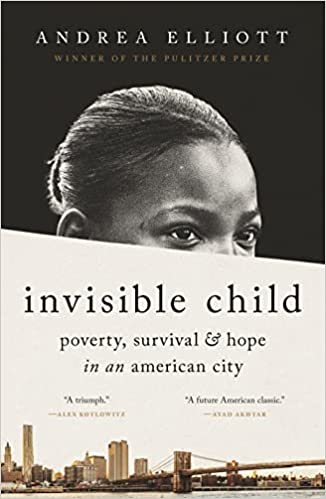
Invisible Child: Poverty, Survival & Hope in an American City by Andrea Elliott was a gift from my son Jon. The New York Times selected “Invisible Child” as one of the best books published this year. It is indeed one of the top books on my all-time list.

GoodReads summary provides a good overview,

The riveting, unforgettable story of a girl whose indomitable spirit is tested by homelessness, poverty, and racism in an unequal America—from Pulitzer Prize-winning journalist Andrea Elliott of The New York Times

Invisible Child follows eight dramatic years in the life of Dasani Coates, a child with imagination as soaring as the skyscrapers near her Brooklyn homeless shelter. Born at the turn of a new century, Dasani is named for the bottled water that comes to symbolize Brooklyn’s gentrification and the shared aspirations of a divided city. As Dasani grows up, moving with her tight-knit family from shelter to shelter, this story goes back to trace the passage of Dasani’s ancestors from slavery to the Great Migration north. When Dasani comes of age, New York City’s homeless crisis explodes as the chasm deepens between rich and poor.

In the shadows of this new Gilded Age, Dasani must lead her seven siblings through a thicket of problems: hunger, parental drug addiction, violence, housing instability, segregated schools, and the constant monitoring of the child-protection system. When, at age thirteen, Dasani enrolls at a boarding school in Pennsylvania, her loyalties are tested like never before. As she learns to “code switch” between the culture she left behind and the norms of her new town, Dasani starts to feel like a stranger in both places. Ultimately, she faces an impossible question: What if leaving poverty means abandoning the family you love?

By turns heartbreaking and revelatory, provocative and inspiring, Invisible Child tells an astonishing story about the power of resilience, the importance of family, and the cost of inequality. Based on nearly a decade of reporting, this book vividly illuminates some of the most critical issues in contemporary America through the life of one remarkable girl.

Jan and I were involved and knew that child poverty and homelessness needed repair. In addition, Jan lived on Washington Park across from Ft. Greene Park in 1974-75. We knew the neighborhood where much of the book’s story takes place. 

Before meeting Jan in 1973, I was both a community/tenant organizer and a youth worker. In the latter role, I made weekly hostel trips for eight to ten young boys from East Williamsburg during 1973. The trips were the first the boys had ever been outside of their neighborhood.

Many of them had imaginations like Dasani. They also had her instinct to fight. One of my first tasks was to check for any weapons.

Decades later, when I would see any of them, now adults, they would ask when we were going on another trip. I wish I had met Jan when I made those trips. She would have helped me improve them and document the impact. If I could re-write history, I would have her join me as the second adult on the hostel trips.

After that summer, it was clear my primary skills were as a community/tenant organizer. Over the next few years, my work focused on creating affordable and supportive housing.

Jan and I did meaningful work that made a difference, yet the need for a permanent solution to the crisis remains. The book highlights the crucial role of resilience, the importance of family, and the cost of inequality. As a nation, we cannot undermine those values by breaking up families, impeding resilience, and maintaining racial and economic inequality. 

The current debate in Washington over the Build Back Better legislation needs to focus not on how much we spend but on its impact on children and families

David Brooks, a conservative commentator, has supported these expenditures for what they can do to address this country’s cultural and economic crisis. 

These packages say to the struggling parents and the warehouse workers: I see you. Your work has dignity. You are paving your way. You are at the center of our national vision.

This is how you fortify a compelling moral identity, which is what all of us need if we’re going to be able to look in the mirror with self-respect. This is the cultural transformation that good policy can sometimes achieve. Statecraft is soulcraft.

If you can only read one book this year, this is the one to read. Child poverty, homelessness, and inequality impact all of us. Ending child poverty and homelessness will make us a healthier and more inclusive nation. It is time for a compelling moral call to action!

Subscribe

Contact Us

When you buy a book or product using a link on this page, I receive a commission. Thank you for supporting Sharing Jan’s Love blog.

The Jan Lilien Education Fund!

The Hidden Habits of Genius

Read: September 2019

Get this book

The Hidden Habits of Genius

by Craig Wright

The Hidden Habits of Genius: Beyond Talent, IQ, and Grit―Unlocking the Secrets of Greatness by Craig Wright, Ph.D., I got through my membership in One Day University.

Dr. Wright raises many important questions as he analyses fourteen (14) critical traits of genius. Professor Craig Wright, creator of Yale University’s famous “Genius Course,” explores what we can learn from brilliant minds that have changed the world.

What we often presume about a genius does not match reality. Among other interesting observations, Dr. Wright reminds the reader that Picasso could not pass a fourth-grade math test, and Steve Jobs’s high school GPA was 2.65. He questions why to teach children to behave and play by the rules when transformative geniuses do not.

Examining the lives of transformative individuals ranging from Charles Darwin and Marie Curie to Leonardo Da Vinci and Andy Warhol to Toni Morrison and Elon Musk, Wright identifies more than a dozen drivers of genius, characteristics and patterns of behavior common to great minds throughout history. He argues that genius is about more than intellect and work ethic and that the famed “eureka” moment is a Hollywood fiction. Brilliant insights that change the world are never sudden, but rather, they are the result of unique modes of thinking and lengthy gestation.

I found the book to be a fascinating read and raised more questions for future thought and reading. Professor Wright argues that the habits of mind that produce great thinking and discovery can be actively learned and cultivated. In the book, he explains how. He notes that reading the book will not make you a genius but can “make you more strategic, creative, and successful, and, ultimately, happier.

Subscribe

Contact Us

×
Black Sun

Read: November 2021

Get this book

Black Sun – Between the Earth and Sky

by Rebecca Roanhorse

Black Sun by Rebecca Roanhorse.  Black Sun is the first book in the Between Earth and Sky trilogy, inspired by the civilizations of the Pre-Columbian Americas and woven into a tale of celestial prophecies, political intrigue, and forbidden magic.

I have always enjoyed fantasy novels like Black Sun, and this is the first one set in the Pre-Columbian Americas.

A god will return
When the earth and sky converge
Under the black sun

In the holy city of Tova, the winter solstice is usually a time for celebration and renewal, but this year, it coincides with a solar eclipse, a rare celestial event proscribed by the Sun Priest as an unbalancing of the world.

Meanwhile, a ship launches from a distant city bound for Tova and set to arrive on the solstice. The captain of the ship, Xiala, is a disgraced Teek whose song can calm the waters around her as quickly as it can warp a man’s mind. Her ship carries one passenger. Described as harmless, the passenger, Serapio, is a young man, blind, scarred, and cloaked in destiny. As Xiala well knows, when a man is described as harmless, he usually ends up being a villain.

Will Serapio be harmless or a villain? The answer, my friend, will be known when you read this book or perhaps the second one in the trilogy.

Before meeting and falling forever in love with Jan, I had dreamed of the life of an American Studies professor. Thousands of students are relieved to know I did not pursue that life. If I had opened that door, an area of focus would have been on Pre-Columbian Americas.

I recommend this book and will read the next two in the Between Earth and Sky trilogy.

Subscribe

Contact Us

When you buy a book or product using a link on this page, I receive a commission. Thank you for supporting Sharing Jan’s Love blog.
×
20 Under 40

Read: January 2019

Get this book

20 Under 40 Fiction

by Various Writers Under 40

Short Stories that Will Define the Future of American Letters

The New Yorker’s collection of short stories – 20 Under 40 – is a collection of twenty writers “whose work will help define the future of American letters.”

Some of these I had read in The New Yorker and others I had missed. Either way, they were a pleasure to read.

As The New Yorker wrote,

The range of voices is extraordinary. There is the lyrical realism of Nell Freudenberger, Philipp Meyer, C. E. Morgan, and Salvatore Scibona; the satirical comedy of Joshua Ferris and Gary Shteyngart; and the genre-bending tales of Jonathan Safran Foer, Nicole Krauss, and Téa Obreht. David Bezmozgis and Dinaw Mengestu offer clear-eyed portraits of immigration and identity; Sarah Shun-lien Bynum, ZZ Packer, and Wells Tower offer voice-driven, idiosyncratic narratives. Then there are the haunting sociopolitical stories of Chimamanda Ngozi Adichie, Daniel Alarcón, and Yiyun Li, and the metaphysical fantasies of Chris Adrian, Rivka Galchen, and Karen Russell.

Each of these writers reminds us why we read. And each is aiming for greatness: fighting to get and to hold our attention in a culture that is flooded with words, sounds, and pictures; fighting to surprise, to entertain, to teach, and to move not only us but generations of readers to come. A landmark collection, 20 Under 40 stands as a testament to the vitality of fiction today.

I recommend this collection of short stories.

Subscribe

Contact Us

×
The Singing Word

Read: September 2025

Get this book

The Singing Word

by Walt Hunter

The Singing Word: 168 Years of Atlantic Poetry, edited by Walt Hunter, celebrates the people, land, and spirit of America. This remarkable collection showcases a wide range of contemporary and historical poetry from the 168-year archive of The Atlantic magazine. Since its first issue in 1857, the poetry published in The Atlantic has drawn attention to the nation’s ongoing journey of self-discovery.

The magazine’s verse has featured odes to American leaders and landscapes, laments for the dead, and calls for change, appealing to the enduring ideals of Atlantic readers.

This one-of-a-kind collection selects poems of rousing optimism, clear-eyed realism, and moving lyricism—poems infused with the language of America’s songs, myths, and history, from the Civil War up through the present in three rich parts: National Anthems, Natural Lines, and Personal Mythologies.

Curated by The Atlantic’s Poetry Editor, this anthology features both world-famous poets—from Longfellow to Limón, including Robert Frost, W. S. Merwin, Sylvia Plath, and Adrienne Rich—as well as poets whose work has never before been published outside of the magazine.

Offering readers an essential understanding of American canon and the evolving nation, its poets have yearned to capture—the poetry of The Atlantic is the poetry of America.


Walt Hunter is a professor of twentieth- and twenty-first-century literature and chair of the English department at Case Western Reserve University. He is also the fiction and poetry editor for The Atlantic.


Discover your next favorite book and dive into a world of curated, exciting reads by purchasing through my links. You’ll have access to a diverse selection of books that I’ve personally vetted to ensure quality and enjoyment. Additionally, by supporting these selections, you’ll help me continue to provide you with more personalized recommendations. I earn a small commission from your purchase, which allows me to buy and share even more books with you. Your support truly makes a difference!


×
The Annual Banquet of the Gravediggers' Guild

Read: January 2024

Get this book

The Annual Banquet of the Gravediggers’ Guild

by Mathias Énard

Today, I started reading “The Annual Banquet of the Gravediggers’ Guild” by Mathias Énard. The book has been translated into English by Frank Wynne. This novel is full of Mathias Énard‘s characteristic humor and extensive knowledge. It is a lively book where the boundaries between past and present are constantly blurred, set against a backdrop of excess reminiscent of Rabelais’ writing.

David Mazon, an anthropology student, moves from Paris to La Pierre-Saint-Christophe, a village in the marshlands of western France, to research his thesis on contemporary agrarian life. He is determined to understand the essence of the local culture and spends his time scurrying around on his moped to interview the residents.

David must be made aware of the extraordinary events in an ordinary location. This place, where wars and revolutions once occurred, is now a dancefloor for Death. When something dies, its soul is recycled by the Wheel of Life and thrown back into the world as a microbe, human, or wild animal – sometimes in the past and sometimes in the future. Once a year, Death and the living agree to a temporary truce, during which gravediggers indulge in a three-day feast filled with food, drink, and conversation.

Mathias Énard’s novel, The Annual Banquet of the Gravediggers’ Guild, is a riotous and exciting comic masterpiece that won the prestigious Prix Goncourt award. The novel is set in the French countryside and is filled with Énard’s characteristic wit and encyclopedic brilliance. Against a backdrop of excess, the story blurs the lines between past and present, creating a Rabelaisian world of chaos and humor.


The Jan Lilien Education Fund sponsors ongoing sustainability and environmental awareness programs. Gifts made this month; I will match dollar-for-dollar. All donations are tax-deductible.

Subscribe

Contact Us

I receive a commission when you buy a book or product using a link on this page. Thank you for supporting Sharing Jan’s Love blog.


×
A Love Story from the End of the World

Read: January 2026

Get this book

A Love Story from the End of the World

by Juhea Kim

Juhea Kim, the acclaimed author of Beasts of a Little Land and City of Night Birds, presents an exquisite collection of stories that explores the delicate balance between humans and the natural world. With the clear-eyed reverence of Richard Powers and the sparkling sincerity of George Saunders, her first story collection, A Love Story from the End of the World, offers a breathtaking view of our fractured world—and our broken hearts. Through its passionate narrative, the collection serves as a poignant reminder that, as humans, we are nothing without nature.

Spanning multiple locales and time periods, and rendered in fine detail and vivid color, this transportive collection illustrates what it means to live as human inhabitants of our singular, miraculous planet.

Lyrical, at times hilarious, and always heartfelt, each of these ten stories reflects individual choices in the face of “man-made” apocalypses. In a near-future Seoul, where air pollution has become so severe that a translucent biodome has covered the city, a civil engineer responsible for its upkeep considers an arranged marriage. A painter, disenchanted with New York City, travels to the South of France and becomes romantically involved with an entrepreneur who claims to have invented a new color. Meanwhile, on an island where the Indian and Pacific Oceans converge, and where foreign countries have dumped their waste, causing a landfill mountain to form, a local boy facing daily hardships gains internet fame for his K-pop-inspired dances.


Juhea Kim is the author of the novel Beasts of a Little Land, which was a finalist for the Dayton Literary Peace Prize and the winner of the Yasnaya Polyana Literary Award, Russia’s most significant annual award in literature. It has been translated into many languages and is for television. She is also the author of City of Night Birds, which was a Reese’s Book Club pick.

A graduate of Princeton University, her writing has been published in Granta, the Times Literary Supplement, the Independent, Zyzzyva, Guernica<, and other outlets. She is an advocate for wildlife conservation, animal rights, and education and aid in Africa. Born in Korea and raised in Portland, Oregon, Kim now lives in London.


Discover your next favorite book and dive into a world of curated, exciting reads by purchasing through my links. You’ll have access to a diverse selection of books that I’ve personally vetted to ensure quality and enjoyment. Additionally, by supporting these selections, you’ll help me continue to provide you with more personalized recommendations. I earn a small commission from your purchase, which allows me to buy and share even more books with you. Your support truly makes a difference!


×