
IMG_1438
Estimated reading time: 0 minutes, 0 seconds
Subscribe to Sharing Jan's Love Newsletter!
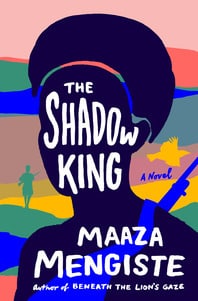
by Maaza Mengiste
The Shadow King: A Novel by Maaza Mengiste is a book happened to offer two often overlooked threads of history. The first is Mussolini’s 1935 invasion of Ethiopia. The second one I am most interested in is the women soldiers who were left out of the historical record. I highly recommend The Shadow King. It is a gorgeously crafted and unputdownable exploration of female power and what it means to be a woman at war.
Hirut and Aster come alive in Maaza Mengiste talented writing. Their struggles to be seen as equal in a society at war is engaging. Hirut’s plan to create a shadow kingpin the absence of Emperor Haile Selassie is one that turns defeat into victory.
Goodreads provides a good overview of the book.
With the threat of Mussolini’s army looming, recently orphaned Hirut struggles to adapt to her new life as a maid in Kidane and his wife Aster’s household. Kidane, an officer in Emperor Haile Selassie’s army, rushes to mobilize his most muscular men before the Italians invaded. His initial kindness to Hirut shifts into flinty cruelty when she resists his advances. Hirut finds herself tumbling into a new world of thefts and violations, betrayals, and overwhelming rage. Meanwhile, Mussolini’s technologically advanced army prepared for an easy victory. Hundreds of thousands of Italians―Jewish photographer Ettore among them―march on Ethiopia seeking adventure.
As the war begins in earnest, Hirut, Aster, and the other women long to do more than care for the wounded and bury the dead. When Emperor Haile Selassie goes into exile and Ethiopia quickly loses hope, Hirut offers a plan to maintain morale. She helps disguise a gentle peasant as the emperor and soon becomes his guard, inspiring other women to take arms against the Italians. But how could she have predicted her war as a prisoner of one of Italy’s most vicious officers, who would force her to pose before Ettore’s camera?
What follows is a gorgeously crafted and unputdownable exploration of female power, with Hirut as the fierce, original, and brilliant voice at its heart. In incandescent, lyrical prose, Maaza Mengiste breathes life into complicated characters on both sides of the battle line, shaping a heartrending, unforgettable exploration of what it means to be a woman at war.
When you buy a book or product using a link on this page, I receive a commission. Thank you for supporting Sharing Jan’s Love blog.
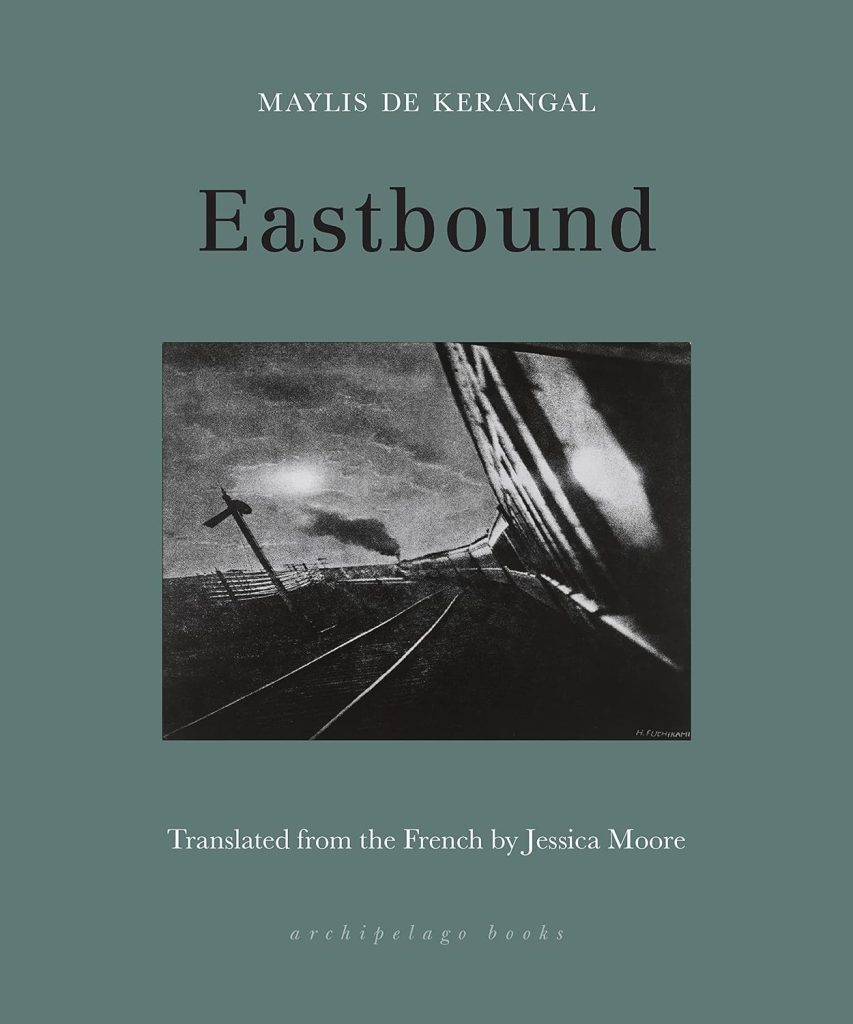
by Maylis De Kerangal
Today, I would like to recommend the book “Eastbound” by Maylis De Kerangal, which has been beautifully translated into English by Jessica Moore. The story revolves around a Russian conscript and a French woman who cross paths on the Trans-Siberian railroad, each trying to escape to the East for different reasons. “Eastbound” is an adventure story that takes you through two vibrant inner worlds.
The book has been listed as one of the five best fiction books 2023 by The New York Times. Maylis De Kerangal has done an excellent job telling the story of two unlikely souls with gorgeously translated, winding sentences that evoke a striking sense of tenderness. The brutality of the surrounding world contrasts sharply with the growing collaboration between the two characters.
As the story progresses, we meet Aliocha, a young Russian conscript who decides to desert the train soon after boarding the Trans-Siberian train with other Russian conscripts. During a midnight smoke in a dark corridor of the train, Aliocha encounters an older French woman, Hélène, for whom he feels an uncanny trust. He urgently asks Hélène, through pantomime and basic Russian, for her help hiding him. They hurry from the filth of his third-class carriage to Hélène’s first-class sleeping car. As Aliocha becomes a hunted deserter, Hélène becomes his accomplice, having her inner landscape of recent memories to contend with.
The Jan Lilien Education Fund sponsors ongoing sustainability and environmental awareness programs. Gifts made this month; I will match dollar-for-dollar. All donations are tax-deductible.
I receive a commission when you buy a book or product using a link on this page. Thank you for supporting Sharing Jan’s Love blog.
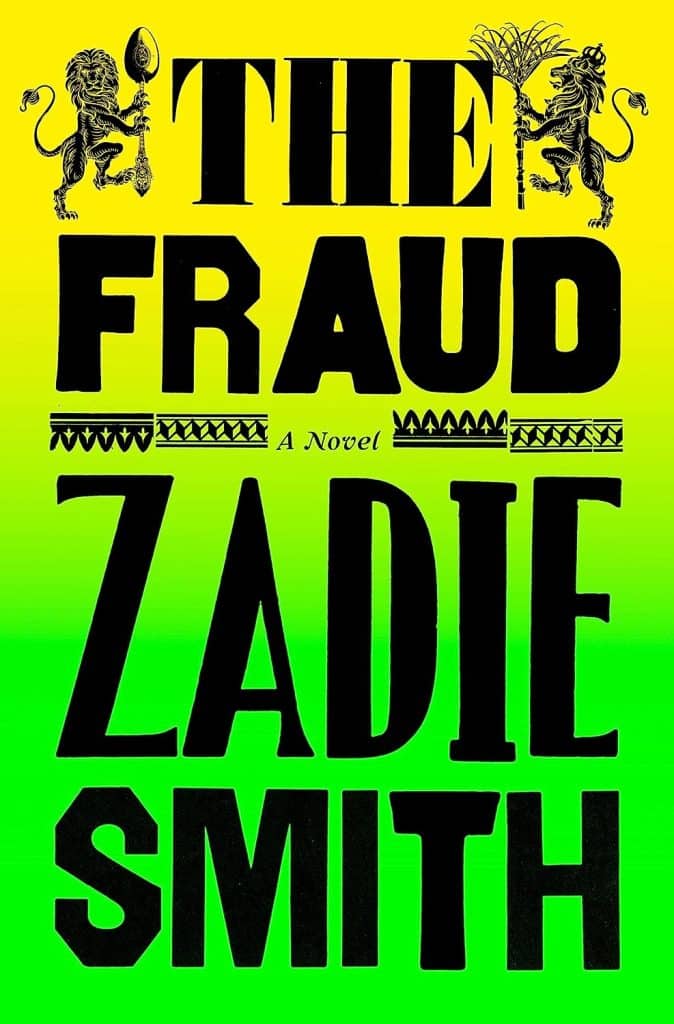
by Zadie Smith
I started reading The Fraud: A Novel by Zadie Smith today. The book is a kaleidoscopic work of historical fiction that revolves around a legal trial that divided Victorian England. The story is set in 1873, where Mrs. Eliza Touchet, a Scottish housekeeper and cousin by marriage of a once-famous novelist, William Ainsworth, lives with him for thirty years. Mrs. Touchet is interested in literature, justice, abolitionism, class, and her cousin’s wives.
However, she is skeptical of her cousin’s talent, Mr. Charles Dickens’ character, and England’s facades, in which nothing is as it seems.
On the other hand, Andrew Bogle grew up enslaved on the Hope Plantation in Jamaica. He knows that every lump of sugar comes at a human cost, that the rich deceive the poor, and that people are more easily manipulated than they realize. When Bogle finds himself in London, a star witness in a celebrated case of imposture, he knows that his future depends on telling the right story.
The “Tichborne Trial” captivates Mrs. Touchet and all of England. The trial involves a lower-class butcher from Australia who claimed he was the rightful heir of a sizable estate and title. The question is whether Sir Roger Tichborne is genuinely who he says he is or whether he’s a fraud. In a world of hypocrisy and self-deception, deciding what’s real is complicated for Mrs. Touchet and Mr. Bogle.
The Fraud is a dazzling novel about truth and fiction, Jamaica and Britain, fraudulence and authenticity, and the mystery of “other people.” It’s based on historical events.
The Jan Lilien Education Fund sponsors ongoing sustainability and environmental awareness programs. Gifts made this month; I will match dollar-for-dollar. All donations are tax-deductible.
I receive a commission when you buy a book or product using a link on this page. Thank you for supporting Sharing Jan’s Love blog.
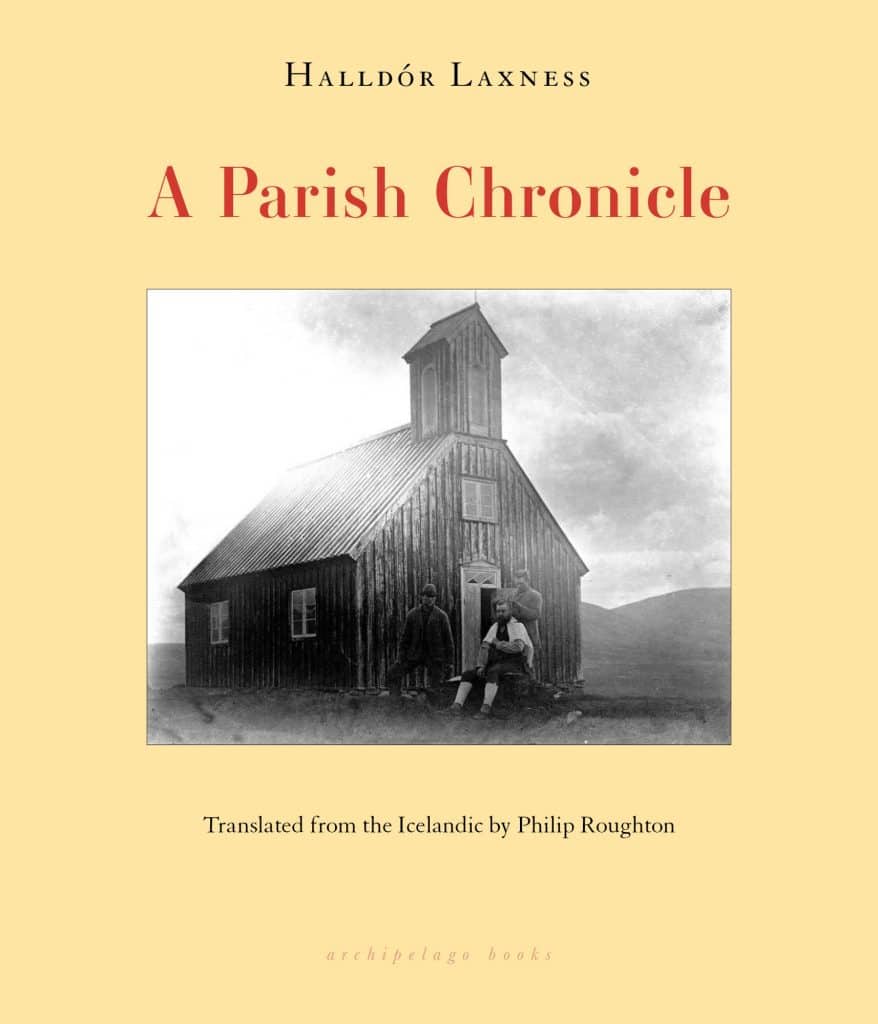
by Halldór Laxness
In “A Parish Chronicle,” celebrated novelist Halldór Laxness weaves an essayistic tale about the unlikely miracles that keep a church—destined to disappear time and again—rooted on the same hillside. Laxness explores the minutiae of history, from the location of the ancient burial mound of national hero Egill Skallagrímsson to the end of the 19th century, where weak-sighted Ólafur and boisterous farmhand Gunna each play unexpected roles in the parish’s enduring survival.
1882. In the still of morning, Ólafur sharpens his scythe on the bone-dry pavestones that separate his farmhouse from the rest of Mosfell Valley, where life revolves around sheep. The sound of his hammer rings out like a high-pitched bell over the tussocky fields. Across the valley, perched on a hill that receives more sunshine than others, stands Mosfell Church. Nearby, the parish priest’s maid Gunna pours her “slosh,” a weak cup of coffee. Further afield in Reykjavík (“down south” as the locals say), the general assembly decides to revisit an old plan to cut costs by consolidating small parishes and calls for the demolition of Mosfell. Yet today a church stands on that same hillside—its sharp steeple silhouetted against the clouds, its crown bell hanging to the left of the altar.
This intimate tribute to life in Laxness‘s home valley also offers a thoughtful commentary on how the peculiarities of certain individuals can shape history. “A Parish Chronicle” is rich with life and detail.
Halldór Laxness (1902-1998) is the undisputed master of modern Icelandic fiction. He was awarded the Nobel Prize in Literature in 1955, “for his vivid epic power which has renewed the great narrative art of Iceland.” His body of work includes novels, essays, poems, plays, stories, and memoirs: more than sixty books in all. His works available in English include Independent People, The Fish Can Sing, World Light, Under the Glacier, Iceland’s Bell, and Paradise Reclaimed.
Philip Roughton has translated the work of Halldór Laxness, Jón Kalman Stefánsson, Kristín Marja Baldursdóttir, and many others. He has twice been awarded the American-Scandinavian Foundation Translation Prize for his renderings of Halldór Laxness‘s work, in 2001 for Iceland’s Bell and in 2015 for Wayward Heroes. He also received the 2016 Oxford-Weidenfeld Prize for his translation of Jón Kalman Stefánsson’s The Heart of Man. He lives in Iceland. Translator Residence: Akureyri, Iceland
Salvatore Scibona is the recipient of a Mildred and Harold Strauss Living Award from the American Academy of Arts and Letters. His first novel, The End, was a finalist for the National Book Award and winner of the Young Lions Fiction Award. His second novel, The Volunteer, was called a “masterpiece” by the New York Times and won the Ohioana Book Award. His books have been translated into ten languages. His work has won a Guggenheim Fellowship, a Pushcart Prize, an O. Henry Award, and a Whiting Award, and the New Yorker named him one of its “20 Under 40” fiction writers. He is the Sue Ann and John Weinberg Director of the Cullman Center for Scholars and Writers at the New York Public Library.
Discover your next favorite book and dive into a world of curated, exciting reads by purchasing through my links. You’ll have access to a diverse selection of books I’ve personally vetted for quality and enjoyment. Additionally, by supporting these selections, you’ll help me continue to provide you with more personalized recommendations. I earn a small commission from your purchase, which allows me to buy and share even more books with you. Your support truly makes a difference!
by Steven Levitsky and Daniel Ziblatt
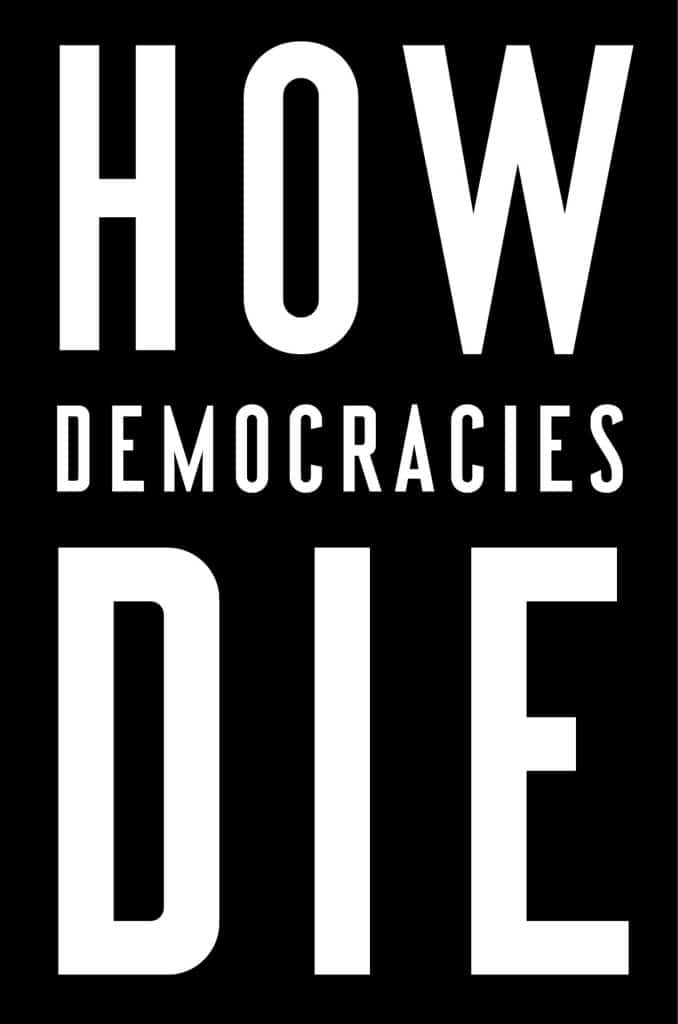
How Democracies Die: What History Reveals About Our Future by Steven Levitsky and Daniel Ziblatt was on my reading list for almost a year. In late December of last year, I started reading it and was in the final chapter on January 6, 2021. Like many of us, I never in my life expected to see a day like that in our country.
This type of event is one the authors talk about in their book.
According to the overview in GoodReads,
Donald Trump’s presidency has raised a question that many of us never thought we’d be asking: Is our democracy in danger? Harvard professors Steven Levitsky and Daniel Ziblatt have spent more than twenty years studying the breakdown of democracies in Europe and Latin America, and they believe the answer is yes. Democracy no longer ends with a bang–in a revolution or military coup–but with a whimper: the slow, steady weakening of critical institutions, such as the judiciary and the press, and the gradual erosion of long-standing political norms. The good news is that there are several exit ramps on the road to authoritarianism. The bad news is that, by electing Trump, we have already passed the first one.
Drawing on decades of research and a wide range of historical and global examples, from 1930s Europe to contemporary Hungary, Turkey, and Venezuela, to the American South during Jim Crow, Levitsky and Ziblatt show how democracies die–and how ours can be saved.
Our democracy is too valuable for us to have it die. We all need to work to preserve and strengthen it. How Democracies Die is a book that everyone needs to read!
by Cristina Henriquez
I began to read “The Great Divide: A Novel” by Cristina Henriquez today. The book stood out for its compassionate exploration of the lives of activists, fishmongers, laborers, journalists, neighbors, doctors, and soothsayers. It sheds light on individuals whose essential contributions history overlooks. The novel weaves these characters’ stories in a unique and compelling narrative structure.
Set against the backdrop of the yet-to-be-built Panama Canal, the book delves into the lives of various characters. Francisco, a local fisherman, resents the foreign powers vying for control of his homeland. His son, Omar, works in the excavation zone, seeking connection in a rapidly changing world.
Sixteen-year-old Ada Bunting, from Barbados, stows away in Panama to find work and fund her ailing sister’s surgery. When she encounters Omar, who collapsed after a grueling shift, she rushes to his aid, setting off a chain of events that will change their lives.
John Oswald, a scientist dedicated to eliminating malaria, is in Panama when his wife, Marian, falls ill. Witnessing Ada’s bravery and compassion, he hires her as a caregiver, setting off a tale of ambition, loyalty, and sacrifice.