
February Hottest Ever

February Was Record Breaking Hot

Estimated reading time: 0 minutes, 17 seconds

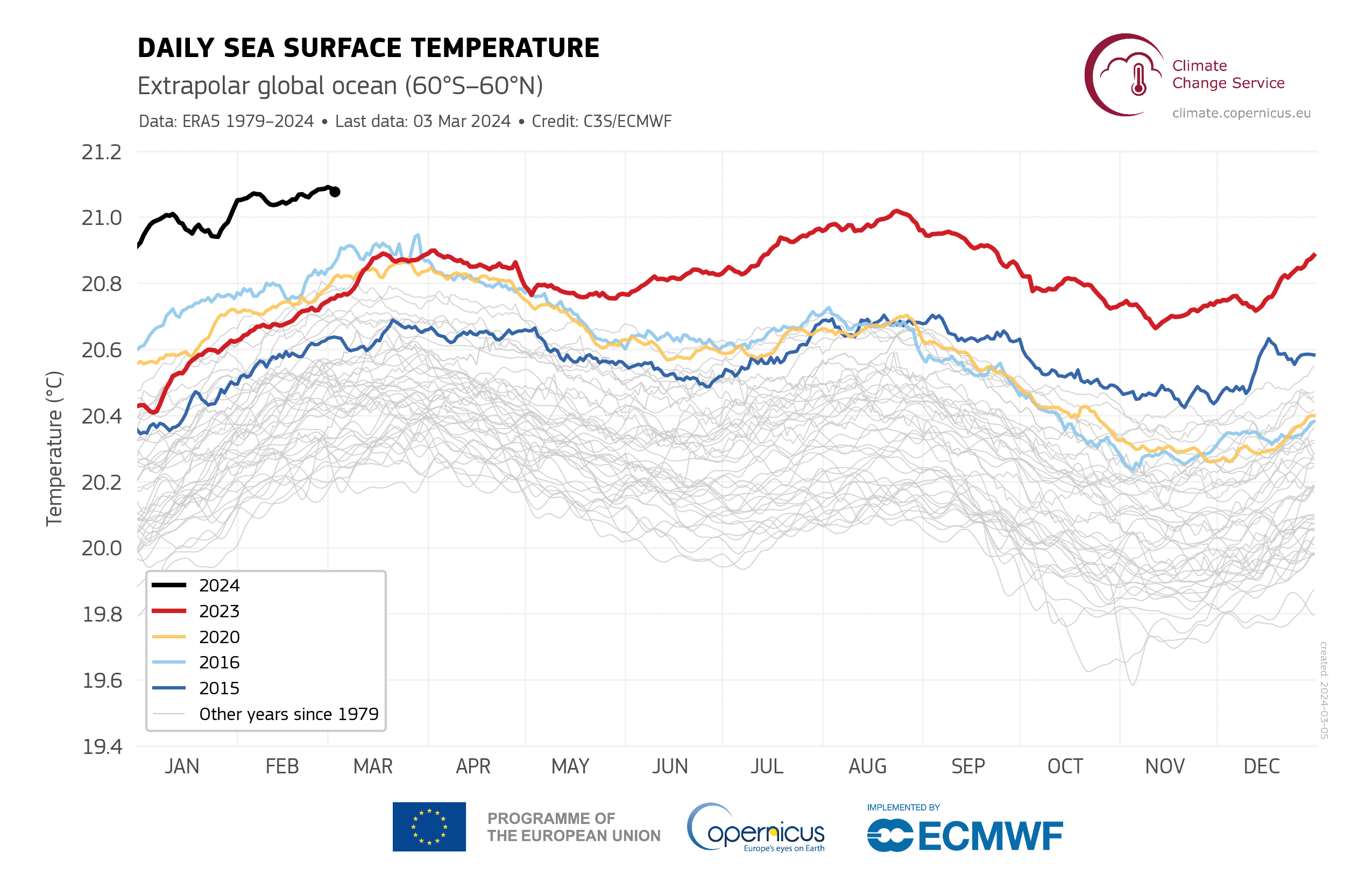
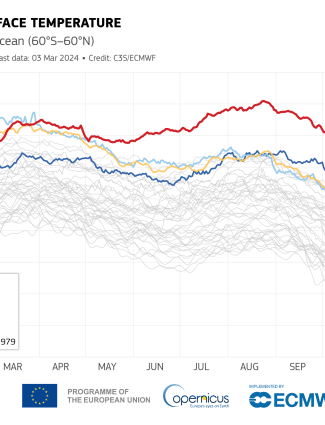
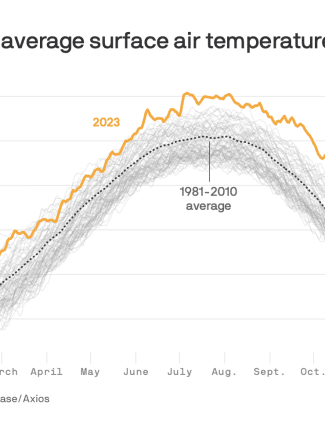
According to the Copernicus Climate Change Service of the European Union, February marked the ninth consecutive month of record-breaking heat, with temperatures 1.56°C  (2.8 degrees Fahrenheit) above preindustrial levels over the nine months.  Copernicus calculated that February was warmer at 1.77 degrees Celsius (3.19 degrees Fahrenheit) than in the late 19th century. Only last December was above preindustrial levels for February.
Plus Two Degrees Celsius

My morning walk began with a chill. However, as Axios reported, 2024 has already started on a record-breaking note, with global temperatures across the surface air and oceans higher than in the previous year, 2023. Global average surface air temperatures have reached or exceeded two °C above preindustrial levels during February, matching spikes first seen in November last year.

1 comment add your comment

Share your thoughts and ideas

This site uses Akismet to reduce spam. Learn how your comment data is processed.

The Jan Lilien Education Fund!

February Hottest Ever
×
Invisible Child

Read: December 2021

Get this book

Invisible Child: Poverty, Survival & Hope in an American City

by Andrea Elliott

Invisible Child: Poverty, Survival & Hope in an American City by Andrea Elliott was a gift from my son Jon. The New York Times selected “Invisible Child” as one of the best books published this year. It is indeed one of the top books on my all-time list.

GoodReads summary provides a good overview,

The riveting, unforgettable story of a girl whose indomitable spirit is tested by homelessness, poverty, and racism in an unequal America—from Pulitzer Prize-winning journalist Andrea Elliott of The New York Times

Invisible Child follows eight dramatic years in the life of Dasani Coates, a child with imagination as soaring as the skyscrapers near her Brooklyn homeless shelter. Born at the turn of a new century, Dasani is named for the bottled water that comes to symbolize Brooklyn’s gentrification and the shared aspirations of a divided city. As Dasani grows up, moving with her tight-knit family from shelter to shelter, this story goes back to trace the passage of Dasani’s ancestors from slavery to the Great Migration north. When Dasani comes of age, New York City’s homeless crisis explodes as the chasm deepens between rich and poor.

In the shadows of this new Gilded Age, Dasani must lead her seven siblings through a thicket of problems: hunger, parental drug addiction, violence, housing instability, segregated schools, and the constant monitoring of the child-protection system. When, at age thirteen, Dasani enrolls at a boarding school in Pennsylvania, her loyalties are tested like never before. As she learns to “code switch” between the culture she left behind and the norms of her new town, Dasani starts to feel like a stranger in both places. Ultimately, she faces an impossible question: What if leaving poverty means abandoning the family you love?

By turns heartbreaking and revelatory, provocative and inspiring, Invisible Child tells an astonishing story about the power of resilience, the importance of family, and the cost of inequality. Based on nearly a decade of reporting, this book vividly illuminates some of the most critical issues in contemporary America through the life of one remarkable girl.

Jan and I were involved and knew that child poverty and homelessness needed repair. In addition, Jan lived on Washington Park across from Ft. Greene Park in 1974-75. We knew the neighborhood where much of the book’s story takes place. 

Before meeting Jan in 1973, I was both a community/tenant organizer and a youth worker. In the latter role, I made weekly hostel trips for eight to ten young boys from East Williamsburg during 1973. The trips were the first the boys had ever been outside of their neighborhood.

Many of them had imaginations like Dasani. They also had her instinct to fight. One of my first tasks was to check for any weapons.

Decades later, when I would see any of them, now adults, they would ask when we were going on another trip. I wish I had met Jan when I made those trips. She would have helped me improve them and document the impact. If I could re-write history, I would have her join me as the second adult on the hostel trips.

After that summer, it was clear my primary skills were as a community/tenant organizer. Over the next few years, my work focused on creating affordable and supportive housing.

Jan and I did meaningful work that made a difference, yet the need for a permanent solution to the crisis remains. The book highlights the crucial role of resilience, the importance of family, and the cost of inequality. As a nation, we cannot undermine those values by breaking up families, impeding resilience, and maintaining racial and economic inequality. 

The current debate in Washington over the Build Back Better legislation needs to focus not on how much we spend but on its impact on children and families

David Brooks, a conservative commentator, has supported these expenditures for what they can do to address this country’s cultural and economic crisis. 

These packages say to the struggling parents and the warehouse workers: I see you. Your work has dignity. You are paving your way. You are at the center of our national vision.

This is how you fortify a compelling moral identity, which is what all of us need if we’re going to be able to look in the mirror with self-respect. This is the cultural transformation that good policy can sometimes achieve. Statecraft is soulcraft.

If you can only read one book this year, this is the one to read. Child poverty, homelessness, and inequality impact all of us. Ending child poverty and homelessness will make us a healthier and more inclusive nation. It is time for a compelling moral call to action!

Subscribe

Contact Us

When you buy a book or product using a link on this page, I receive a commission. Thank you for supporting Sharing Jan’s Love blog.

×
Vulture: A Novel

Read: September 2025

Get this book

Vulture: A Novel

by Phoebe Greenwood

Phoebe Greenwood‘s debut novel, Vulture, immerses readers in the dark heart of Western media and boldly questions its role in the tragedies it reports. This darkly humorous and emotionally charged satire exposes the inner workings of the war news industry. Set in the Middle East, Vulture is a fast-paced critique of war reporting, blending elements of satire with a tragicomic coming-of-age story.

In November 2012, Sara Byrne, an ambitious young journalist, is sent to Gaza to cover the war from The Beach. At the four-star hotel, the staff work tirelessly to provide safety, comfort, and generator-powered internet for the world’s media, all while their own homes and families are under threat.

Sara is determined to use this war to jumpstart her stalled career and win back her lover. When her fixer, Nasser, refuses to help her set up the dangerous story she believes will make her name, she turns to Fadi, the youngest member of a powerful militant family. Driven by the demons of a troubled and entitled childhood, Sara is willing to do anything to prove herself, even if it brings disaster to those around her.


Phoebe Greenwood is a writer and journalist based in London. From 2010 to 2013, she worked as a freelance correspondent in Jerusalem, covering the Middle East for publications such as The Guardian, The Daily Telegraph, and The Sunday Times. From 2013 to 2021, she served as an editor and correspondent at The Guardian, specializing in foreign affairs.


When you purchase a book through one of my links, I earn a small commission that helps support my passion for reading. This contribution allows me to buy even more books to share with you, creating an incredible cycle of discovering great reads together! Your support truly makes a difference!

Enjoy a limited-time offer of 20% off your next book purchase at Bookshop.org!


×
Can You Feel This?

Read: January 2023

Get this book

Can You Feel This?

by Julie Orringer

Today I read Can You Feel This? by Julie Orringer. This short story rekindled so many memories. In the chaos of a maternity ward, memories of tragedy and grief come flooding back for an anxious mother-to-be as she struggles to balance her child’s needs with her healing. Although Jan and I did not have the shadows of tragedy and grief when our sons were born, this short story was more than a page-turner. Can You Feel This? reminded me of the power of the love Jan and I shared.

When our second son was born, we almost had him at home or in the as we waited too long. In Can, You Feel This? , that was not the case. Both children had two loving parents but also grandparents.

When Jan had the first of several hospitalizations, she was in the hospital where her mother died. Jan told me her feelings, and I comforted her, but I could not fully comprehend her angst.

Can You Feel This? is part of Inheritance, a collection of five stories about secrets, unspoken desires, and dangerous revelations between loved ones. Each Inheritance piece can be read or listened to in a single setting. By yourself, behind closed doors, or shared with someone you trust. This is the second one in the series I have read. The previous one was Everything That my Mother Taught Me.

The Goodreads summary provides an overview,

Rushed into an emergency cesarean section, a woman finds herself in the same hospital where her suicidal mother died. She’s buried the trauma of her mother’s last hours—and also the dread that she might be just as vulnerable to breaking. As the new mother relives one crisis in the midst of another, prize-winning author Julie Orringer turns the joyous event of birth into a harrowing, poignant short story.


The Jan Lilien Education Fund sponsors ongoing sustainability and environmental awareness programs. Gifts made this month; I will match dollar-for-dollar. All donations are tax-deductible.

Subscribe

Contact Us

I receive a commission when you buy a book or product using a link on this page. Thank you for supporting Sharing Jan’s Love blog.


×
We Were Eight Years in Power

Read: September 2020

Get this book

We Were Eight Years in Power

by Ta-Nehisi Coates

We Were Eight Years in Power by Ta-Nehisi Coates is a collection featuring the landmark essay The Case for Reparations he wrote for The Atlantic. Even though I am a subscriber to The Atlantic and have read many of the pieces, this is a must-read book as it reflects on race, Barack Obama’s presidency, and its jarring aftermath, including the election of Donald Trump.

We were eight years in power as the lament of Reconstruction-era black politicians as the American experiment in multiracial democracy ended with the return of white supremacist rule in the South. In this sweeping collection of new and selected essays, Ta-Nehisi Coates explores the tragic echoes of that history in our own time: the unprecedented election of a black president followed by a vicious backlash that fueled the election of the man Coates argues is America’s first white president.

But the story of these present-day eight years is not just about presidential politics. This book also examines the new voices, ideas, and movements for justice that emerged over this period and the effects of the persistent, haunting shadow of our nation’s old and unreconciled history. Coates powerfully examines the events of the Obama era from his intimate and revealing perspective:” the point of view of a young writer who begins the journey in an unemployment office in Harlem and ends it in the Oval Office, interviewing a president.

We Were Eight Years in Power features Coatesa’s iconic essays first published in The Atlantic, including Fear of a Black President, The Case for Reparations, and The Black Family in the Age of Mass Incarceration, along with eight fresh essays that revisit each year of the Obama administration through Coate’s own experiences, observations, and intellectual development, capped by a bracingly original assessment of the election that fully illuminated the tragedy of the Obama era. We Were Eight Years in Power is a vital account of modern America, from one of the definitive voices of this historic moment.

I recommend this book to all readers.

Subscribe

Contact Us

×
Maggie; or, A Man and a Woman Walk Into a Bar

Read: December 2025

Get this book

Maggie, or A Man and a Woman Walk Into a Bar

by Katie Yee

In the style of Jenny Offill and inspired by Nora Ephron‘s humorous and poignant writing on heartbreak and womanhood, “Maggie, or A Man and a Woman Walk Into a Bar” by Katie Yee is a masterclass in transforming personal tragedy into bold comedy. This debut novel has been recognized as a New York Times Notable Book and in Time’s list of 100 Must-Read Books of 2025, along with features in many other publications.

A man and a woman walk into a restaurant. The woman expects a lovely night filled with endless plates of samosas. Instead, she finds out her husband is having an affair with a woman named Maggie.

A short while after, her chest starts to ache. She walks into an examination room, where she finds out the pain in her breast isn’t just heartbreak—it’s cancer. She decides to call the tumor Maggie.

Unfolding in fragments over the following months, Maggie, or a Man and a Woman Walk Into a Bar follows the narrator as she embarks on a journey of grief, healing, and reclamation. She starts talking to Maggie (the tumor), getting acquainted with her body’s new inhabitant. She overgenerously creates a “Guide to My Husband: A User’s Manual” for Maggie (the other woman), hoping to ease the process of discovering her ex-husband’s whims and quirks. She turns her children’s bedtime stories into retellings of Chinese folklore passed down by her mother, in an attempt to help them fall in love with their shared culture—and perhaps save herself in the process.


Katie Yee is a writer based in Brooklyn. She has received fellowships from the Center for Fiction, the Asian American Writers’ Workshop, and Kundiman. Her work has been published in the Los Angeles Review of Books, No Tokens, The Believer, Washington Square Review, Triangle House, Epiphany, and Literary Hub. During the day, she works at the Brooklyn Museum, and at night, she writes—often under the watchful eye of her judgmental rescue dog, Ollie.


Discover your next favorite book and dive into a world of curated, exciting reads by purchasing through my links. You’ll have access to a diverse selection of books that I’ve personally vetted to ensure quality and enjoyment. Additionally, by supporting these selections, you’ll help me continue to provide you with more personalized recommendations. I earn a small commission from your purchase, which allows me to buy and share even more books with you. Your support truly makes a difference!


×
Weather

Read: March 2022

Get this book

Weather: A Novel

by Jenny Offil

Weather: A Novel by Jenny Offil was a book that I was confused and uncertain if I wanted to finish for the first few pages. I am delighted that I did, and I highly recommend this book. Its brief diary-like dispatches about life in our time when we sense that we may all be doomed to a climate catastrophe made this a book I truly enjoyed reading. The subtext of the rise of right-wing strongmen in the USA and abroad adds to the crisis her dispatches describe.

Her Obligatory Note of Hope challenges all of us to engage in solutions instead of accepting doom.

How can we contribute to the common good? There are people all over the world trying to answer these questions. In big ways but also in small ways. In grand leaps but also in fits and starts.

I always thought it was ridiculous to try and fight for social change when I couldn’t even get my own house in order. How could a meat-eating, plane-flying, march-hating person like me ever find a place in the climate justice movement? But then I started to read about all the different ways ordinary people were refusing to give into fatalism and were exploring the possibilities of what they could do, what they might fight for in this half-ruined world of ours.

There were saints among these accidental activists, but also stone-cold hypocrites like me. Slowly, I began to see collective action as the antidote to my dithering and despair.

There’s a way in for everyone. Aren’t you tired of all this fear and dread?

Goodreads provides an overview of the book if you are not yet convinced to read it.

 Lizzie Benson is a very relatable woman who slid into her job as a librarian without a traditional degree. But this gives her a vantage point from which to practice her other calling: a fake shrink. She has tended to her God-haunted mother and her recovering addict brother for years. They have both stabilized for the moment, but Lizzie has little chance to spend her new free time with her husband and son before her old mentor, Sylvia Liller, proposes. She wants to hire Lizzie to answer the mail she receives: left-wingers worried about climate change and right-wingers concerned about the decline of western civilization. Sylvia has become famous for her prescient podcast, Hell and High Water, and wants to hire Lizzie to answer the mail she receives: from left-wingers worried about climate change and right wingers worried about the decline of western civilization.

As Lizzie dives into this polarized world, she begins to wonder what it means to keep tending your own garden once you’ve seen the flames beyond its walls. When her brother becomes a father and Sylvia a recluse, Lizzie is forced to address the limits of her own experience. But she still tries to save everyone, using everything she’s learned about empathy and despair, conscience and collusion, floundering the library stacks her years of wa.. And all the while the voices of the city keep floating in—funny, disturbing, and increasingly mad.

Register to Attend Celebrate Jan Day

Subscribe

Contact Us

When you buy a book or product using a link on this page, I receive a commission. Thank you for supporting Sharing Jan’s Love blog.

×