

Refugee and Asylum Advocacy Training
Yesterday my wife and I participated in a Refugee and Asylum Action Advocacy Training sponsored by HIAS. America is an idea, and now is the time to welcome the stranger and protect the refugee.
Continue reading →
Yesterday my wife and I participated in a Refugee and Asylum Action Advocacy Training sponsored by HIAS. America is an idea, and now is the time to welcome the stranger and protect the refugee.
Continue reading →
Richard W. Brown
On January 2, 2019, for the first time in my adult life, I had neither work nor school to do today. Retirement is such a strange word. As a friend said to me, he did not retire; he retired the car. The first time I heard it, I laughed. Today, I am unsure if new tires are needed. My life’s work has been to repair the world—Tikun Olam.
I did not know that word as a child and even as a young adult. When I married the love of my life in 1975, she helped me find a spiritual home in Judaism. Finding a spiritual home has helped me gain focus on my life and meaning to my work.
Continue reading →Subscribe to Sharing Jan's Love Newsletter!
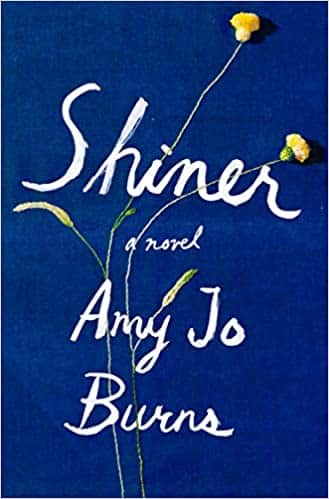
by Amy Jo Burns
Shiner: A Novel by Amy Jo Burns was my twenty-second of the year, and I achieved my Goodreads 2022 Reading Challenge. An hour from the closest West Virginia mining town, fifteen-year-old Wren Bird lives in a secluded mountain cabin with her parents. They have no car, mailbox, or visitors- except for her mother’s lifelong best friend.
Wren’s narration of her discoveries of the secrets of the past over one summer drives the novel and makes it a page-turner. Her mother, Ruby, and her best friend, Ivy, are two strong women who dreamed of escaping the West Virginia mountains. The male characters play secondary roles in the novel, as they should. Shiner is a feminist book about how women can and must take back their stories and lives from men whose power is an illusion.
I highly recommend this novel and look forward to reading other books by Amy Jo Burns. It was the perfect book to finish my reading challenge. As I continue to read this year, I hope to find another of her books on my shelf.
Goodreads provides an overview.
Every Sunday, Wren’s father delivers winding sermons in an abandoned gas station. He takes up serpents and praises the Lord for his blighted white eye, proof of his divinity and key to his hold over the community, Wren, and her mother.
But over the course of one summer, a miracle performed by Wren’s father quickly turns to tragedy. As the order of her world begins to shatter, Wren must uncover the truth of her father’s mysterious legend and her mother’s harrowing history and complex bond with her best friend. And with that newfound knowledge, Wren can imagine a different future for herself than she has been told to expect.
Rich with epic love and epic loss, and diving deep into a world that is often forgotten but still part of America, Shiner reveals the hidden story behind two generations’ worth of Appalachian heartbreak and resolve. Amy Jo Burns brings us a smoldering, taut debut novel about modern female myth-making in a land of men-and one young girl who must ultimately open her eyes.
When you buy a book or product using a link on this page, I receive a commission. Thank you for supporting Sharing Jan’s Love blog.
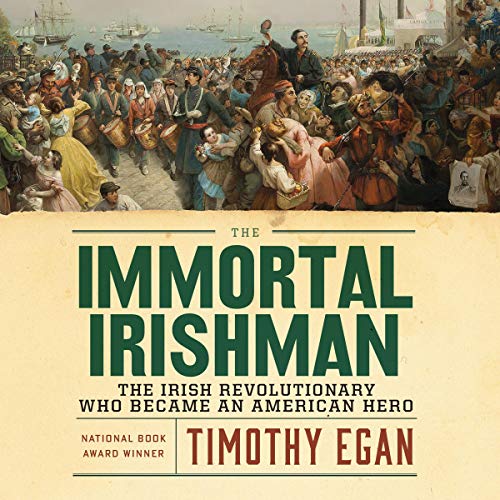
by Timothy Egan
The Immortal Irishman: The Irish Revolutionary Who Became an American Hero by Timothy Egan is a book I started reading as The Worst Hard Timesincluded the first fifty pages.
I often only read a few pages and then return the book to the e-library. The Immortal Irishman was not the case, and I could not stop reading and borrowed the book immediately.
I had never heard of Thomas Francis Meagher or his life in Ireland or America. The story was fascinating, unique, and essential.
The Irish-American story, with all its twists and triumphs, is told through the improbable life of one man. A dashing young orator during the Great Famine of the 1840s, in which a million of his Irish countrymen died, Thomas Francis Meagher led a failed uprising against British rule, for which he was banished to a Tasmanian prison colony. He escaped and six months later was heralded in the streets of New York – the revolutionary hero, back from the dead, at the dawn of the great Irish immigration to America.
Meagher’s rebirth in America included his leading the newly formed Irish Brigade from New York in many of the fiercest battles of the Civil War – Bull Run, Antietam, Fredericksburg. Twice shot from his horse while leading charges, left for dead in the Virginia mud, Meagher’s dream was that Irish-American troops, seasoned by war, would return to Ireland and liberate their homeland from British rule.
The hero’s last chapter, as territorial governor of Montana, was a romantic quest for a true home in the far frontier. His death has long been a mystery to which Egan brings haunting, colorful new evidence.
I recommend this book.
by Richard Powers
I started reading “Playground: A Novel” by Richard Powers today. This remarkable new novel comes from the Pulitzer Prize-winning and New York Times best-selling author of “The Overstory” and “Bewilderment.” Even more astonishing is that this marks my three hundredth book since I embarked on this reading journey on January 1, 2019! I’m also enjoying “Judaism Is About Love,” which means “Playground: A Novel” will be my 98th or 99th book in 2024.
In this sweeping, panoramic novel, four lives intertwine, showcasing Richard Powers at the height of his skills. Twelve-year-old Evie Beaulieu finds herself at the bottom of a swimming pool in Montreal, strapped to one of the world’s first aqua lungs. Ina Aroita grows up on naval bases across the Pacific, finding solace in art as her only home. At an elite high school in Chicago, two opposites bond over a three-thousand-year-old board game: Rafi Young gets lost in literature, while Todd Keane’s work leads to a startling breakthrough in artificial intelligence.
Their paths converge on the history-laden island of Makatea in French Polynesia, once known for its phosphorus deposits that helped sustain the world. This tiny atoll has been chosen for a groundbreaking venture: a plan to create floating, autonomous cities to venture out onto the open sea. However, the island’s residents must vote to approve the project or turn the seasteaders away.
Set against the world’s most enormous ocean backdrop, this awe-inspiring book delves into the last wild place we have yet to colonize, exploring a still-unfolding oceanic narrative. It beautifully weaves rich characters, profound themes of technology and the environment, and a deep examination of our shared humanity—and exploration that only Richard Powers can deliver.
When you purchase a book through one of my links, I earn a small commission that helps support my passion for reading. This contribution allows me to buy even more books to share with you, creating an incredible cycle of discovering great reads together! Your support truly makes a difference!
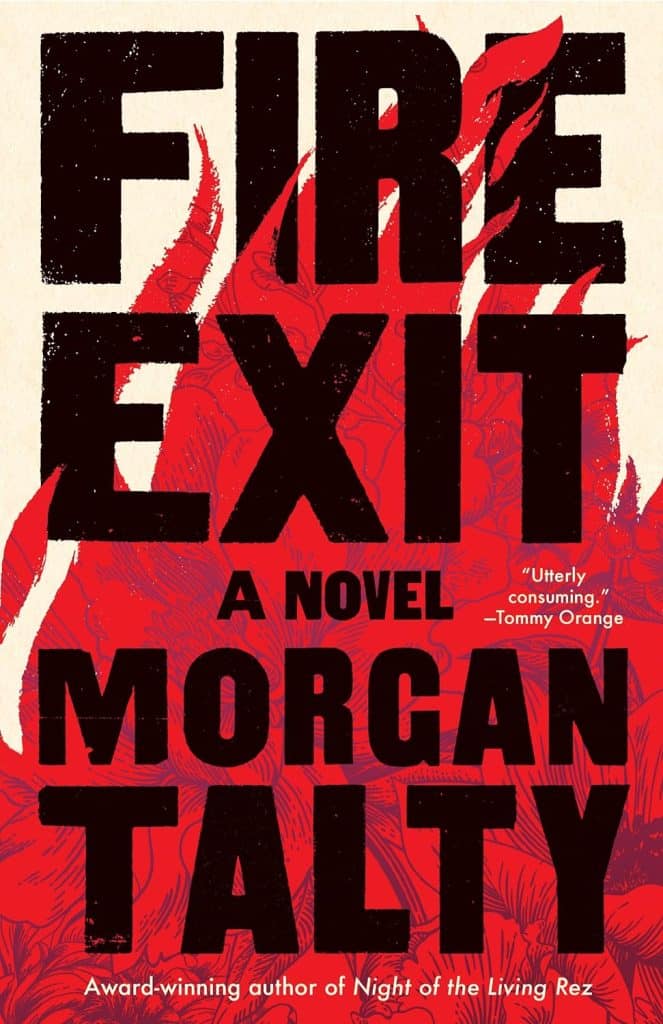
by Morgan Talty
Today, I started reading the novel “Fire Exit” by Morgan Talty. The book is the debut novel of the award-winning author of “Night of the Living Rez,” Morgan Talty. “Fire Exit” is a compelling story that explores the themes of family, legacy, culture, and our complex obligations toward one another. These are themes that I have focused on after losing my wife.
The protagonist, Charles Lamosway, lives by a river near Maine’s Penobscot Reservation. He watches his neighbor Elizabeth grow up, from her early days to her twenties, but he holds a secret: Elizabeth is his daughter, a truth he can no longer conceal.
Charles becomes anxious when he hasn’t seen Elizabeth for weeks. As he tries to hold on to his home, look after his friend Bobby and his mother Louise, and grapple with his past, Charles is forced to confront painful memories and ask himself difficult questions. Is it his place to share the secret about Elizabeth, and would she want to know the truth even if it means losing everything she has ever known?
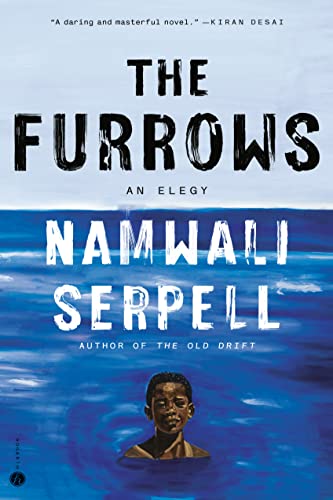
by Namwali Serpell
The Furrows: A Novel by Namwali Serpell is a bold exploration of memory and mourning that twists unexpectedly into a story of mistaken identity, double consciousness, and the wishful—and sometimes willful—longing for reunion with those we’ve lost. Namwali Serpell’s remarkable new novel captures the uncanny experience of grief, the way the past breaks over the present like waves in the sea. I highly recommend this book.
The Furrows: A Novel reminded me of my longing to be reunited with Jan. I know it is impossible, but that does not keep me from desiring the unattainable. Reading this novel helped me remind me that Jan is still with me in spirit and that is far better than reuniting with her.
The Goodreads summary provides an overview,
Cassandra Williams is twelve, and her little brother Wayne is seven. One day, an accident happens when they’re alone together, and Wayne is lost forever. Or so it seems. Though his body is never recovered, their mother, unable to give up hope, launches an organization dedicated to missing children. Their father leaves and starts another family somewhere else.
As C grows older, she sees her brother everywhere: in coffee shops, airplane aisles, subway cars, and cities on either coast. Here is her brother’s more aging face, the light in his eyes, his lanky limbs, the way he seems to recognize her too. But it can’t be, of course. Or can it? Disaster strikes again, and C meets a man, both mysterious and strangely familiar, who is also searching for someone and his place in the world. His name is Wayne.
Namwali Serpell’s remarkable novel captures the ongoing and uncanny experience of grief–the past breaking over the present like waves in the sea. The Furrows is a bold and beautiful exploration of memory and mourning that twists unexpectedly into a masterful story of black identity, double consciousness, and the wishful and sometimes willful longing for reunion with those we’ve lost.
The Jan Lilien Education Fund sponsors ongoing sustainability and environmental awareness programs. Gifts made this month; I will match dollar-for-dollar. All donations are tax-deductible.
I receive a commission when you buy a book or product using a link on this page. Thank you for supporting Sharing Jan’s Love blog.
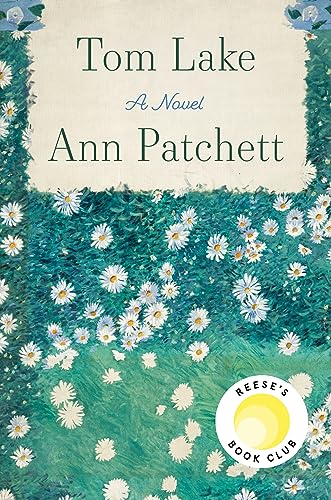
by Ann Patchett
Today, I began reading Tom Lake by Ann Patchett. The novel beautifully explores family, love, and growing up. Patchett once again proves herself as one of America’s finest writers. Both hopeful and mournful, it explores happiness even when the world falls apart.
The story follows Lara’s three daughters as they return to the family’s orchard in Northern Michigan in the spring of 2020. While picking cherries, they ask their mother about Peter Duke, a famous actor with whom she had a romance years before at a theater company called Tom Lake.
As Lara reminisces, her daughters confront their own lives and relationships with their mother, leading them to reevaluate everything they thought they knew. With its hopeful and mournful tone, the novel is a testament to the transformative power of understanding what happiness truly means, even amid chaos. Patchett’s compelling narrative artistry and profound insights into family dynamics weave a rich and luminous story, showcasing why she is one of our time’s most revered and acclaimed literary talents.
I have also read Patchett’s Bel Canto, a compelling tale that explores themes of strength, vulnerability, love, and confinement. It ultimately tells an inspiring story of transcendent romance.
The Jan Lilien Education Fund sponsors ongoing sustainability and environmental awareness programs. Gifts made this month; I will match dollar-for-dollar. All donations are tax-deductible.
I receive a commission when you buy a book or product using a link on this page. Thank you for supporting Sharing Jan’s Love blog.