

Refugee and Asylum Advocacy Training
Yesterday my wife and I participated in a Refugee and Asylum Action Advocacy Training sponsored by HIAS. America is an idea, and now is the time to welcome the stranger and protect the refugee.
Continue reading →
Yesterday my wife and I participated in a Refugee and Asylum Action Advocacy Training sponsored by HIAS. America is an idea, and now is the time to welcome the stranger and protect the refugee.
Continue reading →
Richard W. Brown
On January 2, 2019, for the first time in my adult life, I had neither work nor school to do today. Retirement is such a strange word. As a friend said to me, he did not retire; he retired the car. The first time I heard it, I laughed. Today, I am unsure if new tires are needed. My life’s work has been to repair the world—Tikun Olam.
I did not know that word as a child and even as a young adult. When I married the love of my life in 1975, she helped me find a spiritual home in Judaism. Finding a spiritual home has helped me gain focus on my life and meaning to my work.
Continue reading →Subscribe to Sharing Jan's Love Newsletter!
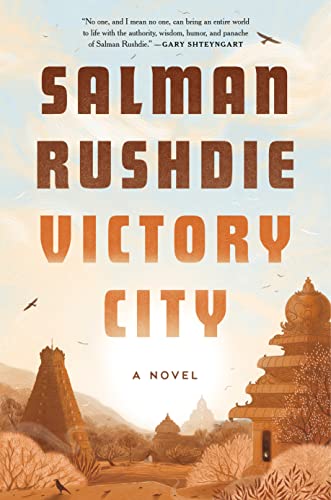
by Salman Rushdie
Victory City: A Novel by Salman Rushdie is an epic tale of a woman who breathes a fantastical empire into existence, only to be consumed by it over the centuries from the transcendent imagination of Booker Prize-winning, internationally bestselling author Salman Rushdie. It is well written and was a page-turner from page one to the end. I highly recommend this novel and encourage everyone to read it.
Brilliantly styled as a translation of an ancient epic, this is a saga of love, adventure, and myth that is a testament to storytelling’s power. After witnessing her mother’s death, the grief-stricken Pampa Kampana becomes a vessel for the goddess Parvati, who begins to speak out of the girl’s mouth. I was hooked when Pampa Kampana provided the seeds that created Victory City out of thin air.
David Remnick’s interview with Salman Rushdie in The New Yorker provided background I would have missed.
“The first kings of Vijayanagara announced, quite seriously, that they were descended from the moon,” Rushdie said. “So when these kings, Harihara and Bukka, announce that they’re members of the lunar dynasty, they’re associating themselves with those great heroes. It’s like saying, ‘I’ve descended from the same family as Achilles.’ Or Agamemnon. And so I thought, Well, if you could say that, I can say anything.”
Above all, the book is buoyed by the character of Pampa Kampana, who, Rushdie says, “just showed up in my head” and gave him his story, his sense of direction. Rushdie’s pleasure in writing the novel was in “world building” and, at the same time, writing about a character building that world: “It’s me doing it, but it’s also her doing it.” The pleasure is infectious. “Victory City” is an immensely enjoyable novel. It is also an affirmation. At the end, with the great city in ruins, what is left is not the storyteller but her words:
The Goodreads summary provides a brief overview,
In the wake of an insignificant battle between two long-forgotten kingdoms in fourteenth-century southern India, a nine-year-old girl has a divine encounter that will change the course of history. After witnessing her mother’s death, the grief-stricken Pampa Kampana becomes a vessel for the goddess Parvati, who begins to speak out of the girl’s mouth. Granting her powers beyond Pampa Kampana’s comprehension, the goddess tells her that she will be instrumental in the rise of a great city called Bisnaga–literally victory city–the wonder of the world.
Over the next two hundred and fifty years, Pampa Kampana’s life becomes deeply interwoven with Bisnaga’s, from its literal sowing out of a bag of magic seeds to its tragic ruination in the most human of ways: the hubris of those in power. Whispering Bisnaga and its citizens into existence, Pampa Kampana attempts to make good on Parvati’s task: giving women equal agency in a patriarchal world. But all stories have a way of getting away from their creator, and Bisnaga is no exception. As years pass, rulers come and go, battles are won and lost, and allegiances shift, the very fabric of Bisnaga becomes an ever more complex tapestry–with Pampa Kampana at its center.
The Jan Lilien Education Fund sponsors ongoing sustainability and environmental awareness programs. Gifts made this month; I will match dollar-for-dollar. All donations are tax-deductible.
I receive a commission when you buy a book or product using a link on this page. Thank you for supporting Sharing Jan’s Love blog.
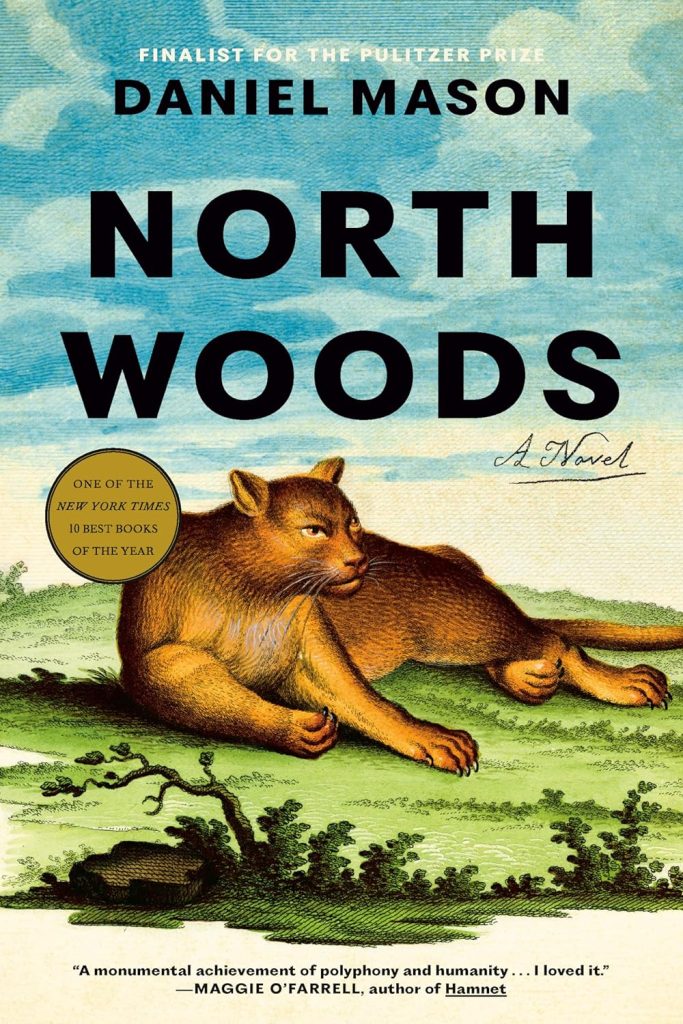
by Daniel Mason
I recommend reading “North Woods: A Novel” by Daniel Mason today. It is the story of two young lovers who leave a Puritan colony and find shelter in a humble cabin in the woods. They are unaware this cabin will become home to a succession of extraordinary human and nonhuman characters. North Woods” has been named one of the ten best books of 2023 by both the New York Times Book Review and the Washington Post.
An English soldier who was destined for glory decides to abandon the battlefields of the New World to dedicate himself to growing apples. Meanwhile, a pair of spinster twins navigate war and famine, dealing with envy and desire. A crime reporter discovers an ancient mass grave but soon realizes the earth refuses to give up its secrets. In the same town, a lovelorn painter, a sinister con man, a stalking panther, and a lusty beetle are all present. As the inhabitants confront the wonder and mystery around them, they realize that the dark, raucous, and beautiful past is still alive.
This remarkable and highly imaginative novel by Pulitzer Prize finalist Daniel Mason is full of love, insanity, humor, and optimism. North Woods follows the cycles of history, nature, and language to reveal the numerous, enchanting ways we are connected to our surroundings, history, and each other. It is not just a memorable story about secrets and fates but a perspective on the world that poses the timeless question: How can we continue living even after we are gone?
The Jan Lilien Education Fund sponsors ongoing sustainability and environmental awareness programs. Gifts made this month; I will match dollar-for-dollar. All donations are tax-deductible.
I receive a commission when you buy a book or product using a link on this page. Thank you for supporting Sharing Jan’s Love blog.
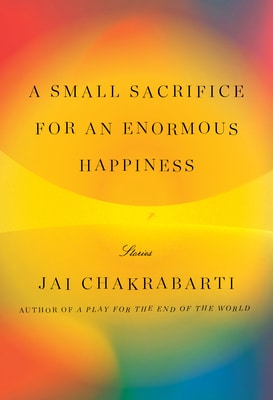
by Jai Chakrabarti
I recently discovered an excellent short story collection called A Small Sacrifice for an Enormous Happiness: Stories by Jai Chakrabarti. This author won the National Jewish Book Award for debut fiction with his novel A Play for the End of the World, and it is clear that his talent extends to the short story form as well.
The stories in this collection follow men and women as they navigate transformations and familial bonds across countries and cultures. Each story is unique and captivating, but the one that struck me was the title story about a closeted gay man in 1980s Kolkata who seeks to have a child with his lover’s wife. Chakrabarti’s skill as a storyteller is on full display in this story and throughout the collection.
I highly recommend A Small Sacrifice for an Enormous Happiness: Stories if you want a book exploring love and family’s complexities in uncertain times. Each story is a masterful exploration of what it means to cultivate a family across borders, religions, and races. I look forward to reading more by Jai Chakrabarti in the future.
The Goodreads summary provides an overview,
In the fourteen masterful stories of this collection, Jai Chakrabarti crosses continents and cultures to explore what it means to cultivate a family across borders, religions, and races today.
In the title story, a closeted gay man in 1980s Kolkata seeks to have a child with his lover’s wife. An Indian widow, engaged to a Jewish man, struggles to balance her cultural identity with the rituals and traditions of her newfound family. An American musician travels to see his guru for the final time—and makes a promise he cannot keep. A young woman from an Indian village arrives in Brooklyn to care for the toddler of a biracial couple. And a mystical agent is sent by a mother to solve her son’s domestic problems.
Throughout, the characters’ most vulnerable desires shape life-altering decisions as they seek to balance their needs against those of the people they hold closest.
The Jan Lilien Education Fund sponsors ongoing sustainability and environmental awareness programs. Gifts made this month; I will match dollar-for-dollar. All donations are tax-deductible.
I receive a commission when you buy a book or product using a link on this page. Thank you for supporting Sharing Jan’s Love blog.
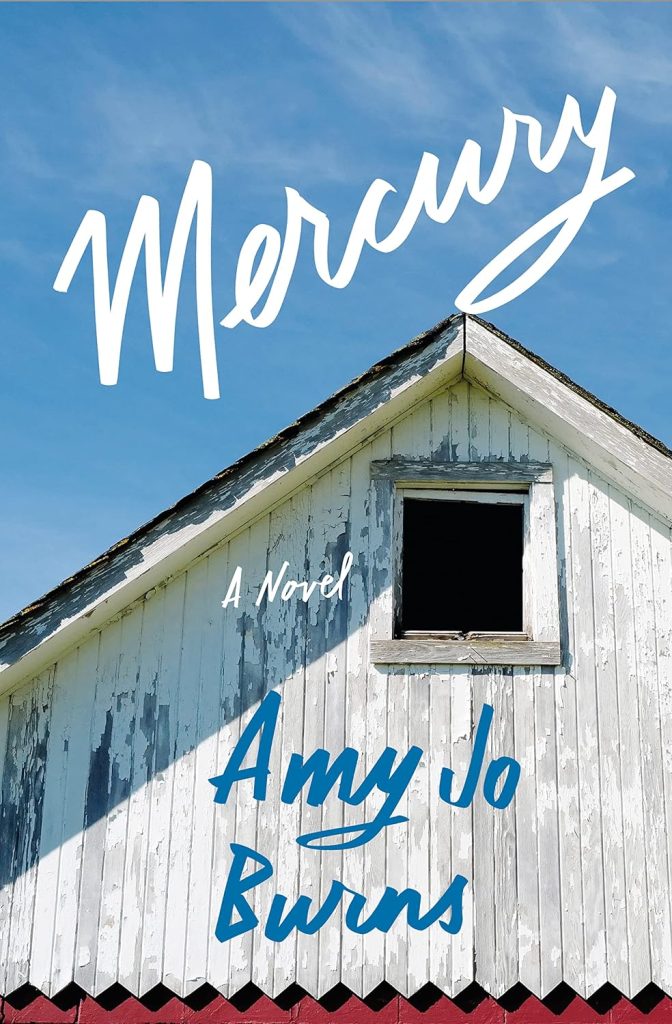
by Amy Jo Burns
Today, I started reading Mercury: A Novel about a roofing family. The family’s bond of loyalty is tested when they uncover a long-hidden secret at the heart of their blue-collar town. The book is written by Amy Jo Burns, the author of the critically acclaimed novel Shiner, which I read and enjoyed in 2022. I highly recommend it.
The story is set in 1990, and it follows the journey of a seventeen-year-old girl named Marley West, who arrives in the river valley town of Mercury, Pennsylvania. She is a loner who is looking for a place to belong. The first thing she sees when she gets to town is three men standing on a rooftop, and they soon become her whole world.
Marley becomes a young wife to one of the Joseph brothers, The One Who Got Away to another, and an adopted mother to all of them. Marley guides these unruly men as their mother fades away and their roofing business crumbles under the weight of their unwieldy father’s inflated ego. Years later, an eerie discovery in the church attic causes old wounds to resurface, and suddenly, the family’s survival hangs in the balance.
With Marley as their guide, the Joseph brothers must decide whether they can save the family they’ve always known or build something more substantial in its place.
The Jan Lilien Education Fund sponsors ongoing sustainability and environmental awareness programs. Regarding gifts made this month, I will match dollar for dollar. All donations are tax-deductible.
I receive a commission when you buy a book or product using a link on this page. Thank you for supporting Sharing Jan’s Love blog.
by T. C. Boyle
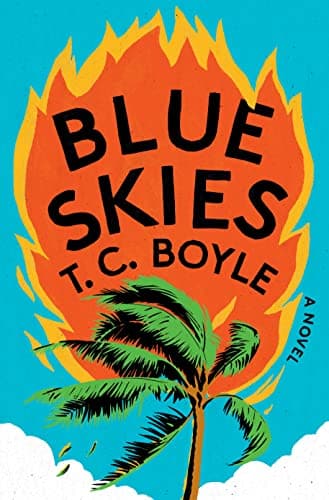
I started reading Blue Skies: A Novel by T. C. Boyle today. The book is an eco-thriller with comedic elements. It explores the relationships between humans and their habitats in a world where natural disasters frequently occur, where “the only truism seems to be that things always get worse.
Denied a dog, a baby, and even a faithful fiancé, Cat suddenly craves a snake: a glistening, writhing creature that can be worn like “jewelry, living jewelry” to match her black jeans. But when the budding social media star promptly loses the young “Burmie” she buys from a local pet store, she inadvertently sets a chain of increasingly dire and outrageous events threatening her survival.
Blue Skies follows the tradition of T. C. Boyle’s finest novels, combining high-octane plotting with biting wit and intelligent social commentary. Here Boyle, one of the most inventive voices in contemporary fiction, transports us to water-logged and heat-ravaged coastal America, where Cat and her hapless, nature-loving family—including her eco-warrior parents, Ottilie and Frank; her brother, Cooper, an entomologist; and her frat-boy-turned-husband, Todd—are struggling to adapt to the “new normal,” in which once-in-a-lifetime natural disasters happen once a week and drinking seems to be the only way to cope.
But there’s more than meets the eye to this compulsive family drama. Lurking beneath the bland façade of twenty-first-century Californians and Floridians attempting to preserve normalcy in the face of violent weather perturbations is a caricature of materialist American society that doubles as a prophetic warning about our planet’s future. Blue Skies deftly explores the often volatile relationships between humans and their habitats, from pet bees and cricket-dependent diets to massive species die-offs and pummeling hurricanes, in which “the only truism seems to be that things always get worse.
The Jan Lilien Education Fund sponsors ongoing sustainability and environmental awareness programs. Gifts made this month; I will match dollar-for-dollar. All donations are tax-deductible.
I receive a commission when you buy a book or product using a link on this page. Thank you for supporting Sharing Jan’s Love blog.
by Daniel Kraus
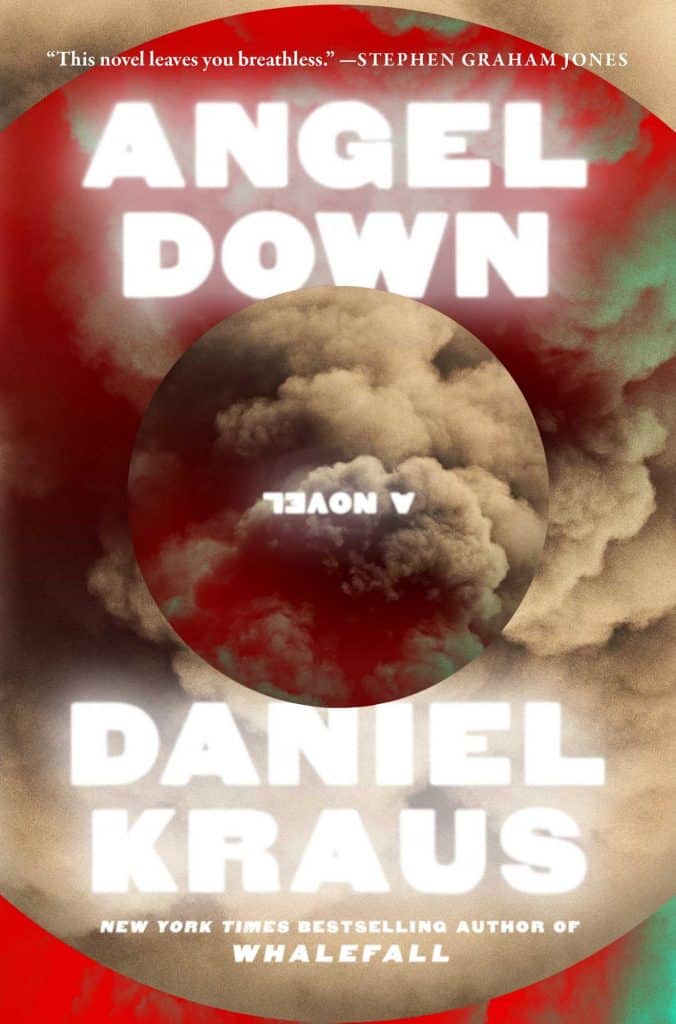
“Angel Down” by Daniel Kraus immerses readers in World War I, weaving a complex tale of survival, supernatural wonder, and moral conflict. Five soldiers on a mission to venture into the perilous No Man’s Land to euthanize a wounded comrade. Instead, they discover a fallen angel. “Angel Down” was recognized as one of the New York Times’ 100 Notable Books of 2025.
Private Cyril Bagger has survived the unspeakable horrors of the Great War by relying on his wits and deception, swindling fellow soldiers at every opportunity. However, his survival instincts are put to the ultimate test when he and four other soldiers are given a deadly mission: to venture into No Man’s Land to end the suffering of a wounded comrade.
What they find amidst the ruined battlefield, however, is not a man in need of mercy, but a fallen angel, seemingly struck down by artillery fire. This celestial being may hold the key to ending the brutal conflict, but the soldiers must suppress their individual desires and work together. As jealousy, greed, and paranoia take hold, the group is torn apart by their inner demons, threatening to transform their angelic encounter into a descent into hell.
Daniel Kraus is a New York Times bestselling author known for his novels, television, and film work. His novel Whalefall received a front-cover review in The New York Times Book Review, won the Alex Award, and was a finalist for the LA Times Book Prize. Recognized as one of the Best Books of 2023 by NPR, The New York Times, the Chicago Tribune, and several other publications.
Kraus coauthored The Shape of Water with Guillermo del Toro, based on the idea they developed for the Oscar-winning film. He also collaborated with del Toro on Trollhunters, which was adapted into the Emmy-winning Netflix series. Additionally, Kraus co-wrote The Living Dead and Pay the Piper with the legendary filmmaker George A. Romero. His novel The Death and Life of Zebulon Finch was named one of Entertainment Weekly’s Top 10 Books of the Year.
Throughout his career, Kraus has received numerous accolades, including the Bram Stoker Award, the Scribe Award, and two Odyssey Awards (for both Rotters and Scowler). He has been featured multiple times as a Library Guild selection and recognized by YALSA as a Best Fiction for Young Adults. His works have been translated into over twenty languages. Daniel Kraus resides in Chicago with his wife. Visit him at DanielKraus.com.
Discover your next favorite book and dive into a world of curated, exciting reads by purchasing through my links. You’ll have access to a diverse selection of books I’ve personally vetted for quality and enjoyment. Additionally, by supporting these selections, you’ll help me continue to provide you with more personalized recommendations. I earn a small commission from your purchase, which allows me to buy and share even more books with you. Your support truly makes a difference!