
Walking in a Mild, Grey Winter

Walking in a Mild, Grey Winter

Estimated reading time: 0 minutes, 59 seconds

Why I Walk“This winter looks good thru the end of the month and into early February,” a fellow walker says to me when our paths cross in Nomehagan Park.

I stop petting his dog and remind him that I will walk whatever winter brings.

“Me too,” he responds.

He might be correct, as we are over eleven degrees above average for January, and the last eight years have been the warmest in recorded history.

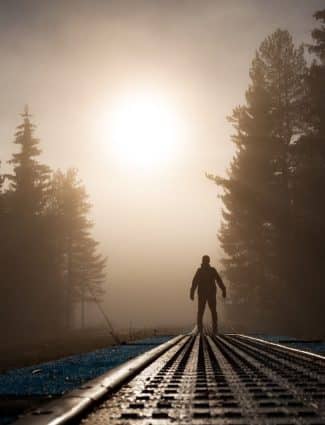
Despite the grey sky that makes it seem colder, I push forward one step at a time to achieve my Apple Watch’s challenge of one hundred thirty-nine minutes of exercise.

The wind is not frost-biting, but it still chills my bones.

One step, one minute, and I make it home!


The Jan Lilien Education Fund sponsors ongoing sustainability and environmental awareness programs. Gifts made this month; I will match dollar-for-dollar. All donations are tax-deductible.

Subscribe

Contact Us

I receive a commission when you buy a book or product using a link on this page. Thank you for supporting Sharing Jan’s Love blog.



These Feet Were Made for Walking

On Friday, the temperature for my morning walk was 55 degrees Fahrenheit.

Today was the polar opposite.

The reading on my Weather app was 5 Fahrenheit (-15 Celsius). With the wind, it felt like -13 Fahrenheit (-25 Celsius).

Yesterday, I walked 7.26 miles. Today I could only go 4.34 miles as nature, exacerbated by the cold, made an urgent call.

Share your thoughts and ideas

This site uses Akismet to reduce spam. Learn how your comment data is processed.

The Jan Lilien Education Fund!

Walking in a Mild, Grey Winter
×
The Emperor of Gladness

Read: May 2025

Get this book

The Emperor of Gladness

by Ocean Vuong

In “The Emperor of Gladness,” Ocean Vuong explores the interconnected themes of history, memory, and time, revealing how love, labor, and loneliness are the foundation of American life. At its core, the narrative presents a courageous epic that examines what it means to live on the margins of society and confront the wounds that affect our shared humanity. It highlights the lengths we are willing to go to grasp one of life’s most fleeting gifts: a second chance.

One late summer evening in the post-industrial town of East Gladness, Connecticut, nineteen-year-old Hai stands on the edge of a bridge in pelting rain, ready to jump, when he hears someone shout across the river. The voice belongs to Grazina, an elderly widow succumbing to dementia, who convinces him to take another path. Bereft and out of options, he quickly becomes her caretaker. Over the year, the unlikely pair develops a life-altering bond, one built on empathy, spiritual reckoning, and heartbreak, with the power to transform Hai’s relationship with himself, his family, and a community on the brink.

Hallmarks of Ocean Vuong‘s writing—formal innovation, syntactic dexterity, and the ability to twin grit with grace through tenderness—are on full display in this story.


Ocean Vuong is the author of the critically acclaimed poetry collections Night Sky with Exit Wounds and Time Is a Mother, as well as the New York Times bestselling novel On Earth We’re Briefly Gorgeous. A recipient of the MacArthur Fellowship and the American Book Award, he once worked as a fast-food server, which inspired The Emperor of Gladness. Born in Saigon, Vietnam, he currently splits his time between Northampton, Massachusetts, and New York City.


When you purchase a book through one of my links, I earn a small commission that helps support my passion for reading. This contribution allows me to buy even more books to share with you, creating an incredible cycle of discovering great reads together! Your support truly makes a difference!


×
We Do Not Part

Read: March 2025

Get this book

We Do Not Part: A Novel

by Han Kang

Today, I explored “We Do Not Part,” the latest novel by Han Kang, the 2024 Nobel Prize in Literature laureate. Translated by the talented e. yaewon and Paige Aniyah Morris, this book offers a remarkable journey. The New York Times has called it Kang’s most revealing work since her acclaimed novel, “The Vegetarian.” What captivates me the most is how it intricately weaves the story of two women’s friendship while shedding light on a hidden chapter of Korean history.

One winter morning, Kyungha receives an urgent message from her friend Inseon, asking her to visit a hospital in Seoul. Inseon has injured herself in an accident and begs Kyungha to return to Jeju Island, where she lives, to save her beloved pet—a white bird named Ama. A snowstorm hits the island when Kyungha arrives. At all costs, she must reach Inseon’s house, but the icy wind and blizzards slow her down as night falls. She wonders if she will arrive in time to save the animal—or even survive the terrible cold that envelops her with every step. Lost in a world of snow, she does not yet suspect the vertiginous plunge into darkness that awaits her at her friend’s house.

Blurring the boundaries between dream and reality, “We Do Not Part” powerfully illuminates a forgotten chapter of Korean history buried for decades, bringing to light the lost voices of the past to prevent them from fading into oblivion. It is both a tribute to enduring friendship and a plea for remembrance. The novel tells a story of profound love in the face of unspeakable violence and celebrates life, however fragile.


Han Kang was born in 1970 in South Korea. She is the author of The Vegetarian, which I have read, and winner of the International Booker Prize,  Human ActsThe White BookGreek Lessons, and We Do Not Part. In 2024, she received the Nobel Prize in Literature.

e. yaewon is based in Korea and translates from and into Korean, including titles by Hwang Jungeun, Deborah Levy, and Samuel Beckett.

Paige Aniyah Morris divides her time between the United States and Korea. Recent translations include works by Pak Kyongni, Ji-min Lee, and Chang Kang-myoung.


When you purchase a book through one of my links, I earn a small commission that helps support my passion for reading. This contribution allows me to buy even more books to share with you, creating an incredible cycle of discovering great reads together! Your support truly makes a difference!


×
Black River

Read: November 2024

Get this book

Black River: A Novel

by Nilanjana S. Roy

Today, I dove into the captivating pages of “Black River” by Nilanjana S. Roy, a standout selection from The New York Times’ 100 Notable Books of 2024. This compelling debut novel unfolds against contemporary India, a country grappling with rising religious intolerance. Roy’s storytelling is nothing short of mesmerizing, intricately weaving a narrative that vividly reflects the nation’s complexities and contradictions.

Teetapur, an unassuming village just a few hours outside bustling Delhi, is known for nothing—until the discovery of an 8-year-old girl named Munia, found dead and hanging from the branch of a Jamun tree. In this predominantly Hindu village, suspicion quickly falls on Mansoor, an itinerant Muslim man. The tension ignites like wildfire, intensified by the underlying religious discord.

The responsibility for uncovering the elusive truth—and preventing the lynching of the prime suspect—falls on the weary shoulders of Sub-Inspector Ombir Singh. With only one other officer under his command and a single working revolver between them, can he bring justice to a grieving father and an angry village? Or will Teetapur demand vengeance instead?

Black River” offers readers a gripping mystery and a sweeping analysis of the nation’s state, serving as a searing critique of modern India.


When you purchase a book through one of my links, I earn a small commission that helps support my passion for reading. This contribution allows me to buy even more books to share with you, creating an incredible cycle of discovering great reads together! Your support truly makes a difference!


×
Year of Wonders: A Novel

Read: November 2024

Get this book

Year of Wonders: A Novel

by Geraldine Brooks

I started reading Year of Wonders: A Novel” by Geraldine Brooks today. It is a compelling story set in 17th-century England about a village that quarantines itself to stop the spread of the plague. The book is written by the author of “The Secret Chord” and “March,” both of which won the Pulitzer Prize. Inspired by the events in Eyam, a village in the rugged hill country of England, “Year of Wonders” offers a richly detailed portrayal of a significant historical moment.

The plot begins when an infected bolt of cloth arrives from London, bringing the plague to an isolated village. A housemaid named Anna Frith emerges as an unlikely heroine and healer. Through Anna’s perspective, we experience the fateful year of 1666 as she and her fellow villagers confront the outbreak of disease and the rise of superstition. As death visits each household and villagers turn from prayer to fear-driven witch-hunting, Anna must find the strength to face the breakdown of her community and the temptations of forbidden love. Her struggle for survival and growth transforms a disastrous year into an extraordinary “year of wonders.

Written with remarkable emotional depth, the novel introduces, according to The Wall Street Journal, “an inspiring heroine” and skillfully weaves themes of love and learning, loss and renewal into a captivating and unforgettable narrative.

×
At the Villa Rose

Read: August 2022

Get this book

At the Villa Rose

by Major Alfred Edward Woodley Mason

At the Villa Rose by Major Alfred Edward Woodley Mason, initially published in 1910, is a mystery novel in which Major Mason introduced his French detective, Inspector Hanaud, who was an early template for Agatha Christie’s famous Hercule Poirot. Missing jewels, high adventure some one hundred and fifty kilometers from Geneva, a casino, and blind love are all factors in a complex case for Hanaud, which ultimately involves a gang of frightened murderers. If you enjoy deductive mysteries like me, I highly recommend At the Villa Rose.

The Goodreads summary,

In Aix les Bains during the early 20th century, Celia Harland, a beautiful (of course) young English girl down on her luck, is befriended by a wealthy widow, Madame Dauvray, an addict of “spiritualism,” and stages seances for her benefactrix, while knowing full well that the supposed manifestations from the spirit world are entirely bogus. This set-up supplies the opportunity for a criminal gang master-minded by Madame Dauvray’s maid, with their eyes on the widow’s jewelry collection, to engineer an introduction for one of their numbers, Adele Tacé (“Rossignol”), whose taunts of disbelief goad the old lady into allowing a seance to be held which, unsuspected by either Celia or her patron, will be the cover for murder and robbery.

The crux of the plot is that as a medium, Celia will be made their innocent victim, on whom suspicion is to be planted.


The Jan Lilien Education Fund sponsors ongoing sustainability and environmental awareness programs. All donations are tax-deductible.

Subscribe

Contact Us

I receive a commission when you buy a book or product using a link on this page. Thank you for supporting Sharing Jan’s Love blog.

×
My Friend, I Care

Read: August 2021

Get this book

My Friend, I Care: The Grief Experience

by Barbara Karnes RN

My journey from the Island of Grief back to the Land of Love is long and arduous. Friends, especially those who have also lost a loved one, are the guideposts on this journey. One of these friends, Sue Gramacy, sent this book to me during the early phases of my grief journey.

My Friend, I Care: The Grief Experience may be one of the shortest books I have ever read, but it is also one that has been most helpful. Barbara Karnes, RN, provides a concise understanding of grief, and she includes a list of dos and don’ts that are very helpful to someone who has recently lost the love of their life.

She provides a compelling explanation of the new life that we all must strive to achieve.

Our inability to further enjoy life does not measure our loss. The quality of our relationship with the person who has died is found in our strength, our resilience and our ability to create a new and meaningful life.

The endpoint of my journey is a new and meaningful life. This book has helped remind me that it is an achievable goal.

Subscribe

Contact Us

×